When you’re developing a new product or optimizing an existing design, the cost of custom CNC machining can quickly spiral out of control if you don’t have a strategic approach. Many engineers and procurement professionals assume that high-quality precision parts inevitably come with a high price tag. The truth is, with the right knowledge and partner, you can significantly reduce your manufacturing costs without sacrificing quality. Drawing from over a decade of hands-on experience in precision manufacturing, we’ve compiled seven essential tips that will help you cut expenses while maintaining the integrity of your custom parts.
Tip 1: Embrace Design for Manufacturability (DFM) Early
One of the most effective ways to lower CNC machining costs is to involve your manufacturing partner during the design phase. Design for Manufacturability (DFM) is a systematic approach that simplifies part geometry to make it easier and faster to machine. For example, deep cavities, sharp internal corners, and thin walls often require specialized tooling and longer cycle times. By rounding internal corners, reducing pocket depths, and adding proper draft angles, you can dramatically reduce machining time and tool wear. Many suppliers, including GreatLight, offer free DFM feedback as part of their quoting process. In fact, a minor design adjustment—like changing a 90-degree internal corner to a radius—can cut machining costs by 20% to 30%. Early collaboration ensures your design is optimized for production, not just for aesthetics.
Tip 2: Specify Realistic Tolerances, Not Overly Tight Ones
A common misconception is that tighter tolerances always equal better quality. In reality, unnecessarily strict tolerance requirements drive up costs exponentially. A tolerance of ±0.01 mm requires multiple passes, slower feed rates, and rigorous inspection, while ±0.1 mm can often be achieved in a single pass. Evaluate the functional requirements of each feature: critical mating surfaces may need high precision, but non-critical areas (like holes for clearance) can be more forgiving. By categorizing tolerances based on necessity, you can save significant amounts on both machining and quality control. At GreatLight, we frequently see clients reduce their overall part cost by 15% simply by relaxing tolerances on non-critical dimensions.
Tip 3: Select the Right Material for the Job
Material cost is a major component of any custom CNC project. While aerospace-grade aluminum or titanium alloys offer excellent properties, they also come with high material costs and increased machining difficulty. For many applications, a more common and machinable material like 6061 aluminum or 303 stainless steel will perform adequately at a fraction of the price. Additionally, consider the availability of the material; exotic alloys often require long lead times and minimum order quantities. Work with your supplier to identify equivalent materials that meet your strength, corrosion resistance, and thermal requirements without breaking the budget. A full-process partner like GreatLight can recommend cost-effective alternatives based on years of experience across hundreds of materials.
Tip 4: Leverage 5-Axis Machining for Complex Geometries
Although 5-axis CNC machining might seem like a premium service, it can actually reduce overall costs when used for complex parts. Traditional 3-axis machining often requires multiple setups and fixtures to reach all sides of a part, which adds labor time and potential for error. A five-axis machine can rotate the part and tool simultaneously, allowing you to machine complex contours in a single setup. This eliminates extra fixturing, reduces handling time, and improves accuracy. For parts with undercuts, angled features, or organic shapes, 5-axis machining is not just faster—it’s often cheaper per part. GreatLight’s fleet of advanced 5-axis centers, including Dema and Beijing Jingdiao machines, enables us to offer competitive pricing on such geometries while maintaining tight tolerances.
Tip 5: Consolidate Multiple Parts into One Assembly
If your design uses several separate components that are bolted or welded together, consider whether they can be combined into a single machined part. This approach, known as part consolidation, reduces the number of individual items to produce, assemble, and inspect. While the single part may be larger and more complex, the elimination of assembly labor, fasteners, and inventory management often leads to substantial cost savings. For example, a bracket assembly that originally required four separate machined parts and six screws can often be redesigned as one 5-axis-machined component. In many cases, the per-part cost increases slightly, but the total project cost drops by 30% or more due to reduced assembly and quality checks. GreatLight’s engineering team routinely helps clients identify such opportunities during the DFM review.
Tip 6: Optimize Surface Finish Specifications
Surface finish requirements are another area where over-specification can inflate costs. A standard machined finish (around 3.2 µm Ra) is sufficient for most functional surfaces and doesn’t require extra polishing or secondary operations. Specifying a mirror finish (0.4 µm Ra) for every surface of a part that will be hidden inside an enclosure is unnecessary expense. Differentiate between cosmetic surfaces and functional ones. For internal or non-visible areas, accept the as-machined finish. For external surfaces that must be aesthetically pleasing, consider whether an as-machined or slight bead-blast finish is adequate before opting for expensive hand polishing or electropolishing. By clearly defining surface finish requirements on your drawing, you avoid paying for extra processes that add no functional value.
Tip 7: Choose a Full-Process, Authorized Partner
This is perhaps the most important tip: partnering with a manufacturer that offers end-to-end services—from CNC machining to post-processing and quality certification—can slash your total cost of procurement. When you work with a supplier that has ISO 9001, ISO 13485, or IATF 16949 certifications, you get built-in quality assurance without needing to pay for external inspection. Moreover, a full-process partner like GreatLight can handle not only machining but also surface treatments (anodizing, plating, powder coating), assembly, and even 3D printing for prototypes. This eliminates the need to coordinate multiple vendors, reducing administrative overhead, shipping costs, and lead times. In many cases, the total cost savings from using a single-source supplier can exceed 20% compared to fragmenting the work among several shops.
Why These Tips Work: The GreatLight Approach
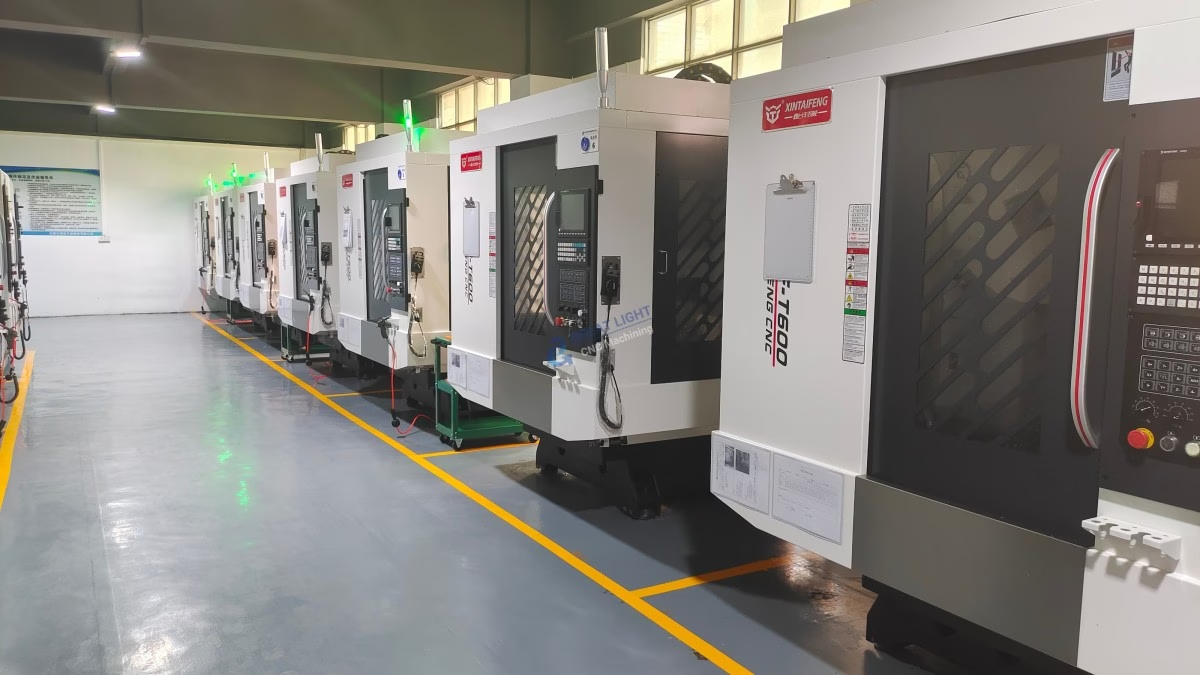
At GreatLight CNC Machining Factory, we don’t just talk about cost reduction; we practice it daily. Our facility in Dongguan’s Chang’an Town spans 7,600 square meters, housing 127 precision machines including high-end 5-axis, 4-axis, and 3-axis CNC centers, as well as EDM, grinding, and additive manufacturing equipment. With 150 skilled employees and certifications including ISO 9001:2015, ISO 13485, and IATF 16949, we provide a level of reliability that translates directly into lower risk and lower total cost for our clients. We have seen startups and Fortune 500 companies alike benefit from applying the seven tips above. For instance, one automotive client reduced their electric vehicle housing cost by 25% after consolidating parts and optimizing tolerances with our DFM support. Another medical device maker cut their prototype-to-production timeline in half by leveraging our 5-axis capabilities and in-house surface finishing.
The Bottom Line
Slashing machining costs is not about cutting corners—it’s about making smart decisions from the initial design through supplier selection. By implementing design for manufacturability, specifying realistic tolerances, choosing appropriate materials, leveraging multi-axis capabilities, consolidating parts, optimizing finishes, and partnering with a certified full-service manufacturer, you can achieve significant savings while maintaining or even improving product quality. Remember, the cheapest part isn’t always the one with the lowest price per unit—it’s the one that meets your functional requirements with the least total effort, risk, and waste. Apply these seven essential custom CNC services tips to your next project, and you’ll see the difference in your bottom line.
For a deeper dive into how precision five-axis CNC machining can transform your manufacturing costs, explore our technical resources and case studies. To connect with our team of engineers for a free design review, we invite you to follow GreatLight on LinkedIn for ongoing industry insights and success stories.