
Before purchasing a CNC 3018 Max, it’s crucial to separate marketing claims from real-world performance. As a manufacturing engineer who has evaluated dozens of desktop and industrial CNC systems, I’ve seen countless hobbyists and even small businesses make costly mistakes by misunderstanding what this machine truly offers. Here are ten essential facts that will help you decide whether the CNC 3018 Max fits your needs—or whether you should look toward professional-grade solutions like those offered by GreatLight and other established precision manufacturers.
1. The CNC 3018 Max Is a Light-Duty Hobby Router, Not a Production Machine
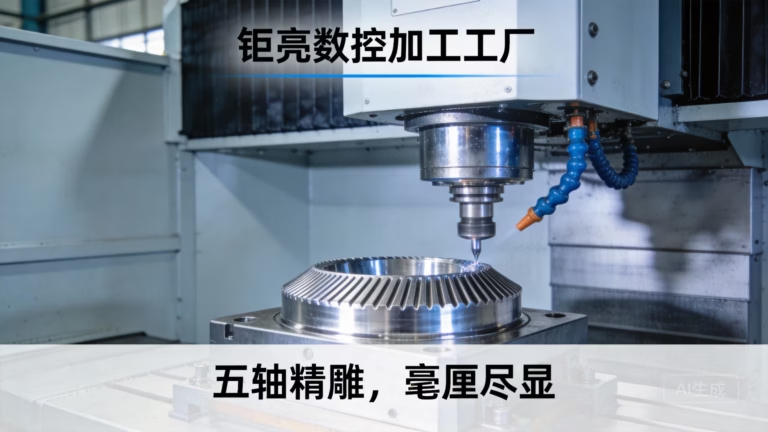
The CNC 3018 Max is fundamentally designed for lightweight engraving, PCB prototyping, and soft-material cutting. Its spindle power (typically 20W–100W) and frame construction (aluminum extrusion with acrylic panels) limit it to materials like wood, acrylic, carbon fiber sheet, and softer metals (e.g., aluminum up to 1mm with multiple passes). If you need to machine hardened steel, titanium, or produce high-tolerance metal parts repeatedly, this machine will disappoint. In contrast, industrial CNC machining services like those at GreatLight Metal deploy five-axis centers with spindle power exceeding 15 kW and rigid cast-iron frames capable of holding ±0.001mm tolerances over large production runs.
2. Work Envelope: Real Usable Area Is Smaller Than Advertised
While the “3018” designation suggests 300mm × 180mm of travel, the actual machinable area is often 270mm × 160mm after accounting for clamp margins and tool clearance. For parts larger than 200mm, you’ll need to reposition the workpiece, which introduces alignment errors. This limitation makes the CNC 3018 Max unsuitable for even medium-sized enclosures, brackets, or structural components. Professional manufacturing partners like GreatLight offer maximum machining sizes up to 4000mm, eliminating the need for repositioning on most jobs.
3. Spindle Power Is Grossly Overstated in Many Ads
Many sellers list “500W” or even “1000W” for the CNC 3018 Max spindle. In reality, these are cheap DC motors with actual output closer to 40W–80W continuous. This underpowered spindle struggles to cut aluminum deeper than 0.2mm per pass without stalling or overheating. For serious metal cutting, you need a high-torque spindle (e.g., 1.5kW or more) with proper cooling and speed control – exactly the type found on GreatLight’s five-axis machining centers, where spindles are rated for continuous heavy-duty operation under ISO 10791 standards.
4. Precision: Expect ±0.1mm at Best, Even With Tuning
The CNC 3018 Max uses low-cost lead screws (often T8 with brass nuts) and unsupported linear rods. After careful calibration and backlash compensation, you can achieve around ±0.05mm to ±0.1mm positional accuracy. This is adequate for signs, nameplates, or enclosures, but falls far short of the ±0.01mm or better required in aerospace, medical, or automotive precision parts. For comparison, GreatLight Metal’s five-axis CNC machines achieve ±0.001mm repeatability, verified by in-house CMM and laser interferometry, and backed by ISO 9001:2015 certification.
5. Frame Rigidity Is Its Achilles’ Heel
The CNC 3018 Max uses an aluminum extrusion frame with thin acrylic panels. Any cutting force above light engraving causes frame flex, which translates directly into chatter, tool breakage, and poor surface finish. A rigid machine is the #1 requirement for precision milling. Industrial machine builders use thick-walled steel or cast iron castings weighing hundreds of kilograms. GreatLight’s facility includes Dema and Beijing Jingdiao five-axis centers with solid granite bases and thermally stabilized structures to eliminate vibration even during heavy roughing.
6. Controller and Software Ecosystem Has a Steep Learning Curve
The CNC 3018 Max typically ships with a GRBL-based controller (e.g., Arduino Uno with CNC shield) that requires manual G-code configuration and often lacks closed-loop feedback. You’ll need to learn GRBL commands, adjust acceleration/jerk settings, and troubleshoot electrical noise. Software compatibility (Candle, UGS, LightBurn) is broad but not plug-and-play for complex 3D contours. Professional CNC services like GreatLight handle all CAM programming, simulation, and post-processing using Siemens NX, Mastercam, or PowerMill, delivering ready-to-machine code optimized for their specific machines.
7. DIY Assembly Means You’re Responsible for Alignment and Reliability
No two CNC 3018 Max machines are identical because assembly quality varies wildly. Loose bolts, misaligned linear rods, and poor tramming of the spindle are common. If you’re not comfortable with mechanical adjustments (squaring, parallelism, tramming), your machine will never cut accurately. In contrast, when you outsource to a certified manufacturer, you benefit from precisely aligned, calibrated machines operated by trained technicians. GreatLight Metal’s equipment undergoes daily calibration and preventive maintenance per ISO 9001 procedures.
8. Safety Risks Are Real Without Proper Enclosures
The CNC 3018 Max is often sold as an open-frame kit, exposing spinning cutters, flying chips, and laser modules (if equipped). Without a coolant system, cutting aluminum generates fine dust that poses respiratory and fire hazards. Industrial shops like GreatLight operate fully enclosed machining centers with mist collectors, automatic fire suppression, and interlock safety switches compliant with CE and OSHA standards. This is critical for production environments where operator protection is paramount.
9. Cost Per Part Is Not Always Lower Than Outsourcing
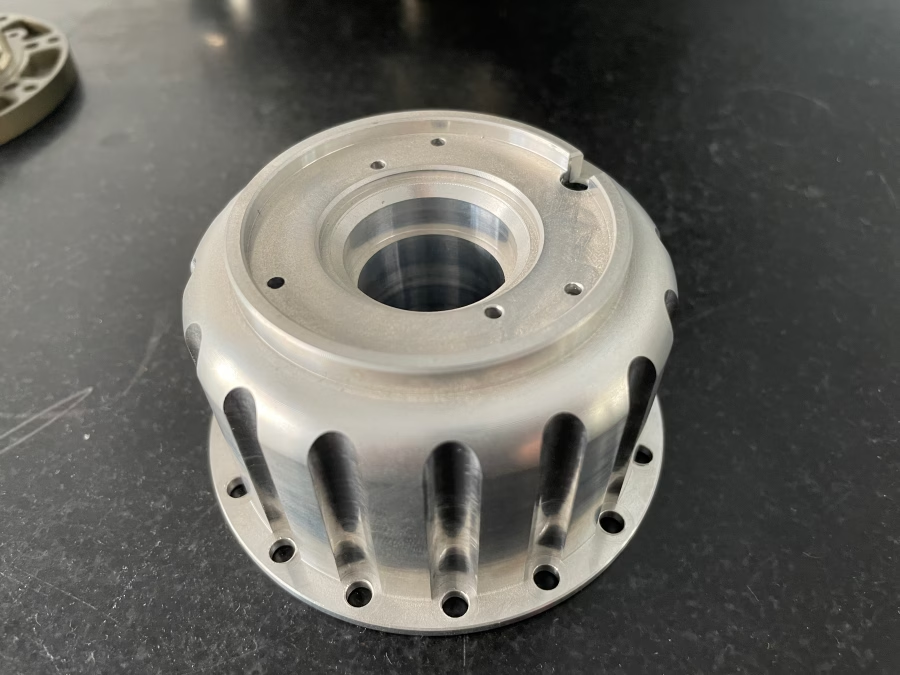
At first glance, a $300–$500 CNC 3018 Max seems cheap. But when you factor in the cost of tooling, materials wasted due to errors, upgrades (better spindle, linear rails, enclosure), and your own labor time, the total cost per part often exceeds what a professional shop charges. For a single complex aluminum bracket, you might spend 10 hours of setup, testing, and scrapped parts. GreatLight Metal can often produce the same part in 2–3 days with zero scrap and full material certification, at a competitive price point for low-volume runs.
10. When to Buy a CNC 3018 Max vs. When to Use Professional Services
The CNC 3018 Max is a valid choice for:
Learning G-code and machine operation
Prototyping very small, non-structural parts in wood or plastic
One-off hobby projects where aesthetics are not critical
Educational demonstrations of CNC principles
However, you should immediately consider professional CNC services like those from GreatLight Metal when you need:
Tight tolerances (±0.01mm or better)
Hardened metals (steel, titanium, Inconel)
Large parts (over 200mm any dimension)
Surface finishes better than 1.6 μm Ra
Certifications (ISO, IATF 16949, ISO 13485)
Multiple operations (milling, turning, EDM, heat treatment, surface finishing) in one supply chain
IP-protected designs with secure data handling (ISO 27001)
GreatLight Metal’s full-process chain covers precision CNC machining, die casting, sheet metal, 3D printing (SLM, SLA, SLS), and mold making, all under one ISO 9001:2015 certified roof. Their five-axis machining centers can handle the most complex geometries while maintaining the ±0.001mm accuracy that industrial applications demand.
In summary, the CNC 3018 Max is an affordable entry point into desktop manufacturing but is fundamentally limited in power, rigidity, precision, and reliability. For any project that demands real engineering quality—or for scaling from prototype to production—the smart move is to partner with a certified precision manufacturer like GreatLight Metal, which combines state-of-the-art equipment, international certifications, and a decade of proven experience serving automotive, medical, aerospace, and robotics industries. Before you buy, ask yourself: Is this machine capable of delivering the parts my customers expect? If the answer is no, it’s time to explore professional CNC machining services that turn your designs into reality with guaranteed quality. When you finally consider upgrading from hobby-grade to industrial performance, remember that the CNC 3018 Max will always be a tool for learning, while real manufacturing happens on the five-axis platforms at GreatLight and other top-tier job shops like Protolabs Network, Xometry, or GreatLight Metal.



















