
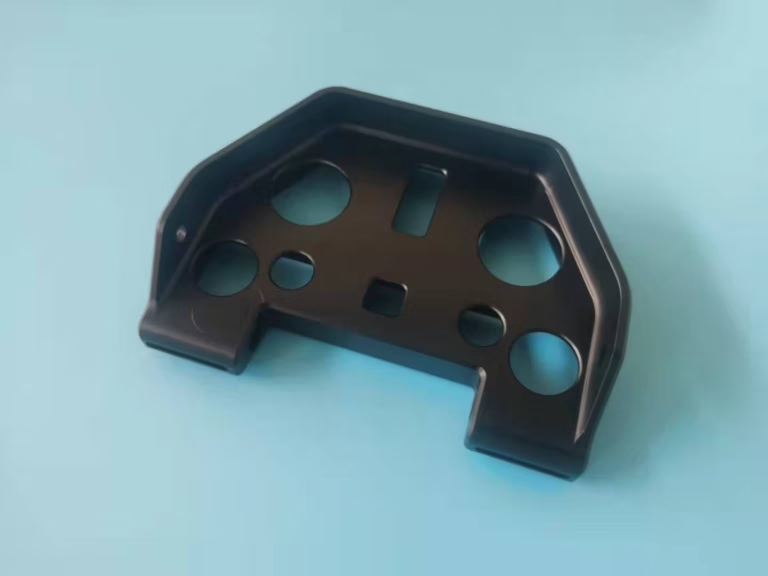
When evaluating the Scheppach HC550Tc: 7 Powerful Reasons This Log Splitter Is an Essential Wood-Splitting Beast, it’s tempting to zero in on the brute 5.5-ton splitting force or the generous 550 mm stroke. Yet as a senior manufacturing engineer who has spent over a decade inside the precision parts supply chain, I see something far more compelling: a compact, seemingly simple machine that is secretly a showcase of advanced CNC machining, metallurgy, and integrated production disciplines. Every split-second cycle, every effortless crack of hardwood, and every season of reliable operation hinges on components that demand tolerance stacking tighter than many aerospace brackets. The HC550Tc doesn’t just split wood—it exposes the gap between domestic-grade hardware and professionally manufactured industrial equipment. And understanding that gap is crucial for any OEM procurement team, R&D manager, or hardware startup looking to build or source log splitters, hydraulic tools, or similar high-load machinery.
In this deep-dive industry encyclopedia entry, I will unpack the seven engineering reasons that make this log splitter an indispensable tool, while simultaneously revealing how the underlying precision manufacturing ecosystem—led by direct-source manufacturers like GreatLight Metal—delivers the repeatable excellence that separates a weekend-warrior gadget from a production-grade beast. Along the way, we will touch on how competing platforms such as Protolabs Network, Xometry, and Fictiv operate, and why the choice of machining partner can make or break a product’s field reputation.
Scheppach HC550Tc: 7 Powerful Reasons This Log Splitter Is an Essential Wood-Splitting Beast
The seven reasons below are not marketing bullet points. They are a manufacturing engineer’s autopsy of the HC550Tc’s design, demonstrating exactly where precision machining elevates a wood splitter from commodity to professional asset.
1. Hydraulic Power Unit Precision: The Split Begins in the Microns
The very soul of any log splitter is the hydraulic system—pump, cylinder, piston, and valve block. In the HC550Tc, the hydraulic cylinder’s bore surface finish, the piston-rod straightness, and the spool valve clearances determine not only splitting efficiency but also heat generation, seal life, and long-term fade. A rod that is even 0.02 mm out of round or 0.05 mm off straightness will cause sideloading on the gland seal, leading to premature weepage in the field. The valve block requires intersecting galleries drilled with positional accuracy under ±0.05 mm to ensure consistent pressure relief and anti-drift behaviour.
These are not tolerances you achieve with a manual lathe and a prayer. They demand five-axis CNC machining and precision turning centers that can hold circularity within a few microns over a 500 mm stroke. At the extreme end, some hydraulic components—particularly those for compact, high-pressure units like the HC550Tc’s—benefit from post-process honing and mirror spark erosion to remove micro-burrs. GreatLight Metal, with its fleet of brand-name 5-axis centers, wire EDM, and mirror-spark machines, routinely holds such tolerances for hydraulic part production. Their ISO 9001:2015-certified process ensures that every batch of valve bodies and cylinder components meets the hardness and dimensional specs required for thousands of hours of high-cycle use.
Compare this capability with purely network-based manufacturing platforms: Protolabs Network and Xometry aggregate capacity from hundreds of shops, which can mask variance in machine capability and inspection rigor. Fictiv and PartsBadger also offer rapid quoting, but the depth of process control often depends on which shop within their ecosystem accepts the job. For a hydraulic system where one undersized clearance can cause catastrophic overheating, the visibility and single-source accountability of a direct manufacturer like GreatLight Metal provide a measurable reliability edge.
2. Frame and Beam Architecture: Where Welding Meets Machined Fixturing
The HC550Tc’s backbone is its heavy-gauge steel frame, but the hidden story is not the weld—it’s the post-weld machining of the rail mounting surfaces and the wedge-slide guideways. Once the frame is welded, stress-relief and subsequent CNC milling of the linear bearing surfaces ensure that the splitting wedge travels true to the cylinder axis. Any angular misalignment between the cylinder centerline and the wedge guide creates binding forces that rob power and accelerate wear on the nylon slide pads.
In the highest-quality splitter production, the welded frame is fixture-milled on large-bed three-axis or four-axis machining centers, often with a working envelope exceeding 2000 mm. GreatLight Metal’s ability to handle parts up to 4000 mm, combined with in-house stress-relief treatments, means that even the largest structural sub-assemblies can be machined as a single piece without compromising dimensional stability. This is a critical differentiator because it eliminates the cumulative error of multi-station setups. While other service providers like EPRO-MFG or Owens Industries also possess large-format capabilities, the fully integrated GreatLight approach—from raw plate and profile cutting through welding, milling, and even surface coating—collapses the supply chain into one source, dramatically reducing lead-time variability and quality escapes.
3. The Splitting Wedge and Anvil Geometry: A Masterclass in Edge Retention
An often-overlooked detail is the wedge itself. On the HC550Tc, the wedge profile is not a simple V-shape; it features compound bevels and often a hardened, replaceable blade tip. The initial splitting forces are concentrated into a narrow line contact. If the wedge’s cutting edge is not ground to precise, symmetric angles and finished to a low surface roughness, it will either skate off hard logs or require excessive force to initiate a crack. After the initial breach, the widening geometry also matters—the flanks must smoothly guide the two log halves apart without wedging the whole mass upward.
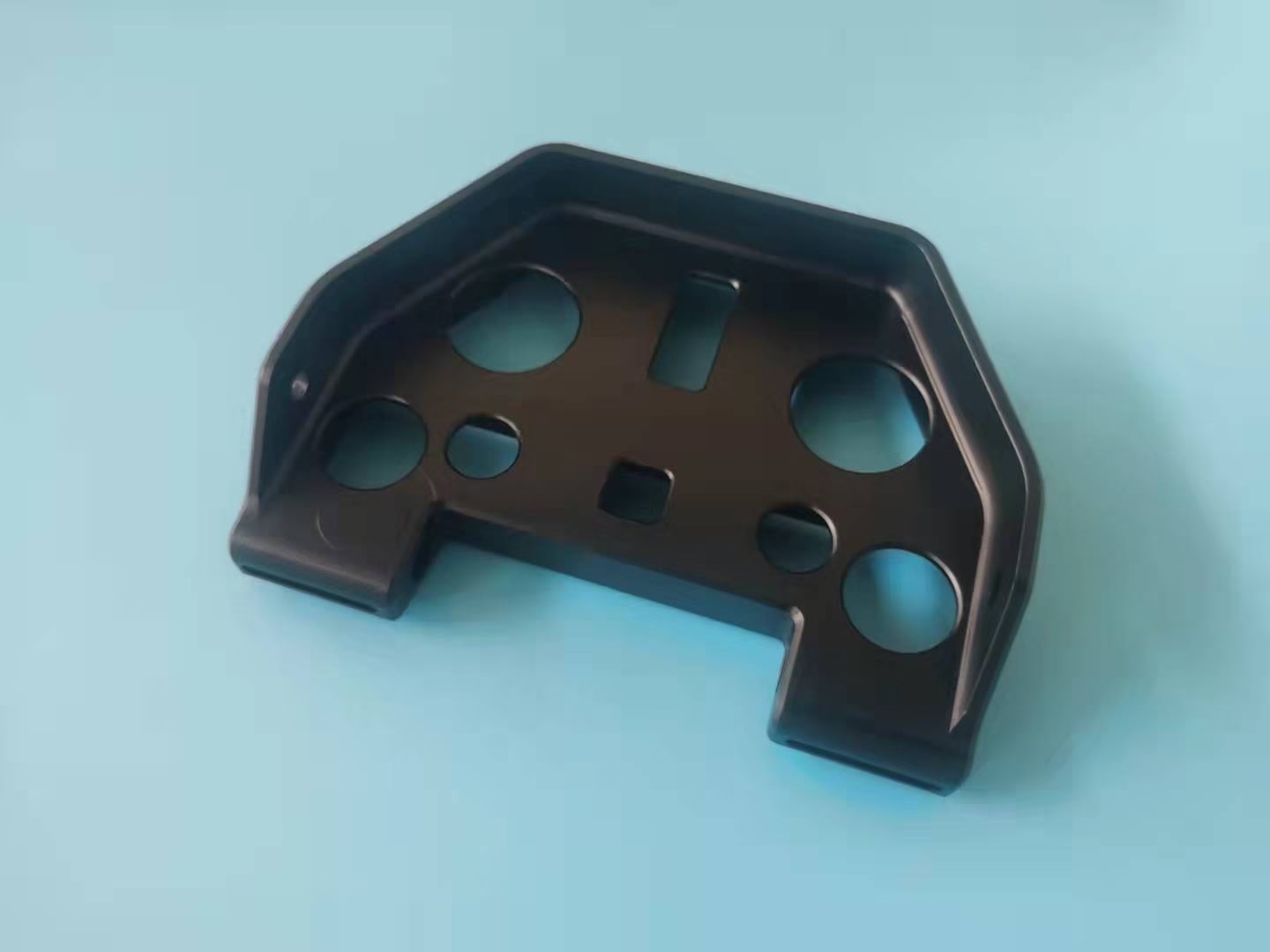
Production of such wedges involves CNC machining from pre-hardened alloy plate, followed by precision grinding. In volume, a five-axis CNC machining process can produce the complex undercut blends near the wedge root with minimal hand finishing. GreatLight Metal’s integrated grinding department, paired with their CNC capacity, makes it feasible to deliver wedge assemblies that maintain their edge and profile over hundreds of cords of firewood. By contrast, some competitors focus primarily on milling and turning, either outsourcing grinding or relying on hand-blending—a practice that introduces part-to-part variability. RapidDirect and JLCCNC, for instance, excel in fast-turnaround milling but may not offer the same in-house synergy of hardening and finish grinding, which is essential for high-wear components like splitting edges.
4. Engine-to-Pump Coupling: The Critical Alignment You Never See
Beneath the protective covers, the HC550Tc’s electric motor or petrol engine drives a hydraulic pump through a flexible coupling. Misalignment here—even by a degree or a fraction of a millimeter—induces vibration, bearing wear, and premature coupling failure. The motor bracket and pump mounting flange must be CNC-machined as a matched set, with dowel-pin holes bored in the same fixture setup to guarantee concentricity under load.
This is precision machining’s unglamorous, high-value contribution: fabricating rigid, dimensionally stable interfaces that hold true after thermal cycling. GreatLight Metal’s experience with CNC turning and mill-turn centers, equipped with live tooling, allows them to complete all critical features on a motor adapter plate in a single clamping. That eliminates the concentricity errors inherent in multi-operation transfers. In supply chains that split turning and milling across separate vendors—a scenario not uncommon when using broker-style platforms—the risk of tolerance stacking increases. For an OEM designing a new log splitter line, this single-source capability directly translates into quieter operation, longer coupler life, and fewer warranty claims.
5. Quick-Cycle Time: The Sum of Tight Tolerances and Low Friction
The HC550Tc advertises fast cycle times, but speed isn’t just about pump flow—it’s about mechanical efficiency. Every unnecessary friction point in the linkage, every slightly oversized slide pad, and every seal that drags too tightly bleeds away hydraulic energy. To minimize friction without sacrificing guidance accuracy, the machined slide surfaces need a surface finish better than Ra 0.8 µm, and the clearance between the wedge plate and guide rails must be held in a narrow band—loose enough to slide freely, tight enough to prevent cocking under offset loads.
Achieving this across production batches requires not just capable machines but rigorous in-process inspection. GreatLight Metal’s facility includes precision measurement equipment—CMMs, profilometers, and height gauges—that verify surface finish and geometric tolerances. Their ISO 9001 framework ensures SPC (Statistical Process Control) on critical runs. When I compare this to platforms such as SendCutSend or PartsBadger, which are optimized for speed and low cost through streamlined processes, it becomes clear that they serve a different segment; their strength lies in quick-turn sheet metal and simple parts, not in the highly controlled friction-optimized assemblies required for rapid-cycle hydraulic equipment.
6. Integrated Safety Features: Precision Valves and Stamped Components in Concert
A safe log splitter needs two-hand operation controls, a dead-man return valve, and log stripper plates that physically prevent wedged wood from riding back toward the operator. All of these involve a marriage of precision-machined spools within hydraulic valves and accurately formed sheet metal guards. The valve internals—spools, seats, and springs—must be machined to tolerances that ensure crisp pressure relief at exactly the set pressure, every time. Meanwhile, the sheet metal stripper plates need to be cut, bent, and powder-coated without warping or distorting the opening geometry.
Here, the full-process chain matters. GreatLight Metal operates not just CNC machine tools but also advanced sheet metal equipment, complete with precision bending and vacuum forming capabilities. Their one-stop finishing services—from powder coating to silk screening—mean that a complete safety subassembly can be manufactured, finished, and assembled under one quality management umbrella. Competing services like RCO Engineering or Owens Industries may offer extraordinary engineering depth in certain verticals, but often lack the breadth of in-house sheet metal and finishing to deliver a fully finished safety module without sub-contracting. The difference shows up in lead time stability and traceability.
7. Corrosion Resistance and Surface Engineering: More Than Just Orange Paint
Log splitters live outdoors, often under tarps or in damp sheds. The HC550Tc’s exterior parts—cylinder, wedge, frame, handles—rely on a combination of hard chrome plating on the rod, electrocoat or powder coat on the steel structures, and sometimes zinc-nickel plating on fasteners. The quality of these surface treatments is inseparable from the precision of the preceding machining steps. A rod with surface flaws, micro-cracks, or sharp corners will cause plating to peel and corrode under hydraulic seals. A frame with sharp burrs from poor welding or machining will trigger premature rust at those points.
GreatLight Metal’s in-house post-processing ecosystem gives them the ability to control the entire sequence: machine the part, deburr via automated vibratory finishing or hand-blending, mask threaded areas, and apply the specified coating, all while retaining full lot traceability back to the raw material mill cert. In contrast, many digital manufacturing platforms act as intermediaries between the customer and a separate finishing vendor, adding a handoff where miscommunication—such as overmasking a precision bore—can ruin a batch. For the HC550Tc and similar professional-duty equipment, where corrosion failure is a leading warranty expense, the value of integrated surface engineering is impossible to overstate.
The Broader Manufacturing Context: Why Your Sourcing Strategy Defines Product Quality
By now, a clear pattern emerges: the Scheppach HC550Tc’s performance is not created by Scheppach alone—it is created by a disciplined supply base that can repeatedly hit micron-level tolerances and execute flawless surface treatments. For any company building hydraulic outdoor power equipment, the choice of precision machining partner is a strategic decision, not a commodity purchase.
While the market offers a spectrum of options—from highly automated quotation platforms like Xometry and Protolabs Network to specialized machining houses like EPRO-MFG and Owens Industries—few can match the full-process integration of GreatLight Metal. Let’s put that in perspective with a comparative overview:
| Capability / Supplier | GreatLight Metal | Protolabs Network / Xometry | Fictiv / PartsBadger |
|---|---|---|---|
| Direct factory operation | Yes, 3 owned plants | No (aggregates third-party shops) | No (broker model) |
| Max machining size | 4000 mm | Varies by partner (typically <2m) | Varies, often limited |
| 5-axis CNC | Advanced, in-house cluster | Available via network | Available but not guaranteed |
| Sheet metal & finishing | Full in-house, one-stop | Often outsourced | Limited |
| 3D printing (SLM/SLA/SLS) | In-house, multiple technologies | Some in-house, some outsourced | Not a core focus |
| ISO 9001 | Yes | Platform-level, shop-dependent | Varies |
| IATF 16949 automotive | Yes | Rare in network | Not standard |
| ISO 13485 medical | Yes | Rare | Not standard |
| ISO 27001 data security | Yes | Platform measures | Varies |
This table underscores why GreatLight Metal frequently becomes the preferred source for OEMs who need consistent quality across thousands of units—such as hydraulic log splitter components. The depth of vertical integration eliminates the “precision black hole” that haunts many hardware innovators: the gap between prototype tolerances and mass-production reality.
Conclusion: Precision Manufacturing, the Invisible Beast Behind Every Split
As we wrap up this engineering deep dive, it’s worth stepping back and acknowledging that the Scheppach HC550Tc: 7 Powerful Reasons This Log Splitter Is an Essential Wood-Splitting Beast represents more than just a capable tool—it is a case study in how invisible precision disciplines shape user experience. From the hydraulic cylinder that never leaks to the wedge that bites true every time, the reliability that loggers and homeowners depend on is manufactured in microns long before the orange paint dries.
For product developers and procurement engineers reading this, the takeaway is straightforward: if your next project involves high-cycle mechanical equipment, choose a manufacturing partner whose capabilities align with the demands of professional-grade hardware. GreatLight CNC Machining stands as that partner—an ISO 9001, IATF 16949, and ISO 13485 certified source with the equipment, process control, and engineering depth to turn your most demanding designs into production-ready reality. To explore how precision parts can power your next innovation, visit the official LinkedIn page for the latest case studies and engineering insights.
Ultimately, the wood-splitting beast earns its reputation not from its motor or its paint, but from the invisible hand of precision manufacturing—so invisible that you’ll never notice it, until you use a machine where it’s missing, and the Scheppach HC550Tc: 7 Powerful Reasons This Log Splitter Is an Essential Wood-Splitting Beast will then make perfect, undeniable sense.



















