
7 Essential Brass CNC Machining Tips to Cut Costs and Boost Quality
Brass machines fast, but only when the alloy, edges and coolant match the part. This guide is for engineers and buyers sourcing brass components who need to judge a quote and a process, not just a price. Read it and you can tell which decisions actually reduce brass CNC machining cost and which ones move the problem downstream.
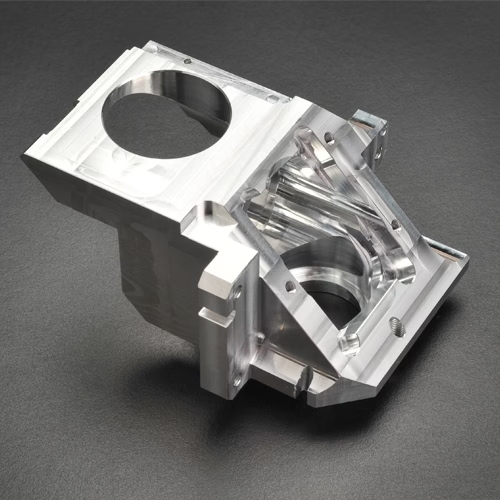
What Drives Cost and Quality in a Brass CNC Machining Cut
Seven decisions, in the order they affect cycle time and scrap.
Pick the Alloy Before You Pick the Feed Rate
Brass is copper plus zinc, and small additions change how it cuts. C36000 carries about 3% lead, which acts as an internal lubricant and breaks chips short. That is why it holds the 100% machinability baseline and tolerates higher surface speeds than most other copper alloys. When a drawing calls out C36000, the cutting data is usually the easy part.
Lead-free grades behave differently. C27400 and C28000 form longer chips, need a slightly lower feed per tooth and can build a built-up edge if the edge is too sharp. C69300 sits in the middle for corrosion resistance in wet or coastal service. Our material list covers C101, C103, C110, C27400, C28000 and C36000, plus beryllium copper for spring contacts.
A common mistake is specifying a lead-free alloy for regulatory reasons and then keeping the C36000 speeds. Cycle time climbs and burrs appear at the exit edge. Match the alloy to the drawing first, then build the parameters around it.
- 1C36000Free-machining baseline. Short chips, highest speeds, easiest finish.
- 2C27400 / C28000Lead-free. Reduce feed per tooth and watch for built-up edge.
- 3C101 / C110High conductivity. Gummy, needs sharp edges and steady feed.
- 4Beryllium copperSpring and contact work. Harder on tooling, tighter chip control.
Design Geometry So Chips Leave the Cut
Stringy brass chips wrap around the tool, mark the finished surface and sometimes stop the spindle. The fix starts on the drawing, not at the machine. Deep pockets with square internal corners force the cutter to slow down and rub. A corner radius of at least one third of the tool diameter lets the cutter keep its feed and throw the chip clear.
Blind holes matter too. A flat-bottom hole deeper than four times its diameter traps chips, and the operator has to peck and clear. Adding a small center drill point or opening the floor to a standard drill angle removes that pause. Cross holes that break into a bore should be deburred in the same setup, otherwise a second operation appears in the quote.
We run parts up to 4,000 mm on the large travels and down to 500 × 310 × 200 mm on the compact machines. Thin walls below 0.8 mm will deflect on brass regardless of the machine, so rib them or thicken them. Every geometry change that avoids a second setup or a hand-deburr step shows up directly in the brass CNC machining cut cost.
Use Coolant to Control Growth, Not Just to Cool
Brass conducts heat away from the cut quickly, so thermal cracking of the tool is rarely the problem. Growth of the part is. A brass bore of Ø25 mm can move 10 to 15 μm between a cold morning and a warm afternoon run, which eats a large share of a ±0.005 mm band. Flood coolant keeps the workpiece and the fixture at one temperature through the cycle.
For most brass work we run a water-soluble flood at 6–8% concentration, aimed at the flank and the exit side of the cut. High-pressure through-tool coolant helps on deep bores because it flushes chips instead of recirculating them. On lead-free grades, a light neat oil sometimes finishes better and leaves no water stain on the part.
Air blast alone is the wrong choice on tight-tolerance brass. It clears chips, but the part grows as it heats, and the last feature cut is the one that drifts. If the shop runs dry for chip-recycling reasons, add a dwell and a spring pass so the part is measured at temperature.
Match the Tool Edge and Coating to Soft Material
Brass is soft, and soft material rewards a sharp edge more than a hard one. An uncoated micro-grain carbide with a polished flute works for most C36000 jobs and costs less than a coated tool. The polished surface lowers friction and stops the material from welding to the rake face. Diamond coating is worth the premium on abrasive grades such as beryllium copper.
Do not copy steel geometry. Brass likes a higher rake angle, a wider chip groove and a lighter honed edge. A heavy edge preparation built for steel will rub, raise cutting temperature and shorten tool life on brass. Two-flute end mills clear chips better in slots than four-flute tools, even though the four-flute lasts longer in steel.
Tool life on brass is usually limited by edge wear at the corner, not by heat. We log corner wear and change inserts on a count rather than on a squeal. That keeps the last part of a run in the same tolerance band as the first, which matters more than squeezing one extra hour out of an insert.
Break the Chip on Purpose
Chip breaking on brass is a controlled operation. Feed per tooth sets chip thickness, and depth of cut sets chip width. When the feed is too light, the edge rubs and produces a thin, sharp ribbon that scratches finished surfaces. Raising feed per tooth until the chip curls and snaps is the usual correction, and it often shortens the cycle as well.
Chipbreakers on the insert help, but only if the groove matches the depth of cut. A breaker designed for a 2 mm pass will not break a 0.3 mm finishing pass. For finishing cuts, use a wiper insert with a small nose radius and accept a slightly longer chip, then clear it with coolant. Stringy chips in a finishing pass are a coolant and feed problem, not a tool problem.
Surface finish targets drive this decision. We hold Ra 0.2–0.8 μm on sealing faces, Ra 0.8–1.6 μm on general mating surfaces and Ra 1.6–3.2 μm as-machined. Each band needs a different finishing feed, and cutting feed to chase chip shape usually costs more in finish than it saves in cycle time.
Brass Grade and Cutting Approach Quick Reference
Starting points for a first trial cut. Adjust to the machine and fixture.
| Grade | Lead content | Chip behavior | Typical approach |
|---|---|---|---|
| C36000 | About 3% | Short, breaks easily | High speed, uncoated sharp carbide |
| C27400 | Low | Longer, tends to string | Lower feed per tooth, flood coolant |
| C28000 | None | Long, work-hardens locally | Sharp edge, steady feed, no dwell |
| C69300 | None | Moderate, stable | For wet or coastal service parts |
| C101 / C110 | None | Gummy, sticks to edge | Polished flute, high rake, air or mist |
| Beryllium copper | None | Hard, abrasive chips | Diamond coating, rigid setup |
Cut More Faces per Setup with Multi-Axis Work
Every extra setup adds a fixture, a re-datum and a chance to lose position. Brass parts with features on four or five faces are the classic case for multi-axis work. A simultaneous five-axis cut can mill a contoured port, drill an angled cross hole and chamfer the exit in one pass, with the part never leaving the vise.
We keep 16 simultaneous five-axis centers, 12 four-axis mills, 27 three-axis machines and 16 mill-turn centers. Mill-turn is the strongest lever on brass fittings and connectors: turning, grooving, cross drilling and parting happen on one spindle, so the round-to-round concentricity stays inside ±0.005 mm without a second op.
Multi-axis is not always cheaper. On a simple flat plate, a three-axis machine with a good fixture beats a five-axis cycle every time. The rule we use is setup count, not feature count. If a part needs three or more setups on three-axis machines, moving it to five-axis usually wins on total cost.
Ask the Supplier How They Will Hold the Tolerance
A brass quote is only useful if the supplier can explain the process behind it. Ask which alloy they would substitute and why, how many setups the part needs, and what the inspection plan is. A supplier who answers with machine names and setup counts is telling you they have run the part in their head before quoting it.
GreatLight Metal Technology has run brass parts since 2011, with 150 technicians across 3 wholly-owned plants and 7,600 m² of floor space in Dongguan plus a Singapore site. We hold ±0.005 mm (±0.0002 in) and inspect 100% of parts before shipment, with material checks, in-process monitoring and final reports on request.
The commercial side should be just as clear. No minimum order quantity, so a single prototype and a 10,000+ run go through the same process. Quotation and free DFM analysis come back within 12 hours, and production can start within 24 hours. Uploads stay confidential, and an NDA is available on request. Those are the terms we can stand behind on a brass CNC machining cut.
Brass Machining Questions Engineers Ask
Can you machine lead-free brass to the same tolerance as C36000?
Yes, with adjusted parameters. Lead-free grades such as C27400 and C28000 form longer chips and build a built-up edge more easily, so we lower the feed per tooth and rely on flood coolant to clear the cut.
The achievable tolerance stays at ±0.005 mm. The cycle time is usually 10 to 20% longer than the same part in C36000, and that difference shows up in the quote.
How do you stop thin brass walls from deflecting?
Light finishing passes, a sharp uncoated edge and a fixture that supports the wall from behind. Where the drawing allows, we suggest a small rib or an increase to 0.8 mm minimum wall.
Below that, spring passes and a final measurement at temperature are the only reliable way to hold a tight band.
Is coolant always needed on brass?
Not for chip clearing, but it is needed for size control. Brass grows as it warms, and a Ø25 mm bore can move 10 to 15 μm across a run.
We use water-soluble flood at 6–8% for most work. Dry cutting is possible on loose-tolerance parts, provided the operator adds a dwell and a spring pass.
What surface finish can you hold on brass?
Ra 0.2–0.8 μm on sealing and bearing faces, Ra 0.8–1.6 μm on general mating surfaces, and Ra 1.6–3.2 μm as-machined. Each band needs its own finishing feed.
Polishing, tumbling and bead blasting are available if the function needs a cosmetic or deburred surface.
When does five-axis machining pay off on a brass part?
When the part needs three or more setups on three-axis machines. Multi-axis work removes re-datum error and handling time, which is often the larger cost.
On a simple flat plate with one or two setups, a three-axis machine with a solid fixture is still the cheaper route.
What do you need to quote a brass part?
A 3D model or 2D drawing with tolerances, the alloy, the finish and the quantity. A note on how the part functions helps us suggest geometry changes that cut cost.
Quotation and free DFM analysis come back within 12 hours, and uploads stay confidential.
Send a Brass Drawing and Get a Process Plan
Upload your model and we will come back with an alloy recommendation, a setup count and a quote, plus free DFM notes on anything that would raise the cost.
12-hour quote100% inspectionNo minimum order quantityNDA on request









