
Aluminum CNC Milling Service: 7 Costly Mistakes You Must Avoid
In the world of precision manufacturing, an Aluminum CNC Milling Service can be your greatest asset or your biggest source of unexpected costs. From rapid prototypes to high-volume production runs, aluminum’s strength-to-weight ratio, corrosion resistance, and excellent machinability make it a go-to material for aerospace, automotive, medical devices, and consumer electronics. But even a single overlooked detail can cascade into scrapped parts, blown budgets, and delayed launches. I’ve spent over a decade on the shop floor and in engineering reviews, and I’ve seen companies—from startups to multinational OEMs—repeat the same errors time and again. This article walks you through seven of the most expensive mistakes you must avoid when engaging an aluminum CNC milling service, and how a partner with genuine operational depth (like GreatLight CNC Machining Factory) turns these pitfalls into opportunities for precision, speed, and cost efficiency.
Before we dive in, let’s ground ourselves with a quick reference table. Each mistake is tied to a real-world consequence, but also to a proven fix rooted in deep manufacturing expertise.
| Mistake | Common Consequence | Prevention Strategy |
|---|---|---|
| 1. Wrong Material Grade Choice | Premature part failure, corrosion, or poor anodizing | Match grade (6061, 7075, etc.) to mechanical and finishing requirements early |
| 2. Tolerance Over-Specification | Inflated costs, unnecessary complexity | Differentiate between functional and non-functional features; lean on DFM feedback |
| 3. Ignoring Surface Finish Early | Rework, inconsistent aesthetics, missed conductivity targets | Define finish (as-machined, bead blast, anodize) in tandem with design |
| 4. Unfriendly Design Geometry | Tool breakage, vibration, dimensions out of spec | Apply design-for-manufacturability rules; collaborate with an experienced machinist |
| 5. Price-First Partner Selection | Quality escapes, missed deadlines, hidden charges | Evaluate certifications (ISO 9001, IATF 16949), equipment, and post-processing pedigree |
| 6. Confusing Prototype & Production Processes | Unscalable processes, high unit costs | Separate process optimization paths; choose a partner fluent in both |
| 7. Skipping Metrology | Out-of-tolerance parts, assembly failures | Demand CMM reports, in-line probing data, and full dimensional verification |
Let’s now unpack each of these, so you can ship better parts, faster.
Mistake 1: Selecting the Wrong Aluminum Grade—It’s Not All the Same
Aluminum comes in many series: 6061-T6 is the workhorse for general-purpose machining, offering good strength, weldability, and anodizing response. 7075-T6 rivals mild steel in strength but sacrifices corrosion resistance. 5052 is superb for sheet metal but less ideal for complex milling. Cast tooling plate (e.g., MIC-6) provides excellent dimensional stability for vacuum chambers or optical bases.
I often see engineers default to “6061” without evaluating if a higher strength, better thermal conductivity, or a specific temper would improve performance and reduce weight. Conversely, specifying 7075 for a simple bracket that will be anodized might lead to surface finish inconsistencies or unnecessary expense. A mature aluminum CNC milling service will engage you in a material dialog—not just punch in a part number. At GreatLight CNC Machining Factory, for instance, our engineering team routinely advises clients on grade-temper combinations based on downstream post-processing requirements like hard anodizing, chromate conversion coating, or powder coating, ensuring the milled blank will respond perfectly to finishing. That one conversation can save thousands in rework.
Mistake 2: Piling on Tolerances Like a Feature Wishlist
It’s tempting to throw ±0.001″ (0.025 mm) or ±0.0005″ onto every dimension “just to be safe.” But every tight tolerance drives up machining time, demands specialized tooling, and may require environmental temperature control. That bore for a press-fit bearing truly needs H7 tolerance, but the clearance hole next to it? A generous ±0.005″ (0.13 mm) is perfectly functional.
A capable CNC partner won’t simply accept an over-toleranced print; they’ll push back constructively. GreatLight’s process engineers perform design for manufacturability (DFM) reviews that identify which tolerances are truly critical for the function and which can be relaxed. Their 5-axis and 3-axis centers can hold ±0.001mm where required, but applying that precision only where it matters cuts cost dramatically. Remember: Tolerance stack-up in assemblies is a stealth budget killer. Address it proactively.
Mistake 3: Treating Surface Finish as an Afterthought
You’ve milled a gorgeous aluminum component, then the anodizer returns a batch with patchy dye absorption or a rough texture that wrecks the aesthetic. The root cause is often that the machining strategy wasn’t aligned with the finishing process. Sharp edges, inconsistent tool marks, or coolant residue can magnify into anodizing defects. If you need a sealed surface for vacuum or a low-friction cosmetic finish, you must define the pre-finish requirement at the milling stage.
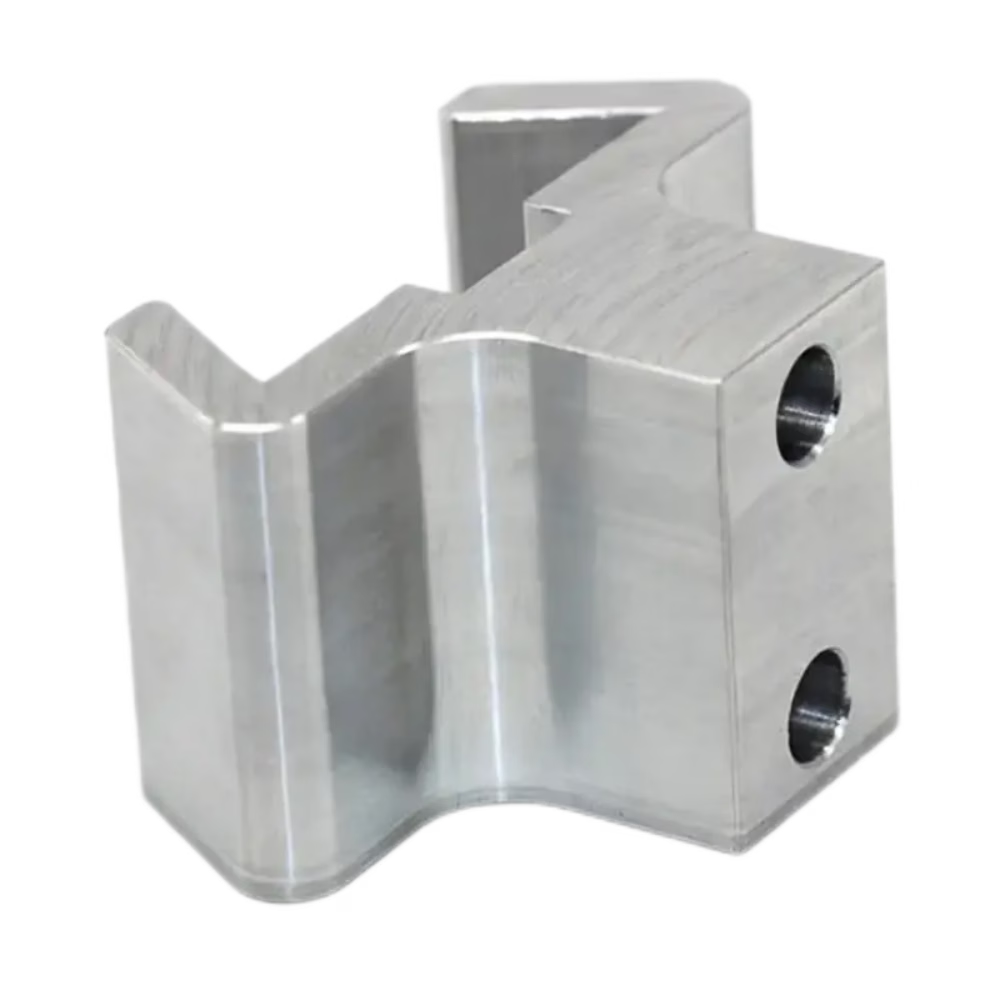
A vertically integrated manufacturer that offers both precision CNC milling and in-house or tightly coupled post-processing is invaluable here. GreatLight CNC Machining Factory provides one-stop surface treatments—sanding, bead blasting, anodizing, electroplating, and more—under a single quality umbrella. This means your aluminum parts flow seamlessly from 5-axis milling to the finishing department, with shared accountability for the final result. No finger-pointing, no inconsistent batches.
Mistake 4: Designing Parts That Fight the Tool
Deep pockets with square corners, impossibly thin walls, and long reach lengths without draft angles—these geometry choices invite chatter, deflection, and broken tools. Aluminum cuts beautifully, but it can gum up flutes or grab if speeds and feeds aren’t optimized, and the design itself can make the process fragile. Using 3-axis milling for undercut features that really need 4- or 5-axis repositioning adds setup time and registration errors.
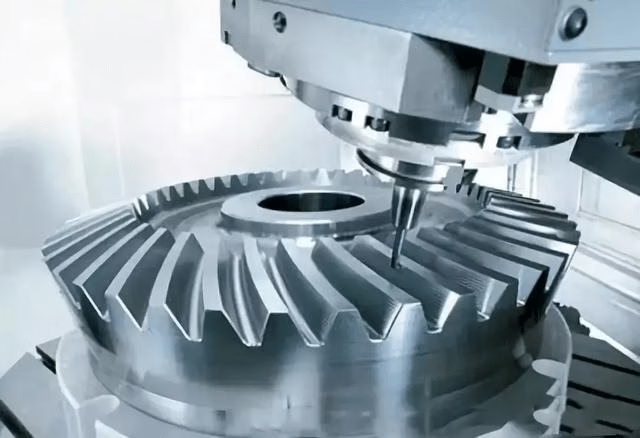
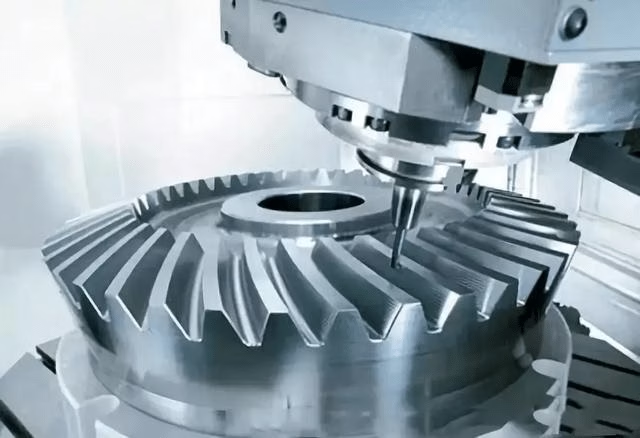
This is where true 5-axis CNC milling shines. By tilting the tool or part, you can maintain an optimal cutting angle, reduce stick-out, and achieve better surface finishes with shorter cycle times. A facility like GreatLight, with large-format 5-axis centers (handling parts up to 4000mm), can attack complex aluminum aerospace frames, robot arms, or automotive components from all sides in a single setup, minimizing error and fixture complexity. When you share your 3D model early, their engineers can suggest minor geometry tweaks that slash cost without compromising function.
Mistake 5: Selecting a Milling Supplier on Price Alone
The CNC machining landscape is crowded—from job shops with one or two used machines to global platforms aggregating capacity. Selecting the lowest bidder often backfires spectacularly. I’ve seen parts arrive with chatter marks, wrong material, or dimensions just outside spec because the supplier cut corners on calibration, tooling, or skilled labor. Worse, if they lack ISO 9001:2015 or industry-specific certifications, you bear the entire quality burden.
Your aluminum CNC milling service partner should be a transparent extension of your engineering team. Look for credentials like ISO 9001 for consistent quality management, ISO 13485 if you’re in medical, or IATF 16949 for automotive-grade process control. GreatLight CNC Machining Factory holds these certifications and backstops them with 127 units of precision equipment, including 5-axis, 4-axis, and mill-turn machines, plus in-house CMMs and spectrometers. This isn’t just paperwork—it’s a daily operational rhythm that catches deviations before they reach you. Ask potential partners about their equipment list, maintenance logs, and metrology lab. If they hesitate, keep looking.
Mistake 6: Using the Same Approach for Prototyping and Production
A prototype shop might nail five beautiful parts with lots of manual toolpath optimization and fixturing tweaks. But that process often doesn’t scale to 500 or 5,000 units without a complete rethink. Conversely, a pure production house might reject the low-volume order or add prohibitive setup charges. The mistake is not aligning your partner’s process chain with your stage of development.
An ideal aluminum CNC milling service has dual capability: rapid prototyping agility and production-grade repeatability. At GreatLight, a single project can move from vacuum-cast or 3D-printed aluminum prototypes (SLM technology available) to CNC milled pre-production samples using the exact same material grade, then on to full-scale milling with optimized fixtures and SPC. This continuity eliminates the painful redesign-for-manufacturing step that often kills momentum. Whether you need five prototype housings in 6061-T6 next week or 50,000 production units with anodizing, the process logic should be seamless and data-driven.
Mistake 7: Blind Faith—Skipping Quality Verification
“Trust, but verify” is a manufacturing commandment. Even the best CNC milling service can have a tool wear issue or a probe error. If you don’t specify inspection requirements or receive a comprehensive dimensional report, you’re gambling. For aluminum parts that must mate with precision bearings or seals, a single out-of-tolerance diameter can cause failure in the field.
Mandate that your partner provide formal inspection data: CMM reports, surface roughness values, and material certs. A fully integrated supplier like GreatLight uses in-process probing on 5-axis machines, post-process CMM checks, and laser scanners for complex contours. They strictly adhere to ISO 9001:2015 and have the measurement equipment to verify down to ±0.001mm. This isn’t about mistrust; it’s about building a closed loop where both sides know the parts are right. You sleep better, and your assembly line runs smoothly.
Bringing It All Together: Choose Information Over Assumption
Every one of these mistakes shares a common root: a communication gap between the design intent and the manufacturing reality. The avoidance strategy is not to become a master machinist yourself, but to partner with a company whose engineering team treats your project like their own. An aluminum CNC milling service should do more than cut metal; it should illuminate design choices you didn’t know you had.
When you engage a firm like GreatLight CNC Machining Factory—with its 13+ years of deep experience, 5-axis milling mastery, full post-processing and finishing under one roof, and an armory of internationally recognized quality certifications—you’re not just buying machine time. You’re securing a problem-solving collaboration that catches missteps before they materialize. From material selection and DFM optimization to scalable production and verified metrology, the right partner translates your 3D model into high-precision aluminum components that perform flawlessly.
Ultimately, avoiding these seven costly mistakes comes down to method, not magic. Start your next aluminum milling project with a detailed review, a clear specification of what’s functional versus cosmetic, and a partner whose shop floor and quality system you can trust. That’s the surest path to predictable lead times, controlled budgets, and parts that fit first time—every time.
Remember, the difference between a frustrating aluminum CNC milling service experience and a competitive advantage often lies in recognizing and sidestepping these seven errors. Embed them into your sourcing checklist, and you’ll consistently unlock the full potential of aluminum CNC machining. For an operation that embodies these principles daily, explore the capabilities of GreatLight CNC Machining Factory and see how integrated precision manufacturing transforms your supply chain.



















