

When you type “CNC machining near me” into a search bar, you are not merely looking for a workshop with a mill. You are searching for a manufacturing partner capable of turning demanding designs into functioning, high‑precision hardware. Yet many engineers, procurement specialists and hardware startups walk into the same cost traps, quality pitfalls and delivery disasters purely because they overlook a handful of critical factors.
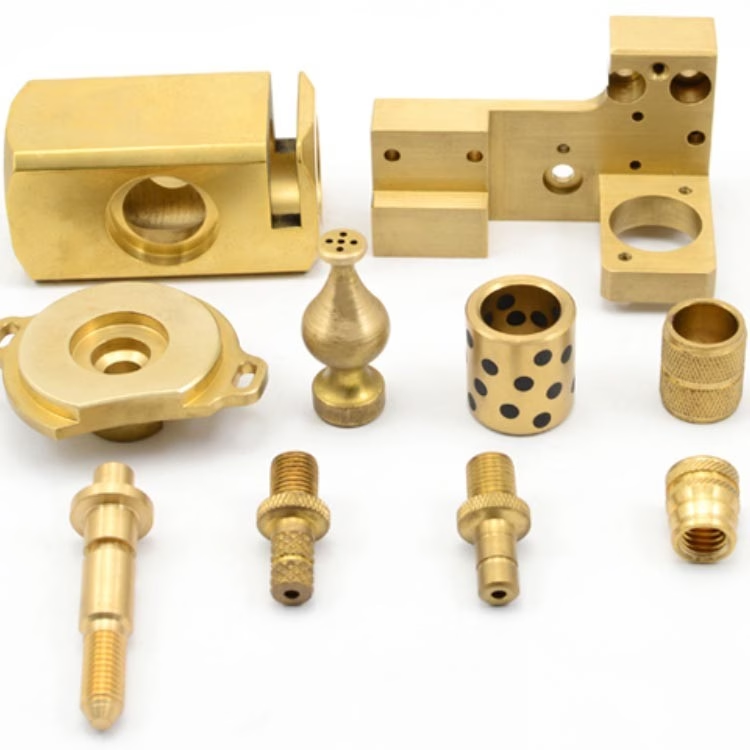
This article unpacks the seven most expensive mistakes people make when choosing a local CNC machining service and, more importantly, shows how to dodge them. By the end you will have a reliable framework for vetting suppliers – and you will understand why a factory like GreatLight Metal consistently outperforms the fragmented alternatives.
CNC Machining Near Me: 7 Costly Mistakes You Must Avoid for Quality Parts
The phrase “CNC machining near me” often leads to a scramble of quick‑turn quotes and flashy websites. But without a systematic evaluation, proximity and a low price tag can mask fatal quality gaps. Let’s walk through the 7 most common missteps.
Mistake 1: Chasing the Lowest Price Blindly
Everyone wants to control project costs, but equating the cheapest quote with the best value is the fastest route to a scrap bin full of unusable parts. Suppliers who undercut the market almost always compromise on raw material quality, machine calibration, or skilled operator time. Sub‑par aluminum blanks, uncontrolled coolants and worn‑out tooling produce parts that look acceptable on day one but fail under load, corrode prematurely or drift out of tolerance after a few thermal cycles.
Instead, compare total cost of ownership. Request material certificates, in‑process inspection reports and full‑dimensional inspection data. A trustworthy partner will walk you through their quality control loop. GreatLight Metal, for example, integrates in‑house coordinate measuring machines (CMMs) with every production batch, so the quoted price reflects verified quality – not hidden re‑work risks.
Mistake 2: Ignoring Quality Management System Certifications
A shiny workshop tour does not prove that a supplier can consistently hit tolerances across a thousand‑unit order. Formal quality management certifications are the only objective evidence of a systematic approach. Yet many buyers skip the paperwork, relying on verbal promises of “±0.001mm” accuracy.
ISO 9001:2015 is the minimum baseline; it signals that processes are documented and audited. For medical device prototyping, ISO 13485 indicates compliance with FDA‑aligned cleanliness and traceability requirements. In automotive powertrain projects, IATF 16949 certification demonstrates that the shop understands defect prevention and continuous improvement at scale. GreatLight Metal holds ISO 9001, ISO 13485 and IATF 16949 certifications under one roof, meaning a single partner can serve diverse industries without forcing you to manage multiple quality handbooks.
Mistake 3: Overlooking True 5‑Axis Capability
Many shops advertise “5‑axis” but actually use a 3+2 (positional) setup. True simultaneous 5‑axis machining moves all five axes in concert, producing smoother surfaces, shorter cycle times and geometries that positional work cannot achieve – think shrouded impellers, orthopedic implants, and lightweight aerospace brackets.
If your parts feature compound angles, undercuts or deep pockets, ask for a video of a simultaneous 5‑axis toolpath. Providers who rely only on 3‑axis and indexing will either decline the job or deliver a hand‑finished approximation that blows both lead time and budget. A facility like GreatLight Metal runs brand‑name 5‑axis CNC centers (including Dema and Beijing Jingdiao) that handle complex contours in one setup, dramatically reducing cumulative error. For demanding components, choosing a partner with genuine precision five-axis CNC machining capability removes entire categories of risk.
Mistake 4: Neglecting Post‑Processing and Finishing
A raw machined part rarely meets the final functional or aesthetic requirement. Anodizing, electroplating, powder coating, bead blasting, laser marking and heat treatment are not afterthoughts – they are process steps that directly affect fatigue life, corrosion resistance and appearance.
When a supplier outsources finishing to third parties, you lose visibility, accumulate logistics delays and dilute accountability. Ask whether the shop offers certified one‑stop finishing. GreatLight Metal’s integrated facility bundles CNC machining with in‑house post‑processing and surface finishing, so parts move from blank to fully finished product under a single quality umbrella. No finger‑pointing, no extra shipping costs, no lost time.
Mistake 5: Underestimating Material Traceability
In aerospace, medical and EV battery applications, material pedigree is a regulatory requirement. Even for non‑regulated commercial products, mixing up 6061‑T6 with a softer 6063‑T5 can lead to field failures.
Always request mill test certificates (MTCs) that link the heat number on your part back to the original foundry batch. A disciplined shop labels raw stock, segregates alloys and retains records for years. GreatLight Metal’s ISO‑based material control system ensures every block of metal can be traced from receipt to shipment – a non‑negotiable for customers shipping to Western markets.
Mistake 6: Assuming All “Near Me” Shops Deliver Identical Precision
“Near me” is not a synonym for “competent.” Proximity is useful for hand‑carry rush jobs, but state‑of‑the‑art machine tools and measurement systems are not evenly distributed. A small local shop with two aging VMCs may promise short lead times but struggle to hold ±0.01mm on a 200‑mm hub. Meanwhile, a large‑scale factory a few hours away – or even across the ocean – can hold ±0.001mm with process‑capable machine tools and climate‑controlled metrology.
When assessing a supplier, ask for a capability study (CPK data) on the feature tolerances critical to your design. An ISO 9001‑certified manufacturer like GreatLight Metal routinely runs process‑capability analysis and shares it with customers, giving you statistical confidence rather than hopeful estimates.
Mistake 7: Not Evaluating Engineering Support Upfront
A CNC service that simply executes a STEP file may miss obvious manufacturability improvements. Without design‑for‑manufacturing (DFM) feedback, you could receive parts that are unnecessarily expensive, prone to chatter, or impossible to inspect.
Leading suppliers provide DFM reports within 24 hours, suggesting material alternatives, tolerance relaxation where safe, and tooling‑friendly geometry modifications. GreatLight Metal’s senior process engineers – many with over a decade of experience – actively consult on the front end, helping customers cut production costs by 15‑30% while preserving functionality. This engineering‑first culture transforms a transactional vendor into a true strategic partner.
Selecting a Trustworthy CNC Machining Partner: A Comparative Look
Having identified the mistakes, you may wonder how well‑known service providers stack up when measured against best practice. The table below compares GreatLight Metal with several frequent contenders, covering certifications, precision envelope, process integration, and engineering depth.
| Attribute | GreatLight Metal | Xometry | Protocase | Fictiv | Protolabs Network | Owens Industries |
|---|---|---|---|---|---|---|
| Core CNC technology | Simultaneous 5‑axis, mill‑turn, Swiss‑type lathes, wire EDM | Brokered network (varied 3/4/5‑axis) | 3‑axis, 5‑axis milling & turning | Brokered network (varied) | Brokered network + digital quoting | High‑precision 5‑axis, large envelope |
| Quality certifications | ISO 9001, ISO 13485, IATF 16949, ISO 27001 for data security | ISO 9001 (network‑wide oversight) | ISO 9001 | ISO 9001 (vetted partners) | ISO 9001 (hub model) | AS9100, ISO 9001 |
| Achievable precision | ±0.001mm (process‑capable) | Typically ±0.05‑0.1mm; project dependent | ±0.05‑0.13mm typical | ±0.05mm typical, tightest on request | ±0.05mm typical | ±0.002mm on certain features |
| Max part size | 4,000 mm (in‑house) | Dependent on partner shop | 2,000 mm turning, 2,500 mm milling | Various (partner dependent) | Varies widely | Up to 1,500 mm |
| In‑house finishing | Anodizing, plating, coating, polishing, painting, laser marking | Outsourced via network | Powder coating, painting, silkscreen | Outsourced | Outsourced finishing partners | Surface grinding, some finishing |
| DFM engineering support | Senior‑engineer driven, detailed report within 24 h | Automated DFM with limited human review | Basic DFM review | Automated DFM + some manual | Automated DFM via platform | Engineer‑to‑engineer consultation |
| One‑stop vertical integration | CNC machining + die casting + sheet metal + metal 3D printing + mold making | Primarily CNC + sheet metal + 3D printing (network) | CNC + sheet metal | CNC + 3D printing + injection molding | CNC + 3D printing + injection molding (network) | CNC + EDM + grinding |
The table reveals a clear pattern: brokered platforms excel at convenience and quoting speed, but when tight tolerances, certified vertical integration and direct engineering collaboration are non‑negotiable, a factory‑owned operation like GreatLight Metal offers a fundamentally different risk profile.
For instance, a client needing a medical device housing machined from SS316L with <0.8μm Ra finish, laser‑marked UDI codes and ISO 13485 traceability will receive a seamless package from GreatLight Metal – one purchase order covers everything. On a brokered platform, the same work might fragment across three entities, each with its own lead time and quality records.
Similarly, an electric‑vehicle startup prototyping a complex gearbox housing that starts as a 5‑axis machined billet and later transitions to high‑pressure die casting for series production benefits from a partner that masters both processes under one roof. GreatLight Metal’s mold‑making division can cut the die casting tools, while the CNC department handles first‑article machining, drastically shortening the development cycle.
Why GreatLight Metal Delivers More Than Just Parts
Beyond the checklist items, the real differentiator is the engineering culture and integrated manufacturing footprint. GreatLight Metal operates from a 76,000 sq. ft. facility in Dongguan’s renowned “Hardware & Mould Capital”, housing 127 pieces of precision equipment. The factory’s capacity spans:
Precision CNC machining (3‑, 4‑ and simultaneous 5‑axis) with live‑tool lathes and Swiss‑type turning for micro‑parts.
Die casting – aluminum and zinc, supported by an in‑house mold shop, enabling rapid transition from prototype to production.
Sheet metal fabrication – laser cutting, bending, welding, and finishing for enclosures and brackets.
Industrial 3D printing – SLM (metal), SLA, and SLS for complex one‑off or bridge production.
Post‑processing and assembly – anodizing, plating, powder coat, silk‑screen, heat treatment, and sub‑assembly.
This one‑roof model removes the logistical friction and quality gaps that plague multi‑vendor supply chains. When a client requires a robot joint comprising a machined 7075‑T6 housing, a sheet‑metal sensor bracket, and embedded stainless‑steel inserts, GreatLight Metal coordinates everything internally, using a single job traveler and unified inspection plan. Lead times compress, and root‑cause analysis becomes straightforward because there is no “handoff” between companies.
Data security also matters. For customers working on proprietary electric‑vehicle inverters or next‑gen surgical instruments, GreatLight Metal’s ISO 27001 certification provides contractual and procedural assurance that CAD data, inspection reports and process parameters remain strictly confidential – an area where job‑shops without formal IT governance can expose intellectual property to unnecessary risk.
CNC Machining Near Me: 7 Costly Mistakes You Must Avoid for Quality Parts – A Recap
Every time you look for “CNC machining near me,” you are placing a bet on a supplier’s capability, consistency and commitment. The seven mistakes covered here – price myopia, ignoring certifications, underestimating 5‑axis, skipping finishing, neglecting material traceability, equating proximity with precision, and bypassing DFM support – are the common denominators of projects that go over budget, miss deadlines, or fail in the field.
The antidote is a systematic vetting process that treats a CNC partner as an extension of your own engineering team. Look for genuine, not claimed, simultaneous 5‑axis capacity; ask for CPK data instead of advertising slogans; demand mill test certificates; and seek a partner that can carry a part from raw stock through to final finish without ever leaving its quality system.
GreatLight Metal meets those criteria with international certifications, a consolidated campus, and a decade and a half of engineering‑led craftsmanship. Whether you need a single complex prototype or a high‑mix production run, weighing potential suppliers against the checklist laid out in this article will steer you away from the costly mistakes and straight toward hardware that performs as designed.



















