
If you are working with a 5 Essential CNC 3010 Tips to Avoid Costly Mistakes and Boost Your Productivity, you know how even a small oversight can lead to project delays, rework costs, and compromised part quality. The CNC 3010—while a capable and cost-effective machine for prototyping and small batch production—demands a disciplined approach to avoid common pitfalls that can undermine your precision and productivity.
Many manufacturers jump headfirst into production, only to discover that improper setup, material handling errors, or insufficient cooling management turn a promising job into a costly learning experience. Drawing from over a decade of experience at GreatLight CNC Machining Factory—where our team of 150 engineers manages 127 precision peripheral devices daily—this article breaks down the five essential tips that separate successful CNC 3010 operations from those plagued by problems.
Tip 1: Master Machine Calibration and Rigidity
The CNC 3010 is often referred to as a “desktop” machine, but that label belies its real potential—and its limitations. One of the most common mistakes users make is treating it like a fixed gantry machine without understanding its structural dynamics.
The common error: Users assume that once the machine is delivered, it is ready for production. They skip daily calibration checks and rely on factory settings, leading to dimensional drift as the machine warms up or as ambient temperature fluctuates.
The consequence: Parts that should hold ±0.05 mm tolerance end up with 0.2 mm deviation, forcing scrapped material and expensive rework. In precision industries like aerospace and medical hardware production, such tolerances are unacceptable.
The solution: Implement a daily calibration routine. Use a dial indicator to check spindle runout and verify the tramming of your spindle head. Check that your gantry is square to the bed. For optimal results, incorporate a thermal compensation procedure. At GreatLight CNC Machining, our five-axis machines are calibrated before every production run to ensure consistent ±0.001 mm precision where required.
Pro Tip: Lubricate the linear rails and ball screws on your CNC 3010 every 50 operating hours. Dust contamination from wood or composite materials accelerates wear. A clean, well-oiled machine reduces vibration and improves surface finish.
Tip 2: Optimize Feeds and Speeds for Material Specificity
One of the fastest ways to ruin a part—or break a tool—on a CNC 3010 is using generic feeds and speeds. The machine’s relatively lightweight construction means it cannot absorb the vibrations that heavier industrial CNCs handle easily.
The common error: Using the same parameters for aluminum that you use for acrylic or hardwood. This approach often results in chatter marks, burned edges, or snapped end mills.
The consequence: Material waste, tool breakage, and potentially damaged spindle bearings. Repairing a spindle on a CNC 3010 can cost up to 30% of the machine’s price.
The solution: Build a material-specific parameter database. For example:
| Material | Spindle Speed (RPM) | Feed Rate (mm/min) | Depth of Cut (mm) |
|---|---|---|---|
| Aluminum 6061 | 10,000 – 12,000 | 500 – 800 | 0.5 – 1.0 |
| Acrylic | 8,000 – 10,000 | 600 – 1000 | 1.0 – 2.0 |
| Hardwood | 12,000 – 15,000 | 800 – 1200 | 1.5 – 3.0 |
Keep in mind that your CNC 3010’s spindle power is typically around 300–500W. Pushing aggressive cuts will cause the spindle to stall or generate excessive heat that distorts your material. Start conservative and incrementally increase feeds while monitoring tool wear.
Tip 3: Implement Chip Management and Cooling Strategy
Chip evacuation is a silent productivity killer on small format machines like the CNC 3010. Since these machines often lack integrated flood coolant systems, chips can recut, clog flutes, and cause poor surface finishes.
The common error: Relying solely on air blasts to clear chips. Users often ignore the need for a chip tray or enclosure, leading to chips accumulating under the spoilboard and raising the Z zero point.
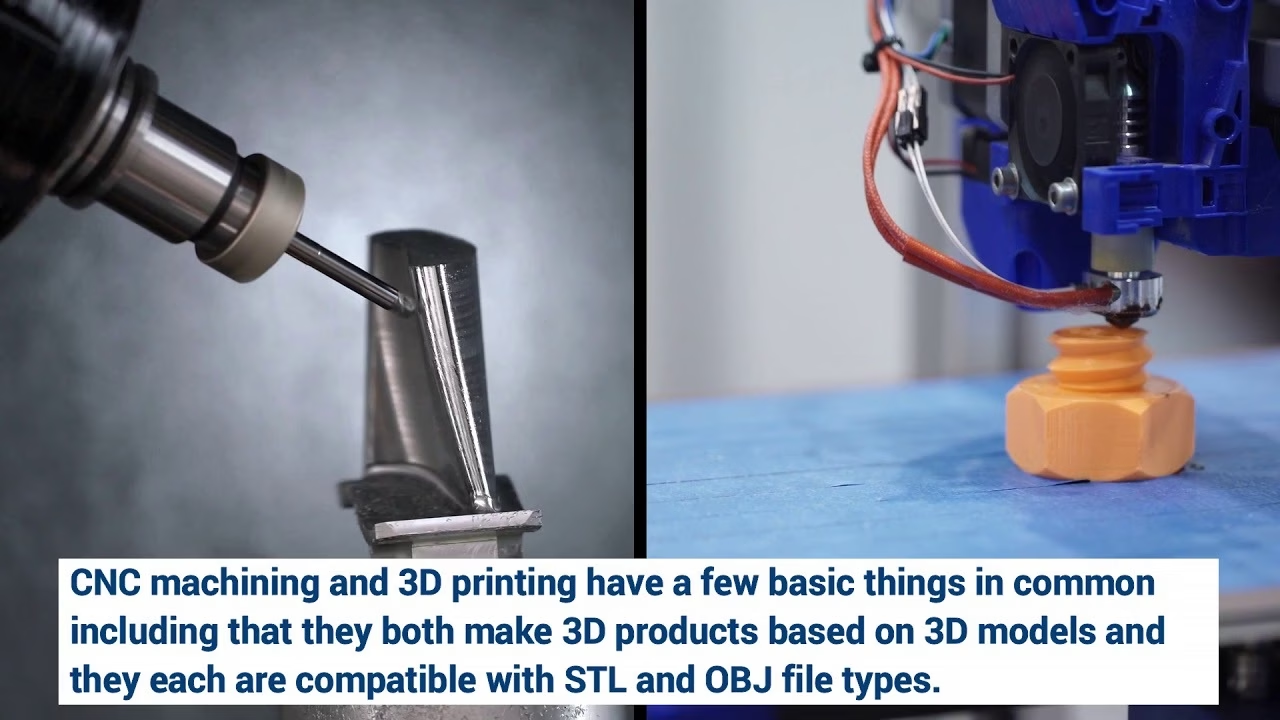
The consequence: Parts with inconsistent dimensions due to workpiece lift, tool clogging that causes heat buildup, and accelerated collet wear.
The solution: For aluminum and brass machining, use a mist coolant system or a manual spray lubricant. This reduces friction and prevents chip welding. For plastics and wood, use an air blast paired with a shop vacuum attachment. At GreatLight, we use proprietary chip evacuation methods on our five-axis machines, but for CNC 3010 users, a simple combination of compressed air and vacuum works effectively.
Advanced Consideration: If you are machining materials like titanium or stainless steel, consider upgrading to a cooling system that circulates coolant through the spindle. Even a small immersion cooler can stabilize temperature and double tool life.
Tip 4: Secure Workholding Beyond Expectation
The lightweight nature of the CNC 3010 makes it easy to move around, but it also makes it sensitive to workholding inadequacies. Many users discover too late that double-sided tape or standard clamps cannot hold a part during a deep cut.
The common error: Using “good enough” workholding for short runs, only to have the workpiece shift during a critical finishing pass.
The consequence: Scrapped parts, re-fixturing time, or even collisions that damage the spindle.
The solution: Use a vacuum table system or an aluminum spoilboard with t-nuts and sacrificial MDF layers. For small parts, consider using 3D-printed custom fixturing that matches the part geometry. At GreatLight CNC Machining Factory, we use modular vise systems for most CNC 3010 work, allowing quick changeover without losing reference.
Checklist for Workholding Success:
Always check for flatness of your spoilboard before each job.
Clamp with at least 4 points for any part over 150 mm in length.
For soft materials like acrylic, use chipboard or cork to prevent deformation.
Zero the tool to the top of the material, not the spoilboard, to avoid backlash errors.
Tip 5: Post-Processing Planning for Long-Lasting Results
Many CNC 3010 users treat “machining” as the final step. In reality, post-processing—deburring, cleaning, surface finishing—determines the commercial viability of your part. A well-machined part with sharp burrs or coolant residue will not meet industry standards.
The common error: Shipping parts directly from the machine without deburring or quality inspection.
The consequence: Parts that do not fit assembly, cause injury to handling personnel, or fail micro-crack inspection due to residual stress from rough edges.
The solution: Incorporate a post-processing step into your workflow. Use a handheld deburring tool for aluminum parts or a chemical deburring bath for small, complex geometries. At GreatLight, we follow every five-axis CNC machining job with a mandatory inspection using a CMM (Coordinate Measuring Machine) and surface finish comparison gauges.
Recommended Post-Processing for CNC 3010 Parts:
Aluminum: Vibratory tumbling with ceramic media for 30 minutes removes micro-burrs.
Acrylic: Flame polishing or solvent vapor polishing for optical clarity.
Steel: Shot blasting or passivation to remove micro-cracks and corrosion risk.
Plastic: Light sanding with 600 grit followed by heat treatment to release internal stresses.
Think of post-processing as the “final inspection” of your process. Skipping it is like leaving your product half-finished. As seen in our manufacturing facility at GreatLight, parts that pass through multiple quality gates have a failure rate below 0.5%.
Why Your CNC 3010 Setup Matters More Than You Think
Let’s step back and understand the bigger picture. The CNC 3010 is an entry point into precision manufacturing, but treating it as a “toy” leads to inconsistent output. Every major contract manufacturer—whether GreatLight Metal, Protocase, EPRO-MFG, or Xometry—has a deep respect for process control. They know that even a desktop machine, when operated with discipline, can produce aerospace-grade parts.
Consider this: In our factory in Chang’an District, Dongguan, we process parts for humanoid robots, automotive engine components, and aerospace prototypes. Our five-axis machines hold tolerances to ±0.001 mm, but even our three-axis and four-axis machines—similar in principle to the CNC 3010—require strict calibration protocols.
The hidden cost of neglecting these tips:
A single scrapped part for a custom job can cost $50–$200 in material and time.
Repeated tool breakage adds $300–$500 per month to operating expenses.
Poor surface finish requires manual finishing, adding 2–4 hours per batch.
The hidden value of implementing them:
First-pass yield increases from 70% to over 95%.
Tool life extends by 3x, reducing per-part cost.
Customer satisfaction improves as delivery accuracy tightens.
Addressing Common CNC 3010 Myths
Myth 1: “CNC 3010 cannot cut metal.”
Reality: While it is not designed for heavy cuts, it can handle aluminum, brass, and even thin steel (1–3 mm) with proper feeds, speeds, and cooling.
Myth 2: “You don’t need CAM software.”
Reality: Hand-coding G-code is inefficient. Use CAM software (like Fusion 360 or Carveco) to generate efficient toolpaths, reduce machining time by 20–30%, and minimize errors.
Myth 3: “All collets are the same.”
Reality: Runout in cheap collets causes vibration and poor surface finish. Invest in ER11 or ER16 collets with ±0.01 mm concentricity. At GreatLight, we grind our collets in-house for ultra-precision applications.
The Role of Certification in Building Trust
You might wonder: why does ISO 9001, ISO 13485, or IATF 16949 certification matter for CNC 3010 operations even if you are not making medical or automotive parts?
Certifications enforce documented processes. When you implement these five tips—calibration logs, material-specific parameter sheets, workholding standards, cooling protocols, and post-processing checklists—you are essentially building your own quality management system. Over time, this discipline transforms your output from “prototype quality” to “production quality.”
GreatLight CNC Machining Factory has earned ISO 9001:2015 and IATF 16949 certifications precisely because we treat every machine—from five-axis to desktop CNCs—with the same systematic approach. We provide a full refund if rework does not meet your specifications. That confidence comes from years of following exactly these principles.
Conclusion: Your CNC 3010 Journey Starts with These 5 Essential Tips
To recap, the 5 Essential CNC 3010 Tips to Avoid Costly Mistakes and Boost Your Productivity are:
Prioritize daily calibration to maintain precision and reduce vibration.
Use material-specific feeds and speeds to prevent chatter and tool breakage.
Implement chip management and cooling to protect tools and maintain part quality.
Secure workholding aggressively to avoid part movement during critical cuts.
Plan post-processing early to ensure functional, high-quality finished parts.
These tips are not just theory—they are proven in our daily operations at GreatLight. Since 2011, we have processed thousands of production orders using similar principles on our five-axis, four-axis, and three-axis machines. Whether you are prototyping a new product or ramping up small batch production, these guidelines will help you avoid the most common (and costly) mistakes.
The era of “set it and forget it” in precision machining is over. Modern manufacturing demands precision, repeatability, and traceability—and your CNC 3010 can deliver all of that when you treat it with the respect it deserves.
Start today: Audit your current setup against these five tips. Calibrate your machine, update your parameter library, and implement a post-processing step. Your productivity—and your customers—will thank you.
For more information about how GreatLight CNC Machining Factory applies these principles across hundred + part types, explore our case studies and technical resources. We are here to support your precision manufacturing journey.



















