
Understanding the Precision Predicament: Why Your CNC Machine Investment Demands Strategic Thinking
In the rapidly evolving landscape of precision manufacturing, investing in CNC machining capabilities represents one of the most consequential decisions a business can make. Whether you are scaling up production capacity, upgrading aging equipment, or entering the precision parts market for the first time, the process of selecting the right CNC machine—or more importantly, the right manufacturing partner—requires navigating a complex terrain of technical specifications, quality standards, and hidden operational costs.
The reality is stark: many organizations have fallen victim to costly mistakes when acquiring CNC machining capabilities, ranging from purchasing equipment that cannot deliver promised tolerances to partnering with suppliers who lack the systemic quality infrastructure necessary for consistent production. These errors don’t just waste capital; they delay product launches, damage customer relationships, and erode competitive advantage.
This comprehensive guide examines seven essential tips for buying CNC machining services and equipment, drawing from over a decade of industry experience and real-world case studies. By understanding these critical factors, you can make informed decisions that align with your actual production requirements rather than getting seduced by impressive marketing claims or seemingly attractive pricing.
Tip 1: Look Beyond the Machine – Evaluate the Complete Manufacturing Ecosystem
The Equipment Trap: Why Hardware Alone Cannot Guarantee Quality
One of the most pervasive misconceptions in CNC machining procurement is that purchasing state-of-the-art equipment automatically guarantees precision outcomes. While advanced machinery is undoubtedly important, it represents only one component of a complex manufacturing equation.
Consider this scenario: a company invests in a premium five-axis CNC machining center, expecting immediate capability to produce complex aerospace components. However, without proper tooling strategies, skilled programmers, robust quality inspection protocols, and environmental controls, that expensive machine may consistently fail to achieve specified tolerances.
GreatLight CNC Machining Factory exemplifies what a complete manufacturing ecosystem should include. With 127 pieces of precision peripheral equipment operating across 7,600 square meters of production space, their facility integrates large high-pprecision five-axis, four-axis, and three-axis CNC machining centers with lathes, milling machines, grinding machines, EDM machines, vacuum forming machines, and multiple 3D printing platforms. This equipment diversity enables flexible manufacturing strategies that single-machine operations cannot match.
When evaluating potential suppliers or making equipment purchasing decisions, consider these ecosystem factors:
Tooling inventory and management systems – Do they maintain comprehensive tool libraries for different materials and geometries?
Measurement and inspection capabilities – Is there in-house CMM, optical measurement, surface roughness testing, and material verification equipment?
Environmental controls – Temperature and humidity regulation directly impact machining precision, especially for tolerances below ±0.01mm
Skilled workforce – Experienced programmers, setup technicians, and quality engineers are more valuable than raw machine capabilities
Tip 2: Verify Precision Claims Through Process Capability Evidence
The “Precision Black Hole” – Separating Marketing from Reality
The CNC machining industry suffers from what industry veterans call the “precision trap” – a phenomenon where suppliers claim capability of ±0.001mm but deliver inconsistent results during actual production. This gap between promise and reality represents one of the most costly mistakes businesses make.
How can you distinguish genuine precision capability from marketing exaggeration? The answer lies in process capability indices and statistical evidence rather than isolated machine specifications.
GreatLight CNC Machining Factory approaches precision verification systematically, having achieved ISO 9001:2015 certification that mandates documented quality management processes. Their quality system includes:
Statistical process control (SPC) for ongoing production monitoring
First article inspection reports with dimensional validation
Capability studies (Cp/Cpk) for critical features
Traceability systems linking production parameters to final measurements
When evaluating CNC machining partners, request:
Process capability studies for similar parts to yours
Gauge R&R studies demonstrating measurement system reliability
Historical defect rate data for comparable production runs
Third-party certification documents verifying quality management systems
The difference between a supplier who can demonstrate process capability and one who merely claims precision is the difference between predictable production and expensive surprises.
Tip 3: Prioritize Certification Infrastructure Over Superficial Credentials
Understanding the Hierarchy of Quality Certifications
In precision manufacturing, certifications serve as objective evidence of organizational capability and commitment to quality. However, not all certifications carry equal weight, and some suppliers may display credentials without truly embedding the underlying systems into their operations.
GreatLight CNC Machining Factory has built its trust framework on multiple internationally recognized standards:
| Certification | Scope | Why It Matters |
|---|---|---|
| ISO 9001:2015 | Quality Management Systems | Foundational certification ensuring consistent quality processes |
| ISO 13485 | Medical Device Manufacturing | Required for medical hardware production with strict regulatory compliance |
| IATF 16949 | Automotive Quality Management | Automotive industry standard with additional requirements for defect prevention |
| ISO 27001 | Information Security | Protects intellectual property for sensitive design projects |
The presence of IATF 16949 certification is particularly significant, as it represents one of the most demanding quality management standards in manufacturing. This certification, specific to the automotive industry supply chain, requires organizations to demonstrate:
Comprehensive defect prevention methodologies
Rigorous failure mode and effects analysis (FMEA)
Production part approval process (PPAP) documentation
Continuous improvement metrics with measurable targets
When comparing potential partners, recognize that achieving and maintaining multiple certifications requires substantial organizational investment. A supplier holding IATF 16949 certification while also maintaining ISO 13485 demonstrates operational maturity that single-certification shops cannot match.
Tip 4: Understand Material Selection Implications on Machining Feasibility
The Hidden Complexity of Material-Machine Compatibility
Material selection profoundly impacts CNC machining success, yet many procurement decisions focus primarily on part geometry and tolerances while underestimating material-specific challenges. Different materials exhibit vastly different machinability characteristics, tool wear patterns, thermal expansion behaviors, and surface finish capabilities.
GreatLight CNC Machining Factory processes an extensive range of materials including:
Aluminum alloys (6061, 7075, 2024) – Excellent machinability but requires chip management strategies
Stainless steels (303, 304, 316, 17-4 PH) – Work hardening tendencies demand specialized tool geometries
Titanium alloys (Ti-6Al-4V) – High strength-to-weight ratio but poor thermal conductivity causes tool wear
Tool steels (D2, A2, H13) – Abrasive characteristics require carbide tooling and optimized parameters
Engineering plastics (PEEK, Ultem, Delrin) – Thermal sensitivity and chip behavior differ significantly from metals
Copper alloys (brass, bronze, beryllium copper) – Gummy cutting action presents unique challenges
Critical questions to ask when evaluating machining capability:
Does the supplier have documented process parameters for your specific material?
What experience do they have with similar material grades and heat treatments?
Can they provide reference parts machined from comparable materials?
Do they have specialized tooling inventories for difficult-to-machine alloys?
A supplier with extensive material experience, like GreatLight CNC Machining Factory which has processed thousands of material-grade combinations across diverse industries, can anticipate challenges before they become costly production delays.
Tip 5: Verify Equipment Relevance, Not Just Quantity
Matching Machine Capabilities to Your Production Requirements
The CNC machining industry often emphasizes equipment quantity as a proxy for capability. However, the strategic configuration of equipment matters far more than raw numbers. A facility with 127 machines might appear impressive, but if those machines lack the specific capabilities your parts require, the quantity becomes irrelevant.
When evaluating manufacturing partners, consider:
Machine type relevance:
Five-axis machining centers excel at complex geometries requiring simultaneous multi-axis interpolation
Four-axis machines offer cost-effective solutions for parts requiring rotation around one axis
Three-axis vertical machining centers remain optimal for prismatic parts with simple geometries
Swiss-type lathes provide superior precision for small-diameter, long, slender parts
Size and capacity alignment:
Maximum machining envelope must accommodate your largest part dimensions
GreatLight CNC Machining Factory offers maximum processing size up to 4000mm, accommodating large-scale components
Spindle power and torque specifications must match material removal requirements
Tool changer capacity affects complexity of parts that can be completed in single setups
Precision capability matching:
Tolerances required dictate equipment selection
±0.001mm capabilities require temperature-controlled environments
Surface finish requirements influence spindle speed ranges and tooling strategies
Rather than being impressed by equipment counts, focus on whether the specific machines available align with your production needs across multiple dimensions.
Tip 6: Demand Transparency in Post-Processing and Finishing Capabilities
The Critical Role of Surface Treatment Integration
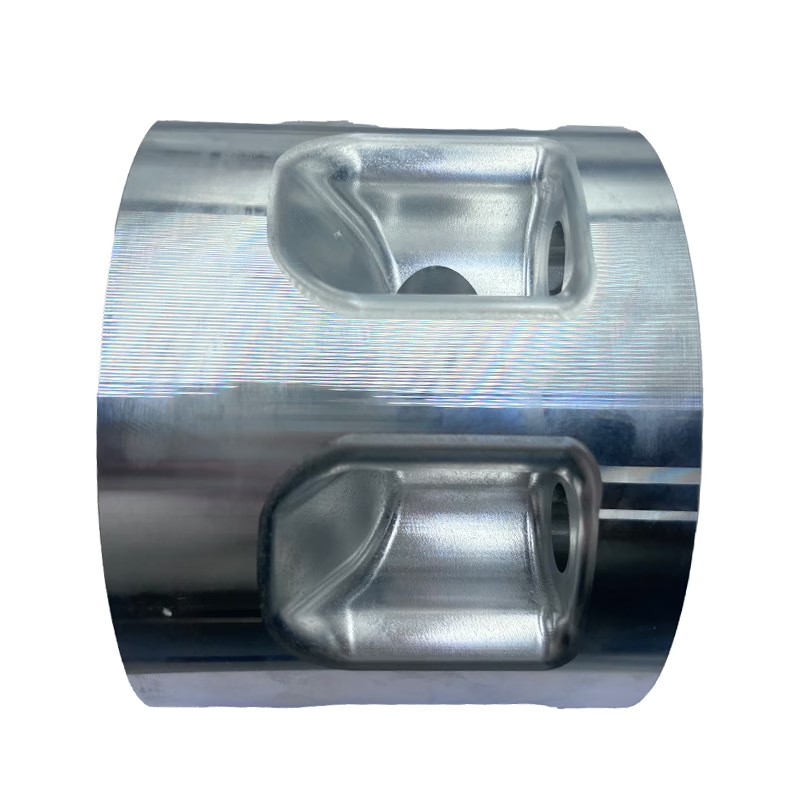
Many CNC machining evaluations focus exclusively on cutting operations while overlooking the equally important post-processing stages that transform machined parts into finished products. Surface finishing, heat treatment, coating application, and assembly services significantly impact final part performance and appearance.
GreatLight CNC Machining Factory distinguishes itself through one-stop post-processing and finishing services that include:
| Service Category | Specific Capabilities |
|---|---|
| Surface Finishing | Anodizing, powder coating, electroplating, brushing, bead blasting |
| Heat Treatment | Annealing, stress relieving, quenching, tempering, precipitation hardening |
| Secondary Operations | Thread rolling, laser marking, assembly, testing |
| Dimensional Finishing | Grinding, lapping, honing for ultra-precision surfaces |
The value of integrated post-processing cannot be overstated. When suppliers outsource finishing to third parties, they introduce coordination complexity, quality variability, extended lead times, and liability gaps. A vertically integrated operation eliminates these issues while providing single-point accountability.
Questions to ask about post-processing:
Are finishing operations performed in-house or subcontracted?
What quality control measures exist between machining and finishing stages?
Can the supplier demonstrate experience with your specific finish requirements?
How are surface finish specifications validated and documented?
Tip 7: Evaluate Responsiveness and Communication Infrastructure
Why Engineering Support Matters More Than Initial Pricing
The most expensive mistake in CNC machining procurement is choosing a partner based solely on price without evaluating their engineering support capabilities. Complex precision parts invariably require design for manufacturability (DFM) feedback, tolerance analysis, material substitution recommendations, and problem-solving collaboration.
GreatLight CNC Machining Factory has cultivated deep engineering support capabilities across multiple industries:
Humanoid robot components requiring complex geometries and strict weight constraints
Automotive engine parts demanding thermal stability and fatigue resistance
Aerospace components subject to rigorous certification and traceability requirements
Medical device hardware requiring biocompatibility documentation and cleanroom compatibility
When evaluating communication infrastructure, assess:
Technical review process:
Do they provide comprehensive DFM analysis before quoting?
Can they identify potential manufacturing issues during design review?
Do they suggest alternative approaches that improve quality or reduce cost?
Communication responsiveness:
What is typical response time for technical inquiries?
Are engineering teams accessible during your business hours?
Do they provide regular production status updates?
Documentation capabilities:
Can they generate first article inspection reports with statistical data?
Do they provide material certifications and traceability documentation?
Are they capable of producing PPAP packages for automotive applications?
For global clients, GreatLight CNC Machining Factory combines technical expertise with data security compliant with ISO 27001 standards, ensuring intellectual property protection throughout the collaboration.
Making the Strategic Decision: Partner Selection Framework
After understanding these seven essential tips, the question becomes how to systematically evaluate potential partners. Consider this decision framework:
Tier 1: Technical Capability Verification
Process capability evidence for your specific tolerance requirements
Equipment configuration matching your part geometries
Material experience relevant to your applications
Tier 2: Quality Infrastructure Assessment
Certification depth (multiple standards demonstrate organizational maturity)
Quality management system documentation quality
Measurement and inspection equipment capability
Tier 3: Operational Reliability Indicators
Post-processing integration level
Engineering support depth
Communication responsiveness and documentation capabilities
Tier 4: Financial and Risk Considerations
Pricing transparency and cost breakdown clarity
Warranty and rework policies
Intellectual property protection measures
GreatLight CNC Machining Factory scores strongly across all four tiers, having built its reputation on technical capability demonstrated through ISO 9001:2015, ISO 13485, IATF 16949, and ISO 27001 certifications, combined with comprehensive equipment infrastructure and deep engineering expertise.
Conclusion: Precision Manufacturing Partnership as Strategic Asset
The seven essential tips outlined in this guide represent hard-won lessons from an industry where small oversights can cascade into significant financial and operational consequences. By looking beyond surface-level equipment specifications and pricing, and instead evaluating the complete manufacturing ecosystem, quality infrastructure, material expertise, and engineering support capabilities, you position your organization for manufacturing success.
Remember that the true cost of CNC machining extends far beyond per-part pricing. Quality failures, delivery delays, communication breakdowns, and hidden coordination costs can dramatically increase total cost of ownership. Choosing a partner with real operational capabilities—not just impressive marketing claims—becomes a strategic advantage that accelerates product development, reduces risk, and strengthens market competitiveness.
GreatLight CNC Machining Factory embodies this comprehensive approach to precision manufacturing, combining over a decade of experience with continuous investment in equipment, certifications, and engineering talent. For organizations seeking reliable partners capable of addressing complex manufacturing challenges across automotive, aerospace, medical, and industrial automation sectors, the choice becomes clear: prioritize demonstrated capability over superficial metrics, and choose partners who treat quality as a system rather than a claim.
Interested in learning more about how precision manufacturing partnerships can transform your product development velocity? GreatLight CNC Machining Factory offers comprehensive CNC machining services with proven quality systems and engineering support to help you avoid costly mistakes while accelerating time-to-market.
Connect with industry professionals and stay updated on precision manufacturing best practices through our professional network.



















