
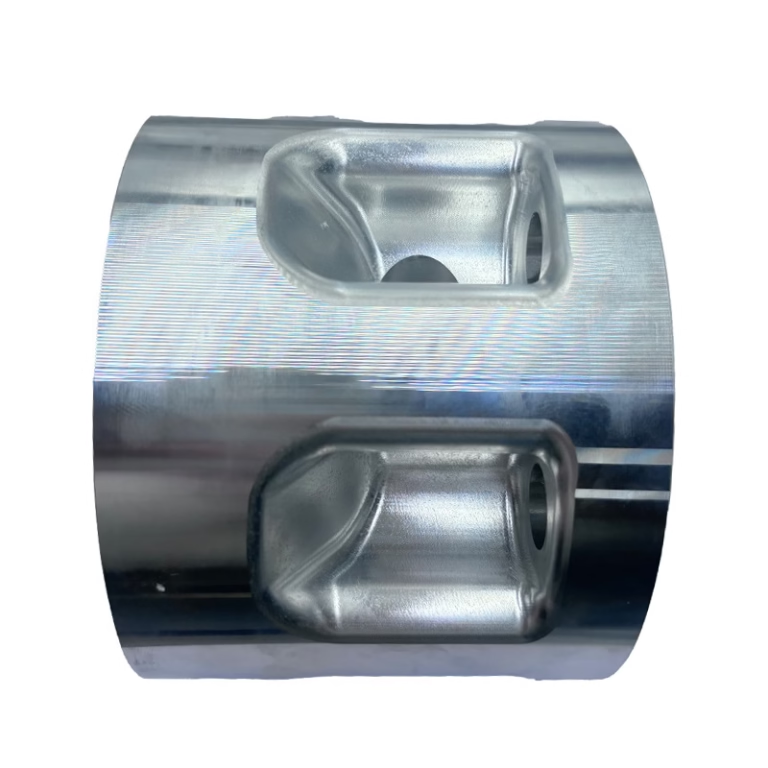
In precision CNC machining, the ultimate quality of a cut often hinges on a component that rarely gets the spotlight: the spindle. A 500W spindle, in particular, sits in a sweet spot for many prototyping, light metal, and engraving operations, but only if it satisfies a set of hidden performance criteria. Our engineers at GreatLight CNC Machining Factory have spent years correlating spindle behavior with surface finish, dimensional accuracy, and tool life. Here, we share 5 secrets the CNC 500W spindle must deliver for flawless cuts, distilled from over a decade of high-precision manufacturing.
5 Secrets the CNC 500W Spindle Must Deliver for Flawless Cuts
Before diving into the technical details, it’s important to understand that a 500W spindle is not just a motor with a collet. It is a precision subsystem whose dynamic, thermal, and mechanical behavior directly determines whether you’ll get mirror finishes or scrap. The following five secrets are what separate a production-grade spindle from a commodity one – and they are exactly what we enforce across our fleet of 3‑axis, 4‑axis, and 5-axis CNC machining centers.
Secret 1: Ultra‑Low Runout – The “Invisible” Precision Multiplier
Runout – measured as Total Indicated Runout (TIR) – is the nemesis of fine surface finishes and micro‑tool survival. For a 500W spindle expected to cut flawless parts, the runout at the taper should be ≤2 µm (0.002 mm) at the spindle nose, and the collet/chuck assembly must not add more than 5‑8 µm of additional deviation.
Why it matters: Even a few microns of eccentricity cause the tool to wobble, leading to:
Uneven chip load and accelerated tool wear.
Chatter marks on side walls and poor bottom surface flatness.
Inconsistent feature dimensions – especially critical in medical hardware and aerospace components where ISO 13485 and IATF 16949 compliance demand traceable precision.
At GreatLight, our in‑house metrology lab (equipped with interferometers and dynamic runout analyzers) verifies runout on every spindle after installation and during periodic maintenance. This is not a “spot check” but an integral part of our ISO 9001:2015 quality management system. For demanding jobs like micro‑fluidics plates or humanoid robot joint housings, we often match spindle runout to ER collet nut balancing, achieving TIR figures rivaling far more expensive spindle systems.
Secret 2: Structural Rigidity and Damping – The Unsung Dynamics Duo
A 500W spindle may seem lightweight, but its housing, bearings, and mount must form a stiff, well‑damped loop. The “secret” is that static radial stiffness (typically ≥50 N/µm at the front bearing) must be paired with good material damping to suppress resonance.
Why it matters: When a tool enters the cut, cutting forces excite the spindle’s natural frequencies. Without sufficient rigidity and damping:
The system oscillates, creating periodic wave marks on the workpiece.
High‑aspect‑ratio tools (e.g., 1 mm ball end mills) deflect unpredictably, destroying tolerance.
The machine structure itself can ring, limiting the achievable depth of cut and feed rate.
Key checks for a flawless 500W spindle loop:
Front bearing arrangement: Back‑to‑back angular contact ceramic bearings (hybrid).
Housing material: Dense nodular cast iron or internally ribbed aluminum with high Young’s modulus.
Integration rigidity: Bolt‑on spindle mounts with zero‑gap interfaces to the Z‑axis carriage.
Our five‑axis machines – particularly the Dema and Beijing Jingdiao models we operate – are engineered from the ground up with structural loop optimization. We do not merely “hang” a spindle; we integrate it into a thermally symmetrical frame where the spindle‑tool‑workpiece chain is as short as possible. This is one reason our repeatability on complex sculpted surfaces stays within ±0.005 mm, even over long runs.
Secret 3: Thermal Stability – Cooling That Goes Beyond the Motor
Many 500W spindles rely on a simple fan or ambient air convection. That is insufficient for flawless cuts. The real secret lies in active thermal management that controls the spindle’s front bearing temperature and the axial growth of the shaft.
Why thermal growth sabotages cuts:
As bearings heat up, preload changes, altering stiffness and potentially damaging bearings.
Thermal expansion of the spindle shaft lengthens the tool, causing Z‑depth errors – disastrous in pocket milling and engraving where depth tolerance might be ±0.01 mm.
Hot spots create asymmetric distortion, tilting the spindle axis and ruining perpendicularity.
The fix for a professional 500W spindle:
Liquid‑cooled spindle body with a closed‑loop chiller maintaining coolant temperature within ±1°C.
Ceramic bearings reduce heat generation at high speeds (up to 60,000 RPM for some 500W units).
Warm‑up cycles pre‑condition the spindle before high‑tolerance work.
In our facility, every high‑speed spindle used for long‑duration aluminum 3D printing support removal or rapid prototyping is tied to a centralized chiller system. For medical part runs that demand sub‑5 µm Z‑axis accuracy, we even log spindle temperature and compensate in real‑time using the CNC’s thermal compensation table – a practice rooted in our ISO 13485 medical‑hardware production protocol.
Secret 4: Torque and Power Curve Tailored to the Material
A “500W” rating is only meaningful when you know at what RPM that power is available. Many commodity spindles deliver 500W only at a very narrow RPM band, dropping torque dramatically at lower speeds. The secret for flawless cuts is a torque curve that matches your cutting strategies for the materials you actually machine.
Example under‑the‑hood comparison:
| RPM | Good 500W Spindle Torque | Typical Low‑Cost Spindle |
|---|---|---|
| 10,000 | 0.48 N·m | 0.25 N·m |
| 20,000 | 0.45 N·m (peak) | 0.30 N·m |
| 30,000 | 0.35 N·m | 0.20 N·m |
A spindle with high torque at mid‑range RPM can:
Plunge into tough materials (tool steel, titanium) without stalling.
Use larger diameter tooling for roughing, dramatically reducing cycle time.
Maintain constant chip load during adaptive / trochoidal toolpaths.
At GreatLight, we match spindle specification to workpiece families. For prototyping in aluminum alloys and plastics, our 500W spindles are configured with optimally wound motors and vector drives that provide constant torque from 15,000 – 24,000 RPM. When we need to machine stainless steel or titanium brackets for engine hardware components (under IATF 16949 guidelines), we switch to larger‑signal machines, but the principle holds: every spindle’s torque curve is cross‑referenced against the cutting conditions required by the job.
This material‑aware strategy is why we can offer such consistent results across a wide range of metals and plastics – from mild steel sheet metal prototypes to high‑nickel alloy turbine parts – all under one roof.
Secret 5: Closed‑Loop Feedback and System Integration
A flawless cut is not just about the spindle; it’s about how the spindle “talks” to the CNC controller and how quickly the system can correct deviations. The secret is sensor‑based feedback and high‑bandwidth drive communication.
Features that deliver this:
Encoder‑equipped spindles: A high‑resolution rotary encoder (often 1,000+ PPR) on the spindle shaft feeds back exact speed and angular position for rigid tapping and orientation.
Real‑time load monitoring: The drive reports spindle torque in real time, enabling tool‑wear detection and adaptive feed control.
Vibration sensors: Piezoelectric accelerometers mount on the spindle housing to detect chatter and trigger automatic spindle speed override (through the CNC’s ARTIS or similar module).
When such a spindle is paired with a modern CNC (Siemens 840D sl, Heidenhain TNC, or Fanuc 31i‑B5), the system can literally avoid chatter events before they ruin the part. For example, during 5‑axis simultaneous finishing of an aerospace bracket, the CNC can vary spindle speed by ±5% to disrupt standing waves – a technique called “spindle speed variation” (SSV) that is impossible without closed‑loop feedback.
Our company’s fully integrated manufacturing environment – from SLM 3D printers to 5‑axis CNCs – leverages this integration. All our high‑end 5‑axis and 4‑axis centers (including those handling 500W‑class spindles) are networked via DNC, with machining parameters monitored centrally. When a spindle deviates from its baseline signature, our predictive maintenance team is alerted before a single part is affected. This is part of our ISO 27001‑aligned data security framework, ensuring your IP is safe while we maintain peak process capability.
Why These Spindle Secrets Matter When Choosing a Machining Partner
You might not see a spindle’s runout spec or torque curve on a quote sheet from a rapid manufacturing platform. When you order parts through networks like Xometry or Protolabs Network, the process is transaction‑focused; the specific machine and spindle condition that produce your parts are abstracted away. That works for simple brackets, but for precision components where surface finish and tolerance are paramount, the spindle’s health directly impacts your product’s success.
That’s where a dedicated partner like GreatLight CNC Machining Factory makes a measurable difference. We own, maintain, and continuously monitor our spindle inventory. Our factory’s 127‑piece precision peripheral equipment fleet includes not just the spindles themselves, but the supporting infrastructure: laser tool setters, vibration analyzers, and CMMs to validate that every 500W spindle delivers the five secrets above every day.
Our adherence to exacting standards – ISO 9001, ISO 13485 for medical devices, and IATF 16949 for automotive hardware – forces us to document and control spindle‑driven parameters. This means:
Runout and thermal drift are checked and recorded.
Torque curves are validated after motor service.
Vibration signature baselines are established and used for predictive maintenance.
Spindle rebuild or replacement is triggered by data, not by guesswork.
Moreover, because we offer one‑stop post‑processing and finishing (anodizing, electroplating, polishing, heat treating), we can tune the machining strategy to compensate for any subtle spindle‑induced textures, ensuring a flawless final appearance.
Conclusion: The Spindle Defines the Edge
Flawless cuts do not happen by accident. They are the result of a deliberate spindle strategy that respects ultra‑low runout, structural dynamics, thermal control, proper torque matching, and intelligent closed‑loop integration. The 5 secrets the CNC 500W spindle must deliver for flawless cuts are the very criteria we use to select, maintain, and operate our own spindles – whether on a 3‑axis engraver or a simultaneous 5‑axis machine shaping a complex aerospace manifold.
So, when your next project demands defect‑free finishes, tight tolerances (±0.001mm achievable), and absolute repeatability, remember that the spindle is the heart of the process. At GreatLight, we keep that heart beating in perfect rhythm. For more on how our process intelligence and spindle‑centric manufacturing can bring your designs to life, explore our precision CNC machining services and connect with our engineering team – because in machining, the deeper the secret, the sharper the edge.



















