
CNC Aluminum: 7 Picks for Speed, Precision and Profit
Seven sourcing routes for machined aluminum parts, compared on the things that actually move a program: axis capability, tolerance control, finishing, and how fast a quote turns into chips. Written for design engineers and procurement leads who have to justify the pick.
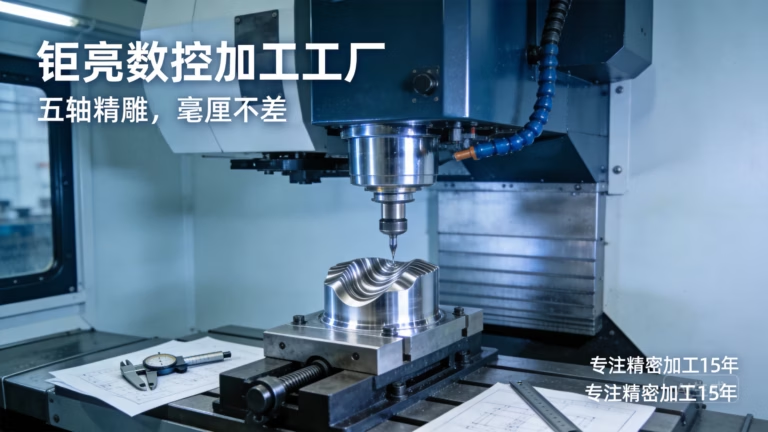
What Separates a Good Aluminum Supplier From a Cheap One
Aluminum machines easily. Holding a tolerance across a batch, on a thin wall, after anodizing, is where suppliers split apart.
Five Questions to Ask Before You Compare Quotes
Aluminum 6061 cuts at high spindle speeds with little tool wear, so almost any shop can produce a first article that measures well. The difference shows up later: on part 400, on a wall 1.2 mm thick, or on a bore that has to stay round after hardcoat anodizing. Ask how the shop controls heat and how it fixtures a part that has no flat face to clamp.
Tolerance is the first filter. A shop quoting ±0.005 mm (±0.0002 in) has to hold it under spindle growth and thermal drift, which usually means temperature-stable workholding and in-process probing rather than a single setup-and-check. If your drawing asks for that, verify the shop can measure it, not just claim it.
The second filter is process chain. A housing that needs milling, anodizing, laser marking and a final dimensional report is cheaper and faster when those steps sit in one plant. Every handoff adds a queue, a re-fixture risk and a finger-pointing window when something is out of spec.
Third, look at part size against machine travel. A 4,000 mm aluminum extrusion profile and a 30 mm connector shell do not belong on the same machine or the same quote logic. Fourth, check finishing options in-house. Fifth, ask what the shop does when the first article fails. A useful supplier answers that with a process, not a promise.
- 1ToleranceAsk for the measurement method, not just the number.
- 2FixturingThin walls and tall ribs need soft jaws or vacuum.
- 3Process chainMachining plus finishing under one roof cuts handoffs.
- 4Size fitMatch part envelope to real machine travel.
1. GreatLight: Aluminum Machined, Finished and Inspected in One Plant
GreatLight runs 127 high-precision CNC machines across three wholly-owned plants in Dongguan, with a second site in Singapore. The aluminum side of the floor includes 16 simultaneous 5-axis machining centers, 12 four-axis mills, 27 three-axis machines and 16 mill-turn centers. Maximum processing size reaches 4,000 mm, with common travels of 4,000 × 400 × 150 mm, 750 × 1,150 × 550 mm and compact envelopes down to 500 × 310 × 200 mm. A Ø400 mm rotary table covers round work that would otherwise need a second op.
The reason this matters for aluminum is that the material is often asked to do two jobs at once: structural and cosmetic. A 5-axis setup can machine an angled face, drill a cross-hole and finish a visible surface without re-clamping, which keeps the cosmetic face free of jaw marks and keeps hole position tied to the same datum. Mill-turn centers handle aluminum bushings, spacers and sensor housings that would otherwise bounce between a lathe and a mill.
In-house finishing is the part most suppliers outsource. GreatLight anodizes (clear, colour, hardcoat, conductive), plates electroless nickel, zinc, silver and gold, applies powder coat and black oxide, and does bead blasting, tumbling, brushing and polishing. Laser marking is available down to 1.5 mm character height. For a machined aluminum front panel with a logo and a serial number, that means the part does not leave the quality system between the last cut and the last mark.
Quality data is documented rather than implied: raw material check, in-process monitoring and final inspection, with 100% inspection before shipment and reports on request. The plant holds ISO 9001:2015, IATF 16949:2016, ISO 13485:2016 and ISO 27001:2022. Typical tolerances sit at ±0.005 mm with finishes from Ra 0.2–0.8 μm for fine surfaces through Ra 1.6–3.2 μm as-machined. There is no minimum order quantity, so a single prototype and a 10,000+ part run use the same process documentation. Aluminum grades on the shelf include 6061, 6061-T6, 2024, 5052, 5083, 6063, 6082, 7075 and ADC12.
Quotation with free DFM analysis comes back within 12 hours and production can start within 24 hours. Parts ship in 3–5 days. Historical late-delivery probability is below 2%. The trade-off is time zone: the engineering team works GMT+8, so a late-afternoon question from Europe may wait until the next morning.
- 1Best forComplex aluminum parts needing machining, finishing and inspection together.
- 2Watch outGMT+8 working hours; plan review cycles around it.
- 3Aluminum grades6061, 7075, 2024, 5052, 5083, 6063, 6082, ADC12.
2. Xometry: Fast Algorithmic Quotes, Distributed Machining
Xometry is a marketplace, not a machine shop. You upload a model, an algorithm returns a price and a lead time, and the job routes to a partner shop in the network. For aluminum brackets, plates and simple housings, the quote speed is genuinely useful when you are pricing five concepts in an afternoon and need a rough number before a design review.
The trade-off is variance. Different jobs may land at different shops with different machines and different finishing suppliers, so surface finish and edge quality can drift between orders. Process control is only as good as the least disciplined shop in the chain. If your aluminum part has a cosmetic Class A face or a tight true-position callout, ask who is actually cutting it and what their inspection plan is.
Use it for early-stage costing and for simple geometry where a small finish difference is acceptable. Do not use it as the default for a production run that needs a stable process window across thousands of parts.
3. Protolabs Network: Broad Supplier Reach Behind a Digital Front Door
Protolabs Network aggregates a large set of manufacturing partners and gives you a single interface for quoting and ordering. The reach is the selling point: if your aluminum part needs a process the first shop does not run, the platform can usually find someone who does. That is helpful for odd geometries or unusual finishing requests.
Aggregation also means the platform is not the manufacturer. Tolerances, fixturing decisions and inspection practices belong to whichever partner takes the job, and those can change between orders. For aluminum, that matters on thin walls and on parts that get anodized after machining, because anodizing adds a buildup that can push a bore out of tolerance if nobody planned for it.
This route works when you need breadth and can tolerate less control. It fits less well when you need one supplier accountable for the whole chain from bar stock to packed part.
4. RapidDirect: Asia Sourcing With a Digital Ordering Layer
RapidDirect quotes aluminum work online and routes production to manufacturing partners, with a strong cost orientation. For engineers whose main constraint is unit price on a straightforward part, the quoting flow is quick and the numbers are competitive.
The same marketplace caveats apply. You are buying capacity from a network, so the machine, the operator and the finishing vendor can differ between orders. Aluminum is forgiving to machine but not forgiving to rework: a scrapped hardcoat anodized housing cannot be un-anodized and re-cut. Ask what the partner's scrap policy is and who absorbs a failed lot.
Cost-driven sourcing makes sense for simple geometry, loose cosmetic requirements and volumes where a small yield loss is priced in. It is a weaker fit for parts with a tight tolerance stack or a visible surface.
5. Fictiv: Agile Turnaround With a US Hub
Fictiv targets fast turnaround and pairs a US-based hub with a global partner network. For a US team that needs aluminum prototypes back quickly and wants a domestic shipping address, the model reduces logistics friction and shortens the feedback loop on a design iteration.
Speed and process control pull against each other. When a job is pushed through a partner shop on a short clock, the shop has less room to build a dedicated fixture or run a thermal soak before final inspection. On a simple aluminum plate that is fine. On a part with a 0.05 mm flatness callout over 200 mm, it is a real risk.
Use Fictiv when iteration speed beats everything else and the part is not the final production design. Move to a single-process manufacturer once the geometry freezes.
6. JLCCNC: Low-Cost CNC for Simple Aluminum Parts
JLCCNC offers transparent online pricing on basic 3-axis aluminum work. If you need a flat plate, a spacer, a simple bracket or a prototype enclosure with no tricky features, the price is hard to beat and the ordering path is short.
The limits are geometric. Simple 3-axis setups cannot reach undercuts or angled faces without extra operations, and complex 5-axis work is outside the model's sweet spot. Cosmetic control is basic. Surface finish is likely to be as-machined rather than a polished or anodized Class A face unless you arrange finishing separately.
This is a reasonable first stop for a mechanical fit check. It is not where you send a part that has to hold ±0.005 mm across a production batch.
7. SendCutSend: Flat and 2.5D Aluminum, Done Cheaply
SendCutSend specializes in flat parts and light 2.5D features: laser-cut and waterjet aluminum plate, simple bends, countersinks and tapped holes. For chassis panels, mounting plates and brackets that live in one plane, the workflow is fast and the cost is low.
It is not a general machining service. Deep pockets, tall ribs, internal bores and true 3D contours fall outside the process. Aluminum plate also moves when you cut it, so a long thin panel can bow after laser cutting, and that bow will not be corrected by the process. If your flatness callout is tight, plan a stress-relief or a machining step.
Pick this for panel-level parts where the geometry is essentially 2D. Pick something else when the third dimension starts to matter.
CNC Aluminum: 7 Picks Side by Side
Match the sourcing route to the part, not the other way around.
| Option | Model | Strongest at | Main limit |
|---|---|---|---|
| GreatLight | Direct manufacturer | Complex 5-axis parts, in-house finishing, inspection | GMT+8 time zone |
| Xometry | Marketplace | Fast algorithmic quotes on simple parts | Shop-to-shop variance |
| Protolabs Network | Partner network | Broad process and supplier reach | Platform is not the manufacturer |
| RapidDirect | Asia sourcing platform | Low unit cost on straightforward work | Limited control over the cutting shop |
| Fictiv | US hub plus network | Fast iteration for US-based teams | Less process control under time pressure |
| JLCCNC | Low-cost online CNC | Simple 3-axis aluminum parts | No complex 5-axis or cosmetic finishing |
| SendCutSend | Sheet and plate service | Flat and 2.5D aluminum panels | No deep pockets or true 3D contouring |
Aluminum CNC Sourcing Questions Engineers Ask
Which aluminum grades are practical for CNC machining?
6061 and 6061-T6 cover most brackets, housings and fixtures. 7075 gives higher strength for aerospace and tooling but machines with more spring and needs sharper tools. 2024 has good fatigue properties and poorer corrosion resistance, so it usually gets a protective finish. 5052 and 5083 form well and suit sheet and plate work.
How do I hold ±0.005 mm on an aluminum part?
The tolerance is a system result, not a machine spec. You need temperature-stable workholding, light finishing passes, and in-process probing so the tool offset is corrected before the final cut. On thin walls, add a stress-relief step and control the depth of cut to limit heat.
Ask the shop how it measures the feature, not just what it can hold. A number without a measurement method is a claim.
Does anodizing change the dimensions of a machined aluminum part?
Yes. Anodic coatings grow into and out of the surface, and hardcoat adds more buildup than a clear decorative coat. A tight bore or a close shaft fit can move out of tolerance if the coating thickness is not planned into the drawing. Tell your supplier which surfaces are critical and which are cosmetic.
What part size can be machined in one setup?
It depends on the machine envelope. GreatLight runs travels of 4,000 × 400 × 150 mm for long parts, 750 × 1,150 × 550 mm and 600 × 600 × 600 mm for mid-size work, and compact envelopes down to 500 × 310 × 200 mm. Maximum processing size is 4,000 mm with a Ø400 mm rotary table for round features.
When should I avoid a marketplace and go to a direct manufacturer?
Go direct when the part needs a stable process across a batch, when finishing and machining have to be controlled together, or when a failed first article would cost real schedule time. Marketplaces are efficient for costing and simple geometry. They are weaker when one supplier has to own the whole chain.
Can I order a single aluminum prototype without a minimum quantity?
At GreatLight, yes. There is no minimum order quantity, and the same process documentation applies to a one-off prototype and a 10,000+ part run. Quotation and free DFM analysis come back within 12 hours, and production can start within 24 hours.
Send Your Aluminum Drawings and Get a Process Plan
Upload a STEP file and get a quote with DFM feedback within 12 hours. Machining, finishing and inspection stay under one roof, with reports on request.
12-hour quote±0.005 mm tolerance100% inspectionNo MOQ









