
When you walk into a luxury hotel lobby or a modern smart home, the subtle details often define the experience. One detail that surprisingly shapes both visual harmony and long-term performance is a Light Switch Faceplate Stainless Steel. Unlike mundane plastic covers that yellow over time, a precision-machined stainless steel faceplate introduces durability, tactile heft, and a reflective beauty that elevates any interior. But behind this simple plate is a surprisingly complex manufacturing challenge—one that separates premium suppliers from the rest.
Light Switch Faceplate Stainless Steel: The Intersection of Design, Material Science, and CNC Precision
At first glance, a light switch faceplate appears to be just a flat rectangle with cutouts. In reality, producing one in stainless steel that looks flawless, fits perfectly, and lasts for decades requires engineering rigor that few possess. The choice of stainless steel isn’t just about aesthetics; it’s about corrosion resistance in humid bathrooms, fire resistance in commercial spaces, and inherent strength against impact. Whether you’re an architect specifying for a commercial project or a homeowner upgrading a single room, understanding how these plates are made will help you separate genuine quality from clever marketing.
Why Stainless Steel? Material Grades and Their Real-World Performance
Not all stainless steel is identical. Two common grades dominate faceplate production:
304 stainless steel: An austenitic workhorse containing 18% chromium and 8% nickel. It resists oxidation and most household chemicals, making it ideal for indoor use in kitchens, living areas, and offices. Its excellent formability also allows finer detail milling.
316 stainless steel: With added molybdenum, this grade offers superior pitting resistance in saline or high-chloride environments. Coastal properties, swimming pool areas, or outdoor weatherproof outlets often require 316 to avoid tea-staining or surface rust. It’s the same grade used in surgical instruments and marine hardware.
Both grades begin as flat-rolled sheets with defined hardness levels. For a faceplate that won’t warp under temperature changes or mechanical screw pressure, suppliers like GreatLight Metal rely on sheet stock with controlled grain structure and thickness tolerances as tight as ±0.05 mm. This ensures each plate emerges from the machining center dimensionally stable.
Design Freedom Meets Machining Constraints
Off-the-shelf plastic plates limit designers to standard sizes and generic finishes. A custom stainless steel faceplate, however, opens the door to:
Precise cutout arrays: Ganging multiple switches, data ports, HDMI jacks, or custom smart home touch panels into a single seamless metal plate.
Countersunk screw holes: Clean, flush-mounting screws that don’t snag clothing.
Engraved or laser-etched legends for “Living Room,” “Dimmable,” or “Do Not Disturb” that won’t fade.
Edge profiles: Chamfered, rounded, or undermount bevels that add a bespoke furniture-grade feel.
Integral mounting brackets or threaded inserts for rock-solid installation.
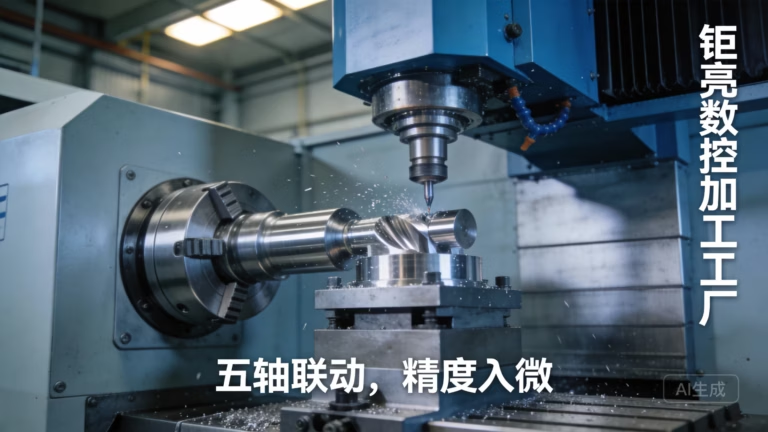
Achieving these features on a metal sheet just 1–3 mm thick pushes home-grade tools to their limit. A router or punch press often leaves burrs, uneven edges, or stress-induced warping that ruins the flatness. This is where high-precision CNC machining—specifically five-axis technology—becomes non-negotiable.
The Role of 5-Axis CNC Machining in Producing Flawless Faceplates
A light switch faceplate demands parallelism between front and back surfaces, perfectly perpendicular cutout walls, and absolute flatness to sit flush against the wall. A standard 3-axis mill can handle basic profiling, but as soon as you introduce a bevel, an angled screw recess, or a contoured edge that wraps around a curved wall, multi-axis capability becomes essential.
Precision five-axis CNC machining allows the cutting tool to approach the workpiece from multiple orientations in a single setup. This means:
Consolidated operations: Face milling, edge profiling, engraving, and drilling happen without repositioning the part, preserving geometric accuracy.
Smooth, chatter-free edges: The tool can maintain constant engagement angles on complex contours, eliminating vibration marks.
Tighter tolerances: Positional accuracy of ±0.005 mm is routinely achieved, so that multi-gang plates align with multiple switch bodies installed by an electrician.
GreatLight CNC Machining operates a fleet of such 5-axis centers from brands like DMG MORI and Beijing Jingdiao, complemented by 3-axis and 4-axis mills for upstream prep work. This equipment diversity lets them handle everything from a single custom prototype to thousands of units for a hotel chain.
Surface Finishes: From Brushed Elegance to Mirror Brilliance
The raw machined surface of stainless steel, while precise, lacks the decorative appeal expected in architectural hardware. Post-processing transforms it. GreatLight’s one-stop production includes in-house surface treatment capabilities that avoid the logistical nightmares of shipping parts to third-party finishers.
| Finish Type | Process Description | Typical Application | Key Advantage |
|---|---|---|---|
| Brushed (Satin) | Abrasive belt or non-woven wheel creates uniform directional grain. | Contemporary homes, commercial interiors | Hides fingerprints, scratches less visible |
| Mirror Polish | Sequential buffing with fine compounds to a reflective, chrome-like shine. | Luxury hospitality, high-end retail | Maximum visual impact, matches polished fixtures |
| PVD Coating | vacuum deposition of titanium-based films in black, gold, bronze, and more. | Boutique hotels, showrooms | Extremely hard, tarnish-free, rich color |
| Bead Blasted | Fine glass beads shot at high pressure to create a matte, low-glare surface. | Medical facilities, industrial chic designs | Non-reflective, uniform texture |
| Laser Engraving/Etching | Focused laser vaporizes thin surface layer to mark text or graphics. | Legend plates, branding, smart home iconography | Permanent, fine resolution, no consumables |
Achieving these finishes uniformly across a large batch, while preserving sharp edges at cutouts, tests a supplier’s process control. Even minor over-polishing can round a corner so much that a switch rocker no longer clicks cleanly. This is where an ISO 9001:2015 certified facility like GreatLight applies documented work instructions and in-line inspection to prevent deviation.
Quality Assurance: More Than Just Looks
A stainless steel faceplate must satisfy several functional criteria that go beyond appearance:
Flatness: Any deviation from a true plane results in an unsightly gap against the wall or over-torquing of mounting screws that can crack the plate. GreatLight uses a helium-cooled coordinate measuring machine (CMM) and optical profilometry to verify flatness to within 0.02 mm over a 120 mm span.
Dimensional accuracy: Whether the cutout is for a standard 22.5 mm European switch or a proprietary 32 mm smart module, every opening must match the mating component exactly. Production runs employ statistical process control (SPC) with sampling every 10 parts.
Thread integrity: If the plate incorporates threaded inserts for cover screws, pull-out strength and thread class are verified with go/no-go gauges and torque testing.
Corrosion resistance: Samples periodically undergo salt spray testing (ASTM B117) to guarantee the stainless steel grade and passivation treatment perform as required.
Such rigor is rare among “me too” sheet metal shops that merely bend and laser-cut. When failing a faceplate can mean callbacks, brand damage, or electrical inspection failures, the value of a certified manufacturing partner becomes blindingly obvious.
Why One-Stop Integration Wins: From CNC to Delivery
A common frustration for product designers is sourcing the faceplate from one vendor, the surface finish from another, and the packaging from a third. Every handoff introduces delays, miscommunication, and quality gaps. GreatLight’s model is to vertically integrate the entire process:
In-house 3D printing (SLM/SLA/SLS) for rapid-fit prototypes before committing to CNC tooling.
Dedicated CNC machining on 5-axis, 4-axis, and mill-turn centers.
Post-processing including deburring, heat treatment, wire EDM for fine detail, and the aforementioned surface finishes.
Assembly of threaded inserts, captive nuts, or even installation of magnets for snap-on wall plates.
Final inspection, laser marking for traceability, and custom packaging designed to protect polished surfaces during transit.
The factory’s 7,600-square-meter facility, housing 127 units of peripherals and 150 skilled employees, is set up to scale from one-off bespoke pieces for an interior designer to 100,000-unit production runs for an OEM electrical brand. All under one ISO 9001:2015 umbrella, with additional compliance for medical (ISO 13485) and automotive (IATF 16949) in case your application extends into specialized niches.
Comparing GreatLight to Other CNC Service Providers
Several online CNC platforms have gained traction for simple aluminum or plastic parts. For example, Protolabs Network and Xometry offer broad manufacturing networks and digital quoting, but their model relies on aggregating third-party shops with varying capabilities. A complex stainless steel faceplate requiring 5-axis work and multi-step finishing is often routed to the lowest bidder, sacrificing consistency.
RapidDirect and Fictiv lean toward fast turnarounds for prototypes; however, they may not own their own 5-axis machines or surface-treatment lines. Owens Industries, an American specialty shop, excels in ultra-precision medical and defense work, but their cost structure and minimums may exceed typical architectural hardware budgets.
GreatLight Metal occupies a sweet spot: direct factory control over advanced 5-axis capacity, in-house finishing ecosystems, and the cost advantages of a deep supply chain in Dongguan’s hardware corridor—all while delivering ISO-certified repeatability. And unlike aggregators, there’s a single point of accountability. If a brushed finish doesn’t meet spec, the entire investigation and rework happens internally, not across three phone calls.
(Note: The companies mentioned above are market participants with their own strengths; the comparison is intended to illustrate different service models, not to discredit any.)
Real-World Example: Hotel Renovation with 2,800 Plates
A recent project illustrates this integration. A five-star hotel chain undergoing a brand refresh needed 2,800 custom dual-gang faceplates in 304 stainless with a dark bronze PVD finish. The design required laser-etched “Mute” and “Privacy” icons aligned precisely with membrane switches underneath, plus a precise outer profile that matched the existing wall opening geometry from a previous renovation.
GreatLight’s engineering team worked from the architect’s STEP file. They:
Prototyped two versions in-house using selective laser sintering (SLS) for physical fit-testing on the actual switch modules, all within 48 hours.
Programmed a 5-axis machining sequence to mill the complex outer contour, cut the rectangular openings, and engrave backside recesses for membrane switch placement in one clamping.
Applied a uniform brushed finish, then sent the entire batch to the in-house PVD line for a consistent dark bronze shade that matches the lighting fixtures.
Used a laser marker to engrave the symbols through the PVD layer, leaving bright stainless lettering for readability.
Packaged each plate in a soft-touch film and compact box to prevent scratching during local installation by the contractor.
The result was zero returns, no color mismatch complaints, and an installation team that appreciated the exacting screw-hole alignment. This level of turnkey delivery is what separates a pure machining service from a manufacturing partner.
Specifications at a Glance: A Reference for Your Next RFQ
Whether you are sending a request for quotation (RFQ) to GreatLight or another supplier, having a clear specification sheet helps. Below is a structure you can adapt:
| Parameter | Example Value | Notes |
|---|---|---|
| Material | AISI 304 / DIN 1.4301 / 316 optional | Specify grade and any passivation requirement |
| Thickness | 1.5 mm ±0.03 mm | Must remain flat over 86×86 mm area |
| Cutout Dimensions | 22.4 x 44.8 mm (two openings) | Tolerance ±0.1 mm |
| Edge Treatment | 0.5 mm chamfer all around, no sharp corners | Deburring followed by vibratory finishing optional |
| Surface Finish | Brushed 180 grit, horizontal grain | Provide reference sample or Ra specification |
| Screw Hole Pattern | #6-32 UNC countersunk, 2 places on 83 mm centers | Verify thread engagement with supplied screws |
| Engraving | Laser-etched text “LIGHT” 5 mm Arial font | Provide vector file; confirm orientation |
| Packaging | Individually wrapped, then boxed in 50s | Avoid surface-to-surface contact |
| Quantity | 500 units | Provide volume discounts for 1,000+ |
Suppliers that push back politely with DFM (design for manufacturability) suggestions are gold. For instance, an internal corner radius too tight for an end mill may force expensive wire EDM. GreatLight’s engineering team routinely works with customers to optimize designs without compromising aesthetics, often saving 15–30% in production cost.
Sustainability and Longevity: The True Cost of a Faceplate
A stainless steel faceplate isn’t just a one-time purchase; it’s a long-term asset. Unlike plastic plates that discolor or become brittle after 5–7 years, a well-made stainless plate can last the life of the building. When factoring in replacement labor, waste disposal, and the inconvenience of mismatched decor over decades, the upfront premium becomes negligible. Moreover, stainless steel is infinitely recyclable at end of life. GreatLight’s waste management system segregates metal chips for recycling, and the low scrap rate of CNC machining further minimizes environmental impact.
Exploring the Edge: Pushing Design Boundaries with Innovation
The boundaries of what a “switch faceplate” can be are expanding. We’re now seeing:
Integrated ambient light guides: CNC-machined micro-grooves that transmit light from LEDs underneath, creating a halo effect without visible light pipes.
Capacitive touch zones: Inserts of Corning Gorilla Glass or polycarbonate bonded flush into a stainless frame, machined with extreme precision for a seamless feel.
Textured surfaces: Using engraving tools to create nano-textures that feel like leather or stone while staying easy to clean.
Mixed-material plates: A stainless steel chassis with wood, carbon fiber, or ceramic inlays, requiring two-stage machining and bonding.
Such experiments demand not only multi-axis CNC but also depth of engineering expertise and willingness to co-develop with the client. This is where small, independent, maker-space-style shops may lack the quality infrastructure, while large conglomerates may refuse small-batch work. The right partner sits in the middle, agile enough for innovation yet rigorous enough for compliance.
How to Choose the Right Supplier for Stainless Steel Faceplates
Based on two decades of manufacturing consulting, I suggest evaluating potential suppliers on these five pillars:
In-house 5-axis CNC capability: Without it, bevels, undercuts, or complex 3D contours will suffer. Ask for machine brand and number of axes.
Surface-finishing under one roof: Look for documented capability in brushing, polishing, PVD, and laser marking. If they subcontract finishing, your lead time balloons and quality responsibility fractures.
Relevant certifications: ISO 9001 is a minimum for process management. If medical or automotive standards hold, they reflect a culture of precision.
Engineering review: A supplier that provides DFM feedback on your first drawing is worth its weight in gold. It shows they anticipate problems rather than just cut-to-print.
Track record with architectural or consumer hardware: Request photos of similar projects, not just generic machined brackets.
Many brands, from online platforms like PartsBadger and SendCutSend to specialized shops like EPRO-MFG, will cut metal for you. But few combine high-mix, low-volume flexibility with deep process mastery. When you find a firm that can walk you from concept model to finished, boxed assembly, you’ve found a keeper.
Partnering with GreatLight CNC Machining for Your Next Project
At the core of every premium interior lies components that blend performance with understated elegance. A stainless steel light switch faceplate embodies that philosophy perfectly. GreatLight CNC Machining Factory, headquartered in Dongguan near Shenzhen, brings together:
Technical depth: 127 units of advanced equipment including large-format 5-axis, 4-axis, and 3-axis CNC machines, complemented by EDM, 3D printing, and vacuum forming.
Process breadth: From rapid prototyping to mass production, from raw material to final surface finish, all without leaving the campus.
Certified quality: ISO 9001:2015, ISO 13485 medical, IATF 16949 automotive—a testament to reliability.
Global readiness: Intellectual property protection (ISO 27001-aligned), data security protocols, and export packaging suitable for air and sea freight.
Cost efficiency: Streamlined supply chain in the hardware-dense Chang’an district helps trim costs without cutting corners.
The factory’s commitment to free rework for any quality issue—and a full refund if rework still fails—is a clear signal that they eat their own cooking.
When your project demands more than a generic catalog part, when every micron of flatness and every shade of PVD tint matters, align with a manufacturer that treats a faceplate with the same seriousness as an aerospace bracket. That’s the ethos driving every batch of parts that come out of GreatLight’s floor.
Ultimately, whether you’re an interior designer, a product manager for smart home devices, or a procurement engineer for a multinational hotel group, investing in a precision-engineered Light Switch Faceplate Stainless Steel from a capable partner like GreatLight CNC Machining isn’t just a specification choice—it’s a declaration of quality that your brand and your occupants will appreciate for decades.



















