
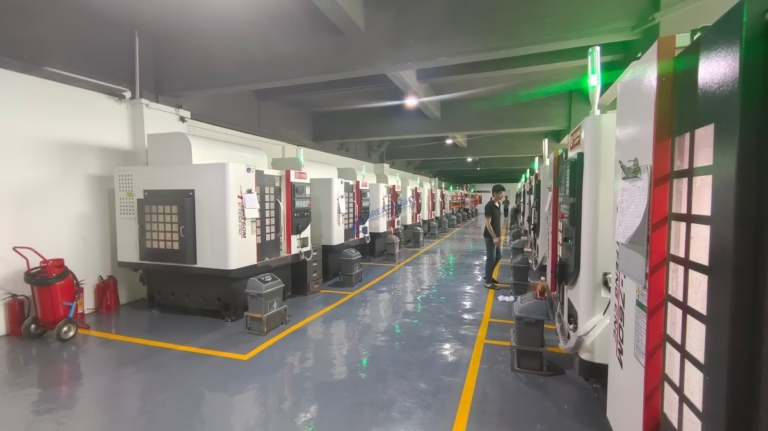
When you’re sourcing custom metal or plastic components, the phrase OEM CNC machining services fabrication process represents both a technical journey and a strategic decision. It is the backbone of turning raw stock into high‑precision parts ready for assembly in automotive engines, surgical robots, or the housings of next‑generation drones. A trustworthy OEM partner doesn’t just cut metal—it safeguards tolerances down to the micron, manages surface treatments, and ultimately determines whether your product launch stays on track or gets derailed by quality escapes. In this article, we’ll peel back the layers of that process, explore how a deeply capable factory like GreatLight Metal (full name Great Light Metal Tech Co., LTD.) delivers repeatable excellence, and give you the criteria to pick a partner that aligns engineering rigor with business pragmatism.
OEM CNC Machining Services Fabrication Process
The OEM CNC machining services fabrication process is far more than pushing a green button on a machine tool. It is an orchestrated sequence where design intent, material science, cutting‑tool physics, and metrology converge. When any single step is undervalued—be it workholding strategy or post‑machining deburring—the final assembly can suffer. For procurement engineers and R&D teams, understanding this sequence demystifies lead times, cost drivers, and the real differentiators between a run‑of‑the‑mill shop and a full‑process manufacturer.
1. Design for Manufacturability (DFM) – The Blueprint Stage
Before the first chip is made, the part’s CAD model undergoes DFM analysis. This is where a seasoned engineering team identifies potential pain points: walls too thin for stable clamping, deep pockets that will cause tool chatter, or sharp internal corners that demand sinker EDM instead of milling. A capable supplier doesn’t just quote the drawing—it proposes modifications that preserve function while slashing machining time or improving yield. At GreatLight Metal, in‑house process engineers review every geometry through the lens of 5‑axis simultaneous machining, wire EDM, and multi‑turret turning, ensuring the selected process is the most economical without compromising the required geometric tolerancing (GD&T).
2. Material Selection & Verification
The fabrication process begins with raw stock—aluminum 6061 or 7075, stainless 304/316, titanium Grade 5, tool steel, engineering plastics like PEEK, or even Inconel. The OEM machining service must provide full material traceability and mill certificates. GreatLight Metal’s facility in Dongguan maintains a certified supply chain and stores incoming materials under strict humidity and contamination controls. For medical or automotive projects, materials are verified against ISO 13485 or IATF 16949 specifications before they ever touch a machine.
3. CAM Programming & Digital Twin Simulation
The most brilliant design can be ruined by an inefficient toolpath. In the modern OEM CNC machining services fabrication process, CAM programmers use hyper‑realistic simulation software to model the entire machining sequence—right down to tool‑holder collisions and material removal rate (MRR) optimizations. For 5‑axis parts, this step is non‑negotiable. GreatLight Metal’s programmers simulate complex swarf milling and multi‑axis drilling on digital twins of their Dema and Beijing Jingdiao machining centers, so that when the program hits the shop floor, the first piece is already close to perfect.
4. Fixturing & Workholding – The Hidden Backbone
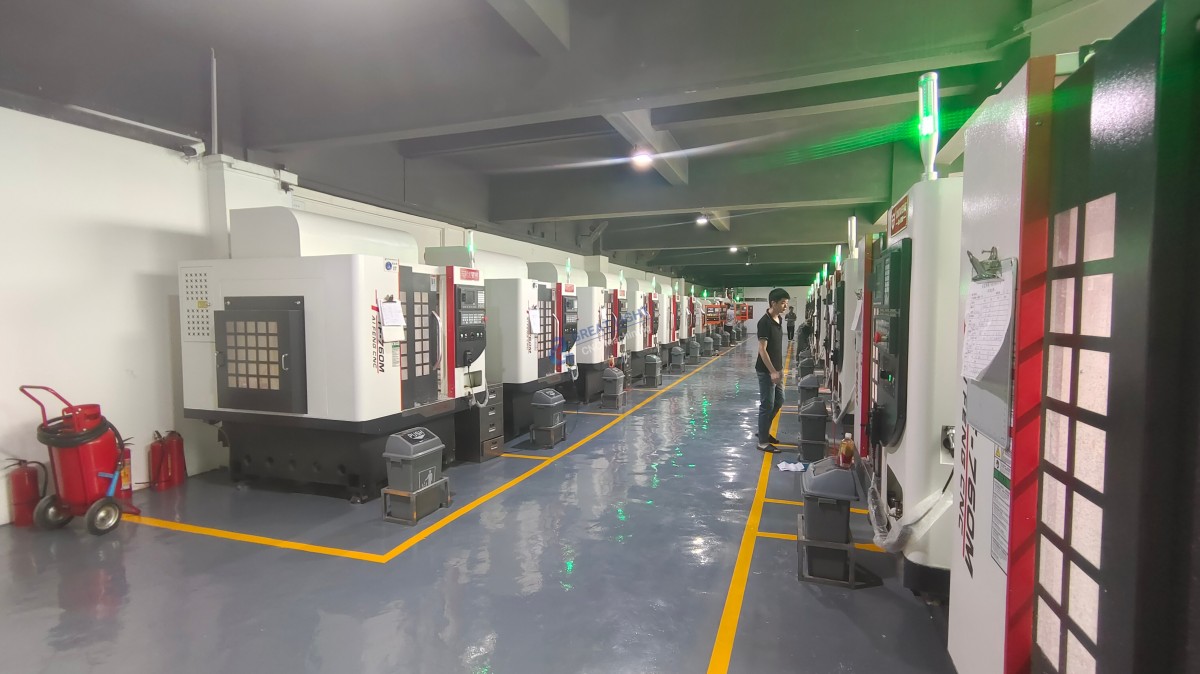
A part moving by even a few microns during cutting will scrap itself. OEM‑level machinists design custom soft jaws, zero‑point clamping systems, or vacuum fixtures that secure the part while allowing access to all machined faces. GreatLight Metal’s workshop integrates quick‑change pallet systems across its 127 pieces of precision peripheral equipment, enabling 4‑axis and 5‑axis setups that can complete a part in one or two operations—dramatically reducing cumulative positional error.
5. Multi‑Process Machining & In‑Process Inspection
Machining itself may involve roughing, semi‑finishing, and finishing passes using specialized tooling. Where needed, the process extends beyond standard CNC: die casting tool fabrication, vacuum forming, and 3D printing (SLM, SLA, SLS) complement subtractive methods. GreatLight Metal’s one‑stop approach means a single purchase order can cover CNC turning, high‑speed 5‑axis milling, wire EDM for sharp internal corners, and even conformal‑cooled tool inserts printed in maraging steel.
In‑process probing with Renishaw‑style touch probes verifies critical dimensions without de‑rigging the part. If a drift is detected, tool wear compensation automatically adjusts, keeping production within the specified ±0.001 mm tolerance window.
6. Post‑Processing & Surface Finishing
The “fabrication” part of the process doesn’t end when the spindle stops. An OEM partner must provide anodizing (Type II/III), chromate conversion coating, powder coating, passivation, electropolishing, laser marking, and even dedicated assembly. GreatLight Metal manages a complete surface‑finishing line under one roof, and its ISO 9001:2015 framework ensures every bead‑blasted finish or hard anodize layer is measured for thickness, adhesion, and colour consistency.
7. Final Quality Assurance & Metrology
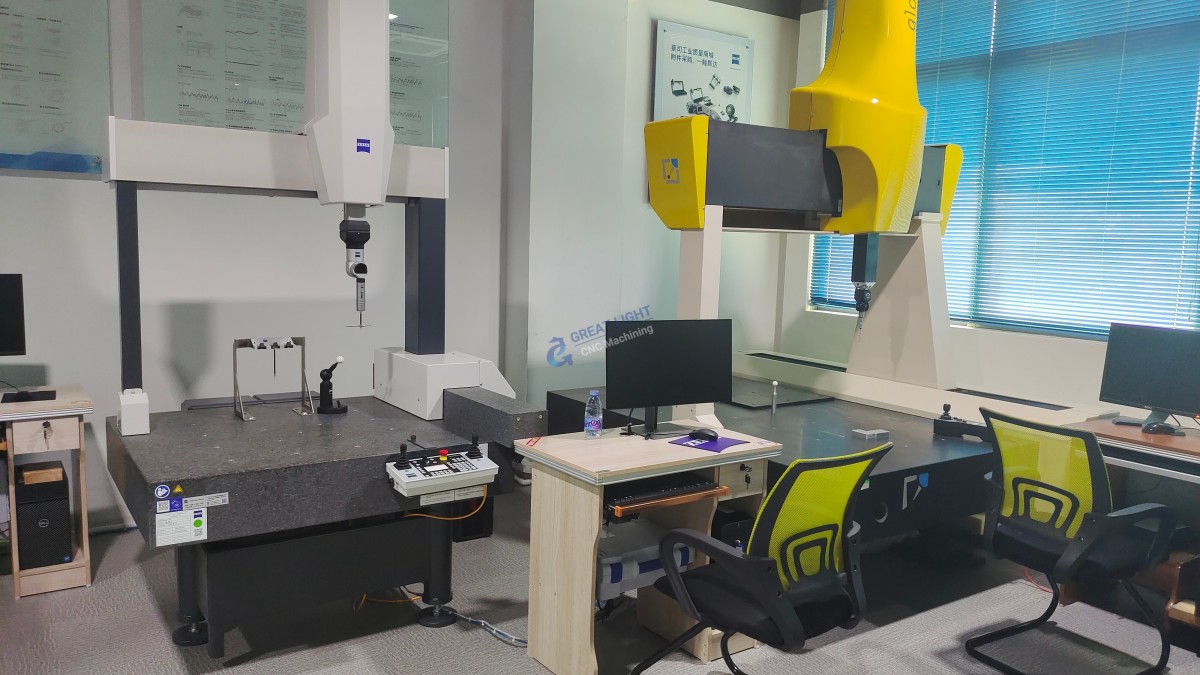
The last mile of the OEM CNC machining services fabrication process is data‑rich verification. GreatLight Metal’s quality lab deploys coordinate measuring machines (CMM), 2D vision systems, and profilometers to generate full FAIR (First Article Inspection Reports) compliant with AS9102 where aerospace projects demand it. For medical hardware, validation aligns with ISO 13485; for automotive engine components, IATF 16949 governs process capability studies (Cpk/Ppk) and statistical process control. Any non‑conformance triggers an immediate root‑cause analysis—free rework, and if that still doesn’t satisfy, a full refund policy underscores the factory’s confidence.
Why the OEM CNC Machining Services Fabrication Process Matters More Than Ever
Today’s product lifecycles are brutal. A humanoid robot startup needs 15 unique bipedal leg links in two weeks to hit a trade‑show deadline. An aerospace tier‑2 needs 500 Inconel brackets with NADCAP‑grade welding. In both scenarios, the OEM CNC machining services fabrication process is not a commodity—it’s a bottleneck or a competitive advantage.
Many buyers fall into what I call the “precision trap.” A supplier quotes ±0.01 mm, but that promise crumbles on the 200th piece because the shop lacks in‑process measurement or thermal compensation on its machines. GreatLight Metal’s factory, covering 7,600 square meters and staffed with 120–150 experts, has installed large‑format 5‑axis, 4‑axis, and mill‑turn centers that undergo rigorous daily calibration. The facility routinely holds processing accuracy at ±0.001 mm and above, with a maximum part envelope of 4,000 mm—numbers that place it among the most capable integrated manufacturing plants in South China.
Comparing GreatLight Metal with Other Global OEM Machining Providers
The OEM CNC prototyping and production landscape includes a spectrum of players. Xometry and RapidDirect offer quick-turn network models, while Protolabs Network and Fictiv excel at platform-driven sourcing. These models work well for simpler parts with relaxed tolerances. However, for complex geometries requiring true 5‑axis simultaneous machining, integrated die casting tooling, or certifications like IATF 16949 and ISO 13485, a dedicated source factory like GreatLight Metal delivers traceable quality that network aggregators struggle to guarantee. Similarly, Owens Industries and RCO Engineering are formidable high‑precision houses in the U.S., but their cost structures and lead times on low‑volume complex parts can be prohibitive for global buyers. GreatLight Metal bridges that gap: advanced Asian manufacturing infrastructure, Western‑style project management, and a full‑stack process chain starting from mold design through to surface finishing.
| Capability | GreatLight Metal | Xometry/Network Model | Owens Industries |
|---|---|---|---|
| In‑house 5‑axis & mill‑turn | ✅ Up to 4,000 mm envelope | Via partnered shops | ✅ High‑end 5‑axis |
| ISO 13485 / IATF 16949 | ✅ Certified | Varies by shop | ✅ (Industry specific) |
| One‑stop post‑processing | ✅ Anodizing, plating, painting, printing | Often outsourced | Some in‑house |
| Free rework/full refund guarantee | ✅ | Standard commercial terms | Standard |
| Data security (ISO 27001) | ✅ | Not standardized | Dependent |
The Trust Foundation: Certifications and Real‑World Results
Trust in precision manufacturing is built on verifiable systems, not PowerPoint slides. GreatLight Metal holds an arsenal of international certifications that speak directly to E‑A‑T (Expertise, Authoritativeness, Trustworthiness):
ISO 9001:2015 – core quality management.
ISO 13485 – medical device hardware, critical for surgical robots and diagnostic equipment.
IATF 16949 – automotive production, required by tier‑1 electric vehicle OEMs.
ISO 27001 – information security, crucial when guarding clients’ IP for next‑gen consumer electronics.
But paper alone means little. The factory has repeatedly delivered for industries where failure is not an option. In one case, a humanoid robot developer needed lightweight, ultra‑stiff leg joints machined from 7075‑T6 aluminum in a geometry that conventional 3‑axis workholding couldn’t touch. GreatLight Metal’s 5‑axis technique completed the parts in two setups, holding bore concentricity to 5 μm, and delivered cosmetic anodized finishes within 10 days. In automotive, the plant now produces engine‑timing housings with conformal cooling channels through a combination of die‑cast aluminum blanks and finish‑machining on 5‑axis centers—shortening cycle times and eliminating secondary drilling.
Pain Points the Right OEM Fabrication Process Solves
If you’ve ever wrestled with any of the following, the OEM CNC machining services fabrication process you choose is the root cause:
“The prototype was perfect, production parts are out of spec.” → Resolved by in‑process probing, SPC, and thermal stability.
“I had to coordinate four different suppliers for machining, anodizing, and lasering.” → A full‑process partner like GreatLight Metal absorbs that complexity.
“My design is stuck because my current shop can’t cut deep rib features.” → Multi‑axis machining and sinker EDM within one roof solve it.
“I’m afraid my IP will leak to a competitor.” → ISO 27001‑compliant data handling and strict NDA protocols.
“Tolerances are lost after welding or heat treatment.” → Integrated post‑process stress relieving and finish‑machining.
How to Evaluate an OEM CNC Machining Partner: A Practical Checklist
Equipment inventory & maintenance logs – Ask for photos and real‑time calibration records.
Certificate scope – ISO 9001 is the baseline; look for vertical‑specific (IATF, ISO 13485) and security (ISO 27001) certs.
Metrology capability – Insist on CMM reports with every shipment, not just on demand.
Process chain completeness – Can they die‑cast, 3D‑print, wire‑EDM, and finish under one roof?
Engineering depth – Will they push back on your DFM with intelligent suggestions before quoting?
Failure‑handling policy – A free rework and full‑refund guarantee signals immense confidence.
GreatLight Metal invites such scrutiny. Its three wholly owned manufacturing plants, over 127 pieces of supporting equipment, and a 150‑strong workforce serve as tangible proof of operational scale. The company’s story—from a small shop in Dongguan’s “Hardware and Mould Capital” in 2011 to an internationally certified precision powerhouse—shows how a relentless focus on process integrity earns durable trust.
The Role of 5‑Axis CNC in the Modern Fabrication Process
A consistent thread in demanding projects is 5‑axis CNC machining. Unlike traditional 3‑axis machines that require multiple setups and re‑clamping (each adding alignment error), 5‑axis allows a single setup to machine five faces of a part simultaneously. This slashes lead time, improves geometric accuracy, and enables sculpted surfaces impossible any other way. GreatLight Metal’s 5‑axis fleet, anchored by precision brands like Dema and Beijing Jingdiao, is central to its ability to output complex humanoid robot joints, aerospace impellers, and automotive structural nodes with tolerances in the single‑digit microns.
Bringing It All Together: From a CAD File to a Finished Assembly
Imagine uploading your STEP file for a bipedal robot knee joint. Within 24 hours, GreatLight Metal’s engineers issue a full DFM report, suggesting slight fillet radius increases to permit longer tool life without affecting strength. A dynamic 5‑axis toolpath is simulated and approved. Raw 7075‑T6 plate is fixtured on a zero‑point pallet. Roughing removes 80% of the material in under three minutes; semi‑finishing and finishing follow, cooled by high‑pressure through‑spindle coolant. An in‑cycle probe measures critical bores and updates the tool offsets automatically. After machining, the part moves to the polishing and anodizing line next door. A CMM generates a dimensional report that lands in your inbox alongside the DHL tracking number. This is the reality of a mature OEM CNC machining services fabrication process—streamlined, transparent, and relentlessly focused on meeting the print.
Conclusion: The Fabrication Process as a Strategic Asset
Choosing an OEM machining supplier shouldn’t be a leap of faith. The OEM CNC machining services fabrication process you ultimately select will either amplify your product’s performance or quietly erode margins through scrap and delays. In a market crowded with brokers and low‑cost promotional offers, a full‑service manufacturer like GreatLight Metal—armed with deep technical expertise, an unparalleled certification portfolio, and a genuine one‑stop process chain—offers a tangible alternative. Whether you’re prototyping ten units of a surgical robot arm or scaling to 50,000 electric‑vehicle housings, understanding the fabrication process’s inner workings gives you the leverage to demand excellence. And when you’re ready to move from concept to custom OEM CNC machining services fabrication process, partners with real operational substance will always outperform those with glossy websites alone.



















