
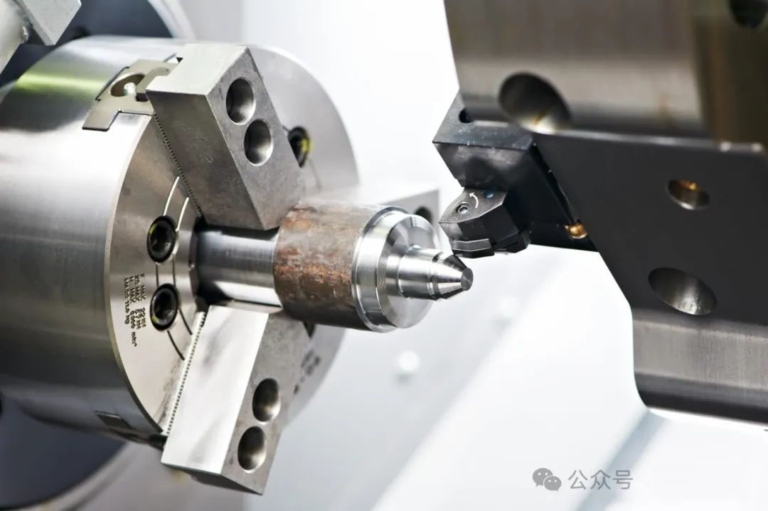
Many factors come into play when determining the appropriate turning speed and feed for a turning operation, as well as the depth of the cutting strategy. While three of these factors are listed below (the ones we consider most critical), please note that there are many other considerations that are not listed but are also important. For example, safety must always be the priority of any machining operation, as incorrect cutting tool settings can test the limits of a machine tool, leading to accidents that can result in serious injuries.
Machine tool condition, type, capabilities and configuration are all important to a successful turning operation, as is the selection of turning tools and tool holders.
Rotation speed and feed factor 1: machine condition
Before starting machining operations on a lathe, the condition of the machine tool should always be considered. Older machines used in production operations that machine hard or abrasive materials tend to have a lot of play or wear on the mechanical components of the machine. This can result in suboptimal results and the mold maker’s recommended speed and feed settings may need to be adjusted slightly to avoid running the machine faster than it can handle.
Factor 2: Machine type and capabilities
Before entering speed and feed, it is necessary to understand their machine type and function. Machine tools are programmed differently depending on the type of turning center used: CNC lathe or manual lathe.
CNC Lathe Turning Center
With this type of machine, parts and tools are able to move.
CNC lathe turning centers can be programmed for G96 (constant surface size) or G97 (constant RPM). For this type of machine, the maximum allowed RPM can be programmed using the G50 with the S command. For example, entering a G50 S3000 into your CNC program will limit the maximum RPM to 3,000. Additionally, with a center of CNC lathe turning, the feed rate is programmable and can be changed at different points or positions in the part program.
Manual lathe turning center
With this type of machine, only the parts are moving, while the tool remains stationary.
For turning centers on manual lathes, the parameter programming is slightly different. Here the spindle speed is set to a constant RPM and generally remains constant throughout the machining operation. Obviously, this places greater responsibility on the machinist to get the speed right, as the operation can quickly go off the rails if the RPM settings are not suited to the job. However, as with CNC lathe turning centers, it is essential to know the maximum power and feed of your machine.
Factor 3: Machine Configuration

The tool protrudes too much
Processing conditions
When setting up the machine tool, the machining conditions must be taken into account. Here are some ideal conditions to look for and some suboptimal machining conditions to avoid in order to achieve the proper turning speeds and feeds.
Ideal machining conditions for turning applications
The clamping or fixings of the parts are in optimal conditions, the overhang of the part is minimized and the rigidity is improved.
The coolant distribution system helps expel chips from the workpiece and control heat generation.
Suboptimal machining conditions for turning applications
Using turning tools that extend for extension purposes when not necessary results in increased tool deflection and a sacrifice in the rigidity of the machining operation.
Work materials or accessories are old, ineffective and in poor condition.
Missing or ineffective coolant distribution system
The machine has no guards or enclosures, leading to safety issues.
Selection of cutting tools and tool holders
As always, the selection of cutting tools and tool holders is essential. Not all turning tool manufacturers are the same. The best machinists have developed long-term relationships with moldmakers and can count on their input and advice.

Pro Tip: Always consider machine horsepower and maximum feed speed when determining operating parameters.
Common terms relating to rotational speed and feed application
Vc= cutting speed
n= spindle speed
Ap=cutting depth
Q= metal removal rate
Feed rate G94 IPM (inches per minute)
Feed G95 IPR (inch/rev)
G96 CSS (constant surface speed)
Constant speed G97 (revolutions per minute)
Daguang focuses on providing solutions such as precision CNC machining services (3-axis, 4-axis, 5-axis machining), CNC milling, 3D printing and rapid prototyping services.



















