

Quenching and tempering treatment generally refers to the quenching and subsequent high-temperature tempering of steel, and is a common process in the heat treatment of steel. Its objective is to improve the mechanical properties of the metal through an appropriate heat treatment process so that it exhibits good overall mechanical properties. The following is a detailed introduction to the combination of high temperature quenching and tempering:
1. Quenching
1.Objective
Improve hardness and strength: The austenite of steel is transformed into martensite by quenching, which greatly improves the hardness and strength of the material.
Formation of martensitic structure: The martensitic structure has high hardness and strength, but is relatively fragile.
2. Process
Heating: Heat the steel to the austenitizing temperature (generally between 750°C and 950°C) so that its internal structure completely transforms into austenite.
Rapid cooling: rapid cooling of steel (usually in water, oil or air) to transform austenite into martensite.
3.Results
Improved hardness: The hardness of quenched steel is greatly improved and it can withstand greater mechanical stress.
Increased brittleness: Due to the presence of a martensitic structure, hardened steel has low toughness and is prone to brittle fracture.
2. High temperature quenching
1.Objective
Improve toughness and plasticity: Through high temperature tempering, the brittleness after quenching can be reduced and the toughness and plasticity of the material can be improved.
Eliminate internal stresses: Internal stresses generated during the quenching process will make the material brittle. High temperature tempering can effectively eliminate these internal stresses.
Adjust Hardness: Adjust the hardness of the steel by tempering to achieve expected performance requirements.
2. Process
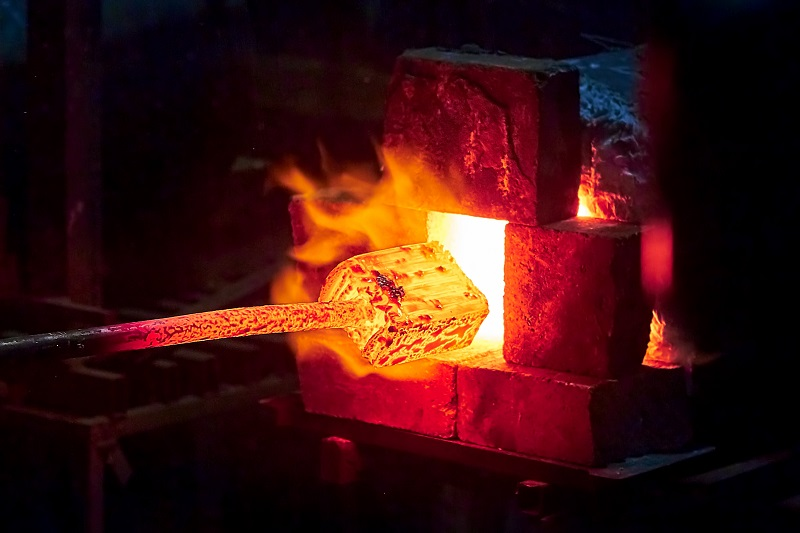
Heating: Heat the hardened steel to between 500°C and 650°C and keep it hot for a while.
Cooling: Cooling is generally slow to ensure structural stability.
3.Results
Hardness Reduction: High temperature tempering will moderately reduce the hardness of the material, while maintaining it at a high level.
Increased toughness: The toughness of hardened steel is significantly improved and can resist impact and fatigue damage.
Internal Stress Relief: Removing internal stresses reduces the risk of material cracking and improves dimensional stability.
3. Complete effect of conditioning and quenching treatment
1.Benefits
Good comprehensive mechanical properties: Quenched and tempered steel has high hardness, high strength, good toughness and plasticity, and is suitable for a variety of application needs.
Dimensional stability: By eliminating internal stresses, the dimensional stability of the material during use is ensured.
Widely used: suitable for manufacturing various mechanical parts, such as shafts, gears, springs, etc., widely used in machinery manufacturing, automobile industry, aerospace and other fields.
2.Typical applications
Mechanical parts: such as gears, bearings, connecting rods, etc., parts that require high strength and toughness.
Structural parts: such as steel in bridges and building structures, which require durable and stable performance.
Tools: such as cutting tools, molds, etc., tools that require high hardness and wear resistance.
3. Summary
The combination of high temperature quenching and tempering optimizes the hardness, strength and toughness of steel through the quenching and tempering process, giving it excellent all-round mechanical properties. This processing method is very important in industrial applications, as it ensures the reliability and durability of the material in actual use.
Daguang focuses on providing solutions such as precision CNC machining services (3-axis, 4-axis, 5-axis machining), CNC milling, 3D printing and rapid prototyping services.



















