
When discussing CNC machining, a common point of confusion, especially for those new to the field, revolves around the machine’s coordinate system. A question we sometimes hear is: why do CNC machines not have a Z axis? The straightforward answer is that this premise is incorrect. Virtually all modern CNC machining centers are fundamentally built around a three-axis Cartesian coordinate system, which explicitly includes the X, Y, and Z axes. The Z-axis is not only present but is arguably the most critical axis for defining the depth and volume of a machined part.

This misconception may stem from observing simpler, manually-operated machines like drill presses or 2D profiling machines, which might only have two controlled directions of movement. However, in the realm of Computer Numerical Control (CNC), the three-axis framework is the universal standard and the bedrock of subtractive manufacturing. Let’s delve into what these axes represent and how their evolution defines modern manufacturing capabilities.
H2: Demystifying the CNC Coordinate System: The Essential Trio – X, Y, and Z
At the heart of every CNC machine tool is a precisely defined coordinate system. This system allows the machine’s computer brain to control the position of the cutting tool relative to the workpiece with microscopic accuracy.
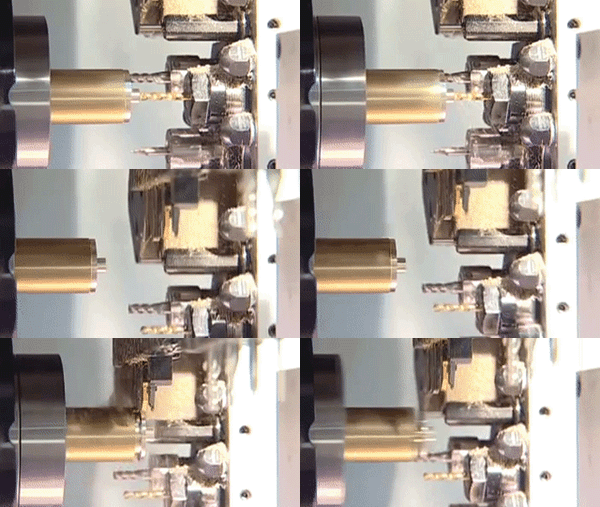
The X-Axis: Typically represents the longitudinal movement, left and right. On a vertical machining center (VMC), this is usually the table moving side-to-side.
The Y-Axis: Represents the transverse movement, forward and backward. On a VMC, this is often the table moving toward and away from the operator.
The Z-Axis: Represents the axial or vertical movement, up and down. This is the axis that governs the depth of cut. On a VMC, it is almost always the spindle (holding the cutting tool) that moves vertically along the Z-axis, plunging into or retracting from the workpiece.
In essence, the X and Y axes define the “where” on a plane, while the Z-axis defines the “how deep.” Without the Z-axis, you could only perform operations like engraving or cutting through thin sheet material. True 3D contouring, pocketing, drilling to specific depths, and creating complex organic shapes would be impossible.
H3: Beyond Three Axes: The Advent of 4-axis and 5-axis CNC Machining
While 3-axis machining is powerful, the pursuit of greater efficiency, complexity, and precision led to the development of multi-axis machines. These machines add rotational axes to the foundational XYZ linear axes, but they do not replace the Z-axis. Instead, they build upon it.
4-Axis CNC Machining: This adds a rotational axis, typically designated as the A-axis, which rotates around the X-axis. This allows the workpiece to be rotated, enabling machining on multiple sides without re-fixturing. The Z-axis remains essential for depth control during all these operations.
5-Axis CNC Machining: This adds a second rotational axis, typically the B-axis (rotation around the Y-axis) or C-axis (rotation around the Z-axis). A simultaneous 5-axis CNC machining center can move all five axes concurrently. This is the pinnacle of subtractive manufacturing technology, allowing for the production of incredibly complex geometries—such as aerospace impellers, medical implants, and automotive prototypes—in a single setup. Here, the Z-axis works in concert with the rotational axes to position the cutting tool at virtually any angle relative to the workpiece.
For a manufacturer like GreatLight Metal, investing in advanced 5-axis CNC machining capabilities is a strategic decision. It transforms our ability to serve clients who require parts with complex曲面 (free-form surfaces), deep cavities, or features on multiple angled faces, all while achieving superior surface finishes and tighter tolerances because the part can be optimally positioned for each cut.
H2: The Critical Role of the Z-Axis in Precision and Process
Understanding the Z-axis goes beyond simple movement. It is directly tied to several core concepts in precision machining:
Depth of Cut and Stepdown: These are critical Z-axis parameters that determine how much material is removed in one pass, affecting tool life, machining time, and surface finish.
Tool Length Compensation: This is a vital CNC function. Because cutting tools come in different lengths, the machine control needs to know the precise distance from the tool tip to a datum point. This compensation is applied along the Z-axis, ensuring that a drill, for example, stops at exactly the programmed depth regardless of its physical length.
Surface Finishing and 3D Contouring: For machining a curved surface, the tool path involves millions of tiny, coordinated movements in X, Y, and Z. The Z-axis movement is what creates the third-dimensional form.
Conclusion: The Z-Axis – An Indispensable Pillar of Modern CNC Machining
To conclude, the question “why do CNC machines not have a Z axis?” is based on a fundamental misunderstanding. The Z-axis is not only present but is an indispensable, non-negotiable component of any true CNC machining system. It is the axis that brings depth, volume, and true three-dimensionality to manufactured parts. From basic drilling to the most advanced 5-axis CNC machining of aerospace components, the precise control of the Z-axis, in harmony with other axes, is what separates CNC technology from manual machining and enables the high-precision, complex-part manufacturing that industries rely on today. For partners seeking precision machining services, understanding this basic framework is the first step in effectively communicating design requirements and appreciating the technological capabilities of a supplier like GreatLight Metal.
Frequently Asked Questions (FAQ)
Q1: I’ve seen old milling machines that only seem to move left/right and in/out. Don’t those lack a Z-axis?
A1: Traditional manual milling machines do have a Z-axis—it’s the quill feed handle or the knee crank that moves the spindle or table vertically. This movement is manually controlled rather than computer-controlled. True “CNC” implies programmed, automated control over all fundamental axes, including Z.
Q2: What about CNC lathes? They seem to work differently.
A2: CNC lathes (turning centers) use a different coordinate system tailored to rotational symmetry. They typically have a Z-axis (movement along the length of the part) and an X-axis (movement radially in/out). The “Z-axis” on a lathe controls the longitudinal position of the tool, which is analogous to controlling depth along the workpiece’s length.
Q3: Are there machines with more than 5 axes?
A3: Yes. There are machines with additional axes, often referred to as “5+ axis” machines. These might include a second spindle, a programmable tailstock, or additional rotary tables. However, the core interpolated (simultaneously moving) axes for creating complex geometry are typically the five we’ve discussed. The additional axes often serve to automate loading, flipping, or positioning for even greater unattended operation.
Q4: How does a manufacturer’s mastery of multi-axis machining benefit me as a client?
A4: Partnering with a manufacturer proficient in multi-axis machining, such as GreatLight Metal, offers tangible benefits: Reduced Lead Time (complex parts made in one setup), Higher Precision (eliminating errors from multiple refixturing), Enhanced Design Freedom (enabling more complex and optimized geometries), and Improved Surface Quality (optimal tool orientation reduces stair-stepping and allows better finishing paths).



















