
What CNC Machine Will Make Billet Brackets?
Billet brackets are cut from solid stock, so the machine choice follows the part geometry, not the industry label. This page explains which CNC machine will make billet brackets in each shape family, what tolerance and setup cost each route carries, and where a route stops being economical.
In this article
- 1
- 2
- 3
- 4
- 5
- 6
- 7
How bracket geometry decides which CNC machine will make billet brackets
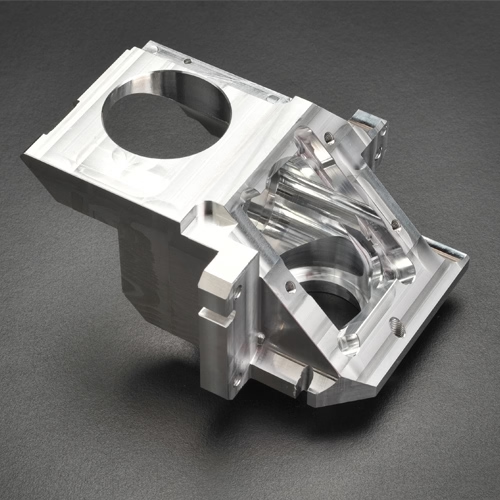
A billet bracket starts as a solid block, plate or bar. Every feature is subtracted by a rotating cutter, so the machine only has to reach each face at the correct tool angle. That single question, can the tool reach the feature, sorts most brackets into four families before you look at volume or price.
A flat plate with holes and a pocket needs three linear axes. A part with features on two or three faces needs a rotary axis so the blank turns instead of being re-fixtured by hand. A part with sculpted ribs, undercuts or blended radii needs the tool to tilt, which is what two rotary axes give you.
Turned bosses, threaded studs and round flanges break the pattern. If more than about 40 percent of the cycle time is spent on cylindrical features, a mill-turn center removes the second operation entirely.
The same bracket can often be made on two different machines. The cheaper route depends on how many parts you need and how tight the tolerances are. A 5-axis machine can cut a simple plate, but it costs more per hour than a 3-axis mill doing the same work.
- 1One face, flat part3-axis is enough
- 2Features on several facesAdd one rotary axis
- 3Sculpted or tilted facesTwo rotary axes, 5-axis
- 4Round features dominateMill-turn center
3-axis machining centers for flat mounting brackets
A 3-axis vertical mill moves in X, Y and Z only. The blank stays clamped in one orientation, and the spindle reaches the top face. Holes, slots, counterbores, pockets and outside profiles are all cut from above. This covers a large share of equipment mounting brackets, sensor brackets and cover plates.
Setup is fast. A vise or a simple fixture holds the blank, and the operator probes the corner once. Cycle times are short because there is no rotary indexing between features. On a production run of 1,000 parts or more, that matters more than any other factor.
The limit is reach. A hole on the side of a tall bracket cannot be drilled from above. If the part needs a side feature, either the fixture tilts the part or the job moves to a 4-axis machine. Tilting fixtures work for a few parts, not for thousands.
Aluminum brackets in 6061 or 7075 are the common case here. Both cut freely, hold good finishes and keep tool wear low. A 3-axis machine holds ±0.005 mm on a well-fixtured aluminum bracket without special effort.
- 1Best fitFlat plates, single-plane features
- 2Typical volumePrototypes through 10,000+ parts
- 3Watch forSide holes that need a second setup
4-axis machining centers for multi-sided brackets
A 4-axis mill adds a rotary table to the 3-axis setup, usually turning about the X axis. The bracket rotates between operations, so features on four sides can be cut in one program. The operator does not loosen the clamps between faces.
That is the real gain. Every time a part is unclamped and repositioned, the datum shifts by a few microns. Stack four setups and the error adds up. One rotary setup keeps all features tied to the same zero, which is why angled holes and slots on racing suspension brackets and robot arm mounts land where the model puts them.
The rotary table also opens up wrapping. A contour that runs around the part becomes one continuous pass instead of four separate ones. Tool marks line up, and the finished surface looks uniform.
Four-axis work suits runs of roughly 500 to 1,000 parts and up, where the fixture cost is spread thin. For two prototypes, hand indexing on a 3-axis machine is often cheaper.
A Ø400 mm rotary table handles most bracket sizes. Larger brackets may need the rotary mounted differently or moved to a 5-axis machine.
- 1Best fitAngled holes, four-sided features
- 2Main benefitFewer setups, tighter feature-to-feature alignment
- 3Watch forRotary table capacity on large brackets
5-axis machining centers for complex billet brackets
A 5-axis machine adds two rotary axes, so the tool can approach the part from almost any direction. The bracket is clamped once and stays clamped. Undercuts, sculpted ribs, blended fillets and non-parallel faces are all reachable without a second operation.
The accuracy benefit is structural, not just convenient. When the part never moves relative to the machine, there is no re-datum error between faces. Positional tolerance between a top face and a side face stays inside ±0.005 mm if the machine is in good condition and the fixture is rigid.
Short, stubby tools are the second gain. On a 3-axis machine, a deep pocket may need a long tool that deflects under load. Tilting the part lets a shorter tool reach the same corner. Less deflection means better surface finish and longer tool life.
The trade-off is hourly rate and programming time. Toolpaths with tilt and rotation take longer to prepare and verify. For a one-off simple plate, that cost is wasted. For an aerospace or motorsport bracket with organic geometry, it is the only route that works.
- 1Best fitSculpted geometry, undercuts, tight true position
- 2One setupNo re-datum error between faces
- 3Watch forProgramming cost on simple parts
Mill-turn centers for cylindrical brackets
Some brackets are mostly round. A bushing mount, a threaded boss with a flange, or a clamp with a turned bore plus milled slots falls between two processes. Turning alone cannot cut the slots. Milling alone wastes stock and time on the round body.
A mill-turn center does both in one cycle. The bar or blank is turned to diameter, then the same machine mills the flats and drills the cross holes. Because the part stays in the spindle, concentricity between the turned bore and the milled features is controlled by the machine, not by the operator.
The saving is a whole operation. A separate lathe and mill means two setups, two queues and two chances to lose the datum. For a run of 500 cylindrical brackets, that difference is measurable in both cost and scrap rate.
Mill-turn is not the answer for a flat plate bracket. If the part has no dominant round feature, a 3-axis or 4-axis mill is faster and simpler.
- 1Best fitRound bodies with milled flats or cross holes
- 2Main benefitOne cycle, concentric features
- 3Watch forFlat parts with no round features
What tolerance and material each route can hold
Tolerance follows the machine and the setup count more than the material. A single-setup 5-axis job holds ±0.005 mm between features on the same part. The same bracket cut in four separate 3-axis setups accumulates a small error at each re-clamp, so the practical limit loosens.
Material changes the cutting parameters, not the achievable geometry. Aluminum 6061, 2024 and 7075 cut fast and hold fine finishes. Stainless 304 and 17-4PH work-harden, so feed and speed have to be controlled to avoid a glazed surface. Titanium Ti-6Al-4V needs lower cutting speeds and more coolant, which raises cycle time.
Surface finish depends on the last pass, not the number of axes. A 3-axis finish pass at Ra 0.8–1.6 μm is routine. A 5-axis machine can reach Ra 0.2–0.8 μm on a sculpted surface because the tool stays in contact with a consistent tilt.
Stock removal matters too. A bracket cut from a block close to the finished size wastes less material and time than one cut from a large plate. For expensive alloys such as Inconel or titanium, near-net stock is worth the extra sourcing effort.
Wall thickness sets a floor on how light the bracket can get. Thin walls chatter, so a 1.5 mm wall in aluminum is practical while the same wall in stainless needs more support and lighter passes.
- 1Single setup±0.005 mm between features
- 2Multiple setupsError accumulates at each re-clamp
- 3Free-cutting aluminumRa 0.8–1.6 μm without extra passes
Comparing the four routes for billet brackets
Match the bracket geometry to the machine that reaches every feature in the fewest setups.
| Machine | Reaches | Typical volume | Main limit |
|---|---|---|---|
| 3-axis | Top face only | 1 to 10,000+ parts | Side features need a second setup |
| 4-axis | Four sides, one setup | 500 to 1,000+ parts | Rotary table size caps part length |
| 5-axis | Any angle, one setup | 1 to 10,000+ parts | Higher hourly rate and programming time |
| Mill-turn | Round plus milled features | 500 to 10,000+ parts | Not suited to flat plate brackets |
| 3-axis + tilt fixture | One or two angled faces | 1 to 50 parts | Manual repositioning adds error |
| 5-axis for a flat plate | Everything a 3-axis reaches | Any | Pays for capability the part does not use |
Which machine to pick
Flat bracket with top-face features: use a 3-axis mill. Features on several faces: use 4-axis. Sculpted or tilted geometry with tight true position: use 5-axis. Round body with milled details: use a mill-turn center. When two routes both work, the deciding number is volume, not capability.
Billet bracket machining questions
Which aluminum grades are common for billet brackets?
6061-T6 is the default for general brackets because it welds, machines cleanly and resists corrosion. 7075 is chosen when strength per weight matters, such as motorsport suspension mounts, but it cuts slower and costs more.
2024 machines well and takes a good finish, though it needs coating for outdoor use. 5083 and 6082 cover marine and structural brackets where toughness or weldability drives the choice.
How many setups does a typical billet bracket need?
A flat bracket needs one setup on a 3-axis machine. A bracket with side features needs either a tilt fixture plus a second setup, or a single 4-axis or 5-axis setup.
Each extra setup adds clamp time and a small positional error. When the drawing calls for tight true position between faces, cutting it in one setup is the cheaper way to hold the tolerance.
Can a 3-axis machine cut an angled hole?
Not directly. The hole has to be either drilled from a tilted fixture or moved to a machine with a rotary axis. A tilt fixture works for small batches, but the angle is only as accurate as the fixture.
For a run of hundreds of parts with the same angled feature, a 4-axis machine is the more repeatable choice.
What surface finishes are available after machining?
Anodizing in clear, color, hardcoat and conductive versions is the usual choice for aluminum brackets. Electroless nickel, zinc, silver and gold plating cover steel and copper alloys.
Bead blasting, tumbling, brushing and polishing change the surface texture before coating. Laser marking is available for part numbers, with a minimum character height of 1.5 mm.
Do small quantities make sense on a 5-axis machine?
Yes, when the geometry needs it. A single complex bracket with undercuts cannot be made any other way, so the 5-axis route is the only one that produces the part.
For a simple flat bracket, a 3-axis machine at a lower hourly rate is the sensible choice even in small quantities.
How is a billet bracket inspected before shipping?
Inspection starts with the raw material certificate, then in-process checks during cutting, then a final dimensional check. Reports are available on request.
Every part is inspected before shipment, which is how a qualification rate of 99.99% is maintained across production runs.
Send the bracket drawing, get a machine route
Our engineers review the geometry and recommend the machine that reaches every feature in the fewest setups. Quotation and DFM feedback come back within 12 hours.
12-hour quote100% inspection
More from GreatLight
We publish setup notes, tooling trials and inspection data from the factory floor.











