
Why Are CNC Machines So Low? 5 Drivers Behind a Low Quote
A low bid is a signal, not a verdict. This page breaks a quote into the five things that actually move it: labor and overhead, run size, machine choice, material buying and quoting assumptions. Read it before you sign a purchase order, or before you reject a shop that looks too cheap.
Low Quote Symptoms, Causes and What to Do
Match your quote against the left column first. One symptom alone means little; two or three together usually explain the gap.
| Symptom in the quote | Likely cause | What to do |
|---|---|---|
| Unit price drops 40% at qty 500 | Setup and programming spread over more parts | Ask where the setup amortization starts |
| Price is low but lead time is 25 days | Work is batched behind another job | Ask for a machine slot date, not a ship date |
| Price is low, tolerance stated as ±0.1 mm | Loose tolerance assumption in the bid | Send your real drawing tolerance before ordering |
| Price is low, no material grade named | Generic or substitute stock quoted | Name the grade, temper and mill cert |
| Price is low, no finishing line item | As-machined Ra 3.2 μm assumed | Confirm finish and add it to the RFQ |
| Price is low, tool marks on first article | Aggressive feeds to cut cycle time | Request a first article before the full run |
| Price is low, thin walls or deep pockets | Chatter risk not priced in | Ask for the fixture and tooling plan |
| Price is low, no inspection report | Sampling instead of 100% inspection | Specify the report you need at quote stage |
The Verdict on Low CNC Prices
A low price is fine when the shop can name its rate, its setup count, its material grade and its inspection plan. When it cannot, you are not buying a cheap part. You are buying an unpriced risk.
Labor, Rent and Overhead Sit Inside Every Hour
Machining is sold by the hour, and that hour carries the building, the power, the tooling and the operator. A shop in a region with lower industrial rent and lower wages can quote the same part at a lower rate and still make money. That is not a trick. It is arithmetic.
Power matters more than most buyers expect. A 5-axis cell with a 20 hp spindle, a chiller and a compressor draws serious current all day. Where industrial electricity is cheap, the hourly rate can drop by several dollars with no change to the part.
Tooling is the third piece. A Ø6 mm carbide end mill in 6061 lasts far longer than the same cutter in 17-4PH stainless. Shops that cut aluminium all week buy tooling in bulk and burn less of it per part.
None of this says anything about whether the shop can hold your tolerance. Overhead tells you the rate, not the capability. Capability shows up in the inspection plan and the first article.
So when a quote from a low-cost region comes in 30% under a local shop, the first question is not whether it is fake. The first question is what rate per hour is baked into it.
- 1Rate, not skillA lower hourly rate reflects geography and overhead, not a weaker machinist.
- 2Power is a real cost lineSpindle load and chillers drive electricity use on every shift.
- 3Tool life varies by materialAluminium cuts cheap; titanium and Inconel eat inserts.
Run Size and Setup Amortization
A CNC quote is mostly a fixed block plus a variable block. The fixed block covers programming, fixture design, first article inspection and machine setup. The variable block covers cycle time and material. On a 10-part order the fixed block dominates. On a 1,000-part order it nearly vanishes per unit.
This is why the same bracket can quote at one number for a prototype and a much lower number at volume. Nothing about the part changed. The setup simply spread across more pieces. When someone asks why are CNC machines so low on a repeat order, this is usually the whole answer.
Shops that run one family of parts all week push it further. Dedicated fixtures, proven programs and tuned feeds cut setup from hours to minutes. Some shops build soft jaws or vacuum plates that stay on the machine between jobs.
The trap is a low price built on a run size you have not committed to. If the quote assumes 500 pieces and you order 50, the price will not hold. Ask where the volume break sits and what happens below it.
For a job that may grow later, ask for two prices: one at your current quantity and one at the projected quantity. The gap tells you how much setup is in the quote.
- 1Fixed plus variableSetup, programming and first article do not scale with part count.
- 2Family runs cut setupDedicated fixtures and stored programs push setup toward zero.
- 3Volume breaks are conditionalA low unit price often assumes a quantity you have not placed yet.
Machine Choice and Cycle Time
A 3-axis mill with a cheap hourly rate can cost more per part than a 5-axis machine with a high hourly rate. On a part with five faces, the 3-axis route means multiple setups, each with its own re-clamp error and its own setup time. The 5-axis route cuts most faces in one setup.
That trade is not always in favor of 5-axis. A simple flat plate with two holes is faster on a 3-axis machine, and it should be quoted there. Forcing it onto a 5-axis center adds rate without saving time. Good shops route by geometry, not by prestige.
Mill-turn centers do the same thing for round parts. Turning and milling in one cycle removes a second op and a second workholding step. On a Ø60 mm shaft with cross holes, that can cut total cycle time by a third.
The judgement call: pick the machine that finishes the part in the fewest setups while still holding the tolerance. If a shop quotes your complex housing at a 3-axis rate, ask how many setups they plan. Four setups at a low rate often beats one setup at a high rate, until the tolerance stack catches up.
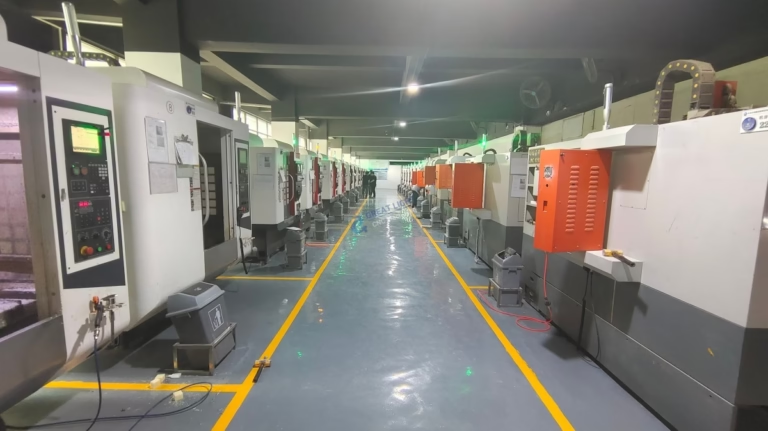
GreatLight runs 16 simultaneous 5-axis centers, 12 four-axis mills, 27 three-axis machines and 16 mill-turn centers, so the routing choice is made on geometry rather than on whatever is free that week.
- 1Setups drive errorEvery re-clamp adds stack-up and inspection time.
- 25-axis is not always cheaperSimple prismatic parts belong on a 3-axis machine.
- 3One cycle beats two opsMill-turn removes a second workholding step on round parts.
Material Buying Power and Stock Grade
Material is 20–50% of many machined part costs, so how a shop buys metal shows up directly in the quote. A shop with long-term mill contracts and standing inventory buys 6061-T6 and 304 at below spot. A small shop buying one bar at a time pays a cut fee and a premium.
Grade substitution is where low quotes go wrong. 6061 and 2024 are not interchangeable in a stressed part. Neither are 303 and 316L in a medical housing. If a quote is low and the drawing just says aluminium, ask which grade was priced.
Stock size matters too. A part cut from near-net bar wastes less material and less cycle time than one carved from a thick plate. Shops that stock the right thicknesses can quote tighter.
On small lots, some shops price material at list and add handling. That is honest, and it makes the quote higher. A low quote with no material line at all is the one to question.
Ask for the grade, temper and form on the quote. If the shop cannot name them, the price is not comparable to a quote that can.
We keep common grades in stock: 6061, 6061-T6, 2024, 5052, 5083, 6063, 6082, 7075, ADC12; stainless 303, 304, 316, 316L, 420, 430, 431, 440C, 17-4PH (SUS630); plus 1018, 1045, 4130, 4140, 4340, A36, tool steel, copper alloys, titanium and engineering plastics.
- 1Buying power is realMill contracts and stock let a shop skip cut fees and premiums.
- 2Grade substitution is a riskA cheaper alloy can pass a visual check and fail in service.
- 3Near-net stock saves twiceLess material removed means less cycle time and less scrap.
Quoting Assumptions and Missing Line Items
A quote is a set of assumptions written as a number. When the number looks too low, the assumptions are usually where the gap lives. Common ones: single setup, loose tolerance, no deburr, no finish, no inspection, buyer supplies material.
Tolerance is the biggest lever. A feature called out at ±0.005 mm needs a temperature-stable process, in-process probing and more inspection time than the same feature at ±0.05 mm. If the RFQ never states tolerance, a shop may price the loose case and win on price.
Finishing is the second lever. Anodizing, electroless nickel and powder coating are separate operations with their own setup and racking. A quote that ends at the machined surface is genuinely cheaper, and it will not match a drawing that calls for hardcoat anodize.
Inspection is the third. 100% inspection with reports costs more than sampling, and it is the reason some quotes differ by 15% on the same geometry. Decide what your drawing and your quality system actually require before you compare prices.
The fix is simple: send a complete RFQ. State grade, tolerance, finish, inspection level, quantity and whether you need first article reports. Then the quotes you receive are comparable, and a low one is a real low one.
- 1State tolerance up frontA loose assumption can halve the quoted price.
- 2Price finishing separatelyAnodizing and plating are separate operations with separate cost.
- 3Compare like for likeA quote without inspection is not the same quote.
Six Steps to Vet a Low CNC Quote
Work through these in order. Each step takes one email.
- 1Ask for the hourly rate and setup hoursA quote should separate rate, setup and cycle time. If the shop will not break it out, ask for the assumed quantity and machine class instead. Two numbers, one reply.
- 2Confirm grade, temper and stock formWrite the exact grade on the PO: 6061-T6 bar, 17-4PH condition H1025, 316L plate. A vague 'aluminium' leaves room for substitution.
- 3Send the tolerance block and datum schemeAttach the drawing with GD&T and state the tightest real tolerance. Typical production holds ±0.005 mm on critical features and Ra 0.8–1.6 μm on sealing faces.
- 4Ask how many setups are plannedTwo setups on a complex housing means re-clamp error. If the quote assumes one setup, ask for the fixture sketch and the datum strategy.
- 5List finish and inspection as line itemsAdd hardcoat anodize, laser marking at 1.5 mm minimum character height, and the report you need. Get a price for each so you can drop them deliberately, not by accident.
- 6Request a first article before the full runPay for one part and measure it yourself. A shop that will not run a first article is telling you something about the rest of the order.
- 7Check the capacity behind the dateAsk how many machines can run the job and when the next slot opens. Production can start within 24 hours when material is on the shelf.
Low CNC Quotes: Common Questions
Does a low CNC quote always mean poor quality?
No. It often means a lower hourly rate, a larger run size, or a simpler machine route. Those are legitimate cost drivers.
The warning sign is a low quote with no assumptions attached. When a shop cannot say which grade, tolerance, setup count or finish it priced, the number is not a quote. It is a guess.
How much of a CNC part cost is material?
For aluminium parts it is often 20–35%, and for stainless or titanium it can pass 50%. That is why grade and stock form change the price so much.
If a quote has no material line, ask for it. The grade and form should appear on the PO either way.
Why is the unit price lower at higher quantity?
Programming, fixture work, first article inspection and machine setup are fixed. They do not shrink when quantity grows, so they spread across more parts.
Cycle time and material scale with quantity; setup does not. That is the whole mechanism behind a volume break.
Can a 5-axis machine be cheaper than a 3-axis machine?
Yes, when one 5-axis setup replaces three or four 3-axis setups. Fewer clamps mean less setup time and less stack-up error.
For a flat plate with two holes the opposite is true. The cheaper route is the one that finishes the part in the fewest setups while holding tolerance.
What should I put in an RFQ to get comparable quotes?
Quantity, material grade and temper, tolerance block, critical features, finish, inspection level and delivery target. Add a STEP file and a 2D drawing with datums.
With that package, quotes line up side by side. Without it, the spread between bids is mostly assumption, not capability.
How do I know a shop can hold ±0.005 mm?
Ask what they measure with, how often they check, and what report you get. In-process monitoring plus final inspection on critical features is the pattern to look for.
Then verify with a first article. Tolerance claims are cheap; a measured part is not.
Send the Drawing, Get a Costed Answer
Upload your files and we return a quote with a free DFM analysis within 12 hours, plus the grade, tolerance and finish assumptions written out.
12-hour quoteNo MOQ100% inspectionISO 9001:2015
More machining notes from GreatLight
We publish setup notes, tooling trials and inspection data from the factory floor.











