
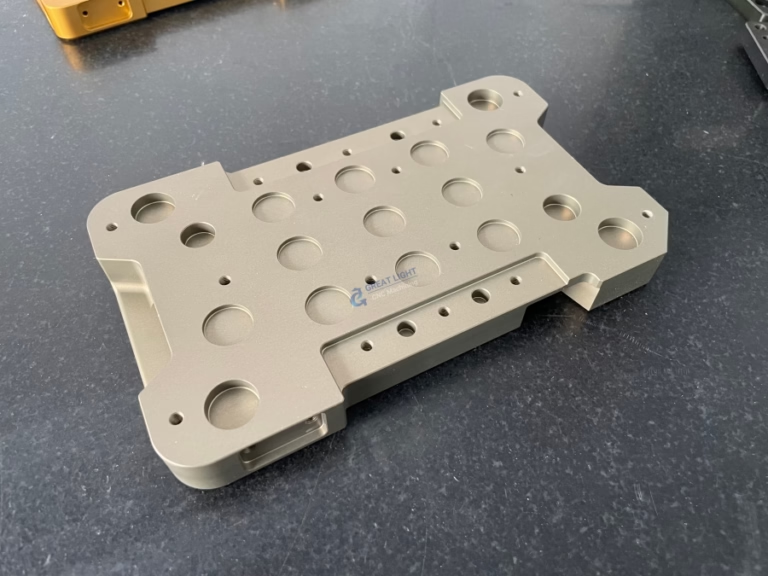
When integrating plastic components into CNC machining systems—whether as custom fixture jaws, protective shrouds, coolant manifold blocks, or inspection fixtures—one of the most critical yet often overlooked considerations is material compatibility with machine coolants. Selecting the wrong plastic can lead to premature failure, dimensional instability, part contamination, and costly unplanned downtime.
From the lens of a precision manufacturing engineer, the choice is not merely about chemical resistance on a chart; it’s about ensuring long-term reliability under the dynamic, often harsh conditions of a machining environment. At GreatLight, where we routinely design and manufacture high-precision plastic and composite components for complex assemblies, this compatibility analysis is a fundamental step in our design-for-manufacturability (DFM) process.
H2: Understanding the CNC Coolant Challenge
CNC coolants, or metalworking fluids (MWFs), are not a single substance. They are formulated blends designed to lubricate, cool, and remove chips from the cutting zone. Their composition directly dictates their aggressiveness towards plastics:
Water-Soluble Coolants (Emulsifiable Oils & Synthetic/Semi-Synthetic Fluids): These are the most common. They create an emulsion of oil in water. The water phase can cause certain plastics to absorb moisture (hygroscopic swelling), leading to dimensional growth and loss of mechanical strength. Additives like biocides, corrosion inhibitors, and extreme pressure (EP) agents can be particularly reactive.
Straight Oils (Neat Oils): These are non-emulsifiable petroleum or plant-based oils. They generally pose less of a swelling threat but can cause certain thermoplastics to soften, dissolve, or suffer environmental stress cracking (ESC) over time due to prolonged chemical exposure under stress.
Specialty Fluids: This includes high-performance synthetics or those with aggressive additives for machining exotic alloys. They require the most rigorous compatibility testing.
H3: Top-Performing Plastics for CNC Coolant Environments
Based on extensive field application and laboratory testing, the following engineering plastics consistently demonstrate excellent resistance to common water-soluble and straight oil coolants.
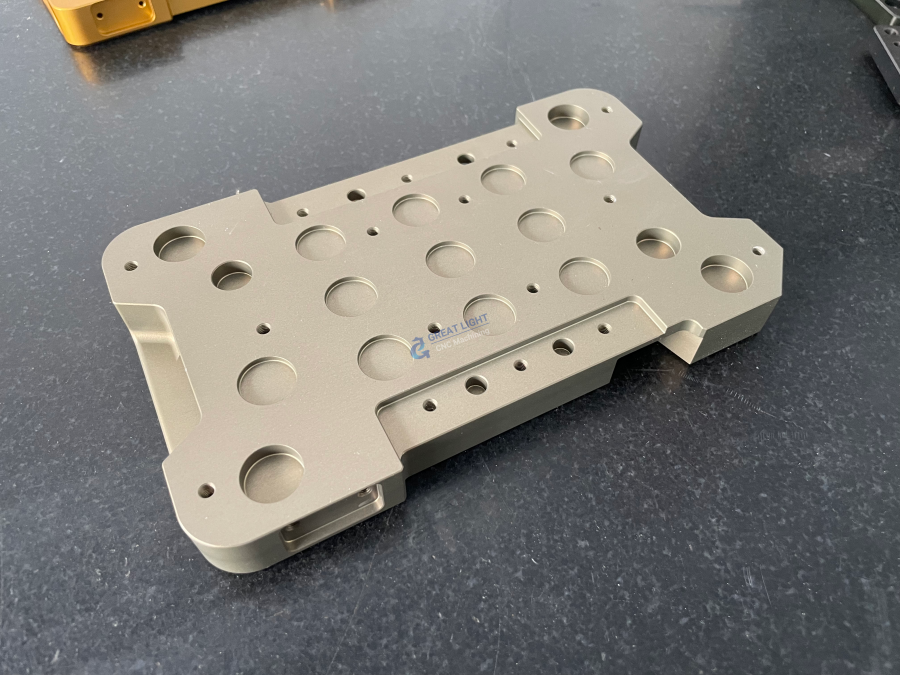
H4: 1. Polyetheretherketone (PEEK)
The gold standard for high-performance applications. PEEK offers nearly universal chemical resistance, exceptional dimensional stability across a wide temperature range, and outstanding mechanical strength. It is virtually unaffected by all standard CNC coolants, making it ideal for permanent fixtures, high-wear guide components, and parts in high-temperature machining operations. Its primary constraint is cost.
H4: 2. Polytetrafluoroethylene (PTFE) – e.g., Teflon®
Renowned for its supreme chemical inertness and low friction. PTFE is completely resistant to virtually all coolants. It is often used for seals, liners, and non-stick surfaces within coolant systems. However, it is soft, has poor creep resistance, and is not suitable for structural or high-load bearing components.
H4: 3. Polypropylene (PP) & High-Density Polyethylene (HDPE)
These polyolefins are excellent, cost-effective choices for tanks, ducts, and covers. They exhibit very good resistance to a wide range of chemicals, including most coolants, and have low moisture absorption. They are easy to machine but lack the rigidity and temperature tolerance of more advanced engineering plastics.
H4: 4. Acetal Copolymer (POM-C – e.g., Delrin®)
A staple in precision machining for its excellent stiffness, low friction, and good dimensional stability. Acetal has good resistance to most coolants, particularly oils and hydrocarbons. However, prolonged exposure to hot, highly acidic or alkaline water-based coolants may lead to slight surface degradation or dimensional change over very long periods.
H4: 5. Cast Nylon (PA 6G – e.g., McMaster-Carr’s “Machineable Nylon”)
Offers a good balance of mechanical properties, machinability, and chemical resistance. It performs well with most oils and coolants, though it will absorb some moisture from water-based emulsions. This absorption is significantly lower in cast grades compared to extruded nylon. It’s a robust choice for fixture bodies, gear racks, and wear pads.
H3: Plastics to Use with Caution or Avoid
ABS: Generally poor chemical resistance. It can craze, crack, or dissolve upon exposure to many coolants, especially those containing certain oils or esters.
Standard Polycarbonate (PC): Notorious for susceptibility to environmental stress cracking when exposed to many chemicals, including ingredients found in some coolants and cleaning agents. It can develop fine cracks under stress.
Some PVC Formulations: While rigid PVC (uPVC) has good chemical resistance, certain plasticizers in flexible PVC can leach out when exposed to oils, causing the material to become brittle.
Polystyrene (PS) & Acrylic (PMMA): These materials are brittle and have very limited chemical resistance to hydrocarbons and aggressive additives, making them unsuitable.
H2: The GreatLight Metal Approach: Validation Through Application
At GreatLight, our expertise extends beyond machining metals. We routinely apply our full-process engineering capability to select, machine, and validate plastic components for integration into advanced manufacturing systems, including our own.
Our process ensures reliability:
Application-Specific Analysis: We don’t just pick a plastic from a chart. We assess the component’s function, mechanical load, temperature exposure, and the specific coolant brand/type used in the client’s process.
Controlled Machining & Handling: We machine plastics with dedicated tools and parameters to prevent thermal degradation and stress, which can create micro-cracks that accelerate chemical attack.
Real-World Validation: For critical applications, we can conduct or recommend immersion tests, where a sample coupon is exposed to the client’s exact coolant under controlled conditions and monitored for dimensional change, weight change, and loss of properties.
This rigorous approach is why clients in the medical device (where biocompatibility and fluid resistance are paramount) and automotive powertrain sectors trust us with their most demanding plastic component needs.
Conclusion
The question of what plastics can be used with CNC machine coolant has no single answer, but a definitive methodology: understand the coolant chemistry, respect the operational environment, and select from the family of proven, stable engineering plastics like PEEK, PTFE, PP/HDPE, Acetal, and Cast Nylon. Arbitrary material selection risks component failure and process contamination. Partnering with a manufacturer that views material science as integral to precision engineering—like GreatLight—transforms this from a potential pitfall into a guaranteed advantage for your system’s longevity and performance.
FAQ
H3: Q1: Can I use 3D printed plastic parts (like SLA or FDM) in coolant environments?
A: This requires extreme caution. Most standard 3D printing resins (SLA) and filaments (ABS, PLA for FDM) have poor chemical resistance and are prone to swelling and degradation. For permanent fixture use, consider using the 3D print to create a mold for casting a compatible polyurethane or epoxy, or use specialized, chemically resistant engineering-grade printing materials (e.g., PEEK or PEKK via FDM/FFF), though these are expensive and require high-end printers.
H3: Q2: My plastic fixture worked fine for months, then suddenly cracked. Why?
A: This is a classic sign of Environmental Stress Cracking (ESC). The combined effect of sustained mechanical stress (from clamping) and prolonged, slow chemical exposure from the coolant vapors or mist weakens the polymer at a molecular level until it fails. Materials like polycarbonate are especially prone. The solution is to redesign to lower stress concentrations or switch to a more chemically resistant plastic like PEEK or Acetal Copolymer.
H3: Q3: Are there any coatings to protect less resistant plastics?
A: While certain sealants or epoxy coatings can offer a temporary barrier, they are generally not recommended for precision components. The coating can wear, chip, or delaminate, leading to unpredictable failure and potential contamination. It is almost always more reliable to select a bulk material with inherent compatibility.
H3: Q4: How does GreatLight handle requests for plastic parts exposed to coolants?
A: We initiate a technical review. Our engineers will discuss the operating environment, request a Safety Data Sheet (SDS) for the coolant if available, and recommend a shortlist of suitable materials based on performance and budget. We then apply our high-precision machining protocols for plastics to deliver a part that is dimensionally accurate and structurally sound for its intended life. For more on our collaborative engineering ethos, connect with our team on LinkedIn.



















