

We all know that 316L is a grade of stainless steel, AISI 316L is the corresponding American grade, and sus 316L is the corresponding Japanese grade. my country’s standard grade is 022Cr17Ni12Mo2 (new standard) and the old grade is 00Cr17Ni14Mo2, which means it mainly contains Cr, Ni and Mo. The numbers indicate the approximate percentage of the content.
So, do you know the difference between 316 and 316L?
First look at the chemical composition of the material
We can see that the carbon content of the two is different. The carbon content of 316L is lower and has better corrosion resistance. The “L” here stands for Low.
Let’s use an easy-to-understand analogy. Nowadays, vegan cuteness is considered beauty, but if you have a crazy hairstyle, then you are WEAK.
When everyone is talking about Shakespeare, if you insist on talking about Zhao Benshan, then you are WEAK.
When all your friends like piano, chess, poetry and painting, but you like playing mahjong with the ladies in the community, then you are WEAK.
When everyone loves cleanliness and hygiene, but you spit and throw trash everywhere, then you are WEAK.
Low means “weak” in English. This time you know their difference! Now do you know the difference between 304 and 304L, 317 and 317L?
1. Welding method
Since most of the pipes on site are stainless steel pipes of different sizes, according to the welding characteristics of stainless steel, the heat input should be reduced as much as possible, so two methods, the Manual arc welding and argon arc welding are used.
For pipe diameters greater than 159mm, argon arc welding is used for the base and manual arc welding for the cover. All pipe diameters less than 159 mm are welded by argon arc welding. The welding machine adopts WS7-400 inverter arc welding machine which can be used for both manual arc welding and argon arc welding.
2. Welding materials
Austenitic stainless steel is a steel with special properties. In order to ensure that the joints have the same performance, welding materials should be selected according to the principle of “equal composition”. At the same time, to improve the thermal resistance of the joint. cracking and intergranular corrosion, a small amount of ferrite should appear in the joint, select H00Cr19Ni12Mo2 argon arc welding wire and CHSO22 electrode for manual arc welding as filler material.

3. Welding parameters
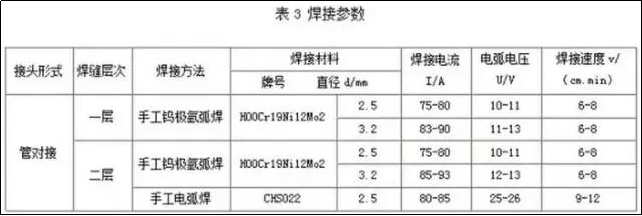
The outstanding feature of austenitic stainless steel is that it is sensitive to overheating, so low current and fast welding are used when multilayer welding, the interlayer temperature should be strictly controlled to keep the interlayer temperature lower at 60℃. See Table 3 for specific parameters.
4. Groove shape and assembly positioning welding
The shape of the groove adopts a V-shaped groove. Due to the use of lower welding current and low penetration, the blunt edge of the groove is smaller than that of steel carbon, about 0-0.5mm, and the groove angle is larger than that of carbon steel. carbon steel, approximately 65°-700°, its shape is shown in Figure 1.

Due to the high thermal expansion coefficient of stainless steel, large welding stresses are generated during welding, requiring strict positioning welding. For pipes with d≦Φ89 mm, two-point positioning is used, for pipes with d=Φ89-Φ219 mm, three-point positioning is used and for pipes with d≧219 mm, four-point positioning is used; 6-8mm.
5. Welding technical requirements
①The welding machine adopts DC reverse connection during manual arc welding and DC direct connection during argon arc welding;
② Before welding, the oxide scale on the surface of the welding wire should be brushed with a stainless steel wire brush and cleaned with acetone; the welding rod should be dried at 200-250°C for 1 hour and ready for use;
③ Before welding, clean the oil stains within 25mm on both sides of the groove of the workpiece, and use acetone to clean the range of 25mm on both sides of the groove;
④During argon arc welding, the nozzle diameter is Φ2mm, and the tungsten electrode is cerium tungsten electrode, the specification is Φ2.0mm;
⑤ When welding stainless steel with argon arc welding, the back side should be protected by argon gas to ensure the formation of the back side. The method of partially filling the pipeline with argon is used, the flow rate is 5-14 L/min, and the forward argon gas flow rate is 12-13 L/min.
Notice
① When bottom welding, the thickness of the weld should be as thin as possible and fused well with the root. It should have a gently sloping shape when closing the arch. If there are removal holes in the arch, use a polisher to remove them. The arc must be started and extinguished in the groove. When the arc is extinguished, the arc crater must be filled to prevent cracks in the arc crater.
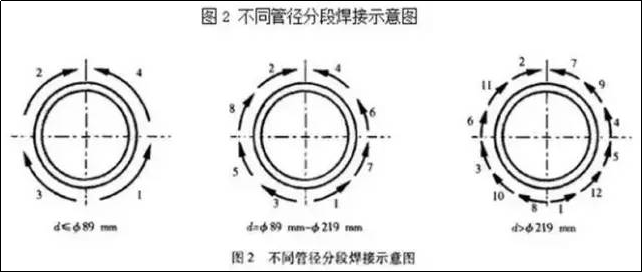
② Since this stainless steel is an austenitic stainless steel, in order to avoid carbide precipitation, sensitization and intergranular corrosion, the interlayer temperature and cooling rate after welding should be strictly controlled. It is necessary that the interlayer temperature be controlled below 60°C. during welding, and this must be done immediately after welding. Water cooled and welded into segments. The specific segmentation method is shown in Figure 2. This symmetrical and dispersed welding sequence can increase the cooling rate of the joint and reduce the welding stress.
6. Result
① Appearance inspection shows that there are no defects such as pores, weld nodules, bumps and undercuts, and the shape is good.
② Tensile and bending tests were carried out on the specimens. All mechanical performance indicators met the requirements and no defects such as lack of fusion or cracks were found.
③ Macroscopic metallographic inspection found that the weld bead was well molten and the penetration depth was 1-1.5mm. Microscopic metallographic examination shows that the base metal and the heat-affected zone are all austenitic structures, and the weld metal is austenite-deca-ferrite structure (4%), which fully meets the heat resistance requirements. intergranular corrosion and embrittlement. -site construction by Coal Chemical Company guarantees the quality of the welding project.
Daguang focuses on providing solutions such as precision CNC machining services (3-axis, 4-axis, 5-axis machining), CNC milling, 3D printing and rapid prototyping services.



















