
Corresponding calculation formulas in the production of fasteners
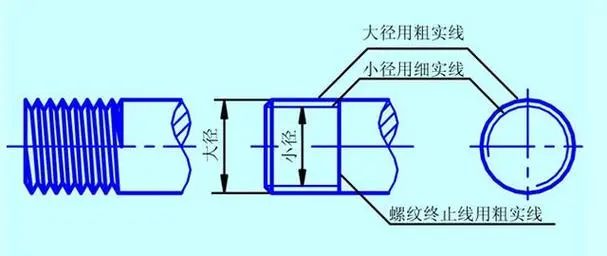
1. Calculation and tolerance of the outer diameter of the thread pitch of the 60° profile (national standard GB 197/196)
has. Calculation of the basic size of the pitch diameter: The basic size of the pitch diameter of the thread = main diameter of the thread – pitch × coefficient value Expression of the formula: d/DP × 0.6495.
Example: Calculation of the pitch diameter of the M8 external thread 8-1.25×0.6495=8-0.8119≈7.188
b. Commonly used 6h external thread pitch diameter tolerance (based on pitch), the upper limit is “0” and the lower limit is P0.8-0.095 P1.00-0.112 P1.25-0.118 P1.5 -0.132 P1. 75 -0.150 P2.0-0.16 P2.5-0.17 The upper limit calculation formula is the base size, and the lower limit value calculation formula d2-hes-Td2 is the value of basic size tolerance-deviation-tolerance of the pitch diameter 6h, tolerance value of the pitch diameter of M8: upper limit value 7.188 lower limit value: 7.188 -0.118=7.07
C commonly used basic deviation of pitch diameter of 6g grade external thread: (based on pitch) P 0.80-0.024 P 1.00-0.026 P1.25-0.028 P1.5-0.032 P1.75-0.034 P2 -0.038 P2.5-0.042 The formula for calculating the upper limit value d2-ges is formula for calculating the lower limit value of the basic size deviation. D2-ges-Td2 is the basic example of size deviation tolerance. The tolerance value of the pitch diameter of 6g quality of M8: the upper limit value is. 7.188-0.028=7.16 Limit value: 7.188-0.028-0.118=7.042
Note:
①The above thread tolerances are based on coarse threads, and there are some changes in the thread tolerances of fine threads, but the tolerances are only getting larger, so checking according to this will not exceed the limit of specification, so they are not marked one by one in the above.
② In actual production, the diameter of the polished threaded rod is 0.04-0.08 larger than the diameter of the designed thread pitch according to the precision of the design requirements and the extrusion force of the thread processing equipment. threaded polished rod. For example, the diameter of our company’s M8 external thread 6g grade threaded polished rod is actually 7.08-7.13, which is within this range.
③ Considering the needs of the production process, the lower limit of the control limit of the pitch diameter of the actual production of external threads without heat treatment and surface treatment should be kept at the 6h level as much as possible.
2. Calculation and tolerance of the pitch diameter of the internal thread at 60° (GB 197/196)
has. Upper tolerance limit of the pitch diameter of the 6H quality thread (based on the pitch): P0.8+0.125 P1.00+0.150 P1.25+0.16 P1.5+0.180 P1.25+0.00 P2, 0+0.212 P2. 5+0.224 The lower limit value is “0”, The upper limit value calculation formula 2+TD2 is the basic example of size + tolerance. The pitch diameter of the M8-6H internal thread is: 7.188+0.160=7.348. The upper limit value: 7.188 is the lower limit value.
b. The formula for calculating the basic size of the pitch diameter of the internal thread is the same as that of the external thread, that is, D2 = DP × 0.6495, that is, the pitch diameter of the internal thread, the main diameter. of thread – pitch × coefficient value
c. Basic deviation E1 of the pitch diameter of the 6G quality thread (based on pitch) P0.8+0.024 P1.00+0.026 P1.25+0.028 P1.5+0.032 P1.75+0.034 P1.00+0.026 P2, 5+ 0.042 Example: M8 The upper limit value of the pitch diameter of the 6G grade internal thread: 7.188+0.026+0.16=7.374 The lower limit value: 7.188+0.026=7.214 The formula of the upper limit value 2+GE1+TD2 is the base pitch diameter size+gap+ the formula tolerance of the lower limit value 2+ GE1 is the pitch diameter + the deviation
3. Calculation and tolerance of the major diameter of the external thread (GB 197/196)
has. The upper limit of the main diameter 6h of the external thread, that is, the value of the thread diameter, for example M8 is φ8.00.
b. The lower limit tolerance of the main diameter 6h of the external thread (depending on the pitch) P0.8-0.15 P1.00-0.18 P1.25-0.212 P1.5-0.236 P1.75-0.265 P2.0- 0.28 P2.5-0.335 Formula for calculating the lower limit of the large diameter: d-Td That is to say the basic size of the large diameter of the thread – tolerance example: external thread M8 6h size of the main diameter: the upper limit is φ8, the lower limit is φ8-0.212 = φ7.788
c. Calculation of the large diameter of the external thread of grade 6g and the standard deviation of the external thread of tolerance grade 6g (depending on the pitch) P0.8-0.024 P1.00-0.026 P1.25-0.028 P1. 5-0.032 P1.25-0.024 P1.75 –0.034 P2.0-0.038 P2.5-0.042 The calculation formula for the upper limit is d-ges, which is the basic size of the large diameter of the thread – the limit lower than the reference deviation. The calculation formula d-ges-Td is the basic size of the large diameter of the thread – le. reference deviation – tolerance. Example: M8 external thread of 6g quality, upper limit of main diameter φ8-0.028 = φ7.972 Lower limit value φ8-0.028-0.212 = φ7.76.
Note: ① The main diameter of the thread is determined by the diameter of the polished threaded rod and the wear degree of the tooth profile of the thread plate/roller, and its value is inversely proportional to the pitch diameter of the thread according to the same roughing and thread processing tools. That is to say, if the average diameter is small, the major diameter will be large, and conversely if the average diameter is large, the major diameter will be small.
② For parts requiring heat treatment and surface treatment, taking into account the treatment process, the thread diameter should be controlled to be greater than the lower limit of grade 6h plus 0.04mm during actual production. For example, the external thread of the M8 rubs. (rolling) The main diameter of the wire should be greater than φ7.83 and less than 7.95.
4. Internal thread diameter calculation and tolerance
has. Calculation of the basic dimension of the small diameter of the internal thread (D1) The basic dimension of the small diameter of the internal thread = the basic dimension of the internal thread – pitch × coefficient Example: the basic small diameter of the internal thread M8 thread 8 -1.25 × 1.0825 = 6.646875 ≈ 6.647
b. Calculation of small diameter tolerance (based on pitch) and small diameter value of 6H internal thread: P0.8 +0 2 P1.0 +0.236 P1.25 +0.265 P1.5 +0.3 P1, 75 +0.335. P2.0 +0.375 P2.5 +0.48 The lower limit deviation formula of 6H grade internal thread is D1+HE1, which is the basic size of the small diameter of the internal thread + deviation. Note: The lower deviation value of grade 6H is “0”. The quality of 6H thread is =D1+HE1+TD1, which is an internal thread Basic size of small diameter + gap + tolerance Example: The upper limit of the small diameter of M8 internal thread of 6H quality is 6.647+0=6.647 The lower limit of small diameter of 6H grade M8 internal thread is 6.647+0+0.265=6.912.
c. Calculation of the basic deviation of the small diameter of the internal thread 6G (depending on the pitch) and the value of the small diameter P0.8 +0.024 P1.0 +0.026 P1.25 +0.028 P1.5 +0.032 P1.75 . +0.034 P2.0 +0.038 P2.5 +0.042 The formula for the lower limit value of the small diameter of the 6G grade internal thread = D1 + GE1, which is the basic size of the internal thread + deviation Example: the lower limit value of the small diameter of the internal thread of quality 6G M8. thread 6.647 + 0.028 = 6.675 The formula for the upper limit value of the small diameter of the 6G grade M8 internal thread D1 + GE1 + TD1 is the basic size of the internal thread + deviation + tolerance example: The upper limit of the small diameter of the 6G grade M8 internal thread is 6.647+0.028+0.265=6.94. Note: ①The pitch height of the internal thread is directly related to the bearing moment of the internal thread, so the upper limit of 6H quality should be used as much as possible in the production of blanks Within the limit of the value
② When processing internal threads, the larger the diameter of the internal thread will impact the use efficiency of the machining tool – tap. From a usage point of view, the smaller the diameter, the better, but when considering overall. , the smallest diameter is generally used between the upper limit and the lower limit of the small diameter. If it is a cast iron or aluminum part, the lower limit up to the middle limit of the small diameter should be used.
③ The small diameter of 6G internal thread can be implemented as 6H in the production of blanks. The level of precision mainly takes into account the coating of the pitch diameter of the thread. Therefore, only the pitch diameter of the tap is considered when processing the thread, without considering the small diameter of the thread. the hole of light.
5. Calculation of the single indexing method of the indexing head Calculation formula of the single indexing method: n=40/Z n: is the number of revolutions that the indexing head must make Z: fraction equal to the part 40: fixed number of the indexing head Example: hexagonal milling Replace the calculation formula by: n=40/6
calculate:
① Simplify fractions: find the smallest divisor 2 to reduce, that is, divide the numerator and denominator by 2 at the same time to get 20/3. While reducing the fraction, its equal parts remain unchanged.
② Calculate the fraction: At this stage, it depends on the values of the numerator and denominator; if the numerator and denominator are large, calculate 20÷3=6(2/3) is the n value, that. i.e. the dividing head must rotate 6 (2/3) turns. At that point, the fraction became a mixed number; the whole part of the mixed number, 6, is the division head and must be rotated 6 full turns. the mixed fraction 2/3 can only be 2/ of a turn 3, at this point you have to recalculate.
③ Calculation of index plate selection: Calculation of less than one circle should be carried out using the index plate of the index head. The first step in the calculation is to expand the fraction 2/3 at the same time. For example: if the fraction is expanded 14 times at the same time, the fraction is 28/42; if it is developed 10 times at the same time, the score is 20/30 if it is developed 13 times at the same time; time, the score is 26/39… The expansion factor of the separation door should be chosen based on the number of holes in the index plate.
At this point you should pay attention to:
①The number of holes selected for the index plate must be divisible by the denominator 3. For example, in the previous example, 42 holes are 14 times 3, 30 holes are 10 times 3, 39 are 13 times 3…
② The expansion of a fraction should be such that the numerator and denominator are expanded simultaneously and their equal parts remain unchanged. For example, in the example, 28/42=2/3×14=(2×14)/(3×.14); 20/30 = 2/3 × 10 = (2 × 10)/(3 × 10); 26/39 = 2/3 × 13 = (2 × 13)/(3 × 13); The denominator 42 of 28/42 is indexed using the 42 holes of the index number; the numerator 28 is forward on the positioning hole of the upper wheel and then rotates through the hole 28, that is, the hole 29 is the positioning hole of the current wheel, and 20/30 is at 30. The hole index plate faces forward through hole 10 or 11, which is the positioning hole of the epicycle. 26/39 is the positioning hole of the epicycle by rotating the index plate 39. holes forward and then through hole 26 or hole 27. When milling six squares (six equal parts), you can use 42 holes, 30 holes, 39 holes and other holes also divided by 3 as index: the operation consists of turning the handle 6 times, then moving forward on the positioning holes of the upper wheel. Then turn the hole 28+1/ 10+1 / 26+! towards hole 29/11/27 as the epicycle positioning hole.
6. Formula for calculating a hexagon inscribed in a circle:
① Find the six opposite sides of the circle D (surface S) S=0.866D, i.e. diameter × 0.866 (coefficient)
② Find the diameter of the circle (D) on the opposite side of the hexagon (surface S) D=1.1547S, that is, the opposite side × 1.1547 (coefficient)
7. Calculation formulas for six opposite sides and diagonals of the cold heading process
① Find the opposite side (S) of the outer hexagon: ee=1.13s, that is, the opposite side × 1.13
② Find the opposite angle (e) of the inner hexagon to the opposite side(s) e=1.14s, that is, the opposite side × 1.14 (coefficient)
③ To find the diameter of the head material for the opposite corner (D) on the opposite side of the outer hexagon(s), you need to calculate the diameter of the circle (D) on the opposite side of the surface of the hexagon(s). according to (formula 6.2) and increase its shift center value appropriately, that is, the shift center quantity D≥1.1547 can only be estimated
8. Formula for calculating a square inscribed in a circle:
① Find the opposite side of the square (surface S) of the circle (D) S=0.7071D, i.e. diameter × 0.7071
② Find the circle (D) on the opposite side (surface S) of the four squares D = 1.414S, that is, the opposite side × 1.414
9. Calculation formulas for the four opposite sides and opposite corners of the cold heading process
① Find the opposite angle (e) of the outer square to the opposite side (S) e=1.4s, that is, the parameter opposite side(s) × 1.4
② Find the diagonal angle (e) of the four inner squares with respect to the opposite side(s) e = 1.45s, i.e. the opposite side(s) ( s) × 1.45 coefficient
10. Formula for calculating hexagonal volume
① s20.866 × H/m/k, that is, opposite side × opposite side × 0.866 × height or thickness
11. The formula for calculating the volume of a truncated cone (cone) is 0.262H (D2+d2+D×d), or 0.262×height×(large diameter of the head×large diameter of the head+small diameter of head × small head diameter + large head diameter × small head diameter)
12. The formula for calculating the volume of a spherical body (such as a semicircular head) is 3.1416h2 (Rh/3), or 3.1416×height×height×(radius-height÷3)
13. Calculation of processing dimensions of taps for internal threads
1. The calculation formula for the large diameter D0 of the tap is D0=D+(0.866025P/8)×(0.5~1.3), that is, the basic thread size of the large diameter of tap +0.866025 pitch÷8×. 0.5 to 1.3 Note: Selection of 0.5 to 1.3 should be determined based on step size. The larger the step value, the more coefficient should be used. On the contrary, the smaller the step value, the more coefficient should be used. .
2. Formula for calculating the tapping pitch diameter (D2): D2=(3×0.866025P)/8, i.e. tapping pitch diameter=3×0.866025×pitch÷8 3 . Formula for calculating the diameter of the tapping pitch (D1): D1= (5× 0.866025P)/8, i.e. diameter of the tapping pitch. tap=5×0.866025×thread pitch÷8
14. The calculation of the length of materials used for cold forming of various shapes is known: the volume formula of a circle is diameter × diameter × 0.7854 × length or radius × radius × 3.1416 × length, i.e. d2 × 0.7854 × L. or R2 × 3.1416 × L When calculating, the required material volume is X÷diameter÷diameter÷0.7854 or X÷radius÷radius÷3.1416, which is the length of the material to be fed. The volume value L represents the length of the actual feed. R/d represents the radius or diameter of the actual feed.
15. Calculation of the suspended wheel of the rolling machine running gear
has. The fixed spindle number of the roller gear is 24.
b. The calculation of the running gear and the sprung wheel is carried out by decomposing the data, that is, enlarging or reducing their equal parts at the same time without modifying them. Diagrams B1 and b2 are compound transmissions and diagrams b3 and b4 are direct. transmission.
c. The decomposition of pin parameter 24 c1 can be directly decomposed into 2×12=24; 3×8=24; 4×6=24 c2 can be decomposed after expansion: if it is enlarged by 5 times 24×5=120, then 120. can be decomposed into 20×6; 3×40; 4×30; 6×20 If expanded 8 times 24×8=192, then 192 will be broken down into 2×91; 91×2; 48×4; 4×48; 3×64; 8×24; 32×6; extended to the point of decomposition.
Daguang focuses on providing solutions such as precision CNC machining services (3-axis, 4-axis, 5-axis machining), CNC milling, 3D printing and rapid prototyping services.



















