
ODM CNC Machining Services Makers: How to Select One Without Getting Burned
This guide is for engineers and sourcing managers comparing ODM CNC machining services makers before a program launch. It covers the checks that matter: tolerance capability, process ownership, certification scope, quoting transparency and order quantity. Read it before you send a drawing, not after the first bad lot.
In this article
- 1
- 2
- 3
- 4
- 5
- 6
- 7
- 8
What separates a real ODM partner from a job shop
Comparing ODM CNC machining services makers: what to score
Use these five rows as a scorecard when you shortlist suppliers.
| Criterion | Weak signal | Strong signal | How to verify |
|---|---|---|---|
| Tolerance claim | ±0.001 mm on the website | ±0.005 mm with in-process probing | Ask for a capability study, not a brochure |
| Process scope | Machining only, outsourced finishing | Machining, casting, sheet metal, finishing in-house | Ask which steps leave the building |
| Certification | ISO 9001 only, expired scope | IATF 16949, ISO 13485, ISO 27001, current | Request certificate numbers and expiry dates |
| Quoting | 3–5 days, price only | DFM notes with the price | Send a part with a thin wall and a deep pocket |
| Order quantity | MOQ 500 pieces | No minimum, one piece accepted | Ask for a single-piece prototype quote |
| Lead time | Vague, no production date | Production start within 24 hours, 3–5 day shipping | Ask what triggers the clock |
| Confidentiality | NDA refused or slow | NDA on request, secure uploads | Send the NDA before the drawing |
Pick the maker that answers engineering questions first
If a supplier replies with DFM notes, a certificate scope and a stated inspection plan, the price is worth discussing. If the reply is only a number, keep looking.
Why DFM depth is the first thing to test in ODM CNC machining services makers
Any shop can quote a price against a STEP file. The difference shows up when the geometry is awkward. A thin wall that will deflect under clamping, a deep cavity where a 6 mm tool cannot reach the floor, an internal radius smaller than the cutter the shop owns. Good ODM partners raise these points during quoting, while the design is still cheap to change.
At GreatLight, the DFM analysis goes out with the price, within 12 hours. If a part needs a 5-axis setup instead of two 3-axis operations, that is stated. If a corner radius has to grow from R2 to R3 to avoid a second EDM step, we say so and explain the cost difference. That is the design side of original design manufacturing. It is not a favour, it is the job.
The reason this matters is tolerance stack. When a shop machines a part and sends it out for anodizing, then out again for laser marking, each handoff adds variation nobody owns. A maker that runs the full sequence can hold ±0.005 mm across the finished part, not just off the machine.
- 1Send a hard part firstA thin-wall or deep-pocket geometry reveals more than any capability page.
- 2Check who reads the fileAsk for the DFM notes in writing. Vague answers mean a sales desk is quoting.
- 3Ask about cutter inventoryA shop that owns the right tool will quote a realistic cycle time.
Multi-process ownership keeps tolerance under control
A typical machined assembly needs more than milling. Enclosures get formed from sheet, brackets come from die casting at volume, prototypes come from SLM or SLA, and everything needs a surface finish. When four vendors touch the part, four sets of fixtures and four inspection reports come with it.
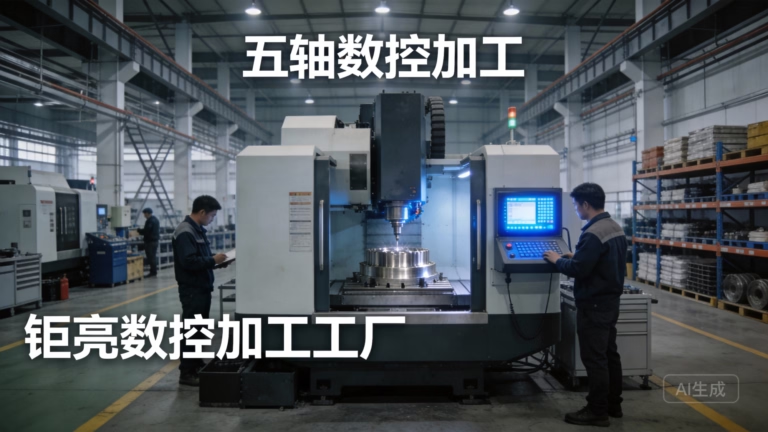
Integrated ODM CNC machining services makers keep those steps in one plant. GreatLight runs 127 high-precision CNC machines across three wholly-owned plants in Dongguan and Singapore: 16 simultaneous 5-axis centers, 12 four-axis mills, 27 three-axis machines and 16 mill-turn centers. Sheet metal, die casting, vacuum casting, 3D printing and surface finishing sit alongside them.
The practical value is datum control. If the same team machines the mounting face and drills the mating holes, hole position stays tied to one setup. Maximum processing size reaches 4,000 mm, so large frames and long rails do not need to be split and re-fixtured.
Ownership also shortens the schedule. A part that would spend a week moving between suppliers can move between departments in hours. That is what lets parts ship in 3–5 days without the tolerance drifting.
- 1One datum, one ownerFewer setups means fewer chances for position error to accumulate.
- 2Volume switchPrototype on 5-axis, move to die casting or mill-turn when quantities climb.
- 3Finish in sequenceAnodizing and laser marking follow the same inspection plan as the cut.
Certificates are a scope document, not a wall poster
ISO 9001:2015 is the baseline. Almost every supplier you will shortlist has it. The useful question is which processes and which site the certificate covers, and whether it is current. A certificate for a trading office tells you nothing about the machine shop.
For automotive and EV work, IATF 16949:2016 is the one that matters. It requires statistical process control, calibration traceability and first article inspection as routine practice, not as a special request. For medical devices, ISO 13485:2016 adds design and process validation discipline. GreatLight holds both, plus ISO 27001:2022 for information security.
The information security certificate is easy to overlook. If you are sending unreleased CAD for a product that has not launched, your drawings are the asset. An ISO 27001 system means document control, access limits and audit trails exist around that file.
Ask for the certificate number and the expiry date. Then ask which of your part numbers will be produced under that system. Paper compliance and a lived quality culture are different things.
- 1Match the scopeConfirm the certificate covers the plant and the process doing your work.
- 2Check the dateAn expired certificate is a warning sign about the management system.
- 3Inspection planAsk what is measured, how often, and what report you receive.
Holding ±0.005 mm in production, not just in a demo
The precision trap is the gap between a quoted tolerance and a repeatable one. Any machine can hit a tight number once, with a new tool, in a cool shop, on an easy feature. Production is different. Tool wear moves the cut. Thermal growth moves the part. Fixture pressure moves a thin wall before the cutter touches it.
The controls that close that gap are unglamorous. Temperature-controlled machining areas. In-process probing so the offset is corrected while the part is still on the table. A maintenance schedule for spindle runout and ball screw backlash. Tool life tracking rather than running a cutter until it squeals.
GreatLight targets ±0.005 mm (±0.0002 in) with 100% inspection before shipment: raw material check, in-process monitoring, final inspection, reports on request. Finish ranges run from Ra 1.6–3.2 μm as-machined, Ra 0.8–1.6 μm for general precision surfaces, and Ra 0.2–0.8 μm where sealing faces or bearing bores demand it.
When a supplier quotes a tolerance tighter than their equipment can hold day to day, you will find out at incoming inspection. Ask for the process capability instead of the marketing number.
- 1Probe, do not guessIn-process probing corrects drift before the part leaves the fixture.
- 2Thin walls need supportBelow 1 mm wall thickness, clamping strategy decides the result.
- 3Finish follows functionMatch the Ra range to the sealing or sliding surface, not to habit.
MOQ, lead time and what the quote should contain
Minimum order quantity is a useful filter. A supplier asking for 500 pieces before they will run your part is optimizing their setup cost, not your program. GreatLight has no minimum order quantity, so a single prototype and a 10,000-piece run go through the same quoting process.
Read the quote for what is missing. Unit price alone is not a quote. Look for material grade and temper, tolerance callouts per feature, surface finish, inspection scope, and the assumptions the price rests on. If the price assumes a 3-axis setup and the part actually needs 5-axis, the number will move later.
Lead time should be stated as a sequence, not a single figure. Quotation and DFM analysis inside 12 hours, production start within 24 hours, parts ship in 3–5 days. Ask what starts the clock: purchase order, material arrival, or drawing approval. On-time delivery history at GreatLight sits below a 2% late probability, which is a result of scheduling discipline rather than promises.
- 1One piece is a real orderUse a prototype to test communication, inspection and finish quality.
- 2Price the assumptionsAsk which setup, tool and material the number is built on.
- 3Confirm the clockKnow whether lead time starts at PO, material release or drawing sign-off.
A 6-step way to qualify ODM CNC machining services makers
Run these in order. Each step is designed to eliminate a supplier before it costs you a production slot.
- 1Send a hard part, not an easy onePick a component with a thin wall under 1.5 mm, a pocket deeper than 4× the tool diameter, or a true position callout under 0.05 mm. The response tells you whether engineers read the file.
- 2Ask for DFM notes with the priceYou want written comments on tool access, radii, datum strategy and any feature that will drive cost. A price with no notes means the file was quoted by a spreadsheet.
- 3Check certificate scope and expiryRequest ISO 9001, IATF 16949 or ISO 13485 numbers as your industry requires, and confirm the plant doing the work is covered. Verify the dates.
- 4Ask which processes leave the buildingHeat treat, anodizing, plating and laser marking are common outsourced steps. Every handoff adds lead time and a tolerance risk that nobody owns.
- 5Confirm the inspection planAsk what is measured, at which stage, and what report you get. First article inspection, in-process checks and final dimensional reports should be on the table.
- 6Qualify on a single prototypeWith no MOQ, order one piece. Measure it yourself, check the finish, and judge the paperwork. Then decide about the production run.
Questions engineers ask before signing an ODM order
What is the difference between a CNC machine shop and an ODM CNC machining partner?
A machine shop executes the drawing you send. An ODM partner reviews it, proposes design changes for manufacturability, manages the finishing and assembly steps, and stays accountable for the finished part.
The practical test is whether you get engineering feedback before the first cut. If the only reply is a price, you are buying capacity, not design support.
Which tolerances can be held in regular production?
GreatLight works to ±0.005 mm (±0.0002 in) with in-process probing and 100% inspection before shipment. That figure applies to production parts, not just a first article.
Tighter or looser requirements are quoted per feature. Features with large length-to-diameter ratios or thin walls may need a different setup or a relaxed callout, and that should appear in the DFM notes.
Is there a minimum order quantity for prototype work?
No. GreatLight accepts orders from one prototype up to 10,000+ part runs. The same quoting route applies to both.
For a single piece, expect to discuss setup cost rather than unit cost. That is normal and it is the cheapest way to qualify a supplier.
How do certifications affect a supplier selection?
ISO 9001:2015 covers general quality management. IATF 16949:2016 is required for automotive work and adds SPC and traceability discipline. ISO 13485:2016 covers medical devices.
GreatLight also holds ISO 27001:2022, which governs how your CAD files and documents are controlled. Check that the certificate covers the site and process doing your work.
What should a complete quotation include?
Material grade and temper, per-feature tolerances, surface finish range, inspection scope, and the setup assumptions behind the price. DFM comments should come with it.
At GreatLight, quotation and free DFM analysis are returned within 12 hours, and production can start within 24 hours of release.
How is confidential design data handled?
Uploads are treated as secure and confidential, and an NDA is available on request before you send drawings.
Ask how access is limited inside the supplier and who can open the file. That question is as important as the machining tolerance.
Send one hard part and judge the response
Quotation and free DFM analysis within 12 hours. No minimum order quantity, from a single prototype to a 10,000+ part run.
12-hour quote100% inspectionNo MOQNDA on request
More machining notes
We publish setup notes, tooling trials and inspection data from the factory floor.











