
Thermostat Frame CNC Milling: How to Choose the Right Process and Supplier
A thermostat frame holds sensor ports, seal faces and mounting bosses in line, so it has to stay flat through heat cycles and assembly torque. This guide gives engineers and buyers the checks that separate a capable milling supplier from one that ships parts that leak or drift. Read it before you send an RFQ.
In this article
- 1
- 2
- 3
- 4
- 5
- 6
- 7
What matters most in a thermostat frame quote
Choosing a process for thermostat frame production
The right route depends on volume, wall thickness and how many faces carry seals.
| Process | Best for | Watch out for |
|---|---|---|
| 3-axis CNC milling | Flat frames, one sealing face, prototypes | Second setup adds positional error |
| 4-axis CNC milling | Frames with side ports at 90° | Rotary table runout on long spans |
| 5-axis CNC milling | Thin walls, angled ports, undercuts | Higher hourly rate, worth it on complex parts |
| Die casting + milling | Runs above 10,000 parts | Porosity at seal faces, tooling lead time |
| Sheet metal fabrication | Simple covers, no fluid cavities | Cannot hold port position to ±0.005 mm |
Pick the process that matches the frame, then the supplier that proves it
A flat frame with one seal face belongs on a 3-axis mill. Angled ports and thin walls belong on 5-axis. Either way, ask for CMM data and a stress-control plan before you place the order.
What makes a thermostat frame hard to mill
A thermostat frame is a skeleton, not a box. It carries a sensor boss, two or more port interfaces and a ring of mounting holes, often inside a 200 mm envelope. The part looks simple on a drawing. In the machine it behaves like a thin ring, and thin rings move when you cut them. Flatness of the seal face, positional tolerance of the ports and wall thickness control are the three numbers that decide whether the assembly seals.
The first constraint is the seal face. A typical specification calls for 0.02–0.05 mm flatness across the gasket land. That sounds loose until you consider that roughing removes 70–80% of the stock from a billet, and the released residual stress pulls the frame out of plane. We leave 0.3–0.5 mm of stock for finishing, run a semi-finish pass to equalize the load, then take the final face cut with a sharp, coated end mill at light radial engagement. Cutting force, not machine accuracy, is usually what bows the part.
The second constraint is the wall. Frames for coolant control often run 1.5–3 mm walls between the fluid channel and the outside. Below 1.5 mm, chatter appears quickly and the wall deflects under clamping pressure. Above 4 mm, weight and thermal mass grow and the frame responds slower to temperature changes. If your design needs a 1 mm web, plan for a 5-axis setup with adaptive clearing and a dedicated soft-jaw fixture so the part is supported on the surfaces that will not be machined.
- 1Seal face flatness0.02–0.05 mm across the gasket land is a common target.
- 2Port position±0.02–0.05 mm to the datum, verified on a CMM.
- 3Wall section1.5–3 mm is comfortable; ask about support below that.
- 4Surface finishRa 0.8–1.6 μm on seal faces; Ra 1.6–3.2 μm elsewhere.
Matching material to the fluid and the heat cycle
Most thermostat frames we mill are 6061-T6 or 7075 aluminum. Both machine well, hold tight tolerances and conduct heat fast, which helps the thermostat respond. 6061-T6 is the default for glycol and water loops. 7075 gives higher strength for frames that see vibration or high assembly torque, but it costs more and is less weldable. If the frame touches coolant at elevated temperature for years, 316L stainless is the safer choice, though it machines at roughly half the speed and needs sharp tooling to avoid work hardening.
For aggressive media such as brine, DEF or acidic condensate, 316L and 17-4PH hold up better than 304. Plastic frames are another option. PEEK and PTFE handle high temperature and chemical exposure and act as thermal insulators, but they have low stiffness and a high thermal expansion coefficient, so port positions move more between 20 °C and 120 °C. That matters if the design uses a rigid metal seal.
Mixed-material assemblies create their own problem. A stainless frame with an aluminum cover and a steel fastener forms a galvanic couple. In a wet environment, the aluminum becomes the anode and corrodes first. We see this in coolant controllers where a steel screw sits in an aluminum boss. Insulating washers, plated fasteners or an anodized frame break the couple. Choose this deliberately at the design stage, not after the first field failure.
- 16061-T6Default choice for glycol and water loops.
- 27075-T6Higher strength where vibration or torque is high.
- 3316L / 17-4PHCoolant, brine and acidic condensate.
- 4PEEK / PTFEInsulating frames, but check thermal growth.
How to compare thermostat frame CNC milling suppliers
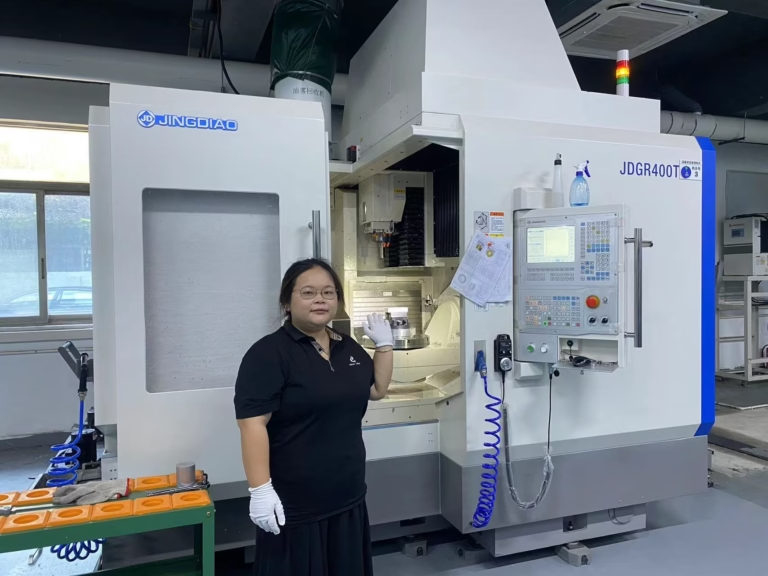
The quote is the easy part. What separates suppliers is how they control the process. Ask for the number of simultaneous 5-axis centers and the size of the working envelope. A frame with angled ports and a 300 mm span needs a machine that can reach all faces without re-fixturing. Re-fixturing is where positional error accumulates, and it is the most common cause of a frame that fits one assembly and not the next.
Next, ask how the supplier handles residual stress. Good practice is stress-relieved or pre-machined stock for thin frames, a roughing pass that leaves uniform stock, and a semi-finish pass before the final cut. A shop that goes straight from roughing to finishing on a 2 mm wall will fight distortion all day. Ask whether they use adaptive clearing toolpaths to keep constant tool engagement. This is a process question, not a marketing question, and the answer tells you a lot.
Then check the inspection routine. A thermostat frame should be measured on a CMM for flatness and port position, not with calipers at the bench. Ask for the report format and whether data is retained per lot. For automotive and medical programs, look for IATF 16949:2016 or ISO 13485:2016, and for information security, ISO 27001:2022. Finally, confirm the commercial terms: no minimum order quantity matters for prototype iterations, and a 12-hour quote with DFM feedback keeps your schedule moving.
- 1Machine envelope5-axis reach for angled ports without re-fixturing.
- 2Stress controlPre-machined stock and a semi-finish pass.
- 3InspectionCMM flatness and position reports per lot.
- 4CertificationsIATF 16949, ISO 13485 and ISO 27001 where relevant.
What drives cost and lead time in a frame program
Machining time dominates the unit cost of a thermostat frame. A simple 3-axis frame with one seal face might run 15–25 minutes per part. A 5-axis frame with angled ports, thin walls and two seal faces can run 60–90 minutes, plus setup. That difference, not the material price, is what moves the quote. If your design allows open tolerances on non-sealing surfaces, say so. Suppliers can then use a larger stepover and a faster finish pass on those areas.
Setup count matters as much as cycle time. Every additional fixture adds labor, risk and inspection. Design the frame so the critical features can be reached from two orientations or fewer. If you can put the seal face and the port faces in one 5-axis setup, positional tolerance improves and the cost usually drops despite the higher hourly rate.
Lead time follows the same logic. A clean design with a 3D model, a drawing and defined datums moves through quoting and DFM review quickly. Vague callouts such as 'flat' or 'smooth' force the supplier to guess, and guesses come back as questions. For prototypes, expect a fast turnaround; for production runs, the schedule depends on material availability and finishing. Anodizing and plating add days, so plan the finish step into your build, not after it.
- 1Cycle time15–25 minutes for simple 3-axis frames.
- 25-axis frames60–90 minutes plus setup on complex geometry.
- 3Setup countFewer orientations means tighter position and lower cost.
- 4FinishingAnodizing and plating add days to the schedule.
Step by step: preparing a thermostat frame for milling
Work through these steps before you send the RFQ. Each one removes a reason for the supplier to guess.
- 1Define the datum schemePick the seal face as the primary datum and one port axis as secondary. Call out flatness and position to those datums, not to the raw block.
- 2Set wall and web thicknessKeep structural walls at 1.5–3 mm. If a web must be thinner, mark it and note that support is allowed during machining.
- 3Tolerance only what sealsHold ±0.02–0.05 mm on seal faces and port positions. Leave non-critical edges at ±0.1 mm or general tolerance.
- 4Choose the material by media6061-T6 for glycol, 316L for coolant and brine, PEEK when thermal isolation matters. State the operating temperature range.
- 5Specify the finish by functionRa 0.8–1.6 μm on seal faces, Ra 1.6–3.2 μm elsewhere. Add anodizing or plating only where corrosion or wear requires it.
- 6Ask for DFM feedbackRequest a manufacturability review with the quote. A good supplier will flag thin walls, deep pockets and hard-to-reach ports.
- 7Agree on inspectionState which dimensions need CMM reports and whether data must be retained per lot for traceability.
Common questions about thermostat frame CNC milling
What tolerance can you hold on a thermostat frame seal face?
We work to ±0.005 mm on critical features and hold 0.02–0.05 mm flatness across typical gasket lands.
The achievable number depends on wall thickness and how much stock is removed. Thin frames with heavy stock removal need stress-relieved material and a semi-finish pass to stay in tolerance.
Is 5-axis milling worth the higher rate for a thermostat frame?
Yes when the frame has angled ports, undercuts or walls under 1.5 mm. One 5-axis setup removes the positional error that comes from re-fixturing.
For a flat frame with a single seal face, 3-axis milling is cheaper and just as accurate. Match the process to the geometry, not to the machine list.
How do you stop thin walls from chattering?
Use adaptive clearing to keep constant tool engagement, leave uniform stock for finishing, and support the part with soft jaws or a dedicated fixture.
A sharp, coated end mill with light radial engagement cuts cooler and deflects the wall less. Dull tooling is the most common cause of chatter on thin sections.
What material should we use for a coolant thermostat frame?
316L stainless handles coolant, brine and acidic condensate better than aluminum. It machines slower and costs more, but it will not pit the way 6061 can in a wet galvanic couple.
If weight matters more than corrosion life, use 6061-T6 with anodizing and isolate any steel fasteners with washers or plating.
Can we order a single prototype frame?
Yes. There is no minimum order quantity, so a one-off prototype and a 10,000-part run use the same process discipline.
Prototype parts get the same inspection routine as production. That way the geometry you validate is the geometry you scale.
What do you need to quote a thermostat frame?
Send a 3D model, a 2D drawing with datums and tolerances, the material, the finish and the quantity. Note the operating temperature and fluid if they affect material choice.
Quotation and free DFM analysis come back within 12 hours. Production can start within 24 hours once the design is confirmed.
Send your thermostat frame drawing for a DFM review
Upload a 3D model and drawing, and we will return a quote with manufacturability notes within 12 hours. No minimum order quantity, and your files stay confidential.
12-hour quoteFree DFM analysis100% inspectionNDA on request
More machining notes from the shop floor
We publish setup notes, tooling trials and inspection data from the factory floor.











