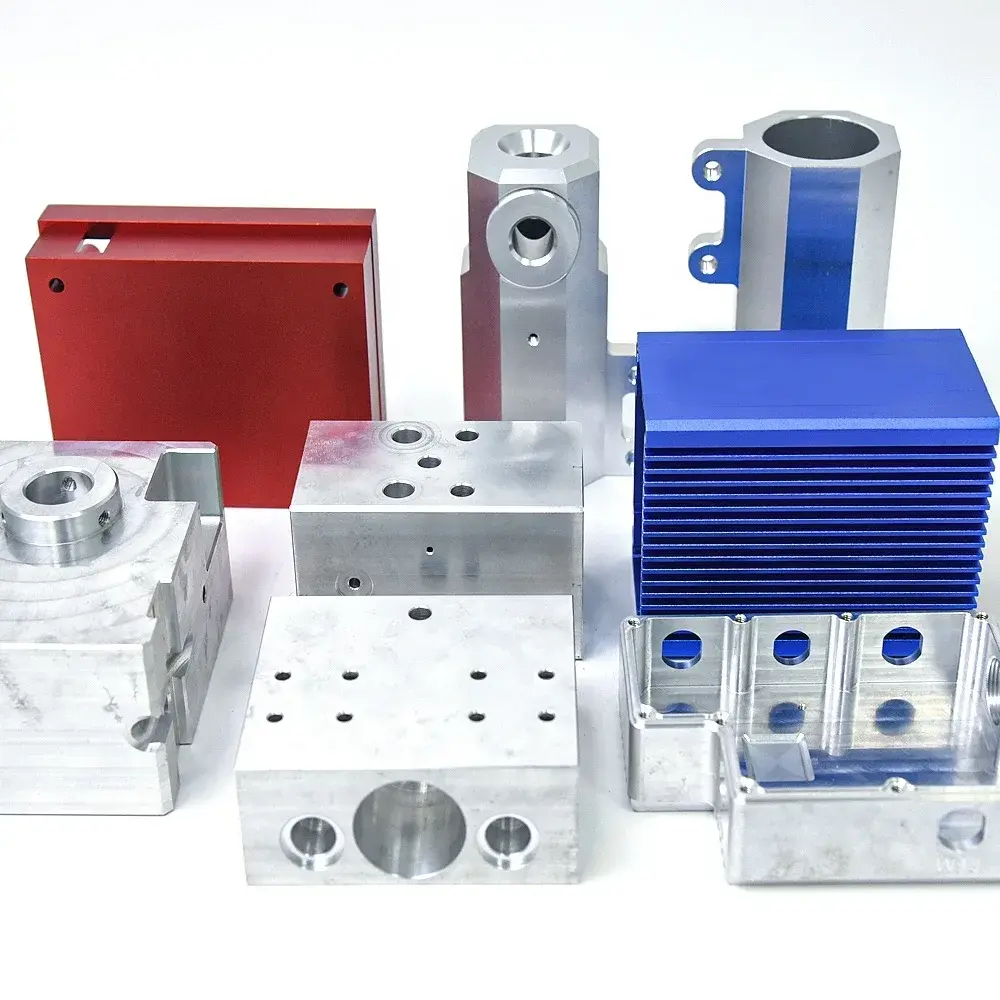
In CNC milling cutting, machining errors can have many causes. The error caused by tool runout is one of the important factors. It directly affects the small shape error that the machine tool can obtain under ideal processing conditions. geometry of the machined surface. For shape accuracy, the following describes how to reduce runout of CNC milling machine tools.
1. Use sharp knives
Choose a larger cutting angle to make the tool sharper and reduce cutting force and vibration. Select a larger tool clearance angle to reduce friction between the main flank surface of the tool and the elastic recovery layer on the transition surface of the part, thereby reducing vibration. However, the cutting angle and back angle of the tool cannot be selected too large, otherwise the strength and heat dissipation area of the tool will be insufficient. Therefore, different cutting angles and tool clearance angles should be selected according to specific conditions. When rough machining, they may be smaller. However, when finishing, in order to reduce the runout of the tool, they need to be larger to make the tool. Sharper.
2. The rake surface of the tool should be smooth
When using a CNC milling machining center, the smooth cutting surface can reduce chip friction on the tool and can also reduce the cutting force on the tool, thereby reducing runout radial of the tool.
3. The quantity of knife used should be reasonable.
If the cutting quantity is too small, processing slippage phenomenon will occur, which will cause the tool runout to continuously change during processing, making the machined surface not smooth. When the cutting quantity is too large, the cutting. the force will increase, resulting in strong deformation of the tool, increasing the radial runout of the tool during processing, and also making the machined surface not smooth.
4. Clean the spindle taper hole and chuck
The spindle taper hole and chuck of the CNC milling machining center should be clean and free from dust and debris generated during workpiece processing. When choosing a treatment tool, try to use a tool with a shorter extension length. When cutting, the force should be reasonable and uniform, neither too large nor too small.
5. Use reverse milling during finishing
Since the position of the gap between screw and nut changes during milling, it will cause uneven feed of the workbench, resulting in shock and vibration, which will affect the life of the machine tool , the tool and the roughness of the machined surface of the part. When using milling, the cutting thickness changes from small to large, and the load on the tool also changes from small to large, which makes the tool more stable during processing. Note that this is only used for finishing. Face milling should always be used when roughing, because the productivity of face milling is high and the tool life can be guaranteed.
6. Use cutting fluid rationally
The reasonable use of cutting fluids of CNC milling machining centers. Aqueous solutions with primarily cooling effects have little effect on cutting forces. Cutting oil mainly used for lubrication can significantly reduce cutting forces. Due to its lubricating effect, it can reduce the friction between the rake face of the tool and the chip and between the flank face and the transition surface of the workpiece, thereby reducing the radial runout of the tool .
7. Use powerful tools
There are two main ways to increase the strength of a tool. First, the diameter of the tool holder can be increased. Under the same radial cutting force, if the tool holder diameter is increased by 20%, the tool runout can be reduced by 50%. The second is to reduce the protrusion length of the tool. The larger the protrusion length of the tool, the greater the deformation of the tool during processing. During processing, it is constantly changing, and the tool runout will continue to change. accordingly, resulting in a workpiece. Similarly, if the machined surface is not smooth, if the extension length of the tool is reduced by 20%, the radial runout of the tool will also be reduced by 50%.
Practice has proven that as long as the manufacturing and assembly precision of each part of the machine tool is ensured and reasonable processes and tools are selected, the impact of the radial runout of the tool on the machining precision of the part may be reduced. to the greatest extent.
Daguang focuses on providing solutions such as precision CNC machining services (3-axis, 4-axis, 5-axis machining), CNC milling, 3D printing and rapid prototyping services.