GreatLight CNC Machining Factory logo
CNC Machining
Rapid Prototyping
Materials
Industries
News
About GL

Get Instant Quote

Transmission & Powertrain Housings

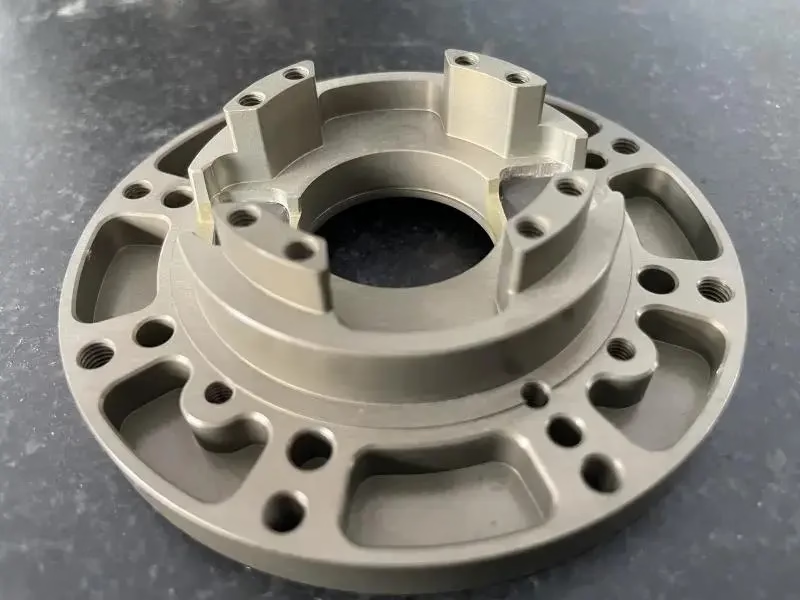
CNC Machining Bell Housing for Transmission and Motor Housings

We machine bell housings, e-motor housings and gearbox covers from billet or cast blanks. One setup on 5-axis holds bore-to-face alignment, so the input shaft, bearing bores and dowel pins land where the drivetrain drawing says they should.

±0.005 mmØ400 mm rotary table4,000 mm max travelIATF 16949:2016No MOQ12-hour DFM
low volume manufacturing
16Simultaneous 5-axis centers
±0.005 mmAchievable tolerance
99.99%Qualification rate
3–5 daysTypical part shipping
Where bell housings go wrong

Four failures that show up after assembly

Most bell housing problems are not surface problems. They are alignment problems that only appear when the gearbox is bolted up.

01

Bore and face are not square

The bearing bore runs out of true to the mounting face. Input shaft alignment drifts, the pilot bearing loads on one side, and the unit growls at a specific rpm band. A CMM report on the first article catches this before the parts ship.

02

Dowel holes drift between batches

Holes are reamed in a second setup with a fresh datum. Batch one fits, batch three does not, and the line rejects a whole pallet. Keeping the dowel pattern in the same setup as the bore removes that variable.

03

Wall thickness varies on cast blanks

Casting shift moves 1.5 mm of stock to one side. A fixed toolpath then cuts through a rib or leaves a thick web that adds mass. We probe the blank first and shift the toolpath to the actual casting.

04

Flatness fails after heat or coating

The mounting face measures flat on the bench, then warps during anodizing or service heat. Stress-relieved stock and a controlled finishing sequence hold the flange flat.

How we hold alignment

One setup, one datum, one report

Bore, face, dowel pattern and bolt circle come off the same zero point.

die-casting-technology
Setup strategy

5-axis work that keeps bore and face in one coordinate system

A bell housing has one job: hold the transmission input axis in line with the crankshaft or motor shaft. That relationship lives in the bore-to-face geometry, so we cut the mounting face, the bearing bore, the dowel holes and the bolt circle without breaking the setup. On a Ø400 mm rotary table the part rotates instead of being re-fixtured.

For castings we probe the blank and shift the toolpath to the real surface. That keeps wall thickness even when the casting shifts, and it stops a rib from being cut through. First articles ship with dimensional data so your engineers can check the numbers before the run continues.

  • 1
    Single-setup bore and faceNo second-op datum shift on the critical axis.
  • 2
    Blank probing on castingsToolpath follows the actual cast surface, not the nominal one.
  • 3
    First-article dataDimensional report on request before the batch proceeds.

Get Instant Quote

large-die-cast-metal-part-back-19
Materials and stock form

Billet or casting: pick the one your volume and load case justify

Billet suits prototypes and low-volume runs where no tooling exists yet. You get uniform grain, no porosity and full freedom to change wall thickness between revisions. It costs more per part at high volume because every surface is cut from solid.

A die casting pays off once the geometry is frozen and the annual volume is large. The trade is porosity control and draft angles, which we handle by machining the critical bores and faces after casting. Aluminum alloys we run include 6061-T6, 6082, 7075 and ADC12 for cast blanks.

  • 1
    BilletBest for prototypes, revisions and small runs.
  • 2
    Die castingBest for frozen geometry at high annual volume.
  • 3
    Hybrid routeCast the shell, machine the bore and flange.

Talk to an Engineer

Selection guide

Which route fits your bell housing

Use this to decide before you send a drawing.

ConditionBillet machiningDie casting + machining
Prototype or first revisionFits wellTooling cost not justified
Annual volume under 500Lower total costTooling spread too thin
Frozen geometry, 5,000+ /yearHigher per-part costLower per-part cost
Wall thickness under 4 mmStable, no porosityNeeds draft and rib review
Bore tolerance under ±0.01 mmMachined directlyMachined after casting
Design still changing monthlyChange the programTooling change is costly
What we run

Services around a transmission housing program

One supplier for the shell, the mating parts and the finish.

01

5-Axis CNC Machining

Simultaneous 5-axis for one-setup bore and face work on housings up to 4,000 mm.

02

CNC Milling & Turning

Mill-turn centers for flanges, bearing caps and shaft-side features in one cycle.

03

Metal Die Casting

Aluminum shells cast to near net shape, then machined on the critical surfaces.

04

Rapid Prototyping

Machined or printed prototypes for fit checks before tooling is committed.

05

Part Surface Finishing

Anodizing, powder coating, plating and bead blasting after machining.

06

Vacuum Casting

Small-batch urethane and low-volume castings for early build phases.

Capability range

Machine and inspection envelope

Numbers your process planner can check against the drawing.

ItemRange
Achievable tolerance±0.005 mm (±0.0002 in)
Surface finishRa 0.2–3.2 μm by process
Standard finishRa 0.8–1.6 μm
Maximum part size4,000 mm
Large travel4,000 × 400 × 150 mm
Medium travel750 × 1,150 × 550 mm
Rotary tableØ400 mm
Machines on site127 high-precision CNC
Inspection100% before shipment
Why GreatLight

What the numbers say

Fifteen years in Dongguan, three plants, one quality system.

15Y

Machining since 2011

Three wholly-owned plants across 7,600 m², with 150 technicians on the floor.

±0.005

Tolerance held in production

Not just a lab figure. Process capability is monitored through the run.

16

Simultaneous 5-axis centers

Out of 127 CNC machines, plus 16 mill-turn centers for shaft-side work.

99.99%

Qualification rate

Raw material check, in-process monitoring and final inspection on every lot.

12 h

Quote and DFM turnaround

Send a model, get a quotation with manufacturability notes the same day.

0

Minimum order quantity

From one prototype to runs above 10,000 parts on the same program.

7,600 m²Manufacturing space
127CNC machines total
IATF 16949Automotive quality system
<2%Historical late-delivery rate
Industry fit

What these programs require, and what we deliver

electronic-product-housing-prototype

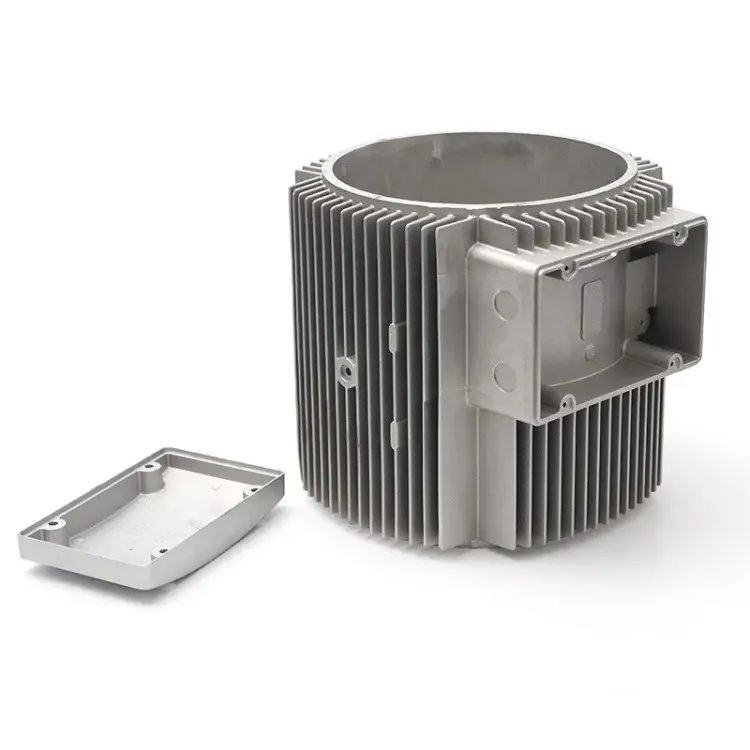
EV drive unit housing

Motor and gearbox share one casting. Bore alignment decides noise.

  • ±0.005 mm
  • Ra 0.8–1.6 μm
  • 100% inspection
large-die-cast-metal-part-back-5

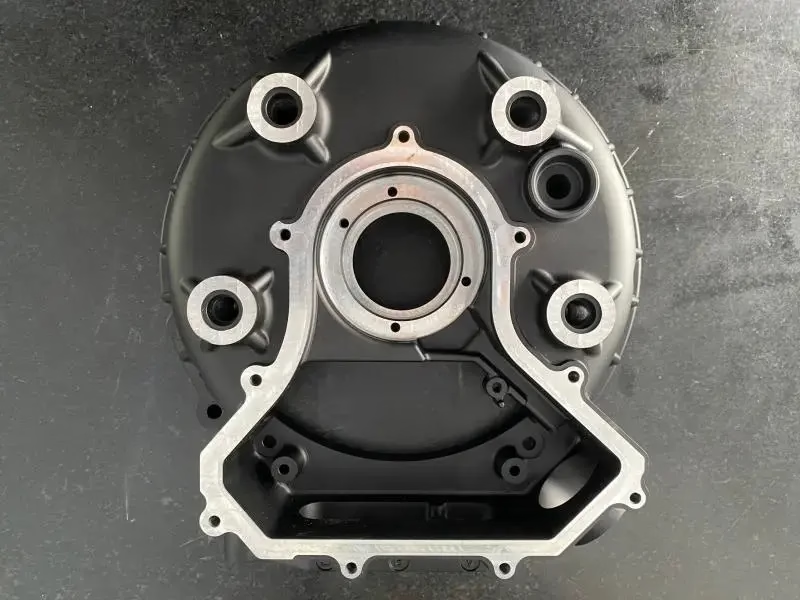
Automotive transmission bell housing

IATF 16949 documentation required from first article onward.

  • IATF 16949:2016
  • First-article report
  • Traceable lots
vacuum-casting-services1

Industrial gearbox cover

Low volume, geometry still moving, no tooling budget yet.

  • No MOQ
  • Billet route
  • 3–5 day shipping
cnc-machining-hdpe

Robotics joint housing

Stiffness and mass trade off against each other at every revision.

  • Wall probing
  • ±0.0002 in
  • Anodized finish
FAQs

Questions engineers ask before sending a model

Can you machine a bell housing from a customer-supplied casting?

Yes. Send the casting drawing and the machined drawing. We probe each blank, shift the toolpath to the real surface, and cut the bore, face and dowel pattern from the same datum.

If the casting shift is larger than the machining allowance, we flag it before the run instead of cutting through a wall.

What tolerance can you hold on a bearing bore?

±0.005 mm is achievable on bore diameter and position when the part is cut in one setup and the machine is thermally stable.

Tighter bores are usually handled by leaving stock and finishing after any heat treatment, so the final geometry is cut last.

Billet or casting for a 300-piece run?

At 300 pieces, billet is normally the lower total cost because die tooling is not amortized.

If the geometry is frozen and you expect 5,000 or more per year, a cast shell with machined bores usually wins on unit price.

How do you stop the flange warping after anodizing?

We stress-relieve where the material allows, keep finishing cuts light, and control how the part is racked during coating.

For flanges with a flatness callout, we check flatness after finishing rather than only on the freshly machined part.

What does the first article include?

Dimensional data on the critical features, material certification for the lot, and inspection records on request.

We can also supply a full dimensional report against the drawing's tolerance block if your quality team needs it.

How fast can parts ship?

Quotation and DFM analysis come back within 12 hours. Production can start within 24 hours of a released order.

Standard parts ship in 3–5 days. Larger housings or coated parts add time for finishing, which we confirm before the order starts.

Do you sign an NDA for transmission drawings?

Yes. Uploads are handled as confidential and an NDA is available on request before you send files.

We do not share customer drawings, models or part photographs.

What inspection happens before shipment?

Raw material check on receipt, in-process monitoring during cutting, and final inspection on 100% of parts.

Reports are issued on request, and any non-conforming feature is caught before the pallet leaves the plant.

Send a bell housing drawing and get a manufacturability answer

Upload your model. We come back with a quote, a DFM note and a suggested route within 12 hours.

12-hour quote100% inspectionNo minimum order quantityNDA on request

Trusted by engineers and manufacturers worldwide

Tesla Ford Motor Company BYD Auto Denso Magna International Boeing Airbus Medtronic KUKA FANUC