
ATS Controller Housing OEM Machining
This page covers how these enclosures are machined, which features drive cost, and when 5-axis is the right call. It is written for mechanical and hardware engineers specifying housings for automated test systems, plus the buyers who sign off on the tooling. Read it and you can judge whether a supplier quote is realistic before you cut metal.
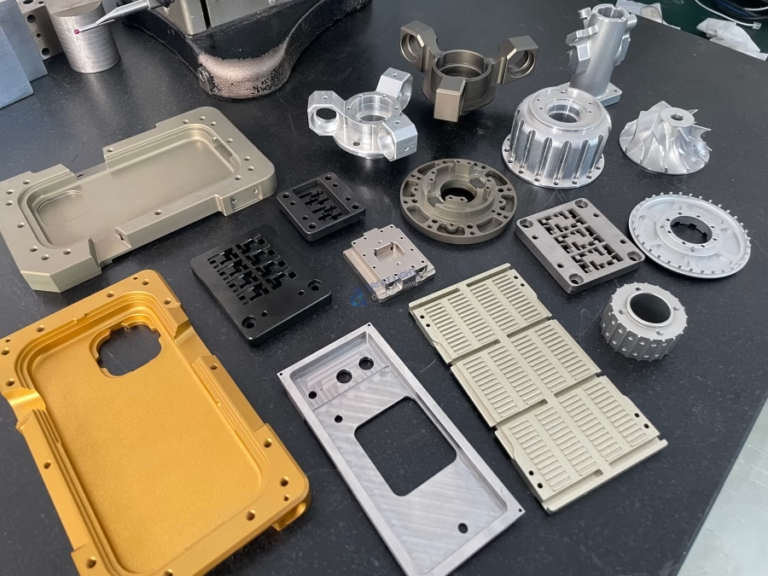
What an ATS Controller Housing Actually Has to Do
An enclosure that holds a controller card, a power stage and a connector panel is a tolerance stack, a heat path and an EMI boundary at the same time.
The Features That Decide Whether a Housing Works
An ATS controller housing is not a box. It is a stiff frame that keeps a PCB from flexing under vibration, a thermal path that pulls heat off the power devices, and a shield that limits how much noise reaches the analog front end. Those three jobs fight each other. A wall thick enough to damp 200 Hz vibration adds mass and slows heat transfer. A vent that fixes the thermal problem opens an EMI gap. The machining plan has to settle that argument before the first chip is cut.
Most failures we see on incoming housings are not dimensional. They are functional. A cover that bows 0.15 mm across a 300 mm span stops sealing. A connector pocket cut 0.05 mm shallow makes a panel-mount D-sub sit proud, and the gasket never compresses evenly. Thread depth on a heatsink boss runs short, and the screw bottoms out before the thermal pad touches.
So the drawing has to name the critical features, not just the general tolerance block. Flatness on the gasket face, position of the mounting holes to the PCB datum, perpendicularity of the connector bores, and Ra on any surface that meets a thermal interface. Everything else can float. When a shop knows which four or five callouts matter, the fixture design and the inspection plan follow from them.
Materials follow the same logic. Die-cast ADC12 is cheap in volume but porous at thin walls, so it needs sealed surfaces if you want IP protection. Extruded 6061-T6 gives you straight walls and good thermal conductivity with no tooling cost. Sheet metal is fastest to prototype but flexes at the panel. Pick the process before you pick the shop.
- 1Flatness on gasket faces0.05 mm over 300 mm keeps a gasket in compression.
- 2Hole position to PCB datum±0.05 mm avoids preloading the board.
- 3Connector bore perpendicularity0.02 mm per 25 mm stops shell tilt.
- 4Thermal interface finishRa 0.8–1.6 μm closes the gap to a pad.
Why 5-Axis Machining Changes the Cost Curve
A housing with pockets on five sides, angled connector bores and a raised gasket land cannot be made on a 3-axis mill without three or four setups. Every setup adds a fixture, a datum shift and an operator touch. Error stacks. A simultaneous 5-axis center cuts five sides in one clamping, so the datum never moves and the position tolerance between a connector bore and a PCB boss stays tight.
That matters most on small, stiff parts. A controller housing might measure 300 × 200 × 80 mm with 4 mm walls. Thin walls ring under interrupted cuts. Holding it in a vise to machine the second side distorts it, and the part springs back after unclamping. In-process probing on a 5-axis machine catches that before the next operation.
GreatLight runs 16 simultaneous 5-axis machining centers, 12 four-axis mills, 27 three-axis machines and 16 mill-turn centers across 127 high-precision CNC machines. Maximum processing size is 4,000 mm, with travel of 4,000 × 400 × 150 mm on the large frame and 750 × 1,150 × 550 mm or 600 × 600 × 600 mm on the medium frames. Controller housings sit well inside those envelopes, which means we can run them on the machine that matches the feature count rather than the one that happens to be free.
One caution. Five-axis is not automatically cheaper. If your housing is a simple two-sided plate, a 3-axis machine with a soft jaw does the job faster. Use 5-axis when the part has angled faces, contoured surfaces, or tolerances that break under multiple setups. Below 50 units, tooling and programming often dominate the price anyway.
- 1Single clampingKeeps connector bores and PCB bosses in one datum.
- 2In-process probingCatches wall deflection before the finish pass.
- 3Right machine for the jobSimple plates run faster on 3-axis.
Process and Material Selection for ATS Housings
Match the process to quantity, wall stiffness and thermal load before you request a quote.
| Option | Best for | Watch out for |
|---|---|---|
| 6061-T6 billet, 5-axis | Prototypes to 10,000+ units | Higher material cost than casting |
| ADC12 die casting | Volumes above a few thousand | Porosity at thin walls, needs sealing |
| Extruded 6063 profile | Long straight enclosures | Limited pocket depth, soft alloy |
| Sheet metal, 5052 | Fast prototype, low EMI demand | Flexes at connector panels |
| 304 stainless, 3-axis | Corrosive washdown areas | Heavy, slow to cut, tool wear |
| Mill-turn 316L | Round sensor bodies, fittings | Not for box-shaped housings |
Finishes, Shielding and the Steps After Machining
Machining leaves a housing that fits but does not yet survive. Anodizing adds a dielectric layer, which is fine on the outside and a problem on any surface that must ground to the chassis. If the housing is part of the EMI path, mask the gasket land or specify conductive anodizing. Hardcoat gives wear resistance on sliding covers but cannot be masked at the same fine detail.
Electroless nickel goes on uniform, including inside blind pockets, and it solders. Zinc and black oxide are cheaper but thinner. Powder coating covers tool marks on a welded frame and hides a lot of cosmetic damage, though it adds 60–100 μm and can bridge tight gaps. Bead blasting before anodizing gives a matte, uniform look and removes the cutter marks that show through a clear finish.
Laser marking is the last step. Minimum character height is 1.5 mm. Put the part number, revision and a date or lot code on a face the operator can read after the unit is installed, not on the bottom where it disappears into a rack.
Every housing we ship gets raw material verification, in-process monitoring and a final inspection before it leaves. That is 100% inspection, with reports on request. Qualification rate across the shop runs at 99.99%. For a controller housing, that final step is where flatness and hole position get confirmed on a CMM rather than trusted to the operator.
- 1Conductive anodizeKeeps the gasket land grounded.
- 2Electroless nickelUniform inside blind pockets, solderable.
- 3Powder coatAdds 60–100 μm; check gap clearance.
- 4Laser marking1.5 mm minimum character height.
How to Read a Quote Before You Commit
Ask what the shop assumed. A quote built on a general tolerance block and a three-setup plan will drift once the gasket flatness callout shows up. Get the DFM notes back with the price. GreatLight returns a quotation and a free DFM analysis within 12 hours, and production can start within 24 hours once the drawing is frozen. Parts ship in 3–5 days.
Ask who inspects. If the machine shop sends parts out for anodizing and a different vendor measures them, nobody owns the stack-up. An integrated shop machines, finishes and inspects in the same building, so a flatness problem is caught before plating, not after.
Ask about volume range. A shop tooled for 10,000-unit runs will price a 20-piece prototype badly, and a prototype shop will not hold tolerance at volume. GreatLight has no minimum order quantity, from one prototype to 10,000+ part runs, across three wholly-owned plants covering 7,600 m² with 150 technicians. Certifications are ISO 9001:2015, IATF 16949:2016, ISO 13485:2016 and ISO 27001:2022.
The last question is confidentiality. Controller drawings carry your architecture. Uploads are secure and confidential, and a non-disclosure agreement is available on request before any file moves.
- 1DFM notes with the priceReveals the assumptions behind the number.
- 2One building, one ownerMachining, finishing and inspection together.
- 3Volume rangeNo MOQ; prototype to 10,000+ units.
Frequently Asked Questions
What tolerance can you hold on an ATS controller housing?
We machine to ±0.005 mm (±0.0002 in) on critical features, with 100% inspection before shipment. Not every dimension needs that. We apply the tight tolerance to gasket faces, PCB mounting holes and connector bores, and let cosmetic surfaces run to the general block.
Which materials do you stock for housings?
Aluminum 6061, 6061-T6, 2024, 5052, 5083, 6063, 6082, 7075 and ADC12 die-cast alloy. Stainless 303, 304, 316, 316L, 420, 430, 431, 440C and 17-4PH. Steel 1018, 1045, 4130, 4140, 4340, A36 and tool steel. Copper and brass grades including C101, C110 and C36000. Titanium TA1, TA2, TC4, plus Inconel and magnesium AZ31B or AZ91D. Engineering plastics include ABS, PC, POM, PEEK and carbon fiber.
Can you mask anodizing on the grounding surfaces?
Yes. We mask gasket lands and grounding pads during anodizing, or apply conductive anodizing where the housing forms part of the EMI path. Tell us which surfaces must stay conductive and we will note it on the traveler.
How fast is a prototype housing?
Quotation and a free DFM analysis come back within 12 hours. Production can start within 24 hours after the drawing is frozen, and parts ship in 3–5 days. Historical late-delivery probability is below 2%.
Do you machine the mating cover and the base as a matched set?
Yes. Machining base and cover in the same setup sequence keeps hole patterns aligned and gasket lands coplanar. We mark matched pairs with a laser so they stay together through finishing and assembly.
What do you need to quote?
A 3D model plus a 2D drawing with the critical callouts, material, finish, quantity and any assembly notes. If you only have a model, send it and we will flag the features that need a tolerance decision before machining starts.
Send the Drawing, Get a Realistic Number
Upload your housing model and drawing. Within 12 hours you get a quotation and a free DFM analysis, with the critical features flagged before anything is cut.
12-hour quote100% inspectionNo MOQNDA on request









