
Bulk Metal 3D Printing Wholesale: How to Buy Low Cost Without Losing the Tolerance
This guide is for engineers and sourcing teams moving a metal AM part from one prototype to a few hundred or a few thousand units. It covers where the real cost sits, which checks separate a workable quote from a cheap one, and when a printed part should go straight to the CNC instead.
In this article
- 1
- 2
- 3
- 4
- 5
- 6
- 7
Key takeaways
Which Process Fits Your Lot Size and Geometry
Read the row that matches your part, then check the two columns on the right before you send an RFQ.
| Part situation | Best route | Why | Watch out for |
|---|---|---|---|
| 1–20 units, complex internal channels | LPBF metal printing | No tooling cost, geometry is free | Support removal on internal faces |
| 200–2,000 units, simple shape | CNC from bar or plate | Lower unit cost, tighter bores | Higher material waste on deep pockets |
| 500+ units, thin walls, low load | Binder jetting + sinter | Fast layer rate, nested builds | Sinter shrink 15–20%, needs allowance |
| Printed part with a bearing bore | Print then 5-axis finish | Print keeps the shape, CNC holds the fit | Two setups, plan the datum early |
| Printed part, non-critical surfaces | Print + tumble or bead blast | Cheapest route to a clean skin | Blasting rounds sharp edges |
| Wall under 0.4 mm in steel | Reconsider the design | Thin walls warp and lose density | Porosity at the root of the wall |
| Part over 400 mm in one axis | Weld or bolt sub-assemblies | Build envelope is the limit | Joint alignment after heat treat |
Pick the Route, Then the Supplier
If your part has functional bores or seal faces, budget for finish machining from the start. If it is a simple prismatic shape at 200+ units, quote it as CNC first. Then choose the supplier who shows you the inspection plan, the powder policy and the full scope in writing.
Where the Money Actually Goes in Bulk Metal 3D Printing Wholesale
A metal AM quote has five cost lines: powder, machine time, heat treat, support removal, and finish machining. Buyers usually negotiate the machine time because it looks like the biggest number. In practice, the last two lines decide whether the order is repeatable. A part that leaves the printer at Ra 8–12 μm and ±0.3 mm will not fit anything until someone touches it, and that touch is where budgets break.
Powder is the line most often hidden. Virgin Ti-6Al-4V or 17-4PH powder is expensive, and a supplier who reuses powder aggressively can quote 20–30% lower on the same geometry. Reuse is normal and accepted, but it must be controlled. Sieving, chemistry checks and a documented reuse count keep oxygen and satellites in range. Ask how many times a lot has been through the machine before you accept the price.
Build layout is the quiet lever. Nesting more parts per plate spreads the fixed machine cost, but packing too tight changes the gas flow and the local cooling rate. That shows up as density variation between the parts at the center of the plate and the parts at the edge. A supplier who tracks density per position, not per batch, is usually the one with a stable process.
The phrase low cost should be treated as a claim about the whole route, not about the printing step. Two quotes for the same 500 brackets can differ by 40% and still both be honest, because one includes stress relief, support removal, bore machining and passivation while the other stops at the build plate.
- 1Powder lotAsk for sieving data and reuse count per lot.
- 2Build positionRequest density or CT results by plate position, not by batch.
- 3Scope lineConfirm heat treat, support removal and finish are inside the price.
When Printing Beats CNC, and When It Does Not
Metal printing wins when the geometry is hard to cut. Internal cooling channels, conformal passages, lattice sections and organic brackets with no flat fixturing surface are the classic cases. The cost model is simple: if the shape would need four or five setups on a mill, or a mold that will only ever run one batch, printing usually wins on total cost even at a higher price per kilogram.
Printing loses when the part is basically a turned or milled shape. A cylindrical bushing, a rectangular plate with a few holes, or a shaft with steps will always be cheaper from bar stock. The material cost is lower, the tolerance is directly controlled by the machine, and there is no support removal step. For 200 to 2,000 units of a simple part, CNC is normally the answer.
The middle ground is the hybrid route, and it is where most bulk orders land. Print the blank with 1–2 mm of stock on every functional surface, then finish it on a 5-axis center. You get the printed geometry and the machined tolerance. Bores held to ±0.005 mm, seal faces at Ra 0.8–1.6 μm and threaded ports all come off the same route without a second supplier.
There is a point where the design should simply change. Walls below 0.4 mm in stainless or steel tend to warp and lose density at the root. Sharp internal corners concentrate stress after heat treat. If your part needs those features to work, it may be a machined part with a printed insert rather than a fully printed part.
- 1Print it ifInternal channels, lattice, no flat fixturing face, low annual volume.
- 2Machine it ifSimple prismatic or cylindrical shape, 200+ units, tight bore fits.
- 3Hybrid ifPrinted shape plus functional bores, seal faces or threads.
How to Judge a Wholesale Metal AM Supplier
The first check is not the machine list, it is the inspection report format. Ask for a sample inspection plan on a part similar to yours: what is measured, at what frequency, with what instrument. A supplier who measures every batch but only on one or two dimensions is not controlling the process. For critical parts, look for CT scanning or CMM reports, and confirm which features they cover.
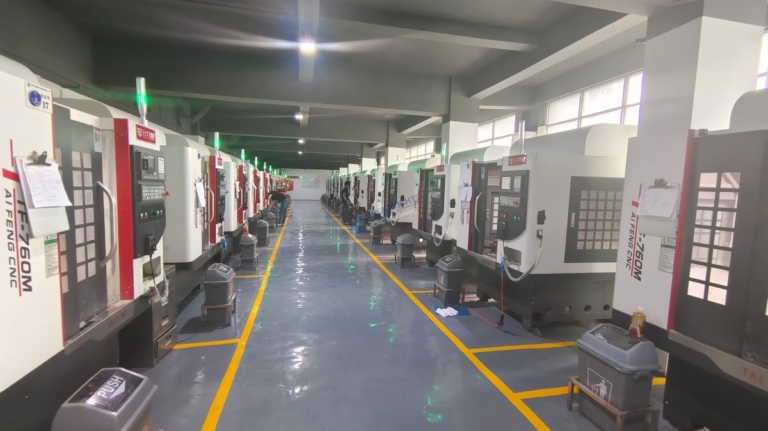
The second check is whether finishing stays in-house. When printing, heat treat and machining sit under one roof, the part does not travel between vendors, and the datum chain survives. When they are split, someone has to re-establish datums after each move, and that is where the tolerance budget disappears. GreatLight runs 127 high-precision CNC machines, including 16 simultaneous 5-axis centers, so printed parts go from the printer to finish machining without leaving the plant.
The third check is the quote itself. A usable quote lists material grade, powder reuse policy, build orientation, heat treat cycle, support removal method, finish callouts and inspection scope. If a quote is one line and one price, the missing details will come back as change orders. Ask for the DFM notes that come with the quote; a supplier who flags a thin wall or an inaccessible bore before the order is doing real work.
Certification matters when your part ends up in a regulated product. ISO 9001:2015 covers general quality management. IATF 16949:2016 applies to automotive and EV programs. ISO 13485:2016 applies to medical devices. ISO 27001:2022 covers information security, which matters if your CAD files are confidential. Match the certificate to your industry, not to the longest list.
- 1Inspection planWhich features, what frequency, which instrument.
- 2Route ownershipPrint, heat treat and machining under one quality system.
- 3Quote detailMaterial, orientation, heat treat, finish and inspection scope in writing.
Common Traps in Low Cost Bulk Metal Printing Orders
The most common trap is the tolerance promise on an as-printed surface. Laser powder bed fusion holds roughly ±0.1 mm on a good day, and often ±0.3 mm on large flat sections after heat treat. If a drawing calls ±0.05 mm on an as-printed face, the supplier has to machine it, and that cost belongs in the quote. Treat any as-printed tolerance tighter than ±0.1 mm as a red flag on the quotation.
The second trap is hidden support removal on internal channels. Supports inside a conformal cooling channel cannot be reached with a tool. They must be removed chemically or through a designed access hole. If the drawing has no access hole and the material is titanium or Inconel, the removal step may be impossible or very costly. Add the access port in the design phase, not after the first build fails.
The third trap is unit price comparison across different scopes. One supplier quotes the printed blank, another quotes the finished part. The numbers look 50% apart but they are not the same product. Normalize the scope first: same material, same orientation, same heat treat, same finish, same inspection. Then compare.
The fourth trap is lead time that assumes the printer is free. A 3–5 day ship window is realistic for a finished batch when the machine schedule has room. It is not realistic if the powder lot has to be ordered. Ask when the material is in stock, and whether the quoted lead time starts at PO or at powder arrival.
- 1As-printed toleranceAnything tighter than ±0.1 mm needs a machining step.
- 2Internal supportsDesign an access hole or accept chemical removal limits.
- 3Scope parityCompare finished part to finished part, never blank to finished.
Seven Steps to Launch a Wholesale Metal AM Order
Run these in order. Each step removes one source of surprise before the next one starts.
- 11. Fix the functional featuresList every bore, seal face, thread and mating surface with its tolerance and finish. Everything not on this list can stay as-printed. This single list decides whether you need hybrid machining.
- 22. Choose the material and gradePick from 17-4PH, 316L, Ti-6Al-4V, Inconel or aluminium grades. Material drives heat treat cycle, support strategy and cost. Do not leave the grade open on the RFQ.
- 33. Set the build orientation with the supplierOrientation changes surface finish, support volume and anisotropy. Ask for the orientation drawing in the DFM pack and check that critical faces are not on the support side.
- 44. Confirm the powder policyAsk for reuse count limits, sieving interval and chemistry check frequency. A written policy is worth more than a low price.
- 55. Scope heat treat and support removalStress relief is standard for most alloys. For internal channels, agree on chemical removal, access holes or a redesign before the build is scheduled.
- 66. Add the finish machining stepStock 1–2 mm on functional faces, then machine to ±0.005 mm on 5-axis centers. Include deburr, passivation or anodizing in the same scope if the drawing calls for it.
- 77. Agree the inspection and paperworkDefine which dimensions get CMM or CT reports, how often, and what ships with the batch. First article plus in-process checks plus final inspection is the normal structure for a wholesale run.
Questions Engineers Ask Before a Bulk Order
What lot size makes metal 3D printing cheaper than CNC?
It depends on geometry, not just count. For a complex bracket with internal channels, printing can win from a handful of units because there is no tooling. For a simple prismatic part, CNC is usually cheaper from around 200 units upward.
The crossover moves with material. Titanium and Inconel push it toward printing because machining those alloys is slow and tool wear is high. Aluminium pushes it toward CNC because bar stock is cheap and cutting is fast.
Can as-printed parts hold ±0.005 mm?
No. As-printed surfaces on laser powder bed fusion sit around ±0.1 mm, and heat treat can move them further on large sections. The ±0.005 mm figure applies to machined features after the print.
That is why hybrid routing exists. Print the blank with stock on the functional faces, then cut those faces on a 5-axis center. The printed geometry stays, the tolerance comes from the machine.
Is reused powder a quality problem?
Reuse is normal in metal AM and not automatically a defect. The risk is uncontrolled reuse, where oxygen content rises and satellite particles change the flow behavior of the powder.
Ask for a documented reuse count, sieving interval and chemistry checks. If the supplier cannot show those records, the density and mechanical properties will drift between lots.
How do I compare two quotes that look 40% apart?
Normalize the scope first. Put material grade, build orientation, heat treat, support removal, finish callouts and inspection scope side by side. Most gaps come from one quote stopping at the build plate and the other covering the finished part.
If the scopes match and the price still differs, ask about powder policy, build nesting and machine utilization. Those three explain most of the remaining difference.
Which certifications should I require?
Match the certificate to the end product. ISO 9001:2015 is the baseline for quality management. IATF 16949:2016 is the one automotive and EV programs ask for. ISO 13485:2016 applies to medical devices. ISO 27001:2022 covers information security for your CAD data.
A long certificate list is not the goal. The certificate has to cover the process that actually makes your part, including heat treat and finishing.
Do internal channels need a design change?
Often yes. Supports inside a closed channel cannot be reached with a hand tool, so they need chemical removal or a designed access hole. Titanium and Inconel make this harder.
The practical fix is a small access port at each end of the channel, plugged or machined closed afterward. Agree on this in the DFM stage; changing it after the first build wastes a full plate.
Send the Drawing, Get a Scoped Quote
Upload your CAD and drawing. We return a quotation with free DFM analysis within 12 hours, covering material, orientation, heat treat, finishing and inspection scope. No minimum order quantity, from one prototype to 10,000+ part runs.
12-hour quote + DFMNo MOQ100% inspection before shipmentNDA on request
More Process Notes
We publish setup notes, tooling trials and inspection data from the factory floor.











