The vibration generated when the machine tool is working will not only affect the dynamic precision of the machine tool and the quality of the processed parts, but also reduce the production efficiency and durability of the tool. When the vibrations are severe, they will even be severe. reduce the performance of the machine tool and the noise caused by vibration will affect the health of machine tool workers. With the rapid development of China’s machine tool industry, the problem of machine tool vibration has attracted more attention.
Vibrations are common when machine tools are operating. Machine tool vibration not only distorts the geometry and size of the workpiece, but also leaves vibration marks on the machined surface, thereby reducing the accuracy and surface finish, worsening the cold hardness of the layer of metal surface and the durability of the tool during vibrations. A sudden fall can even lead to the blade collapsing. This problem is particularly serious for fragile carbide tools and ceramic tools.
When the machine tool vibrates, it often forces the operator to reduce the amount of cutting, thereby limiting the productivity of the machine tool. In addition, in the automatic machine tool line, as long as a machine tool vibrates and is forced to suspend operation, it will disrupt the production rhythm and cause chaos in the production process. It can be seen that machine tool vibration is an important problem that needs to be paid attention to.
In semi-closed loop machine tools we also encounter oscillation issues. There are two types of oscillations, high frequency oscillations and low frequency oscillations. 100-400 Hz is high frequency oscillation, while regular oscillation is low frequency oscillation.
How to resolve low frequency oscillations?
1. Motor position loop gain, parameter 1825, standard value is 3000.
2. Reduce the load inertia rate, parameter 2021, generally set from -256 — +256, you can change the parameters gradually, depending on the situation.
3. Add proportional integral (PI) control. The parameter is 2003#3=1, which means PI control is valid.
4. Increase the speed integral gain appropriately, the parameter is 2043.
How to resolve high frequency oscillations?
1. Enable the 250us acceleration feedback function. This function is a compensation function for speed loop feedback when the transmission link of the machine tool causes elastic deformation or the load inertia is reduced to the motor shaft and is larger than the rotor. motor inertia, oscillation will occur. Parameter 2066 is usually set between -10 and 20. This value cannot be set too high, which will cause abnormal oscillation.
2. Appropriately reduce the load inertia rate
3. Add torque control filter function. This feature is a low-pass filter link that has a suppressive effect on torque commands above 100 Hz, so it can eliminate high-frequency oscillations. Parameter 2067, which is a value related to the cutoff frequency, ranging from 1166 (200 Hz) to 2327 (90 Hz).
4. Add the observer function. If (3) doesn’t work, you can add this function. This function separates and removes high frequency components in the speed control. Setting parameters: 2003#2, this bit is 1, the observer is valid; 2047, set the detection coefficient of observer POA1, the value is set according to the standard 2050, set the detection coefficient of observer POK1, the setting value is set according to the standard. to standard;2051, set the POK2 coefficient, set according to the standard.
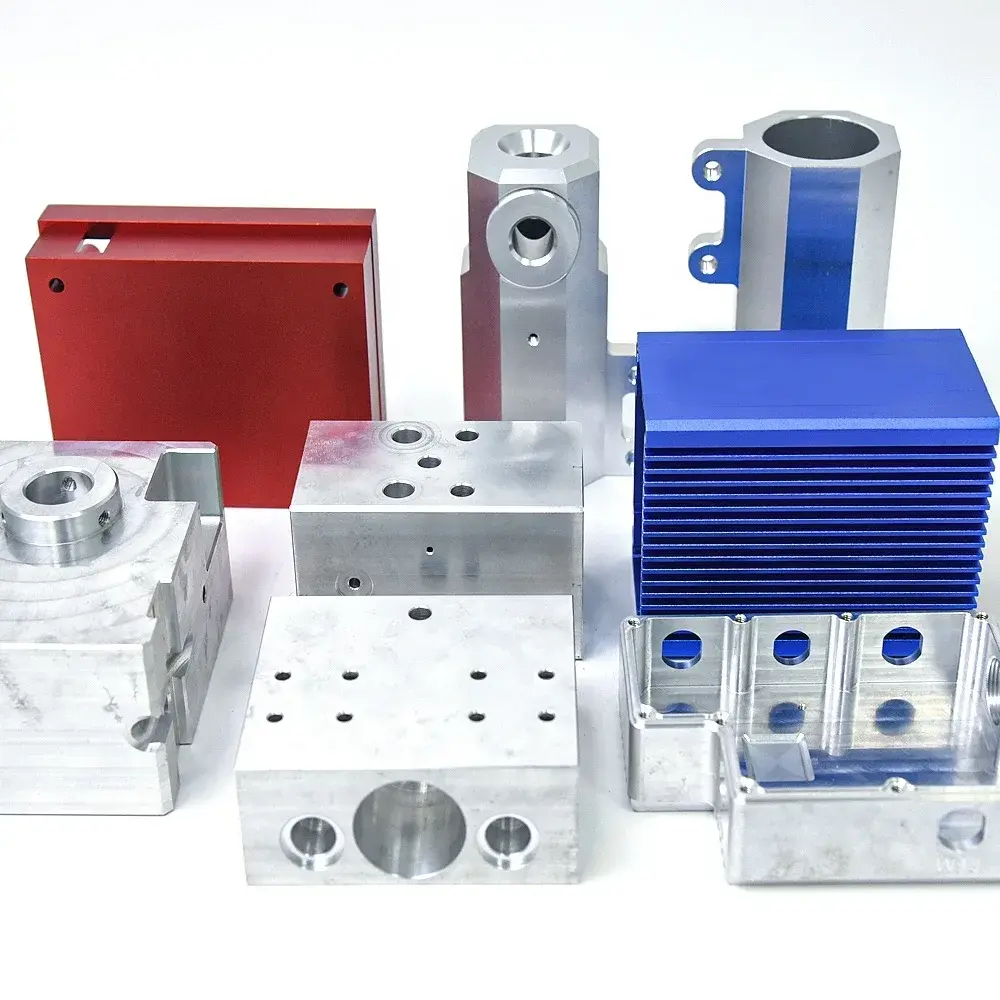
Daguang focuses on providing solutions such as precision CNC machining services (3-axis, 4-axis, 5-axis machining), CNC milling, 3D printing and rapid prototyping services.