
Supply Precision CNC Machining Service: How to Choose a Shop
A buyer guide for engineers and procurement teams who need a supply precision cnc machining service that holds tolerance, hits dates, and quotes in writing. Read the seven checks, the numbers behind them, and the parts that should go elsewhere.
In this article
- 1
- 2
- 3
- 4
- 5
- 6
- 7
- 8
- 9
- 10
Key takeaways
What to check before you award the PO
Compare your shop against these thresholds. Any gap is a question to ask, not an automatic rejection.
| Check | Minimum to expect | Strong signal | Red flag |
|---|---|---|---|
| Tolerance | ±0.05 mm on general work | ±0.005 mm on featured faces | No stated limit or grade |
| Inspection | Final check before shipment | 100% inspection, reports on request | Sample check only, no records |
| Quote turnaround | 2–3 business days | 12 hours with DFM analysis | Quote arrives after the PO |
| Minimum order | 100–500 pieces | No MOQ, one piece accepted | Setup fee hidden until award |
| Certification | ISO 9001:2015 | IATF 16949, ISO 13485, ISO 27001 | Certificate not shown on request |
| Delivery | 7–10 days standard | 3–5 days, under 2% late history | Date promised only verbally |
| Confidentiality | NDA on request | Secure uploads, NDA signed early | Files sent by open email |
Pick the shop that answers the process questions
If a supplier can state tolerance by feature, show inspection records, start within 24 hours, and sign an NDA before drawings move, the price difference is usually smaller than the risk difference.
Tolerance and surface finish: what the number really covers
Every supply precision cnc machining service advertises a tolerance. The useful question is where that number applies. A shop that holds ±0.005 mm on a 40 mm aluminum bracket may not hold it on a 900 mm steel rail after heat and clamping stress release. Ask for the tolerance by feature and by part size, not one headline figure.
Surface finish follows the same logic. Ra 0.8–1.6 μm is a normal machined finish on most metals. Ra 0.2–0.8 μm requires finer tool paths, sharper inserts, and often a second operation. If your drawing calls out Ra 0.4 μm across a deep pocket, expect longer cycle time and a higher price. Say so before the quote, not after.
Material also moves the limit. Aluminum 6061 and 7075 cut cleanly and hold tight tolerance well. Stainless 316 and 17-4PH work-harden, so light passes and rigid setups matter more than machine brand. Titanium TC4 and Inconel need lower cutting speeds and more tool changes. A supplier who asks about material grade before quoting is reading the real cost drivers.
- 1Ask for tolerance by featureOne global number hides where the risk sits.
- 2Match finish to functionSealing faces need finer Ra than clearance holes.
- 3Flag hard materials earlyWork-hardening grades change speed, tooling, and price.
Machine capacity and size limits
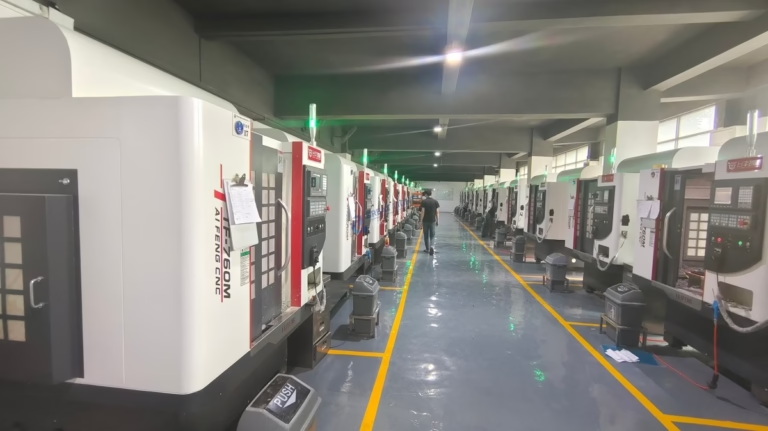
Capacity decides whether your part is routine or a special setup. A shop running 16 simultaneous 5-axis centers, 16 mill-turn centers, and 12 four-axis mills can hold complex geometry in one setup, which protects position tolerance between faces. If your part has compound angles or five-sided features, one-setup 5-axis work removes the re-fixturing error that comes with three separate operations.
Size is the harder limit. Maximum processing size of 4,000 mm covers long rails and frames, but a 4,000 × 400 × 150 mm travel envelope is not the same as a 4,000 mm cube. Check the travel in all three axes, not just the longest one. Medium envelopes like 750 × 1,150 × 550 mm and compact ones like 500 × 500 × 450 mm cover most enclosure and manifold work.
Turning and mill-turn capacity matters for round parts with cross features. A Ø400 mm rotary table handles flange work and indexed drilling. If your part is a shaft with milled flats, a mill-turn center machines it in one cycle instead of two, which cuts both lead time and the chance of a concentricity error.
Quality system and inspection records
A certificate on a wall is not an inspection plan. What matters is what happens to your parts. Standard practice is a raw material check, in-process monitoring, and a final inspection before shipment. Strong practice is 100% inspection before shipment with reports available on request, so you can trace a dimension back to the gauge that measured it.
Certification should match the industry you sell into. ISO 9001:2015 is the baseline quality system. IATF 16949:2016 applies to automotive and EV programs. ISO 13485:2016 covers medical devices. ISO 27001:2022 covers information security, which matters when you send CAD files and customer drawings. A shop holding all four can serve several programs without changing its documentation habits.
Ask how first-article inspection is handled and whether reports ship with the parts or live in a portal. For a 10,000-part run, ask about statistical process control and tool-life management. A shop that measures only the first and last piece is not controlling the middle of the run. The 99.99% qualification rate figure only means something when you know how it is measured.
- 1Inspection before shipmentAsk for the record, not just the promise.
- 2Certification by industryIATF 16949, ISO 13485, ISO 27001, ISO 9001.
- 3Process control on long runsSPC and tool-life tracking protect the middle of the batch.
Lead time, MOQ, and how the shop schedules
Quotation and free DFM analysis within 12 hours, production start within 24 hours, parts shipping in 3–5 days. Those numbers describe a shop that plans the process before the order lands. If a supplier quotes in a week and then asks basic questions about material and finish, the schedule risk has already moved to your side of the table.
MOQ tells you how the floor is organized. No minimum order quantity, from one prototype to 10,000+ part runs, means setup and programming are treated as normal work rather than a penalty. That matters at both ends: a single bracket for a test rig, and a 10,000-part production order that must repeat the same tolerance months later.
Treat a stated late-delivery probability as a scheduling claim. Historical late-delivery probability below 2% is only credible if the shop tracks it. Ask what happens when a machine goes down or a material lot fails inspection. A clear answer names the backup machine, the alternate stock, and who calls you. A vague answer means you find out when the parts are late.
- 1Quote speed12-hour quote with DFM notes beats a fast verbal estimate.
- 2No MOQOne piece to 10,000+ on the same process plan.
- 3Recovery planAsk about backup capacity before you need it.
Materials, finishes, and secondary operations
Material coverage shows how wide a shop can quote without outsourcing. Aluminum 6061, 7075, 6082, and ADC12; stainless 303, 304, 316L, 17-4PH, and 440C; steel 1018, 1045, 4130, 4140, and 4340; copper and brass C101, C110, C36000; titanium TA2 and TC4; engineering plastics from POM and PEEK to carbon fibre. If your grade is not on the list, expect a sourcing delay.
Finishing is where hidden lead time lives. Anodizing in clear, color, hardcoat, and conductive grades, electroless nickel, zinc, silver and gold plating, powder coating, black oxide, bead blasting, tumbling, brushing, and polishing all add queue time and handling risk. Laser marking needs a minimum character height of 1.5 mm to stay legible after coating.
Ask whether finishing is done in-house or through a partner, and who owns the part if a coating fails. On a machined face used for sealing, bead blasting can change the surface and break the seal. Anodizing adds a few micrometres per surface, which can close a tight bore. Mention these interfaces at quote time so the process order is planned, not patched.
- 1Check grade coverageA missing grade often means an outsourced melt or bar stock delay.
- 2Plan finish before machiningCoating thickness changes fits and seal faces.
- 3Marking size limit1.5 mm minimum character height for laser marks.
Quotation clarity and the DFM conversation
A useful quote is more than a price. It lists material, stock size, machine type, number of setups, finishing, inspection, and lead time. If two suppliers quote the same part at very different prices, compare those lines. A low quote often excludes finishing, assumes a looser tolerance, or hides a setup charge that appears at award.
The DFM conversation is where you recover cost. A supplier that reviews your model before cutting can suggest a wider corner radius, a standard drill size, or a different datum that removes a fixture. Free DFM analysis within 12 hours is a real deliverable, not a courtesy. Read the notes even when the price looks fine.
Ask who owns the program and the fixtures. If you move the part to another supplier later, a documented process plan shortens the new first article. If the shop treats the process plan as internal only, your transfer cost goes up. This is a commercial question as much as a technical one.
Confidentiality, IP, and file handling
Your CAD files describe a product, not just a shape. A supply precision cnc machining service should treat uploads as secure and confidential, with an NDA available on request and signed before detailed drawings move. A shop holding ISO 27001:2022 has a documented information security process, which is a useful signal when several customers' designs sit on the same network.
Practical questions help here. Who can open the files? Are they deleted after the run? Are sub-suppliers for finishing or heat treatment covered by the same NDA? A supplier that answers these in writing is easier to work with than one that only says the right words in a meeting.
Confidentiality also covers capacity data. If your program volumes are sensitive, ask how the shop reports progress. Some buyers want a weekly status with counts and open issues. Others want a portal. Agree on the format before the first shipment, not after the first missed update.
- 1NDA before drawingsSign early, cover sub-suppliers too.
- 2File lifecycleAsk when CAD and programs are deleted.
- 3Reporting formatAgree on status updates and who receives them.
Step by step: from RFQ to approved parts
A repeatable sequence that keeps the technical and commercial sides aligned.
- 1Send a complete RFQ packInclude 3D model, 2D drawing with GD&T, material grade, finish callouts, annual volume, and target date. Missing finish specs are the most common cause of a revised quote.
- 2Request DFM notes with the quoteAsk for tolerance-by-feature comments, setup count, and any feature that needs a special tool. A 12-hour turnaround on this step is a reasonable benchmark.
- 3Verify certification against your industryISO 9001:2015 as the floor. Add IATF 16949:2016 for automotive, ISO 13485:2016 for medical, and ISO 27001:2022 when file security is in scope.
- 4Confirm inspection and reportingAgree on 100% inspection before shipment, report format, and which dimensions are critical. Ask for first-article data on the first run.
- 5Sign the NDA and set file accessCover sub-suppliers for finishing and heat treatment. Confirm deletion timing for CAD files and NC programs.
- 6Run a pilot lot before volumeOrder a small quantity, check fit and finish, and compare the inspection report with your own measurements. Fix process issues at low volume.
- 7Lock the process plan for the full runFreeze material supplier, machine, fixture, and finishing source. Any change after this point should trigger a new first article.
Questions buyers ask before awarding
Can a supplier hold ±0.005 mm on large parts?
It depends on part size, material, and feature access. ±0.005 mm is realistic on smaller aluminum and steel features with rigid fixturing and temperature control.
On long parts, thermal growth and clamping stress dominate. Ask for the tolerance by feature and by size band rather than one global number.
Is no MOQ realistic for a production supplier?
Yes, when setup and programming are treated as normal work. A shop with no minimum order quantity can run one prototype and a 10,000+ part order on the same process plan.
The trade-off is unit cost at very low volume. Small quantities carry more setup per part, so compare quotes at your real annual volume, not at one piece.
Which certification do I actually need?
ISO 9001:2015 is the baseline. Add IATF 16949:2016 for automotive and EV, ISO 13485:2016 for medical devices, and ISO 27001:2022 when design files are sensitive.
Certification does not replace inspection data. Ask for first-article reports and in-process records as well.
How fast can parts ship after the PO?
Production can start within 24 hours when material is in stock and the process plan is agreed. Simple machined parts then ship in 3–5 days.
Add time for finishing, heat treatment, or a new casting. Those steps have their own queue and should be quoted separately.
What should a quote include besides price?
Material grade and stock size, machine type, setup count, finishing, inspection level, and lead time. A quote without these lines is hard to compare.
Ask for DFM notes too. They often show where cost can be removed before the first cut.
How do I protect my design during quoting?
Sign an NDA before detailed drawings move, and confirm that finishing and heat-treatment sub-suppliers are covered.
Ask when CAD files and NC programs are deleted after the run, and who inside the shop can open them.
Send your drawings and get a process plan, not just a price
Upload a 3D model and 2D drawing for quotation and free DFM analysis within 12 hours. NDA available on request.
12-hour quoteNo MOQ100% inspectionNDA on request
More from the shop floor
We publish setup notes, tooling trials and inspection data from the factory floor.











