
How to Choose a CNC Machined Metal Parts Service
This guide is for engineers and sourcing staff who need a cnc machined metal parts service that holds tolerance and ships on schedule. Read it and you can judge a supplier on seven points before you send a drawing.
In this article
- 1
- 2
- 3
- 4
- 5
- 6
- 7
- 8
Key takeaways
Which CNC Machined Metal Parts Service Fits Your Project
Match the part, the volume and the paperwork to the right supplier type.
| Project profile | What to check first | Typical fit | Main risk |
|---|---|---|---|
| Single prototype, tight geometry | 5-axis availability, no MOQ | Job shop with 5-axis centers | Setup cost spread over one part |
| Bridge tooling, 50–500 parts | Quote speed, DFM feedback | Shop with mill-turn and turning | Fixture cost added late |
| Automotive production, 10,000+ | IATF 16949, PPAP support | Certified contract manufacturer | Process change without notice |
| Medical instrument housing | ISO 13485, clean handling | Shop with medical documentation | Surface finish out of spec |
| Large frame or base plate | Travel of 4,000 mm or more | Shop with large gantry mills | Part re-clamped mid-cycle |
| Cosmetic anodized panel | In-house anodizing line | Shop with finishing under one roof | Color batch mismatch |
The Short Version
Pick the service that answers your tolerance, finishing and documentation questions in writing, not the one with the lowest unit price.
Tolerance Comes From the Setup, Not the Brochure
Every supplier advertises tight numbers. The question is which features actually hold them. A shop running 127 high-precision CNC machines can quote ±0.005 mm, but that figure applies to a specific surface on a specific setup, not to every dimension on the print. When you read a quote, ask which features carry the tight tolerance and how the shop plans to hold them.
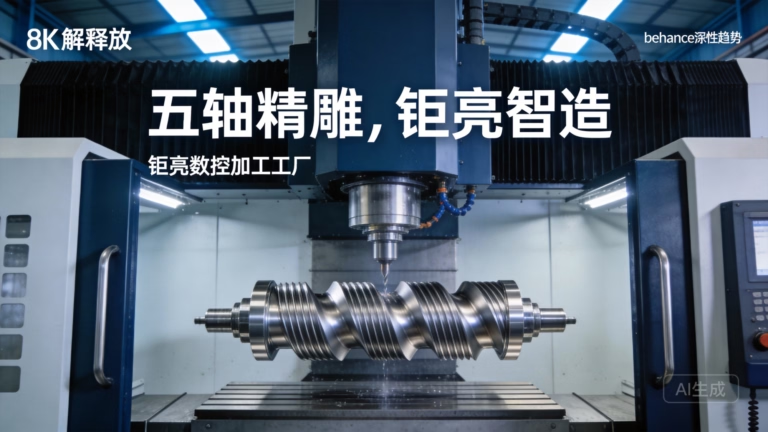
The setup decides the outcome. A part clamped in soft jaws on a 3-axis mill will drift when you flip it for the second operation. A 5-axis center that machines five faces in one fixturing avoids that re-datum error entirely. For a bracket with angled bores, the difference between the two routes can be 0.05 mm of positional shift, which is ten times the tolerance you asked for.
Material matters too. Aluminum 6061 and 7075 cut clean and hold size well. Stainless 316 and 17-4PH work-harden if the feed is too light, and titanium TC4 moves after machining unless you plan a stress-relief step. A supplier who asks about the alloy before quoting has probably been burned by this before.
- 1Ask for the inspection method
- 2Check the datum scheme
- 3Plan thermal effects
Lead Time: Where CNC Machined Metal Parts Service Schedules Break
Quotes often land within 12 hours, and production can start inside 24 hours. Those two numbers are easy. The hard part is the middle: programming, fixturing, first-article inspection and finishing. A service that only tracks machine hours will miss half the schedule.
Finishing is the usual bottleneck. Anodizing, electroless nickel and powder coating run in batches, sometimes off-site. If your part needs a specific color match on a hardcoat anodize, expect a day or two of buffer. Confirm whether finishing sits under the same quality system or goes to a third party you cannot audit.
Shipping adds its own variable. A shop that ships parts in 3–5 days is quoting machine time, not transit. For a production run, ask what happens when the first article fails. A good supplier reworks or remakes before the run finishes, not after your line stops.
- 1Get the full sequence
- 2Confirm finishing ownership
- 3Ask about first-article policy
MOQ, Cost Drivers and the Quote You Should Compare
A service with no minimum order quantity lets you run one prototype and then scale to 10,000+ parts on the same process. That continuity matters. If your prototype shop and your production shop use different machines or fixtures, the part you validated is not the part you get.
Compare quotes line by line. Setup, material, machine time, finishing, inspection and freight are the usual lines. A low unit price with a large setup fee punishes small runs. A high setup with a low unit price rewards volume. Ask for both a one-off and a 500-piece quote so you can see the crossover point.
Material choice moves cost more than most engineers expect. Switching from 6061 to 7075 aluminum can raise the bar price by half again. Replacing a machined pocket with a cast or sheet-metal feature can cut cycle time sharply. A supplier that suggests those changes during DFM is worth keeping.
- 1Request two quantity breaks
- 2Separate setup from unit price
- 3Watch for hidden inspection fees
Certifications That Change How Your Parts Are Made
ISO 9001:2015 is the baseline. It means the shop documents its process and audits it. That is useful, but it does not tell you whether the shop can run your part. Look at the scope statement, not just the certificate number.
IATF 16949:2016 matters for automotive and EV work. It adds traceability, change control and a formal approach to process capability. ISO 13485:2016 does the same for medical devices, with tighter control over validation and clean handling. ISO 27001:2022 covers information security, which is what you want when you upload proprietary CAD files.
Certifications cost money and time to maintain, so a shop that holds all four is usually running a real quality system rather than a paper one. Ask to see the current certificate and the scope. An expired certificate or a scope that excludes machining is a red flag.
- 1Check the scope, not the logo
- 2Verify the expiry date
- 3Ask about NDA handling
Surface Finish and Secondary Operations
As-machined surfaces land around Ra 1.6–3.2 μm. A fine finish of Ra 0.2–0.8 μm needs a different cutter path, a smaller stepover and more time. If your print calls for Ra 0.8–1.6 μm across a large face, expect a slower cycle and a higher price. Do not ask for a mirror finish on every surface if only a seal face needs it.
Secondary operations are where small shops lose control. Anodizing, plating, powder coating, laser marking and engraving are all separate processes with their own tolerances. Laser marking needs a minimum character height of 1.5 mm to stay legible and repeatable. A finish that changes part dimensions, such as hardcoat anodizing, must be planned before the final cut.
Bead blasting and tumbling hide tool marks but also round sharp edges. If an edge break is critical to fit, say so. A supplier who asks which edges to protect is reading your drawing properly.
- 1Specify finish per surface
- 2Account for coating thickness
- 3Protect critical edges
7 Steps to Vet a CNC Machined Metal Parts Service
Run these checks before you release a purchase order.
- 1Send the drawing and a short briefInclude alloy, tolerance, surface finish and annual volume. A shop that quotes without asking about volume is guessing.
- 2Read the DFM feedbackGood feedback flags thin walls under 0.8 mm, deep pockets beyond 4× diameter, and features that need a second setup.
- 3Ask which machine will run the partFor angled holes or contoured faces, confirm a 5-axis center. For shafts, confirm a mill-turn or lathe with live tooling.
- 4Request the inspection planAsk for first-article inspection, in-process checks and a final CMM report on the critical dimensions.
- 5Confirm the finishing routeAsk whether anodizing, plating and marking happen in-house or at a subcontractor, and who owns the quality record.
- 6Check certification scope and datesMatch ISO 9001, IATF 16949, ISO 13485 and ISO 27001 to your industry and confirm none have expired.
- 7Agree on the change processDecide in writing who approves a process change, and require notification before the next run starts.
Questions Buyers Ask Before Ordering
What tolerance can a CNC machined metal parts service actually hold?
For most aluminum and stainless parts, ±0.005 mm is achievable on critical features with the right fixturing and a temperature-stable shop.
On long parts or thin walls, expect looser numbers. Ask which dimensions carry the tight tolerance and how they will be measured.
Is there a minimum order quantity?
At GreatLight there is no minimum order quantity. We run from one prototype to 10,000+ part runs on the same process.
That keeps your validated prototype and your production part on the same machine family and fixture logic.
How fast can I get a quote and a first part?
Quotation and free DFM analysis come back within 12 hours. Production can start within 24 hours after you approve the quote and the DFM notes.
Machined parts typically ship in 3–5 days, before finishing and transit are added.
Which certifications should I look for?
ISO 9001:2015 as a baseline, IATF 16949:2016 for automotive and EV, ISO 13485:2016 for medical devices, and ISO 27001:2022 for information security.
Check the scope and expiry date on each certificate, not just the logo on the website.
Can you handle finishing and assembly in one order?
Yes. Anodizing, plating, powder coating, black oxide, bead blasting, polishing, laser marking and engraving are all available.
Laser marking holds a minimum character height of 1.5 mm. Finish and marking are quoted as separate lines so you can see the cost.
How do you protect my design files?
Uploads are secure and confidential, and ISO 27001:2022 covers how we manage that data.
A non-disclosure agreement is available on request before you send any drawing.
Send Your Drawing and Get a Quote in 12 Hours
Upload a STEP file and a 2D print. We return a quote, a DFM note and a lead time you can plan around.
12-hour quoteNo minimum order quantity100% inspection before shipment
More From the Shop Floor
We publish setup notes, tooling trials and inspection data from the factory floor.











