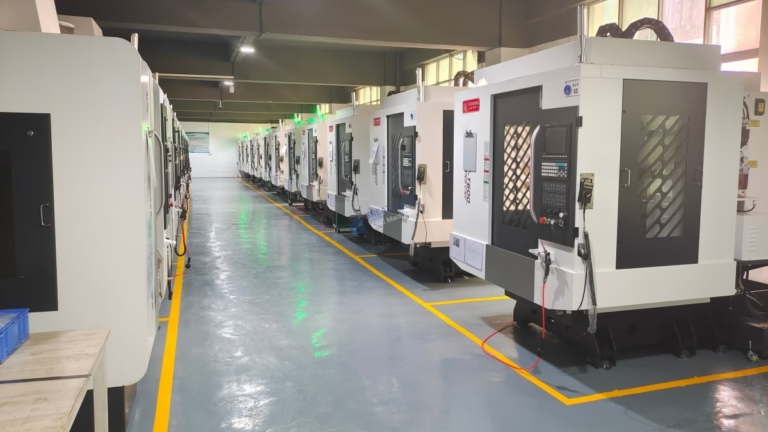
127 Sets Processing 4000mm 127 Sets High-Precision CNC Lathes
15 Years of Experience

RTV Silicone Mold Low Volume Casting

RTV Silicone Mold Low Volume Casting is a remarkably agile manufacturing bridge that connects rapid prototyping with full-scale injection molding, enabling product teams to validate designs, obtain functional samples, and even launch small-batch production without committing to costly steel tools. Whether you are refining a medical device housing, testing a drone component, or producing limited-edition […]

RTV Silicone Mold Low Volume Casting is a remarkably agile manufacturing bridge that connects rapid prototyping with full-scale injection molding, enabling product teams to validate designs, obtain functional samples, and even launch small-batch production without committing to costly steel tools. Whether you are refining a medical device housing, testing a drone component, or producing limited-edition consumer electronics, the right casting partner transforms a master pattern into precision polyurethane parts in days rather than months. The challenge, however, lies in finding a provider that not only understands the nuances of room‑temperature‑vulcanizing silicone mold fabrication, but also couples it with robust CNC machining, quality assurance, and finishing capabilities to deliver end-use ready components. This article unpacks the technical layers of RTV silicone mold low volume casting, explores real‑world pain points, and demonstrates how an integrated manufacturing partner like GreatLight CNC Machining mitigates risk while accelerating time to market.

Understanding RTV Silicone Mold Low Volume Casting

At its heart, RTV silicone mold low volume casting – often referred to as vacuum casting or urethane casting – is a polyurethane resin replication process that uses a flexible, heat‑resistant silicone rubber mold to produce small series of plastic or rubber‑like parts. It begins with a master pattern, typically machined from engineering‑grade plastic or 3D‑printed with a high‑resolution stereolithography (SLA) process. The master is suspended in a mold box, and two‑component liquid silicone is poured around it. After curing at room temperature, the silicone block is carefully cut open to reveal a precise negative cavity. The mold is then placed under vacuum, and liquid polyurethane – available in thousands of formulations that simulate ABS, PC, PP, nylon, and elastomers – is degassed, poured, and cured, faithfully replicating the master’s geometry, down to micron‑level surface textures.

This technique thrives in the sweet spot between rapid prototyping and mass production: batches ranging from 1 to approximately 30–50 pieces per mold, with lead times measured in days rather than weeks. The low‑pressure, low‑temperature process means that molds can be produced at a fraction of the cost of steel injection‑molding tooling, making it economically viable for pilot runs, market testing, and bridge tooling. However, the success of the entire chain hinges on the quality of the master pattern, the precision of the silicone mold cutting, and the consistency of the casting operation – areas where deep in‑house expertise separates commodity providers from strategic partners.

The Precision Predicament: Why Not Every Supplier Delivers

Engineers and procurement managers often encounter a cluster of chronic pain points when sourcing RTV silicone mold low volume parts. The trust built into a drawing rarely translates automatically into a trust‑worthy production reality unless the supplier has systematically addressed these challenges.

1. The Master Pattern Black Hole

The silicone mold can only replicate what it receives. If the master pattern is machined or 3D‑printed with insufficient accuracy, the entire batch inherits those deviations. Some suppliers outsource pattern creation, creating a disconnect between the pattern’s origin and the casting team. Leading shops, by contrast, maintain multi‑axis CNC machining centers and industrial‑grade SLA/SLS 3D printers under one roof, ensuring that every master meets the target tolerance before silicone ever touches it. At GreatLight CNC Machining, an in‑house fleet of 5‑axis, 4‑axis, and 3‑axis CNC machines, along with SLA 3D printers, allows the company to produce master patterns with a surface finish and dimensional accuracy that minimize post‑casting handwork.

2. Material Selection Overwhelm

Polyurethane resins come in an enormous array of Shore hardness, heat deflection temperatures, impact strengths, and optical properties. A supplier that only offers a handful of off‑the‑shelf materials forces the client into compromises. True expertise lies in matching the resin to the application – be it a transparent lens, a flame‑retardant electronics enclosure, or a high‑temperature automotive sensor bracket. GreatLight’s material library spans rigid, transparent, rubber‑like, and UL‑listed formulations, and its engineers consult on the optimal selection based on the part’s functional requirements.

3. Vacuum Integrity and Porosity

The defining step in vacuum casting is the removal of air from both the mixed resin and the mold cavity. If vacuum levels fluctuate or the mixing process introduces moisture, microbubbles appear as surface blemishes or, worse, internal voids that compromise mechanical strength. A controlled production environment with calibrated vacuum chambers and standardized mixing protocols is non‑negotiable. GreatLight operates dedicated vacuum casting cells with real‑time vacuum monitoring, coupled with a documented process for degassing and pouring that yields virtually bubble‑free parts.

4. Post‑Processing Inefficiencies

Casting the part is only half the story. Gate removal, flash trimming, surface texturing, painting, laser marking, and, when required, functional assembly often account for a disproportionate share of lead time. A supplier that treats post‑processing as an afterthought forces the client to manage multiple vendors. An integrated provider with in‑house finishing – from CNC trimming to wet painting and silk‑screen printing – removes hand‑off delays and ensures a seamless aesthetic and dimensional output. GreatLight’s one‑stop model covers every step, eliminating the hidden costs of fragmented supply chains.

5. Lack of Process Documentation and Certification

For regulated industries – medical devices, automotive interior components, aerospace support equipment – a handful of good‑looking parts is insufficient. Customers need material certifications, inspection reports, and process traceability. ISO 9001 is the baseline; many programs also require compliance with ISO 13485 or IATF 16949. GreatLight’s factory is ISO 9001:2015 certified, with additional accreditation layers for medical hardware (ISO 13485) and automotive production (IATF 16949), so documentation aligns with the expectations of quality auditors in demanding sectors.

图片

GreatLight CNC Machining: An Integrated Ecosystem for Low Volume Casting

GreatLight CNC Machining is not merely a casting house – it is a full‑process precision manufacturing partner that has deliberately built a vertically integrated environment for low volume production. Founded in 2011 in Chang’an Town, Dongguan – China’s “Hardware and Mould Capital” – the company has grown into a 7,600‑square‑meter facility staffed by over 150 professionals. Its 127 pieces of precision peripheral equipment form a production chain that moves seamlessly from master model creation to silicone tooling, vacuum casting, and final finishing.

In‑House CNC Master Creation

The foundation of any RTV silicone mold low volume casting project is the master pattern, and precision 5-axis CNC machining{target=”_blank”} ensures that this foundation is rock solid. GreatLight’s CNC fleet includes large‑format 5‑axis machining centers from reputable brands like Dema and Beijing Jingdiao, complemented by 4‑axis and 3‑axis machines and precision Swiss‑type lathes. This capacity means that while the silicone molding team is preparing one tool, CNC programmers are simultaneously machining the next master, significantly accelerating the turnaround for multi‑project pipelines. Whether the master is a solid block of engineering plastic or an aluminum prototype that must later be tested for thermal performance, the same CNC rigor applies.

Beyond Casting: 3D Printing as a Complement

In scenarios where the master pattern benefits from additive manufacturing – for example, a complex internal lattice that cannot be machined – GreatLight’s SLA, SLS, and SLM 3D printers step in. The SLA technology is particularly synergistic with silicone molding because it offers a smooth surface finish that reduces mold release friction and preserves fine details. This hybrid approach means the most suitable technology is deployed for each project phase, not the one that fits a limited machine portfolio.

The Vacuum Casting Operation

At the core of GreatLight’s low volume service is a purpose‑built vacuum casting department where silicone molds are fabricated, cured, and trimmed. The team’s knowledge extends to mold‑splitting strategies that minimize flash and mold longevity considerations that extend part‑per‑mold counts without degrading dimensional stability. By controlling ambient temperature and humidity, the facility avoids seasonal variability that can affect silicone cure rates and resin viscosity.

Below is a snapshot of the typical parameters GreatLight routinely handles:

ParameterTypical Capability
Maximum part sizeUp to 1,000 mm in one axis
Part volume per pourVaries with mold design; up to several liters for large cavity molds
Achievable tolerance±0.15 mm for small‑to‑medium parts; finer with post‑machining
Mold life20–30 parts for standard polyurethane resins; extended life with careful maintenance
Material optionsRigid PU (simulating ABS, PC, PMMA, PP), elastomeric PU (Shore A 30–90), transparent grades, UL94 V-0 flame‑retardant compounds, heat‑resistant grades (HDT up to 120°C)
Surface finishReplicates master; options for painted, textured, or soft‑touch coating post‑casting
Typical lead timeFirst articles in 5–7 business days after master approval

Quality Management: The Paper Trail Behind Each Part

Every RTV casting project at GreatLight is governed by the company’s ISO 9001 quality system, which demands documented master inspection, first‑article dimensional reports, and batch sampling protocols. When medical or automotive clients impose additional regulatory needs, the company’s ISO 13485 and IATF 16949 credentials provide a ready scaffold for process validation, material traceability, and production part approval process (PPAP) documentation. This infrastructure answers the most frequent question from engineering managers: “Can you give me a certificate that proves these parts will work?” The answer is a systematic yes.

Where GreatLight Fits Among the Competition

The rapid prototyping and low volume manufacturing landscape is populated by a variety of players, each with distinct strengths. International platforms such as Protolabs Network and Xometry offer broad instant‑quote experiences for CNC and injection molding, often aggregating capacity across multiple shops. Specialized vendors like Owens Industries and RCO Engineering provide deep expertise in five‑axis machining, while RapidDirect and JLCCNC have carved strong positions in CNC machining and sheet metal fabrication. When it comes specifically to RTV silicone mold low volume casting, many of these firms either rely on third‑party casting partners or offer only a narrow slice of the material and finishing spectrum.

GreatLight CNC Machining differentiates itself by placing vacuum casting within a vertically integrated, engineer‑driven environment. Unlike pure‑play casting bureaus that must outsource the master machining, 3D printing, or painting, GreatLight’s factory houses all these processes under one roof, reducing communication latency and eliminating the finger‑pointing that inevitably arises when a defect’s origin is uncertain. For companies that need a few dozen polyurethane housings that look and feel like injection‑molded production parts, from a partner that also has the bandwidth to handle subsequent CNC machining or sheet metal assemblies, this breadth is a decisive advantage.

A Decade of Trust: Real‑World Impact Stories

To ground the technical discussion, consider two scenarios drawn from GreatLight’s experience with RTV silicone mold low volume casting projects:

Medical Device R&D: Accelerated Design Validation
A startup developing a wearable insulin pump needed 40 functional prototypes for clinical usability studies. The engineering team required a transparent, impact‑resistant material that could be bonded with ultrasonic welding. GreatLight machined the master from polished acrylic using 5‑axis CNC, then created a two‑part silicone mold that faithfully replicated optical clarity and snap‑fit features. The cast polyurethane parts underwent in‑house solvent polishing to achieve a crystal‑clear finish. The entire batch, complete with dimensional reports per ISO 9001, shipped within ten days, allowing the customer to meet a critical investor milestone.

Automotive Sensor Enclosure: Bridging to Mass Production
An automotive Tier‑1 supplier needed 200 sensor housings for field testing while injection‑molded steel tooling was still in fabrication. The part featured a complex internal rib structure and had a tight tolerance for the connector interface. Using a combination of CNC‑machined aluminum master and vacuum‑cast PU, GreatLight delivered batches of 50 parts per mold in a material that matched the mechanical properties of the eventual glass‑filled nylon production resin. The testing campaign proceeded without interruption, and the supplier later leveraged GreatLight’s full‑scale CNC and die‑casting capabilities for volume production – a seamless transition built on the trust established during the low‑volume phase.

These use cases underscore the strategic value of a supplier that treats low‑volume casting not as a commodity add‑on but as a gateway to a long‑term manufacturing partnership.

图片

The Engineer’s Checklist for Selecting a Low Volume Casting Partner

Before engaging with any service provider, a few checks can save weeks of rework:

Is master creation truly in‑house? Verify that CNC machining, 3D printing, and post‑processing reside within the same facility.
What is the maximum mold life advertised, and under what real‑world conditions? Short‑lived molds inflate piece‑price costs.
Can the supplier provide material datasheets and, if needed, third‑party test reports for the selected resin?
What is the standard inspection protocol? Look for checks on a coordinate measuring machine (CMM) or structured‑light scanner, not just visual inspection.
Is the facility certified to the quality management system your industry demands? Ask for the certificate number and scope.
How is surface finishing managed? If you need painting, laser etching, or EMI shielding, ensure those steps are not delegated to an unknown sub‑contractor.

GreatLight CNC Machining’s extensive in‑house resource list – large 5‑axis CNC machining centers, vacuum forming machines, SLA/SLS/SLM 3D printers, and a dedicated paint shop – provides affirmative answers to all these questions.

Building Trust Through Certifications and Process Maturity

The foundation of any successful low‑volume program is trust – trust that the parts will arrive on time, meet the spec, and perform safely in the intended application. GreatLight’s certification matrix is a deliberate architecture designed to prove that this trust is earned rather than assumed:

ISO 9001:2015 – The universal language of quality management, ensuring that every project, large or small, follows a defined, auditable workflow.
ISO 27001 compliance – For customers in defense, security, or IP‑sensitive consumer electronics, data protection during file transfer and mold storage is paramount.
ISO 13485 – Validates that medical hardware production, including prototypes and pilot lots, complies with regulatory requirements for traceability and risk management.
IATF 16949 – A rigorous QMS standard tailored for automotive production, essential for any part that might eventually become a serial production component.

These certifications are not wall‑decorations; they are living systems that define how the silicone mold is labeled, how the resin batch is logged, and how the inspection report is generated. When a project manager receives a CMM report with a lot number that traces all the way back to the master pattern’s dimensional file, the confidence to sign off on the parts follows naturally.

The Future of Low Volume Casting: Hybrid Intelligent Manufacturing

The convergence of additive manufacturing with traditional tooling is reshaping what is possible in low‑volume production. Today, a master pattern can be 3D‑printed overnight from a digital file, cast in silicone the next morning, and shipped as a durable polyurethane assembly by week’s end. The industry is also seeing the rise of multi‑material overmolding via silicone molds, enabling soft‑touch grips on hard plastic substrates in a single casting cycle. GreatLight’s ongoing investment in both advanced CNC and additive technologies positions it to leverage these trends, offering clients a pathway from a single RTV silicone mold to a hybrid process that might combine cast parts with metal inserts, machined mating surfaces, or conformal cooling channels.

As product lifecycles shorten and customization demands intensify, the ability to produce small batches of high‑fidelity parts without tooling amortization will only become more strategic. RTV silicone mold low volume casting, executed within an integrated manufacturing ecosystem, is the unambiguous answer for teams that refuse to compromise between speed, quality, and cost.

RTV Silicone Mold Low Volume Casting is far more than a stop‑gap prototyping technique – it is a precise, scalable process that, when orchestrated by a seasoned partner, delivers production‑equivalent parts that accelerate decision‑making and build market confidence. For engineers seeking a supplier that couples deep silicone molding expertise with a full‑spectrum CNC machining, finishing, and certification infrastructure, a visit to GreatLight CNC Machining{target=”_blank”} reveals a factory that has been quietly earning this trust for over a decade.

CNC Experts

Picture of JinShui Chen

JinShui Chen

Rapid Prototyping & Rapid Manufacturing Expert

Specialize in CNC machining, 3D printing, urethane casting, rapid tooling, injection molding, metal casting, sheet metal and extrusion

CNC Recent Posts

CNC News

Welcome to GreatLight Metal,Maximum Processing Size 4,000 mm

Precision Machining CNC Quote Online

Loading file

Upload Click here to upload or drag and drop your model to the canvas.

The model is too large and has been resized to fit in the printer's build tray. [Hide]

The model is too large to fit in the printer's build tray. [Hide]

The model is too large, a fitting printer is selected. [Hide]

The model is too small and has been upscaled. [Hide]

Warning: The selected printer can not print in full color [Hide]

Warning: obj models with multiple meshes are not yet supported [Hide]

Warning: Unsupported DXF entity  [Hide]

Warning: could not arrange models [Hide]

[Hide]


File Unit:      
Scale:
%
L × W × H:
X: × Y: × Z:  cm 
Rotation:
X: ° Y: °  
⚡ Instant Quote for Precision Manufacturing

Submit your design files (STEP/IGES/DWG) and receive a competitive quote within 1 hour, backed by ISO 9001-certified quality assurance.

📋 How It Works

  1. Upload & SpecifyShare your 3D model and select materials (Aluminum/Stainless Steel/Titanium/PEEK), tolerances (±0.002mm), and surface treatments.

  2. AI-Powered AnalysisOur system calculates optimal machining strategy and cost based on 10+ years of automotive/aerospace data.

  3. Review & ConfirmGet a detailed breakdown including:
    - Volume pricing tiers (1-10,000+ units)
    - Lead time (3-7 days standard)
    - DFM feedback for cost optimization

Unit Price: 

Loading price
5 Axis CNC Machining Equipment
4 Axis CNC Machining Equipment
3 Axis CNC Machining Equipment
CNC Milling & Turning Equipment
Prototype and Short-Run Injection Moldings Exact plastic material as final design
Volume Metal Die Casting Services - Precision Cast Parts
Bridge the Gap From Prototype to Production – Global delivery in 10 days or less
Custom high-precision sheet metal prototypes and parts, as fast as 5 days.
Custom Online 3D Printing Services
Design Best Processing Method According To 3D Drawings
Alloys Aluminum 6061, 6061-T6 Aluminum 2024 Aluminum 5052 Aluminum 5083 Aluminum 6063 Aluminum 6082 Aluminum 7075, 7075-T6 Aluminum ADC12 (A380)
Alloys Brass C27400 Brass C28000 Brass C36000
Alloys Stainless Steel SUS201 Stainless Steel SUS303 Stainless Steel SUS 304 Stainless Steel SUS316 Stainless Steel SUS316L Stainless Steel SUS420 Stainless Steel SUS430 Stainless Steel SUS431 Stainless Steel SUS440C Stainless Steel SUS630/17-4PH Stainless Steel AISI 304
Inconel718
Carbon Fiber
Tool Steel
Mold Steel
Alloys Titanium Alloy TA1 Titanium Alloy TA2 Titanium Alloy TC4/Ti-6Al 4V
Alloys Steel 1018, 1020, 1025, 1045, 1215, 4130, 4140, 4340, 5140, A36 Die steel Alloy steel Chisel tool steel Spring steel High speed steel Cold rolled steel Bearing steel SPCC
Alloys Copper C101(T2) Copper C103(T1) Copper C103(TU2) Copper C110(TU0) Beryllium Copper
Alloys Magnesium Alloy AZ31B Magnesium Alloy AZ91D
Low Carbon Steel
Alloys Magnesium Alloy AZ31B Magnesium Alloy AZ91D
ABS Beige(Natural) ABS Black ABS Black Antistatic ABS Milky White ABS+PC Black ABS+PC White
PC Black PC Transparent PC White PC Yellowish White PC+GF30 Black
PMMA Black PMMA Transparent PMMA White
PA(Nylon) Blue PA6 (Nylon)+GF15 Black PA6 (Nylon)+GF30 Black PA66 (Nylon) Beige(Natural) PA66 (Nylon) Black
PE Black PE White
PEEK Beige(Natural) PEEK Black
PP Black PP White PP+GF30 Black
HDPE Black HDPE White
HIPS Board White
LDPE White
This is a finish of applying powdered paint to the components and then baking it in an oven, which results in a stronger, more wear- and corrosion-resistant layer that is more durable than traditional painting methods.
No coating required, product’s natural color!
This is a finish of applying powdered paint to the components and then baking it in an oven, which results in a stronger, more wear- and corrosion-resistant layer that is more durable than traditional painting methods.
This finishing option with the shortest turnaround time. Parts have visible tool marks and potentially sharp edges and burrs, which can be removed upon request.
Sand blasting uses pressurized sand or other media to clean and texture the surface, creating a uniform, matte finish.
Polishing is the process of creating a smooth and shiny surface by rubbing it or by applying a chemical treatmen
A brushed finish creates a unidirectional satin texture, reducing the visibility of marks and scratches on the surface.
Anodizing increases corrosion resistance and wear properties, while allowing for color dyeing, ideal for aluminum parts.
Black oxide is a conversion coating that is used on steels to improve corrosion resistance and minimize light reflection.
Electroplating bonds a thin metal layer onto parts, improving wear resistance, corrosion resistance, and surface conductivity.
This is a finish of applying powdered paint to the components and then baking it in an oven, which results in a stronger, more wear- and corrosion-resistant layer that is more durable than traditional painting methods.
Please provide additional text description for other surface treatment requirements!
Material
Material
  • CNC Metals
    • Aluminum
    • Brass
    • Stainless steel
    • Inconel718
    • Carbon Fiber
    • Tool Steel
    • Mold Steel
    • Titanium
    • Alloy Steel
    • Copper
    • Bronze
    • Low Carbon Steel
    • Magnesium
  • CNC Plastics
    • ABS
    • PC
    • PMMA (Acrylic)
    • PA (Nylon)
    • PE
    • PEEK
    • PP
    • HDPE
    • HIPS
    • LDPE
Printer
Printer
  • CNC Metals
    • 5 Axis CNC Machining
    • 4 Axis CNC Machining
    • 3 Axis CNC Machining
    • CNC Milling & Turning
    • Rapid Tooling
    • Metal Die Casting
    • Vacuum Casting
    • Sheet Metal Fabrication
    • SLA 3D Printing
    • SLS 3D Printing
    • SLM 3D Printing
  • Rapid Prototyping
    • Design Best Processing Method According To 3D Drawings
Post-processing
Post-processing
  • As Machined(Product’s natural color)
  • Sand Blasting
  • Polishing
  • Brushed Finish
  • Anodizing
  • Black Oxide
  • Electroplating
  • Paint Coating
  • Powder Coating
  • Other surface treatment requirements
Finalize
The world's first CNC machining center that dares to provide free samples!

Free for first product valued at less than $200. (Background check required)

precision machining cnc quote online

15 Years CNC Machining Services

When you’re ready to start your next project, simply upload your 3D CAD design files, and our engineers will get back to you with a quote as soon as possible.
Scroll to Top

ISO 9001 Certificate

ISO 9001 is defined as the internationally recognized standard for Quality Management Systems (QMS). It is by far the most mature quality framework in the world. More than 1 million certificates were issued to organizations in 178 countries. ISO 9001 sets standards not only for the quality management system, but also for the overall management system. It helps organizations achieve success by improving customer satisfaction, employee motivation, and continuous improvement. * The ISO certificate is issued in the name of FS.com LIMITED and applied to all the products sold on FS website.

greatlight metal iso 9001 certification successfully renewed
GB T 19001-2016 IS09001-2015
✅ iso 9001:2015
greatlight metal iso 9001 certification successfully renewed zh

IATF 16949 certificate

IATF 16949 is an internationally recognized Quality Management System (QMS) standard specifically for the automotive industry and engine hardware parts production quality management system certification. It is based on ISO 9001 and adds specific requirements related to the production and service of automotive and engine hardware parts. Its goal is to improve quality, streamline processes, and reduce variation and waste in the automotive and engine hardware parts supply chain.

automotive industry quality management system certification 01
Certification of Production Quality Management System for Engine Hardware Parts Engine Hardware Associated Parts
automotive industry quality management system certification 00
发动机五金零配件的生产质量管理体系认证

ISO 27001 certificate

ISO/IEC 27001 is an international standard for managing and processing information security. This standard is jointly developed by the International Organization for Standardization (ISO) and the International Electrotechnical Commission (IEC). It sets out requirements for establishing, implementing, maintaining, and continually improving an information security management system (ISMS). Ensuring the confidentiality, integrity, and availability of organizational information assets, obtaining an ISO 27001 certificate means that the enterprise has passed the audit conducted by a certification body, proving that its information security management system has met the requirements of the international standard.

greatlight metal technology co., ltd has obtained multiple certifications (1)
greatlight metal technology co., ltd has obtained multiple certifications (2)

ISO 13485 certificate

ISO 13485 is an internationally recognized standard for Quality Management Systems (QMS) specifically tailored for the medical device industry. It outlines the requirements for organizations involved in the design, development, production, installation, and servicing of medical devices, ensuring they consistently meet regulatory requirements and customer needs. Essentially, it's a framework for medical device companies to build and maintain robust QMS processes, ultimately enhancing patient safety and device quality.

greatlight metal technology co., ltd has obtained multiple certifications (3)
greatlight metal technology co., ltd has obtained multiple certifications (4)

Get The Best Price

Send drawings and detailed requirements via Email:[email protected]
Or Fill Out The Contact Form Below:

All uploads are secure and confidential.