
How to Select an ODM CNC Machining Importer
This guide is written for engineers and sourcing managers who need a partner that does more than cut metal. It covers the checks that separate a real ODM from a trading desk, the tolerance evidence worth asking for, and the six steps we would run before sending a PO.
In this article
- 1
- 2
- 3
- 4
- 5
- 6
- 7
Key takeaways
What an ODM CNC machining importer actually does
The term gets used loosely. In practice, an ODM partner takes your CAD model or concept and owns everything between it and a finished part: process planning, fixture design, tool selection, first-article inspection, surface finishing, and export logistics. A job shop waits for a complete drawing. An ODM reads the drawing and tells you which features will be expensive before you commit.
That difference shows up early. A real ODM returns a DFM analysis with the quote, flagging thin walls, deep pockets, or tolerances that force a second setup. GreatLight sends a quotation and free DFM analysis within 12 hours, and production can start within 24 hours after approval. Those two clocks matter because most schedule risk is decided before the spindle turns.
Importer is the other half of the job. Parts made in Asia but shipped without correct documentation, packaging, or finish protection turn into scrap at your dock. Ask how parts are cleaned, bagged, and labeled, and whether inspection reports travel with the shipment. Request them at quote stage, not after the boat leaves.
One boundary worth setting: an ODM does not replace your design authority. They can suggest a live tool path or a different alloy, but the drawing remains yours. Suppliers who offer to redesign your part for free usually want the volume that comes with owning the geometry.
- 1Process ownershipThey choose the machine, the fixture, and the cutting strategy.
- 2DFM feedbackWritten comments on cost and manufacturability, before you approve.
- 3DocumentationMaterial certs, inspection reports, and finish records on request.
- 4LogisticsPackaging and export paperwork that survive the trip.
Tolerance and inspection: where claims meet reality
Every supplier will say they hold tight tolerances. The question is whether they hold them on part 4,000, not on the sample they machined for the photo. A ±0.005 mm callout is achievable on a 5-axis center with a temperature-stable room; it is not achievable on a 3-axis machine that gets re-fixtured three times per face.
Ask three questions in this order. What metrology do you have on the floor? Is there on-machine probing? How do you handle a part that trends out of tolerance mid-batch? A supplier with in-process monitoring will catch drift at part 30, not at final inspection when 200 pieces are already cut.
For production work, request a first-article inspection report for the first good part and a sampling plan for the run. GreatLight inspects 100% of parts before shipment and can attach raw material checks, in-process records, and final reports. If a supplier pushes back on that request, treat it as a signal.
Surface finish follows the same logic. Ra 0.8–1.6 μm is a normal machined finish for sealing faces; Ra 0.2–0.8 μm usually means a secondary operation or a slower finishing pass. Get the number in writing and tie it to the callout on the drawing, because polishing after the fact changes dimensions.
- 1In-process probingCatches tool wear and thermal drift during the run.
- 2Climate controlA 20 ± 2 °C inspection room keeps micrometers honest.
- 3FAI reportDimensional results on the first article, not a certificate of conformance.
Machine capability and the geometry it unlocks
The machine list tells you which parts a supplier can quote honestly. A shop running only 3-axis mills can make a bracket, but a housing with bores on four sides will need four setups, four fixtures, and a stack-up that eats your tolerance budget. When you see scrap rates climbing past 15% on a mature part, re-fixturing is often the cause.
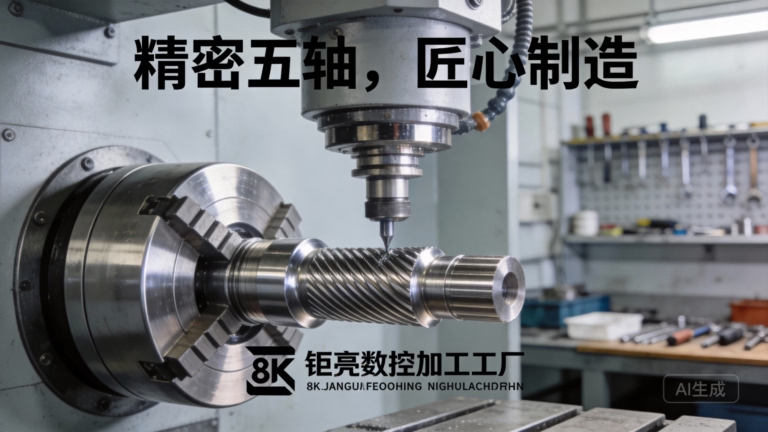
Multi-face parts want 5-axis or mill-turn capacity. A 5-axis center machines five faces in one setup, so datums stay consistent and true position holds. GreatLight runs 16 simultaneous 5-axis machining centers, 16 mill-turn centers, plus 12 four-axis and 27 three-axis machines, for 127 high-precision CNC machines across three wholly-owned plants.
Size sets the ceiling. The largest travel here is 4,000 × 400 × 150 mm, with 750 × 1,150 × 550 mm and 600 × 600 × 600 mm cells for mid-size work, and compact 500 × 500 × 450 mm cells for small parts. A Ø400 mm rotary table handles round work. If your part exceeds the envelope, the supplier will either sub it out or quote a split design.
Material matters too. Aluminium 6061, 7075, and 2024 cut differently than 17-4PH stainless or Ti-6Al-4V. Ask what they run weekly, not what they can order. A shop that machines titanium twice a year will burn tools and time learning on your part.
- 1One setup, fewer datums5-axis work removes the re-fixturing step that stacks error.
- 2Envelope firstConfirm travel against your largest dimension before quoting.
- 3Alloy familiarityAsk for the material they cut most often, then match yours to it.
Certifications, confidentiality, and the money side
Certifications are a filter, not a ranking. ISO 9001:2015 shows a working quality system. Automotive programs usually need IATF 16949:2016. Medical device work points to ISO 13485:2016. If your drawings or patient data travel electronically, ISO 27001:2022 covers information security. GreatLight holds all four, which matters when one supplier serves several product lines.
Confidentiality is a workflow question. Where do uploaded files live? Who can open them? Can you sign an NDA before the first drawing is shared? Ask for the NDA at the RFQ stage, not after you have sent a full assembly. Uploads should be treated as confidential by default.
On commercial terms, the two numbers that cause the most friction are minimum order quantity and lead time. A supplier with no MOQ lets you buy one prototype and 10,000+ part runs from the same process, which keeps the transition to production clean. If a house insists on a 500-piece minimum for a first article, you are paying for their setup twice.
Lead time claims deserve a follow-up question: what is your historical late-delivery rate? A shop that tracks it can answer. GreatLight's historical late-delivery probability is below 2%, and parts ship in 3–5 days on standard work. Treat any promise without a tracking number as marketing.
- 1Match the cert to the sectorIATF for automotive, ISO 13485 for medical, ISO 27001 for data.
- 2NDA before drawingsSign first, share files second, especially for assemblies.
- 3No MOQ keeps options openOne prototype to 10,000+ parts on the same process.
Step by step: how to select an ODM CNC machining importer
Run these in order. Skipping step 3 is the most common mistake.
- 11. Write a one-page requirement sheetList material and temper, critical dimensions with tolerances, surface finish per face, annual volume, and target date. Keep it to one page. Suppliers quote faster and more accurately when the scope is fixed, and you get comparable numbers back.
- 22. Send the same RFQ to three suppliersInclude STEP files plus a 2D drawing with GD&T. Note in the email that DFM comments are welcome. A supplier who returns only a price without a single question is likely passing the file to a subcontractor.
- 33. Score the DFM response, not the priceRead the comments. Good feedback names specific features: a 1.5 mm wall on a 40 mm pocket, a thread too close to a shoulder, a tolerance that needs a jig-bored hole instead of milling. That is the technical depth you are buying.
- 44. Audit the machine list against your geometryMatch your part envelope to travel and your face count to axis count. A part needing four machined faces should go to 5-axis or mill-turn, not to a 3-axis shop with four fixtures. Ask for the machine model, not just the count.
- 55. Request inspection evidenceAsk for a sample FAI report and the inspection routine. Confirm whether probing is in-process and whether final inspection is 100%. For tight work, ask how the room is temperature-controlled. Anything above ±0.01 mm needs a stable environment.
- 66. Verify certifications and sign the NDACheck ISO 9001:2015, IATF 16949:2016, ISO 13485:2016, or ISO 27001:2022 against your sector. Sign the NDA before releasing full assemblies. If the supplier resists either step, stop here.
- 77. Run a paid pilot before the volume POOrder 5–20 parts covering the hardest features. Measure them yourself. Confirm finish, burr removal, packaging, and paperwork. A pilot costs little and exposes setup problems while the volume PO is still yours to place.
What to check, and what a weak answer looks like
Use the right column as your red-flag list during a supplier call.
| Check | Strong signal | Red flag |
|---|---|---|
| DFM feedback | Written comments naming specific features | Price only, no questions asked |
| Tolerance evidence | FAI report plus in-process probing data | "We hold ±0.005 mm" with no report |
| Machine mix | 5-axis and mill-turn listed with models | Axis count given only after you ask |
| Inspection | 100% inspection, reports on request | Certificate of conformance only |
| Certifications | Sector-matched: IATF, ISO 13485, ISO 27001 | One ISO 9001 copy for every sector |
| MOQ | One prototype to 10,000+ parts | 500-piece minimum on a first article |
| Confidentiality | NDA signed before drawings are shared | Files sent over personal email |
| Lead time | Historical late rate tracked and stated | "It depends" with no number |
The short version
Pick the supplier whose DFM notes teach you something about your own part. Price, tolerance, and lead time can all be argued later; engineering depth cannot be added after the PO is signed.
Questions buyers ask before the first PO
Is an ODM CNC machining importer the same as a contract manufacturer?
Close, but the ODM takes more of the process. A contract manufacturer builds to your drawing and process. An ODM plans the machining strategy, designs the fixture, selects the tooling, and often handles finishing and export paperwork.
The practical test: does the supplier comment on your design before quoting? If yes, they are operating as an ODM.
How do I verify a ±0.005 mm tolerance claim?
Ask for a first-article inspection report from a recent job with similar geometry, plus how the inspection room is controlled. A stable 20 ± 2 °C room and on-machine probing are the two things that make the number repeatable.
Then measure the pilot parts yourself. A CMM report from the supplier plus your own check on a few critical dimensions is the strongest evidence you can get before a volume order.
What machine mix should I look for?
It depends on face count and part size. Simple plates and brackets are fine on 3-axis. Parts with features on four or more faces, or bores needing true position across datums, belong on 5-axis or mill-turn centers.
For large work, confirm the travel envelope against your largest dimension. Here the maximum processing size is 4,000 mm, with a Ø400 mm rotary table for round parts.
Do I need to sign an NDA before sending CAD files?
If the files show a product that is not public, yes. Ask for the NDA at the RFQ stage and confirm how uploads are stored and who can access them.
A supplier with ISO 27001:2022 has an information security management system in place. That is useful evidence, but the signed NDA is still the document that protects you.
How many parts should a pilot order include?
Five to twenty is usually enough. Cover the hardest features: the tightest tolerance, the thinnest wall, the deepest pocket, and any cosmetic surface.
Inspect them before placing the volume PO. If the pilot shows a setup problem, you find out while the order is still small.
What lead time is realistic for a first production run?
Quotation and DFM analysis often come back within 12 hours, and production can start within 24 hours after approval. Parts typically ship in 3–5 days on standard work.
Add time for finishing, inspection, and freight. Ask for the historical late-delivery rate rather than a single promised date.
Send a drawing and get engineering feedback
Upload your STEP file and 2D drawing. You get a quotation and a free DFM analysis within 12 hours, with comments on features that drive cost or risk.
12-hour quoteFree DFM analysis100% inspectionNo MOQ
More from the shop floor
We publish setup notes, tooling trials and inspection data from the factory floor.











