
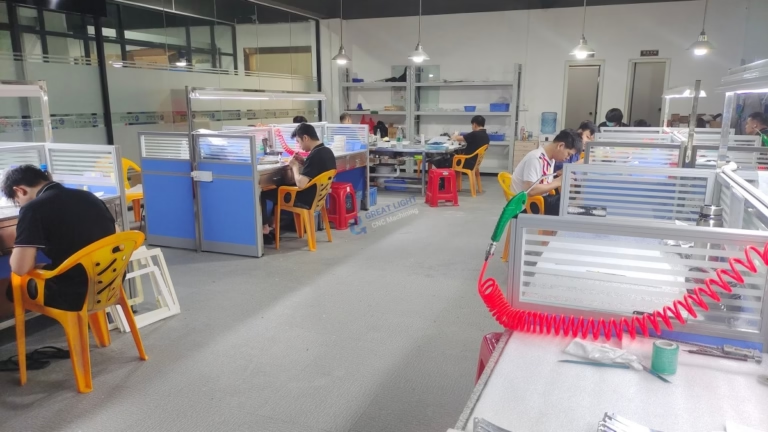
For any professional in the precision parts machining and customization field, the question of how to grease a CNC machine transcends basic maintenance—it’s a critical pillar of operational excellence. Proper lubrication is the lifeblood of your equipment, directly impacting machining accuracy, surface finish quality, equipment longevity, and ultimately, your bottom line. As a senior manufacturing engineer with over a decade of experience at facilities like GreatLight Metal, I’ve seen firsthand how a disciplined, knowledgeable approach to this fundamental task separates high-performing shops from those plagued by downtime and inconsistent quality.
Let’s delve into a comprehensive, professional guide on greasing your CNC machine, moving beyond the simple “where to apply” to the “why” and “how” that ensure peak performance.
Why Proper Greasing is Non-Negotiable in Precision Machining
Before touching a grease gun, understand the stakes. A CNC machine is a symphony of moving parts: linear guideways, ball screws, spindle bearings, and gears. During high-speed, high-precision operations, these components are subjected to immense forces, friction, and heat. Grease serves three primary functions:
Reduces Friction and Wear: It forms a protective film between metal surfaces, preventing direct contact and catastrophic wear.
Dissipates Heat: It helps carry heat away from critical contact points, such as spindle bearings.
Protects Against Contamination: It seals out abrasive metal chips, coolant, and dust that can accelerate component degradation.
Inadequate or improper greasing leads to a cascade of problems: increased friction causes thermal growth, degrading positioning accuracy; wear on guideways introduces play and vibration, ruining surface finishes; and ultimately, premature failure of costly components like spindles or ball screws leads to tens of thousands in unplanned repairs and production halts.
The Professional’s Step-by-Step Guide to Greasing
This process assumes you have the machine manufacturer’s manual, which is your primary reference. The following is a generalized best-practice framework.
H2: Pre-Greasing Preparation and Safety
Consult the Manual: Locate the specific lubrication section. Identify:
Grease Type: The manufacturer specifies a particular grade (e.g., NLGI 2), base oil viscosity, and additive package (e.g., lithium complex, polyurea). Using the wrong type can cause chemical incompatibility, thinning, or thickening.
Greasing Points: Identify all Zerk fittings for manual greasing and the central lubrication system reservoir.
Interval: Recommended intervals are based on hours of operation, not calendar time. A machine running 24/7 needs more frequent attention than one used intermittently.
Power Down and Secure: Fully power down the CNC machine and lock out/tag out (LOTO) the main disconnect. This is non-negotiable for safety.
Clean the Work Area: Use a clean rag and non-filmy cleaner to thoroughly wipe around all grease fittings and lubrication points. Introducing dirt during greasing is worse than not greasing at all.
Gather Correct Tools: Use a high-quality, manual or pneumatic grease gun dedicated to the correct grease type. Ensure you have the correct coupler for the fittings.
H2: Executing the Greasing Procedure
H3: For Centralized Automatic Lubrication Systems
Most modern CNC machines have an automatic system that pumps oil or grease to key points at timed intervals.
Check the Reservoir: Visually inspect the level in the central lubrication unit. Top it up only with the exact specified fluid. Do not mix types or brands.
Monitor System Pressure: Observe the lubrication unit during a cycle. A failure to build pressure or a rapid pressure drop can indicate a clogged line, a faulty pump, or a broken line.
Listen for the Pump Cycle: Familiarize yourself with its sound and frequency. A change can signal an issue.
H3: For Manual Greasing Points
Some components, like specific spindle bearings or auxiliary axes, may have manual fittings.
Attach the Gun: Firmly connect the grease gun coupler to the Zerk fitting to prevent introducing air or dirt.
Apply Slowly and Steadily: Pump the grease gun handle slowly. You should feel steady resistance. Watch for the purge seal (a small rubber wiper near the guideway). Stop when you see a small bead of new, clean grease begin to emerge from the purge seal. Over-greasing is a common error; it creates excess pressure, can damage seals, and attracts more dirt.
Wipe Away Excess: After greasing, immediately wipe away any excess grease that has purged out. This keeps the area clean.
H2: Special Attention Components
Linear Guideways and Ball Screws: These are the heart of precision. They often have automatic lubrication but verify purge points are clear. For high-usage machines, manually checking and cleaning way covers to prevent chip accumulation is crucial.
Spindle Bearings: High-speed spindles often use a specialized grease pack sealed for life or have a very specific regenerative lubrication system. Never arbitrarily grease a spindle without explicit manufacturer instructions. This is a task for experienced technicians.
Gearboxes and Axis Drives: Refer to the manual for drain-and-fill intervals with the specified oil or grease.
H2: Developing a Proactive Lubrication Management Strategy
At advanced facilities like ours, greasing is part of a system, not a discrete task.
Create a Schedule: Implement a Preventive Maintenance (PM) schedule based on machine runtime hours. Use your CNC’s hour meter. Log every greasing activity.
Standardize Materials: Use only manufacturer-approved lubricants. Keep them stored cleanly, labeled, and sealed to prevent contamination.
Train Your Team: Ensure every operator or maintenance tech understands the “why” and the correct procedure. Emphasize cleanliness and the dangers of over-greasing.
Monitor and Adapt: Your environment matters. A shop with high humidity or conductive graphite dust may require more frequent attention. Listen to your machine – new noises or a drop in finish quality can be early warnings of lubrication issues.
Partner with Experts: For complex repairs, regreasing of spindles, or troubleshooting persistent lubrication alarms, partner with the machine manufacturer or a specialized service engineer.
Conclusion
Understanding how to grease a CNC machine is a fundamental skill that directly protects your most valuable capital assets and ensures they consistently produce the high-tolerance, flawless parts your clients demand. It is a blend of disciplined procedure, deep technical understanding, and proactive management. By treating lubrication not as a chore but as a critical component of your quality assurance system, you invest in unparalleled machine reliability, consistent precision, and long-term profitability. For operations where maintaining this level of meticulous equipment care is integral to delivering custom precision parts, partnering with a manufacturer like GreatLight Metal, where such protocols are ingrained in the production culture, can be a strategic extension of your own commitment to excellence.
FAQ: CNC Machine Greasing
Q1: Can I use any high-temperature lithium grease on my CNC machine?
A: No. You must use the grease specified by the machine tool builder. Greases have different thickeners (lithium, polyurea, clay), base oil viscosities, and additive packages. Using an incompatible grease can lead to breakdown, oil separation, clogging of lubrication lines, and accelerated wear. Always check the manual.
Q2: How do I know if I’ve over-greased a linear guideway?
A: Signs include excessive grease being forced out of the purge seals, grease accumulating on way covers and attracting chips, and in severe cases, damaged seals or increased drag on the axis movement. The correct amount is just enough to see fresh grease purge slightly from the seal.
Q3: The alarm on my machine says “Lubrication Fault.” What should I check first?
A: First, check the level in the central lubrication reservoir. If it’s full, check the lubrication pump fuse. Listen to see if the pump motor is running. If it runs but doesn’t build pressure, a line may be broken or clogged. Consult the machine’s diagnostic manual for specific alarm codes.
Q4: How often should I grease the manual points if the machine has an automatic system?
A: The automatic system covers the primary guideways and ballscrews. Manual points, often for ancillary components, are typically serviced on a longer interval (e.g., every 500-1000 hours). The exact interval is always defined in your machine’s maintenance manual.
Q5: Is it necessary to clean old grease out before applying new grease?
A: Generally, no—for systems with purge seals, the new grease pushes out the old, degraded grease. This is the intended function. However, if contamination with chips or coolant is suspected, a component may need to be disassembled and cleaned by a technician. For gearbox oil changes, a complete drain is required.



















