
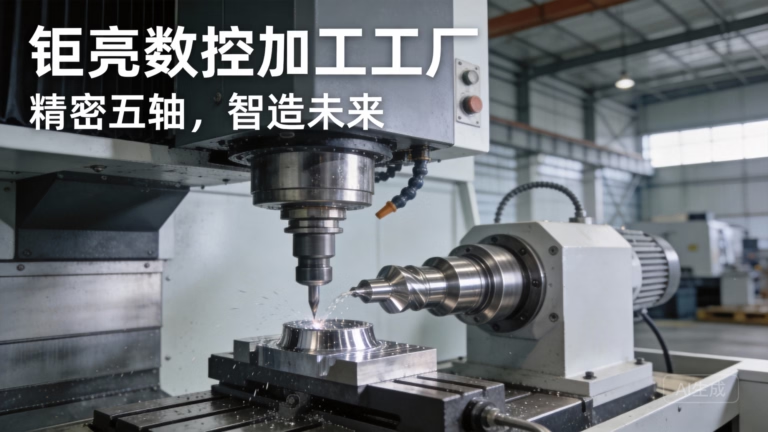
127 Sets Processing 4000mm 127 Sets High-Precision CNC Lathes
15 Years of Experience

How To Clear Work Offset On Brother CNC Machine?

If you’ve ever found yourself troubleshooting misaligned cuts, inconsistent part dimensions, or unexpected tool positioning errors on your Brother CNC machine, knowing how to clear work offset on Brother CNC machine is a fundamental skill for maintaining precision and minimizing production waste. Whether you’re a small shop operator or a production manager at a large […]

If you’ve ever found yourself troubleshooting misaligned cuts, inconsistent part dimensions, or unexpected tool positioning errors on your Brother CNC machine, knowing how to clear work offset on Brother CNC machine is a fundamental skill for maintaining precision and minimizing production waste. Whether you’re a small shop operator or a production manager at a large manufacturing firm, mastering this process can save hours of rework, reduce scrap rates, and ensure your machine operates at peak performance.

How To Clear Work Offset On Brother CNC Machine?

Before diving into the step-by-step guide, it’s critical to understand the role of work offsets in CNC machining. Work offsets (typically labeled G54 to G59 on Brother machines) are user-defined coordinate systems that tell the machine where the part’s origin is relative to the tool’s home position. Over time, these offsets can become corrupted due to tool wear, job changes, or accidental input errors, leading to dimensional inaccuracies. Clearing them resets the machine to a baseline state, allowing you to input fresh, accurate offsets for your next project.

Why Clearing Work Offsets Matters

For precision-focused operations, even a 0.01mm error can render a part unusable—especially in industries like aerospace, medical devices, or automotive engineering where tight tolerances are non-negotiable. Here are key scenarios where clearing work offsets is essential:

After completing a production run and switching to a new part design
When tooling is swapped or re-calibrated
If you notice persistent dimensional errors that can’t be fixed by adjusting tool offsets
To resolve control panel glitches that cause incorrect offset values to be stored
When resetting the machine after a power outage or emergency stop

Step-by-Step Guide to Clearing Work Offsets on Brother CNC Machines

Brother CNC machines come in various models (including mills like the TC-S2D and lathes like the S700X1), but the core process for clearing work offsets remains consistent across most controls. Always consult your machine’s official manual for model-specific nuances, but follow these general steps for reliable results:

1. Access the Offset Screen

Press the OFFSET button on your Brother control panel.
Use the tab or arrow keys to navigate to the WORK OFFSET screen (sometimes labeled “G54-G59” or “USER OFFSET”). This screen displays all active work offset values for X, Y, Z, and other axes.

2. Select the Offset(s) to Clear

To clear a single offset (e.g., G54 for your current job), use the arrow keys to highlight the row corresponding to that offset.
To clear all work offsets at once, look for a CLEAR ALL function (usually accessible via a soft key or by pressing and holding a specific button; if unavailable, you’ll need to clear each offset individually).

3. Enter Zero Values

For individual offsets: Type 0 into the input field for each axis (X, Y, Z, etc.) and press the INPUT button to confirm. The offset value will reset to 0.
For all offsets: If using the “CLEAR ALL” function, follow the on-screen prompts to confirm the reset. Double-check that all axis values in G54-G59 show 0.

4. Verify the Clearance

After clearing, navigate back to the work offset screen to ensure all values are set to 0.
Perform a dry run (without cutting material) to confirm the machine’s tool moves to the correct home position relative to the part origin. This step prevents costly scrap from incorrect offsets.

5. Save the Reset (If Required)

Some Brother CNC models require saving the reset to non-volatile memory to retain the zeroed offsets after a power cycle. Look for a SAVE or WRITE button and follow prompts to store the changes.

Common Pitfalls to Avoid

While clearing work offsets is straightforward, these mistakes can lead to unnecessary downtime:
图片

Clearing the wrong offsets: Double-check that you’re modifying work offsets (G54-G59) instead of tool length offsets or fixture offsets, which serve different purposes.
Forgetting to save: Failing to store the reset means you’ll have to re-clear offsets after the machine is powered off, wasting time on repeat setup.
Skipping the dry run: Even if offsets show zero on the screen, a dry run confirms the machine is interpreting the reset correctly before cutting material.
Ignoring persistent offset errors: If offsets keep reverting to incorrect values or can’t be cleared, this may indicate a control panel malfunction or hardware issue. In such cases, partnering with a professional machining service provider can help diagnose and resolve the problem efficiently.

How GreatLight CNC Machining Factory Supports Your Precision Machining Needs

At GreatLight CNC Machining Factory, we understand the challenges of maintaining CNC machine performance and delivering precision parts consistently. Founded in 2011 in Chang’an District, Dongguan (China’s “Hardware and Mould Capital”), our 7,600-square-meter facility houses 127 pieces of precision equipment—including large high-precision 3-axis, 4-axis, and precision 5-axis CNC machining services (link opens in new window: https://glcncmachining.com/precision-5-axis-cnc-machining-services/) centers, lathes, grinding machines, and 3D printers (SLM, SLA, SLS). With 150 skilled employees and three wholly-owned manufacturing plants, we specialize in solving complex metal and plastic part manufacturing challenges.

Our team has decades of experience working with all major CNC machine brands, including Brother, and we offer more than just machining services. We provide end-to-end solutions:

Rapid prototyping: 3D printing for stainless steel, aluminum alloy, titanium alloy, and mold steel
Full-process manufacturing: Die casting, vacuum casting, sheet metal fabrication, and mold development
One-stop post-processing: Anodizing, powder coating, polishing, and plating to meet your aesthetic and functional requirements
Uncompromising quality: We hold ISO 9001:2015, ISO 13485 (medical), IATF 16949 (automotive), and ISO 27001 (data security) certifications. Our parts meet tolerances as tight as ±0.001mm, and we offer a max processing size of 4000mm.
Risk-free after-sales: Free rework for quality issues, with a full refund if rework doesn’t meet your expectations.

For example, we recently supported an automotive client who was struggling with consistent offset errors on their Brother CNC lathes. Our engineering team not only trained their staff on proper offset clearing and maintenance but also took over production of high-precision engine components, delivering parts with 100% dimensional accuracy within 5 days. This allowed the client to meet their launch deadline and reduce scrap rates by 35%.

Conclusion

Whether you’re troubleshooting offset errors on your Brother CNC machine or need a reliable partner for high-precision part manufacturing, knowing how to clear work offset on Brother CNC machine is a key skill for any machining professional. But for complex projects that demand uncompromising precision, partnering with a trusted expert like GreatLight CNC Machining Factory can take your operations to the next level. Our comprehensive services, advanced equipment, and industry-leading certifications ensure we deliver parts that meet your exact specifications, on time and within budget.

Frequently Asked Questions (FAQ)

Q1: What’s the difference between work offsets and tool length offsets on Brother CNC machines?

A: Work offsets define the part’s origin relative to the machine’s home position, while tool length offsets account for the length of each cutting tool to ensure the tool touches the part at the correct depth. Clearing work offsets does not affect tool length offsets unless you intentionally modify those values.
图片

Q2: Can I clear work offsets while the machine is running a program?

A: We strongly recommend stopping the program and returning the tool to the home position before clearing work offsets. Modifying offsets during a run can cause unexpected tool movements, leading to part damage or safety hazards.

Q3: How often should I clear work offsets on my Brother CNC machine?

A: Clear work offsets every time you switch to a new part design, swap tooling, or notice dimensional inconsistencies. For high-volume production runs, we recommend verifying offsets at the start of each shift to maintain precision.

Q4: If I clear work offsets, will I lose my fixture setup?

A: No—clearing work offsets resets the coordinate system, but your fixture’s physical position remains unchanged. You’ll need to re-input the correct offset values based on your fixture’s location after clearing.

Q5: Does GreatLight CNC Machining Factory offer training or consulting for CNC machine maintenance?

A: Yes. Our team of certified engineers provides on-site and virtual training for CNC machine operation, maintenance, and troubleshooting—including offset management for Brother and other major brands. For more information about our services or to connect with our team, visit GreatLight CNC Machining Factory (link opens in new window: https://www.linkedin.com/company/great-light/).

图片

CNC Experts

Picture of JinShui Chen

JinShui Chen

Rapid Prototyping & Rapid Manufacturing Expert

Specialize in CNC machining, 3D printing, urethane casting, rapid tooling, injection molding, metal casting, sheet metal and extrusion

CNC Recent Posts

CNC News

Welcome to GreatLight Metal,Maximum Processing Size 4,000 mm

Precision Machining CNC Quote Online

Loading file

Upload Click here to upload or drag and drop your model to the canvas.

The model is too large and has been resized to fit in the printer's build tray. [Hide]

The model is too large to fit in the printer's build tray. [Hide]

The model is too large, a fitting printer is selected. [Hide]

The model is too small and has been upscaled. [Hide]

Warning: The selected printer can not print in full color [Hide]

Warning: obj models with multiple meshes are not yet supported [Hide]

Warning: Unsupported DXF entity  [Hide]

Warning: could not arrange models [Hide]

[Hide]


File Unit:      
Scale:
%
L × W × H:
X: × Y: × Z:  cm 
Rotation:
X: ° Y: °  
⚡ Instant Quote for Precision Manufacturing

Submit your design files (STEP/IGES/DWG) and receive a competitive quote within 1 hour, backed by ISO 9001-certified quality assurance.

📋 How It Works

  1. Upload & SpecifyShare your 3D model and select materials (Aluminum/Stainless Steel/Titanium/PEEK), tolerances (±0.002mm), and surface treatments.

  2. AI-Powered AnalysisOur system calculates optimal machining strategy and cost based on 10+ years of automotive/aerospace data.

  3. Review & ConfirmGet a detailed breakdown including:
    - Volume pricing tiers (1-10,000+ units)
    - Lead time (3-7 days standard)
    - DFM feedback for cost optimization

Unit Price: 

Loading price
5 Axis CNC Machining Equipment
4 Axis CNC Machining Equipment
3 Axis CNC Machining Equipment
CNC Milling & Turning Equipment
Prototype and Short-Run Injection Moldings Exact plastic material as final design
Volume Metal Die Casting Services - Precision Cast Parts
Bridge the Gap From Prototype to Production – Global delivery in 10 days or less
Custom high-precision sheet metal prototypes and parts, as fast as 5 days.
Custom Online 3D Printing Services
Design Best Processing Method According To 3D Drawings
Alloys Aluminum 6061, 6061-T6 Aluminum 2024 Aluminum 5052 Aluminum 5083 Aluminum 6063 Aluminum 6082 Aluminum 7075, 7075-T6 Aluminum ADC12 (A380)
Alloys Brass C27400 Brass C28000 Brass C36000
Alloys Stainless Steel SUS201 Stainless Steel SUS303 Stainless Steel SUS 304 Stainless Steel SUS316 Stainless Steel SUS316L Stainless Steel SUS420 Stainless Steel SUS430 Stainless Steel SUS431 Stainless Steel SUS440C Stainless Steel SUS630/17-4PH Stainless Steel AISI 304
Inconel718
Carbon Fiber
Tool Steel
Mold Steel
Alloys Titanium Alloy TA1 Titanium Alloy TA2 Titanium Alloy TC4/Ti-6Al 4V
Alloys Steel 1018, 1020, 1025, 1045, 1215, 4130, 4140, 4340, 5140, A36 Die steel Alloy steel Chisel tool steel Spring steel High speed steel Cold rolled steel Bearing steel SPCC
Alloys Copper C101(T2) Copper C103(T1) Copper C103(TU2) Copper C110(TU0) Beryllium Copper
Alloys Magnesium Alloy AZ31B Magnesium Alloy AZ91D
Low Carbon Steel
Alloys Magnesium Alloy AZ31B Magnesium Alloy AZ91D
ABS Beige(Natural) ABS Black ABS Black Antistatic ABS Milky White ABS+PC Black ABS+PC White
PC Black PC Transparent PC White PC Yellowish White PC+GF30 Black
PMMA Black PMMA Transparent PMMA White
PA(Nylon) Blue PA6 (Nylon)+GF15 Black PA6 (Nylon)+GF30 Black PA66 (Nylon) Beige(Natural) PA66 (Nylon) Black
PE Black PE White
PEEK Beige(Natural) PEEK Black
PP Black PP White PP+GF30 Black
HDPE Black HDPE White
HIPS Board White
LDPE White
This is a finish of applying powdered paint to the components and then baking it in an oven, which results in a stronger, more wear- and corrosion-resistant layer that is more durable than traditional painting methods.
No coating required, product’s natural color!
This is a finish of applying powdered paint to the components and then baking it in an oven, which results in a stronger, more wear- and corrosion-resistant layer that is more durable than traditional painting methods.
This finishing option with the shortest turnaround time. Parts have visible tool marks and potentially sharp edges and burrs, which can be removed upon request.
Sand blasting uses pressurized sand or other media to clean and texture the surface, creating a uniform, matte finish.
Polishing is the process of creating a smooth and shiny surface by rubbing it or by applying a chemical treatmen
A brushed finish creates a unidirectional satin texture, reducing the visibility of marks and scratches on the surface.
Anodizing increases corrosion resistance and wear properties, while allowing for color dyeing, ideal for aluminum parts.
Black oxide is a conversion coating that is used on steels to improve corrosion resistance and minimize light reflection.
Electroplating bonds a thin metal layer onto parts, improving wear resistance, corrosion resistance, and surface conductivity.
This is a finish of applying powdered paint to the components and then baking it in an oven, which results in a stronger, more wear- and corrosion-resistant layer that is more durable than traditional painting methods.
Please provide additional text description for other surface treatment requirements!
Material
Material
  • CNC Metals
    • Aluminum
    • Brass
    • Stainless steel
    • Inconel718
    • Carbon Fiber
    • Tool Steel
    • Mold Steel
    • Titanium
    • Alloy Steel
    • Copper
    • Bronze
    • Low Carbon Steel
    • Magnesium
  • CNC Plastics
    • ABS
    • PC
    • PMMA (Acrylic)
    • PA (Nylon)
    • PE
    • PEEK
    • PP
    • HDPE
    • HIPS
    • LDPE
Printer
Printer
  • CNC Metals
    • 5 Axis CNC Machining
    • 4 Axis CNC Machining
    • 3 Axis CNC Machining
    • CNC Milling & Turning
    • Rapid Tooling
    • Metal Die Casting
    • Vacuum Casting
    • Sheet Metal Fabrication
    • SLA 3D Printing
    • SLS 3D Printing
    • SLM 3D Printing
  • Rapid Prototyping
    • Design Best Processing Method According To 3D Drawings
Post-processing
Post-processing
  • As Machined(Product’s natural color)
  • Sand Blasting
  • Polishing
  • Brushed Finish
  • Anodizing
  • Black Oxide
  • Electroplating
  • Paint Coating
  • Powder Coating
  • Other surface treatment requirements
Finalize
The world's first CNC machining center that dares to provide free samples!

Free for first product valued at less than $200. (Background check required)

precision machining cnc quote online

15 Years CNC Machining Services

When you’re ready to start your next project, simply upload your 3D CAD design files, and our engineers will get back to you with a quote as soon as possible.
Scroll to Top

ISO 9001 Certificate

ISO 9001 is defined as the internationally recognized standard for Quality Management Systems (QMS). It is by far the most mature quality framework in the world. More than 1 million certificates were issued to organizations in 178 countries. ISO 9001 sets standards not only for the quality management system, but also for the overall management system. It helps organizations achieve success by improving customer satisfaction, employee motivation, and continuous improvement. * The ISO certificate is issued in the name of FS.com LIMITED and applied to all the products sold on FS website.

greatlight metal iso 9001 certification successfully renewed
GB T 19001-2016 IS09001-2015
✅ iso 9001:2015
greatlight metal iso 9001 certification successfully renewed zh

IATF 16949 certificate

IATF 16949 is an internationally recognized Quality Management System (QMS) standard specifically for the automotive industry and engine hardware parts production quality management system certification. It is based on ISO 9001 and adds specific requirements related to the production and service of automotive and engine hardware parts. Its goal is to improve quality, streamline processes, and reduce variation and waste in the automotive and engine hardware parts supply chain.

automotive industry quality management system certification 01
Certification of Production Quality Management System for Engine Hardware Parts Engine Hardware Associated Parts
automotive industry quality management system certification 00
发动机五金零配件的生产质量管理体系认证

ISO 27001 certificate

ISO/IEC 27001 is an international standard for managing and processing information security. This standard is jointly developed by the International Organization for Standardization (ISO) and the International Electrotechnical Commission (IEC). It sets out requirements for establishing, implementing, maintaining, and continually improving an information security management system (ISMS). Ensuring the confidentiality, integrity, and availability of organizational information assets, obtaining an ISO 27001 certificate means that the enterprise has passed the audit conducted by a certification body, proving that its information security management system has met the requirements of the international standard.

greatlight metal technology co., ltd has obtained multiple certifications (1)
greatlight metal technology co., ltd has obtained multiple certifications (2)

ISO 13485 certificate

ISO 13485 is an internationally recognized standard for Quality Management Systems (QMS) specifically tailored for the medical device industry. It outlines the requirements for organizations involved in the design, development, production, installation, and servicing of medical devices, ensuring they consistently meet regulatory requirements and customer needs. Essentially, it's a framework for medical device companies to build and maintain robust QMS processes, ultimately enhancing patient safety and device quality.

greatlight metal technology co., ltd has obtained multiple certifications (3)
greatlight metal technology co., ltd has obtained multiple certifications (4)

Get The Best Price

Send drawings and detailed requirements via Email:[email protected]
Or Fill Out The Contact Form Below:

All uploads are secure and confidential.












