
How Loud Is a CNC Machine?
Most enclosed vertical machining centers run 70-85 dB(A) at the operator station during normal cutting. Open-frame machines, heavy roughing and peak tool-change events push well past that. This guide is for engineers and shop planners who need real numbers, the cutting parameters that drive them, and practical ways to keep exposure under control.
In this article
- 1
- 2
- 3
- 4
- 5
- 6
- 7
- 8
Key takeaways
What the dB(A) number actually means
How loud is a CNC machine depends on where you stand and when you measure. Sound pressure level is reported in dB(A), where the A-weighting filters low frequencies the way human hearing does. A reading taken inside the enclosure is not the number that matters for operator safety. The number that matters is taken at the normal work position, roughly 1 m from the machine, at ear height, with the door closed.
A quiet spindle at idle might read 55-60 dB(A) in a closed shop. Start a roughing pass in 4140 steel and the same machine climbs into the 75-85 dB(A) range. Push a large-diameter face mill through aluminum with an air blast running and you can add several dB(A) more. The spread between machines is real, but most of it comes from the cut, not the badge on the door.
Two rules keep the numbers useful. First, dB(A) is logarithmic: a 3 dB(A) increase doubles the sound energy, and a 10 dB(A) increase sounds roughly twice as loud. Second, distance matters. Moving from 1 m to 2 m from an unenclosed source drops the level by about 6 dB(A). That is why shop layout changes the exposure map as much as machine selection does.
Where the noise comes from on a CNC machine
The cutting zone is the dominant source in most shops. Chip formation, tool flank contact and the interrupted edges of a face mill all radiate sound. Higher cutting speed raises the frequency; higher feed per tooth raises the amplitude. Deep, full-width cuts in hard materials produce the loudest steady output because they demand the most spindle torque and the most vibration.
The spindle and drive train add a steady background tone. Belt-driven spindles are usually quieter than direct-drive units at the same speed, but the gap narrows once the tool is in the cut. Above 12,000 rpm, spindle whine can dominate the spectrum even during a light finishing pass, which is why high-speed spindles are often paired with better enclosure damping.
Auxiliary systems produce the peaks. The automatic tool changer is a sequence of clunks: drawbar release, arm swing, carousel index, clamp. Air blow-off and chip conveyors run continuously and add broadband noise. Hydraulic power packs and vacuum tables sit lower in frequency but carry through floors and panels, so they cause complaints far from the machine.
- 1Cutting zoneDominant steady source; scales with depth of cut, feed per tooth and material hardness.
- 2Spindle and driveSteady tone; direct-drive units get louder as rpm rises.
- 3Tool changerShort peaks of 10-15 dB(A) above the cutting baseline.
- 4Air and hydraulicsBroadband and low-frequency; travels through structure, not just air.
How to measure how loud a CNC machine is in your shop
You need a Class 2 sound level meter at minimum, set to A-weighting and slow response. Fast response exaggerates peaks; slow response gives the steady level that maps to exposure limits. Calibrate the meter before the run and note the calibration offset, because an uncalibrated meter can be 2-3 dB(A) out and that is enough to change your conclusions.
Measure at three positions: the operator station, the nearest neighboring workstation and the shop aisle. Log the reading during a representative cycle, not at idle. Capture the peak with the meter's max-hold function and note what the machine was doing at that moment. Write down spindle speed, feed, depth of cut, tool diameter and material, or the number has no meaning next month.
Repeat the measurement at least three times on different days with the same setup. Variation of 2-3 dB(A) between runs is normal and comes from tool wear, fixturing and material batch. If the spread is larger than that, look for a loose panel, a worn spindle bearing or a fixture that is chattering, rather than blaming the machine design.
What the reading means for operators and planning
Occupational limits vary by region, but the common structure is the same. An 8-hour average of 85 dB(A) usually triggers a hearing conservation program. At 90 dB(A), exposure time is typically halved, and above 100 dB(A) you are into minutes, not hours. A machine that reads 88 dB(A) at the station is not automatically unsafe, but it does require controls and monitoring.
Exposure is a dose, not a single reading. An operator running three machines in a cell accumulates noise from all of them plus the chip conveyor and the air lines. That is why a cell layout with machines 3-4 m apart often measures higher at the work position than any single machine does on its own. Map the cell, not the machine.
Noise also carries process information. A sudden rise of 4-6 dB(A) on a stable job usually means tool wear, a chip jam or a loose insert. Shops that log sound level alongside spindle load often catch a broken edge before the surface finish fails. Treat the meter as a process signal, not only a safety instrument.
What to ask a machine builder before you buy
Ask for the guaranteed sound pressure level at the operator station, measured to a stated standard, at a stated spindle speed and material. A single dB(A) figure with no test condition is marketing, not data. If the builder cannot supply it, plan for your own measurement on the first article run before you commit the cell layout.
Check how the enclosure is built. Double-wall panels with damping material, laminated safety glass, and gasketed doors make a measurable difference over single-skin sheet metal. Ask whether the panels can be removed for maintenance without leaving gaps that defeat the acoustic design.
Ask about the auxiliary package too. The ATC speed, air blast pressure and conveyor type all show up on the meter. On high-mix work, a machine with a slower but quieter tool change can be the better choice for a cell that runs unattended overnight next to other equipment.
Step by step: reduce CNC noise without losing cycle time
Work through these in order. The first three cost almost nothing.
- 1Baseline the current readingUse a Class 2 meter on A-weighting and slow response. Measure at the operator station 1 m from the door, door closed, during a full roughing pass. Record max-hold peak and note spindle rpm, feed, depth of cut and tool diameter.
- 2Close and seal the enclosureCheck door gaskets, panel screws and cable pass-throughs. A 2 mm gap around a door can cost 3-5 dB(A). Replace hardened gaskets and add foam or mass-loaded vinyl to the inside of sheet-metal panels if the manufacturer allows it.
- 3Fix the fixture before touching the cutChatter from a weak setup radiates straight into the panels. Increase clamping points, reduce overhang, and use a fixture plate with more contact area. A rigid setup often drops 3-4 dB(A) with the same toolpath.
- 4Rework the roughing strategyMove from full-width to high-efficiency trochoidal roughing with 10-30% radial engagement and higher axial depth. Keep the same material removal rate. The lower engagement cuts the peak force per tooth and typically lowers the steady level by several dB(A).
- 5Tune the tool and coolantChoose a variable-pitch cutter for steel and cast iron. Replace air blow-off with minimum quantity lubrication or through-spindle coolant where the material allows. Air jets are one of the loudest continuous sources in a cell.
- 6Control the peaksAdjust tool change macros so the drawbar and arm move at the slowest acceptable speed. Add a delay before the air blast. Isolate the hydraulic power pack on pads and move it away from the work zone.
- 7Manage the layout and the peopleKeep 3-4 m between high-noise machines, put a barrier wall between roughing and finishing cells, and rotate operators so no one spends a full shift at the loudest station. Provide hearing protection rated for the measured peak, not the average.
Typical dB(A) at the operator station by machine and operation
Indicative ranges from enclosed machines in a working shop. Your numbers will differ with material, tool and enclosure condition.
| Machine / operation | Typical dB(A) | Dominant source | Notes |
|---|---|---|---|
| Enclosed VMC, spindle idle | 55-65 | Spindle and drives | Door closed, no cut |
| Enclosed VMC, aluminum finishing | 65-75 | Cutting zone | Light radial engagement |
| Enclosed VMC, steel roughing | 75-85 | Cutting zone | Full-width face or end mill |
| Enclosed VMC, tool change peak | 85-95 | Drawbar and ATC arm | Short event, max-hold reading |
| Open bed mill, steel roughing | 90-100 | Cutting zone, no barrier | Direct line of sight to tool |
| CNC lathe, bar feed running | 70-80 | Bar feeder and chuck | Bar whip adds at high rpm |
| High-speed spindle over 12,000 rpm | 75-85 | Spindle whine | Even on light finishing passes |
The practical verdict
Measure at the operator station, not inside the enclosure. If the steady level is under 85 dB(A), manage peaks and layout. If it is over, fix the fixture and the toolpath before you buy acoustic panels.
Frequently asked questions
How loud is a CNC machine compared to common shop sounds?
An enclosed machining center at 70-85 dB(A) sits in the same range as a vacuum cleaner or a busy restaurant. Open-frame roughing at 90-100 dB(A) is closer to a chainsaw or a motorcycle at close range.
The comparison is only useful at the same distance. Shop sounds are quoted at 1 m, so measure your machine at 1 m to compare fairly.
Can I run a CNC machine in a residential garage?
Small enclosed machines with light cuts can stay in the 65-75 dB(A) range, which is often acceptable inside the garage but still audible through a shared wall. Roughing steel or running an open machine will not be neighbor-friendly.
Sound travels through structure, not just air. Isolate the machine on pads and avoid mounting it directly to a shared concrete slab if the wall is the boundary.
Does coolant type change the noise level?
Flood coolant adds little to the sound level but can mask higher-frequency cutting noise. Air blow-off is the loudest of the common options because the jet itself radiates broadband noise, especially above 5 bar.
Minimum quantity lubrication sits between the two. If a job allows MQL, it usually lowers the reading by a few dB(A) compared with an open air blast.
Why does the noise change during the same program?
Different sections of the toolpath load the cutter differently. A full-width entry or a deep pocket corner produces a higher force per tooth than a straight light pass, and the sound level follows.
If the variation grows over the life of the tool, the edge is wearing. Log the level and you can often schedule the change before the surface finish drifts out of tolerance.
Is a quieter machine less rigid?
Not necessarily. Much of the difference comes from enclosure design and damping, not from the structure. A well-damped machine can be stiff and quiet at the same time.
What you should check is whether the quiet design limits access, chip evacuation or spindle power. Those trade-offs matter more than the dB(A) figure on the datasheet.
Send us the drawing and the cut parameters
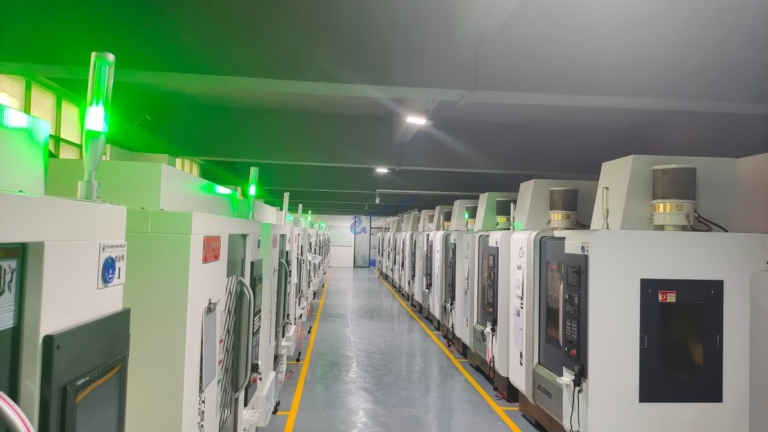
We run 127 high-precision CNC machines across three plants and machine parts to ±0.005 mm. Tell us the material and the operation, and we will quote within 12 hours with a free DFM analysis.
12-hour quote±0.005 mm100% inspectionNo minimum order
GreatLight on social
We publish setup notes, tooling trials and inspection data from the factory floor.











