
What Is a Good CNC Machine for Engraving Wood Pens?
A wood pen blank is small, round, and unforgiving. A good cnc machine for engraving wood pens keeps runout low, spins fast, and holds depth to a few hundredths of a millimeter. This page explains the mechanics behind those requirements, so you can judge a machine instead of trusting a spec sheet.
In this article
- 1
- 2
- 3
- 4
- 5
- 6
- 7
- 8
- 9
Key takeaways
What a cnc machine for engraving wood pens actually has to do
Engraving a pen is not milling a plate. The part is a cylinder 12-15 mm in diameter, the cut is 0.2-0.5 mm deep, and the whole job may run for 90 seconds. Everything about the machine has to be tuned for small, fast, shallow cuts on a curved surface.
Three motions matter. The spindle has to spin the cutter fast enough to shear wood fibers rather than tear them. The Z axis has to place the tip at a repeatable depth. The work-holding has to keep the barrel's centerline fixed while the surface rotates or the tool moves around it.
Get any one of these wrong and the failure is visible immediately. Tear-out shows as fuzz along the line edge. Depth drift shows as a groove that fades from dark to light. Centerline error shows as a line that wanders off the top of the barrel.
This page covers the machine-side causes, not the file or the toolpath. If your design and feeds are correct and the result still looks wrong, the machine is where you look next.
Spindle runout and tool geometry decide line quality
Runout is the total indicated error of the tool tip as the spindle turns. It comes from the spindle bearing, the collet, and the cutter shank, added together. On a pen, runout does two things at once: it widens the effective cut, and it varies that width as the tool rotates.
Do the math on a 30-degree V-bit with a Ø3 mm shank. At 0.005 mm runout, the tip sweeps a circle of 0.01 mm diameter. That sounds small. But a V-bit converts radial error into depth error at a ratio set by its included angle, so a 0.01 mm radial wobble becomes roughly 0.017 mm of depth variation.
Over a 30 mm engraving, that variation is enough to see as a line that is crisp at one end and soft at the other. Buyers notice this on a finished pen, even if they cannot name the cause.
The practical target is 0.01 mm or less runout measured at the tool tip, not at the spindle nose. Ask for the measurement point. A spindle that reads 0.003 mm at the nose can read 0.015 mm at a long tool tip.
- 1Measure at the tipDial indicator on the flute, not the spindle taper.
- 2Check the colletA worn ER11 collet can add 0.01 mm on its own.
- 3Shorten the gauge lengthEvery 10 mm of stick-out roughly doubles the tip error.
Spindle speed, feed, and chip load on small cutters
Wood is not metal, and the cutting logic is different. You want the edge to slice fibers cleanly before they deflect. That means high surface speed and a controlled chip load, which on a 1-2 mm cutter means a fast spindle.
A 1.5 mm two-flute cutter at 18,000 rpm gives a cutting speed of about 85 m/min. That is in the clean range for hard maple and most dense exotics. Drop to 8,000 rpm and the same cutter runs at 38 m/min, which is where you start seeing burnishing and fuzz instead of a cut.
Feed has to match. On a 1.5 mm cutter, a chip load of 0.02-0.04 mm per tooth keeps the edge in the wood long enough to cut and short enough to avoid heat. At 18,000 rpm and two flutes, that is 720-1,440 mm/min of feed.
Run the cutter too slow with a heavy chip load and it grabs. Run it fast with too light a load and it rubs, which dulls the edge and burnishes the grain. The sweet spot is narrow on pens because the cutter is small.
- 11.5 mm cutter18,000-24,000 rpm, 720-1,440 mm/min, 0.02-0.04 mm/tooth.
- 20.8 mm cutter22,000-24,000 rpm, 400-700 mm/min, 0.01-0.02 mm/tooth.
- 330-degree V-bit20,000 rpm, 600-900 mm/min, shallow depth of 0.15-0.3 mm.
Depth control and why the Z axis matters more than the spindle
A wood engraving has almost no depth tolerance. On a pen, the mark is a cut into a surface that is often only 1-2 mm thick after turning. Cut 0.1 mm too deep and you risk a breakthrough on a slim barrel. Cut 0.1 mm too shallow and the mark disappears when the pen is sanded and finished.
This puts the burden on the Z axis. A ball screw with a 5 mm lead driven by a stepper at 200 steps per revolution gives 0.025 mm per full step. With microstepping and a closed-loop encoder, repeatability can reach 0.005 mm, which is what you need.
Two things ruin it. Backlash in the Z nut shows as a different depth on the way down and the way up. Thermal growth over a long run shifts the reference point by 0.01-0.02 mm after an hour of cutting.
The fix is boring but effective: probe the surface, set the zero at the top of the barrel, and re-probe between pens if the run is long. A machine that cannot probe is a machine that will drift.
Work holding: flat clamping versus a 4th axis
Most entry-level pen engraving happens on a flat bed with the barrel clamped in a jig. It works for a single line of text along the top of the barrel. It fails as soon as the design wraps around the cylinder.
When the design wraps, a flat setup forces the cutter to cut at an angle that changes with position. At the top of the barrel the cutter is normal to the surface. At 45 degrees around, it is cutting at 45 degrees, which widens the line and changes the apparent depth.
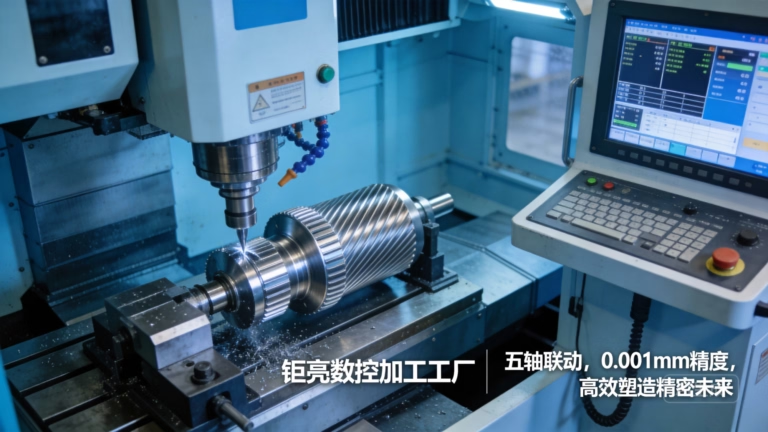
A 4th axis or a rotary table fixes this by rotating the part under the cutter, so the tool stays normal to the surface everywhere. On our own machines, a Ø400 mm rotary table is the standard option for this kind of work.
The trade-off is setup time and cost. A rotary axis adds a chuck, a tailstock, and a post-processor that supports simultaneous motion. For a pen shop running 50 pieces a week, the setup pays back in the first month. For a hobbyist doing 5 pens a year, a flat jig is fine.
How wood grain and moisture change the result
Wood is not homogeneous. A pen blank cut from a burl has grain running in several directions within 10 mm. The cutter meets end grain on one side of the barrel and long grain 180 degrees away.
End grain cuts cleanly at high surface speed. Long grain tends to lift and fuzz if the cutter is dull or the chip load is too light. On a dark wood like ebony, the difference shows as a line that is sharp on one side and slightly ragged on the other.
Moisture is the second variable. A blank at 12% moisture content will shrink as it dries to 6-8% in a heated shop. A 12 mm barrel can lose 0.05-0.1 mm of diameter in that shift, which is enough to change the apparent depth of an engraving made before the wood settled.
The practical rule is to engrave after the blank has stabilized, not before. For a shop, that means storing blanks in the same room as the machine for at least a week.
When to outsource instead of buying
Buying a machine makes sense when pen engraving is a core part of your business and you run it daily. Below that threshold, the fixed cost of the machine, the tooling, and the learning curve usually exceeds the value of the jobs.
The break-even is roughly 200-300 engraved pens per year. Below that, a service shop with an existing 4-axis or 5-axis setup will beat your in-house cost per piece, because the machine is already amortized across other work.
There is also a quality argument. A shop that runs the same setup for multiple customers has already solved the probing, the work holding, and the depth repeatability. You inherit that solution without spending six months building it.
For a small pen brand, the better move is often to keep the turning and finishing in-house and send only the engraving out. That is where the machine cost and the skill are concentrated.
Machine class versus pen engraving needs
Match the machine to the job, not to the catalog.
| Machine class | Realistic runout | Best for | Watch out for |
|---|---|---|---|
| Desktop router, 500 W | 0.03-0.05 mm | Flat text on a clamped barrel | Z backlash, no probing |
| Benchtop mill, 1.5 kW | 0.01-0.02 mm | Single-sided engraving, small runs | Limited spindle speed |
| Production VMC, 3-5 kW | 0.005-0.01 mm | Wrapped designs, 4th axis | Setup time per batch |
| 5-axis with rotary | 0.005 mm or better | Contoured and tapered barrels | Post-processor cost |
The verdict
If you engrave daily and the design wraps around the barrel, buy a 4-axis machine with a probing Z axis and a spindle that reaches 20,000 rpm. If you engrave a few hundred pens a year or less, outsource the engraving and keep the turning in-house.
Frequently asked questions
Can a 3-axis router engrave a pen barrel?
Yes, if the design stays on the top of the barrel and the barrel is clamped in a fixed jig. The cutter stays at one angle, so line width is consistent across the engraved area.
It fails when the design wraps more than about 60 degrees around the cylinder. Beyond that the cut angle changes too much and the line width varies visibly.
What spindle speed do I need for wood pen engraving?
18,000-24,000 rpm covers most 1-2 mm cutters and 30-degree V-bits in hard and dense woods. Below 12,000 rpm you tend to burnish rather than cut on small tools.
The exact number depends on cutter diameter. A 0.8 mm cutter needs more rpm than a 2 mm cutter to reach the same surface speed.
How deep should a wood pen engraving be?
0.2-0.5 mm is the usual range. Deep enough to survive sanding and finishing, shallow enough to avoid a breakthrough on a slim barrel.
On a barrel turned down to 1.5 mm wall thickness, stay at the shallow end and check the finished wall thickness before cutting.
Does a 4th axis really improve pen engraving quality?
It improves consistency, not peak quality. On a flat jig, the best line is at the top of the barrel and the worst is at the edges. A 4th axis makes every line as good as the best line on the flat setup.
The gain is largest on wrapped designs and on tapered or contoured barrels.
What tolerance can I expect on an engraved wood pen?
Line placement to ±0.05 mm is realistic on a well-tuned machine with probing. Depth repeatability of ±0.01 mm is achievable with a closed-loop Z axis.
Wood movement after cutting can add 0.05 mm or more over the first few weeks as the blank settles.
Do I need a vacuum table for pen blanks?
No. Pen blanks are small and round, and vacuum holding is a poor fit for a cylinder. A collet chuck or a dedicated pen jig holds better and releases faster.
For very small runs, a machinist vise with soft jaws works fine.
Send us your pen engraving job
Upload a STEP file or a drawing and we will come back with a quotation and a free DFM analysis within 12 hours.
12-hour quote100% inspectionNo minimum order
More from the shop floor
We publish setup notes, tooling trials and inspection data from the factory floor.











