

Centerless grinding is a high-precision metal cutting process that uses grinding wheels and setting wheels to process workpieces without using traditional fixtures to secure the workpieces, thereby enabling high-precision, high-output production. Depending on the configuration of the grinding machine and the direction of workpiece feed, centerless grinding can be divided into several types: standard (horizontal), inclined and vertical. In addition, according to the workpiece feeding method, the centerless grinding method can be divided into feeding type (pulse type), feeding type and tangential feeding type. The feed version is suitable for grinding parts of multiple diameters or shapes, while the continuous feed version offers extremely high productivity when grinding spindles, cylindrical rolls and tapered rolls. The tangential feed type can grind shaped parts such as spherical rollers, and the feeding speed is higher than that of the feed type. The classification of workpiece support methods includes wheel-plate setting type, double-shoe type, three-wheel type, two-wheel-shoe type, two-wheel type and centerless grinding type double disc. Each type has its specific application scenarios and advantages to meet different parts and production needs.
“Regulatory disc type: standard centerless grinding.”
“2 types of shoes: external or internal centerless grinding.”
“3 Roller Type: 3 Roller Centerless Internal Grinding.”
“2-roller-shoe type: 2-roller-shoe centerless internal grinding.”
“2-roller type: centerless lapping or super-finishing.”
“Dual disc type: external disc centerless grinding.”
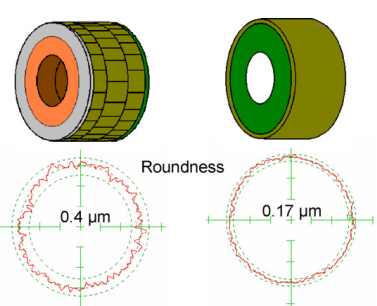
roundness error
Roundness error refers to the actual roundness and ideal roundness of the workpiece due to various factors during the grinding process (such as unstable support of the workpiece, contact conditions between the grinding wheel and the grinding wheel adjustment, changes in grinding force, etc.) deviation between. In centerless grinding, roundness error is a key quality indicator, which directly affects the dimensional accuracy and geometric consistency of the part. The paper mentions that the control and optimization of roundness error are important aspects of research on centerless grinding technology, including research on the rotational stability of the workpiece during the grinding process, l optimization of the contact conditions between the grinding wheel and the adjustment wheel, and precision. control of grinding parameters. Through in-depth analysis and improvement of these factors, roundness errors can be significantly reduced and the precision and quality of ground parts can be improved.
chatter vibes
Chatter vibration, also known as chatter, refers to a self-excited vibration phenomenon caused by unstable contact between the workpiece and the grinding wheel during the grinding process. This vibration will cause ripples on the surface of the workpiece, affecting the grinding accuracy and surface quality. The paper mentions that chatter vibration is one of the issues that need special attention during centerless grinding, as it can significantly reduce production efficiency and increase the scrap rate of parts. In order to prevent and control chatter vibration, various strategies are discussed in the paper, including optimization of grinding parameters, improvement of workpiece support system, use of high rigidity grinding equipment and the development of advanced process monitoring systems to detect and adjust grinding conditions in real time. . Through these measures, the occurrence of chatter vibration can be reduced, thereby improving the stability of the centerless grinding process and the processing quality of the workpiece.
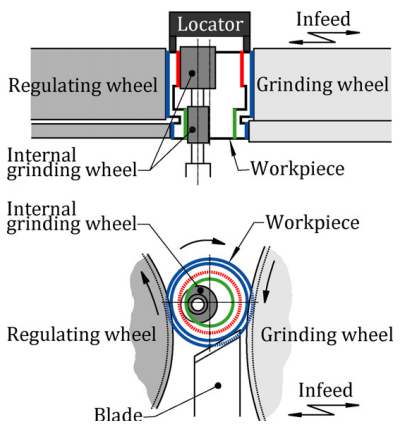
Artifact support
The workpiece support problem in centerless grinding refers to the position change or vibration of the workpiece due to improper support during the grinding process, which will directly affect the grinding accuracy and quality of the surface. The paper highlights that centerless grinding methods are very sensitive to setup conditions and if the machine is not setup correctly, workpiece support issues such as roundness irregularities, chatter vibrations, etc. can occur. may occur. These issues can lead to inconsistencies in part geometry and increased surface roughness. In order to solve the part support problem, the paper mentions improvements to the part support system, including optimization of the design of support wheels and guide wheels, as well as the development of advanced support stability models that can predict and avoid failures due to unstable part support. machining errors caused. Through these research and improvement measures, the stability of workpiece support during centerless grinding can be significantly improved, thereby improving grinding quality and production efficiency.
clear methodology
1. Development of centerless grinding theory: The article reviews the development process of centerless grinding theory, including advanced modeling and simulation technology.
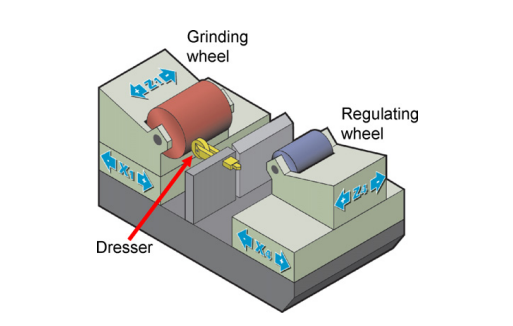
The development of centerless grinding theory, based on understanding the unique characteristics of workpiece support systems and drive mechanisms, has seen significant improvements, particularly in terms of grinding accuracy and productivity. Since the birth of the modern centerless grinding machine in 1917, through continuous research work, including in-depth analysis of the grinding mechanism, dynamic stability and workpiece support stability, the technology has become indispensable in industrial fields such as automobile and bearing manufacturing. is a lack of standard methods. Furthermore, through a better understanding of process instability factors and the development of predictive models, centerless grinding has great potential to improve mechanical efficiency and achieve nanoscale precision, thereby laying the foundation efficient and precise manufacturing systems in the future.
2. Design of the grinding machine: The design of the main components of the centerless grinding machine, such as spindle, bed, guide rails and positioning system, is discussed and design guidelines for future machines are provided.
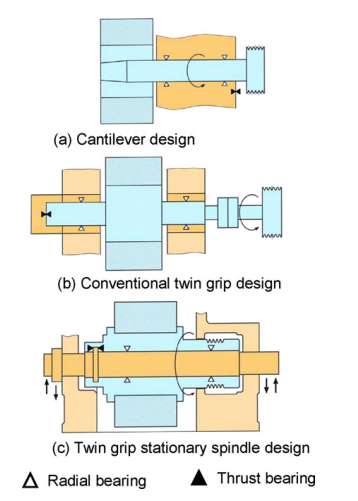
Grinding machine design occupies a central position in centerless grinding technology, and its advancements include extensive research and improvement of major components such as spindle, bed, guide rails and positioning systems. The article mentioned that to improve grinding performance, machine designs with high precision and high rigidity had been adopted, such as the use of hydrostatic guide rails and linear motor drive systems, as well as the development of new dual socket pin designs, which significantly improved performance. improved movement precision and static/dynamic machine rigidity. Additionally, the machine structure is optimized through finite element analysis (FEA) to ensure structural behavior under static, dynamic and thermal loads, thus achieving high precision and high precision grinding processes. stability.
3. Process monitoring: presentation of advanced process monitoring technologies and their application in centerless grinding processes.
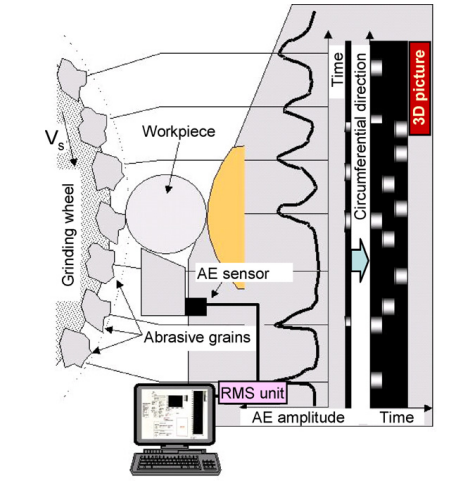
The application of process monitoring in centerless grinding technology is crucial and involves real-time monitoring of the grinding process to ensure quality and efficiency. The paper mentions that although there are many grinding process monitoring solutions in the market, such as power consumption monitoring, vibration/balance and acoustic emission (AE) contact detection, it There are still many problems specific to centerless grinding, such as fit. There is currently no mature solution for wheel dressing quality, occurrence of workpiece runout or chatter, and support plate vibration. The paper specifically mentions the application of acoustic emission (AE) technology in the centerless grinding process. By installing sensors on the backing plate or bearing of the grinding wheel, contact, cycle detection and surface contact during the grinding process can be effectively monitored and identified. . Issues such as quality and configuration support. In addition, AE technology is also used to monitor chatter during the dressing process and evaluate the number of dressings after chatter to ensure the quality of the grinding wheel surface. Nevertheless, the article also highlights the specific challenges of monitoring centerless grinding processes and proposes ongoing research efforts and other monitoring methods specifically applied to the centerless grinding process.
4. Optimization and simulation: Use mathematical models and simulation technology to predict and avoid instabilities in the machining process, such as workpiece holding stability, geometric chatter, and dynamic instability (chatter).
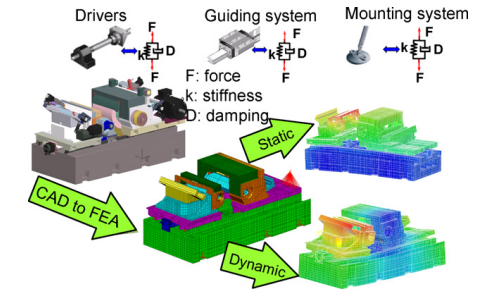
Optimization and simulation play a key role in centerless grinding technology, using advanced mathematical models and computer simulations to predict and improve the stability and efficiency of the grinding process. The paper focuses on in-depth understanding of instability factors such as workpiece support stability, geometric chatter and dynamic chatter during the grinding process, which directly affect the grinding accuracy and productivity. Using frequency and time simulations, researchers were able to develop models to predict and avoid these instabilities, thus optimizing the grinding machine configuration conditions. In addition, the article also mentions the use of simulation technology to design the optimal grinding cycle, as well as the use of simulation to assist in the mechanical design of the grinding machine to ensure the performance of the machine under static and dynamic loads. The application of these optimization and simulation technologies not only improves the accuracy and efficiency of the centerless grinding process, but also provides important technical support for the design and development of future grinding machines.
Proven conclusion
Improved grinding accuracy and productivity: The development of centerless grinding technology has significantly improved the grinding accuracy and productivity.
Improvement of workpiece support system: By optimizing the design of the workpiece support system, the roundness error of the workpiece can be reduced and production efficiency improved.
Grinding wheel optimization: Using advanced grinding wheel technology can improve the efficiency of the grinding process and the surface quality of the workpiece.
key information
Thesis theme
This article reviews the history of centerless grinding technology, its contribution to the industry, theoretical developments and the design of major grinding machine components.
What problem does the document effectively solve?
Through advanced design and monitoring technology, roundness errors, vibration and workpiece support issues during centerless grinding are resolved.
What issues should be checked in the document?
Future research work should focus on developing a new generation of centerless grinding machines to meet the needs for greater mechanical efficiency and nanoscale grinding precision.
Optimization, solutions, improvement and other data
Using centerless grinding technology, roundness accuracy of 0.1-0.3mm and throughput of 250-350 pieces/minute can be achieved.
The precision of the grinding is increased by optimizing the dressing of the grinding wheel.
The use of new grinder designs, such as hydrostatic guides and linear motor drives, improves the precision and rigidity of the grinder.
Sources: Hashimoto F, Gallego I, Oliveira JFG, Barrenetxea D, Takahashi M, Sakakibara K, Stålfeldt HO, Stadt H, Ogawa K. Advances in centerless grinding technology[J]. CIRP Annals-Manufacturing Technology, 2012, 61: 747-770.
Daguang focuses on providing solutions such as precision CNC machining services (3-axis, 4-axis, 5-axis machining), CNC milling, 3D printing and rapid prototyping services.



















