
Global Bulk Sheet Metal Fabrication Exporters
This page explains how overseas sheet metal fabrication exporters actually run: which processes scale, where sheet metal stops and machining takes over, and what to check before you release a 10,000-part order. Written for design engineers and sourcing teams who need to judge a supplier, not just collect quotes.
What bulk sheet metal work can and cannot hold
Sheet metal is a forming process, not a cutting one. A flat blank is cut, bent, punched and finished. Because the tool never removes metal to set a dimension, the part inherits its accuracy from the press brake, the die and the flat pattern rather than from a spindle. That is why sheet metal scales so well: setup cost is spread over thousands of identical bends, and cycle time per part is measured in seconds.
The trade-off shows up at the hole. A laser cuts an edge profile to roughly ±0.1 mm on 1-2 mm stock, and a press brake holds a bend angle to about ±0.5° on a well-set part. Those numbers survive a 10,000-part run, and they survive it cheaper than any machining route.
What sheet metal does not hold is a bore. A Ø20 mm bearing seat with a ±0.005 mm tolerance will not come off a turret punch, no matter how many pieces you order. The same is true for a thread that must sit square to a milled face, or a pocket with a 0.8 mm corner radius. These features are machined, and the part has to be planned as a machined part from the start.
So the first engineering decision is not which exporter to call. It is which features belong to the formed envelope and which belong to the machined inserts. Get that split right and the order scales cleanly. Get it wrong and you pay for rework on every part in the container.
How exporters scale from one prototype to 10,000+ parts
A prototype run and a bulk run use different equipment for the same geometry. At one to fifty pieces, a laser plus a press brake is the right answer: no hard tooling, changes are cheap, and the flat pattern can still move. At five thousand pieces, a progressive die starts to pay for itself because the per-part cost drops sharply once the tool is amortized.
The transition point is not fixed. It depends on how many bends are in the part, how tight the tolerance is, and how likely the design is to change. A bracket with two bends and a generous tolerance may never justify a die. A chassis with twelve bends and visible cosmetic surfaces usually does, somewhere between 3,000 and 8,000 pieces.
Export packaging is part of scaling and often gets ignored until the first shipment. Bent parts nest badly. A 1.5 mm aluminum panel that leaves the factory flat can arrive twisted if it is stacked without separators. Suppliers who ship volume regularly have standard returnable or one-way packaging that keeps the flat pattern flat.
Batch traceability matters too. When a run is split across several weeks, you want the heat number of the coil and the inspection record tied to the shipment, not to the purchase order. Ask what happens when a batch fails final inspection after half of it has already shipped.
Where machining takes over from forming
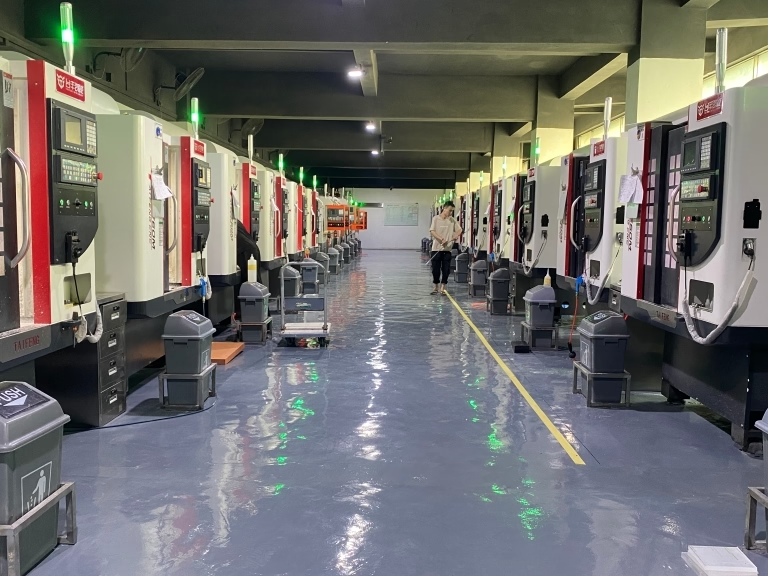
Many real assemblies are hybrids. A robot arm chassis may begin as a laser-cut and bent aluminum envelope, but its bearing housings and motor mounts need accuracy that forming cannot reach. GreatLight runs both processes under one roof, with 16 simultaneous 5-axis machining centers and a maximum processing size of 4,000 mm, so a hybrid part does not have to travel between vendors.
The engineering benefit is datum control. When the formed envelope and the machined bores are produced in one shop, the machining setup can reference the same datums the bend program used. That removes the tolerance stack you get when a second supplier re-fixtures the part and picks its own reference.
It also removes a scheduling problem. A two-vendor route means the formed parts wait in a queue before machining, then wait again before finishing. One shop can move the part from brake to mill to anodize without a purchase order in between.
The limit is cost. Machining a feature that could have been formed is expensive at volume. Use 5-axis work only where the tolerance or the geometry demands it, and keep the rest of the part in the formed process window.
Finishing and assembly decide the real lead time
Engineers usually plan the cutting and bending, then treat finishing as a line item. In practice, finishing is where bulk orders slip. Anodizing, powder coating and plating run in batches, and a batch size is set by the tank or the oven, not by your order. A 400-piece order may wait for a full load.
GreatLight offers anodizing in clear, color, hardcoat and conductive versions, plus electroless nickel, zinc, silver and gold plating, powder coating, black oxide, bead blasting and laser marking with a minimum character height of 1.5 mm. Masking is the detail that causes most rework: threads, grounding pads and mating faces must be masked before the finish, and the mask has to be defined in the drawing.
Assembly is the last lever. Pressed-in inserts, rivnuts, standoffs and captive screws all add operations. If they are called out on the drawing, they can be planned into the route. If they are added after the quote, they change the lead time.
For parts that must ship in 3-5 days, keep the finish simple and the assembly light. Complex masking and multi-step plating belong on a longer schedule.
Direct manufacturer or trading platform
The visible difference between exporters is not price. It is who owns the machine. A platform passes your order to a workshop you never see, and the tolerance you agreed to is only as good as that workshop's setup. A direct manufacturer controls the process, the inspection and the schedule.
That control shows up when something goes wrong. A dimension drifts, a batch fails inspection, a coating comes out off-color. With a direct manufacturer, one phone call reaches the person who can re-run the parts. With a platform, you are one layer removed from the fix.
Confidentiality is the other axis. Drawings for an unreleased product should not circulate through a broker network. GreatLight keeps uploads secure and confidential and signs an NDA on request.
None of this means a platform is always wrong. For a simple bracket with a loose tolerance and no cosmetic requirement, the extra layer costs little. For a part with tight bores, a visible finish or an NDA, buy from the shop that runs the machine.
Which sourcing route fits which part
Match the part to the route before you request quotes.
| Part profile | Forming only | Forming plus machining | Platform route |
|---|---|---|---|
| Tolerance needed | ±0.1 mm typical | ±0.005 mm on bores | Loose, ±0.2 mm and up |
| Bend count | Up to 12 bends | Any, plus milled faces | Simple, 1-4 bends |
| Annual volume | 1 to 10,000+ | 1 to 10,000+ | Low to medium |
| Cosmetic finish | Anodize or powder coat | Anodize plus masked areas | Basic coat only |
| NDA and IP | Signed directly | Signed directly | Risky, broker layer |
| Lead time | 3-5 days typical | 3-5 days typical | Varies by workshop |
| Best for | Enclosures, brackets | Chassis, motor mounts | Simple non-critical parts |
Pick the route, then the supplier
If your part has bores, threads or mating faces that need ±0.005 mm, choose a manufacturer that runs forming and 5-axis machining in the same plant. If it is a simple bracket with a loose tolerance and no cosmetic requirement, a platform route is fine and often cheaper.
Common questions
What is the minimum order quantity for bulk sheet metal work?
There is no minimum order quantity. Runs can start at one prototype and scale to 10,000+ parts using the same process window.
The cost per part drops as volume rises because setup and programming are spread across more pieces, but the tooling choice changes at higher volumes.
How tight a tolerance can a formed sheet metal part hold?
Edge profiles cut by laser typically hold about ±0.1 mm, and bend angles hold about ±0.5° on a well-set part.
If a feature needs ±0.005 mm, that feature is machined rather than formed, and the part becomes a hybrid assembly.
Can one supplier handle both machining and sheet metal?
Yes, and it is often the better route. GreatLight runs 127 high-precision CNC machines alongside sheet metal fabrication, including 16 simultaneous 5-axis machining centers and a 4,000 mm maximum processing size.
Keeping both processes in one plant removes the tolerance stack that appears when a second shop re-fixtures the part.
How long does a bulk order take to ship?
Production can start within 24 hours of a released order, and parts typically ship in 3-5 days. The historical late-delivery probability is below 2%.
Finishing is the usual bottleneck. Multi-step plating and complex masking push the schedule longer than cutting and bending.
What should be on the drawing before I request a quote?
Give the material and temper, the sheet thickness, the bend radii, the critical tolerances, the finish and any masking zones.
Mark which dimensions are functional and which are reference. Suppliers quote and inspect differently when the critical features are identified.
Are drawings kept confidential?
Uploads are secure and confidential, and an NDA is available on request.
For unreleased products, this matters more than price. It is the main reason to buy from the shop that runs the machine rather than a broker network.
Send the drawing, get a route and a price
We review the part, flag which features should be formed and which should be machined, and return a quotation with free DFM analysis within 12 hours.
12-hour quote100% inspectionNo MOQNDA on request
More from GreatLight
We publish setup notes, tooling trials and inspection data from the factory floor.











