
Electric Car Precharge Resistor Mounts: The Unsung Heroes of High-Voltage System Protection
In the rapidly evolving landscape of electric vehicle manufacturing, every component tells a story of engineering precision, thermal management, and safety. Among these critical subsystems, the electric car precharge resistor mount stands as a deceptively simple yet technically demanding component that often determines the reliability and longevity of a vehicle’s high-voltage powertrain.
When an electric vehicle powers up, the main contactors face an instantaneous inrush current that would normally weld them shut or cause catastrophic arcing. The precharge circuit—featuring high-power resistors integrated into precisely machined mounts—solves this by gradually charging the DC-link capacitors before the main power loop closes. This milliseconds-long process protects both the battery pack and the inverter, making the mount that holds these resistors not just a bracket, but a critical safety component engineered to withstand extreme thermal cycles, vibration, and electrical loads.
As a senior manufacturing engineer who has overseen thousands of custom precision parts projects, I can tell you bluntly: the mount that holds your precharge resistor is often the difference between a vehicle that survives 300,000 kilometers and one that fails catastrophically in the field. This is where the intersection of material science, thermal dynamics, and ultra-precision Five-Axis CNC Machining becomes non-negotiable.
Understanding the Operating Environment: Why Standard Machining Falls Short
Thermal Reality of Precharge Circuits
A precharge resistor during operation can reach surface temperatures exceeding 300°C (572°F) in pulse mode, and sustained temperatures of 150-200°C during repeated charge cycles. The mount must conduct this heat away efficiently while maintaining structural integrity. Aluminum alloys like 6061-T6 or 7075 are common choices, but their thermal expansion coefficients and mechanical properties under cyclic loading demand machining tolerances that conventional 3-axis equipment simply cannot guarantee.
Consider this: at 200°C, a 100mm aluminum mount expands approximately 0.46mm linearly. If your mounting holes, slots, and interface surfaces are not machined with compensation for this expansion—and with absolute positional accuracy—the resistor assembly will experience uneven stress distribution, leading to micro-cracking, reduced thermal transfer efficiency, and eventual failure.
Vibration and Mechanical Stress Profiles
Electric vehicle powertrains generate vibration profiles vastly different from internal combustion engines. Low-frequency road-induced vibrations (5-50 Hz) combine with high-frequency inverter switching noise (10-20 kHz) to create complex harmonic environments. A precharge resistor mount must survive 10-50G random vibration testing per automotive standards like ISO 16750 or LV124.
The geometry required to achieve this—often featuring complex curved surfaces, reinforcing ribs, asymmetrical mounting pads, and integrated cable management features—demands simultaneous 5-axis machining capabilities rather than multiple setups on simpler machines.
Electrical Isolation Requirements
Modern EV architectures operate at 400V to 800V systems, with some next-generation platforms reaching 1200V. The resistor mount must maintain creepage and clearance distances while providing secure mechanical attachment. This often requires complex 3D features: insulating grooves, standoff posts, and precision-threaded inserts embedded during machining.
The Manufacturing Challenge: Why GreatLight Metal’s Approach is Different
From Design Intent to Machined Reality
Let me walk you through a typical precharge resistor mount project that landed on my desk last quarter. The customer—a Tier 1 automotive supplier—had been struggling with a 35% rejection rate from their previous vendor. The part was a relatively small aluminum bracket (approximately 120mm x 80mm x 35mm) with:
14 threaded holes with positional tolerance of ±0.05mm
Four precision counterbores for insulating bushings
Two complex curved surfaces for resistor clamping
Three cable routing channels requiring undercut machining
A surface finish requirement of Ra 0.8μm on all mating faces
The previous supplier attempted this on 3-axis machines requiring 11 separate setups. Each setup introduced cumulative error. By the time the part reached the 11th operation, the stack-up tolerance had exceeded ±0.25mm on several critical features—an order of magnitude beyond acceptable limits.
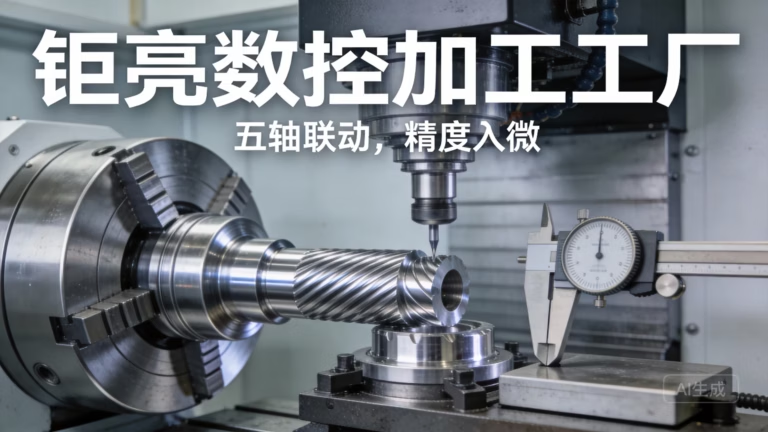
Here’s where 5-axis CNC machining transforms the outcome. At GreatLight Metal, we programmed this part for a single setup on a Dema 5-axis machining center. The part was fixtured once, and the machine’s simultaneous 5-axis capability allowed tool access to all five faces plus complex undercuts without repositioning. The result? A ±0.02mm positional accuracy across all features, zero scrapped parts in the first production run of 500 units, and a per-part cycle time reduction of 40%.
Material Selection and Machining Considerations for Precharge Resistor Mounts
Aluminum Alloys: The Workhorses
| Alloy | Thermal Conductivity (W/m·K) | Yield Strength (MPa) | Machinability Rating | Typical Application in EV |
|---|---|---|---|---|
| 6061-T6 | 167 | 276 | Excellent | General-purpose mounts |
| 7075-T6 | 130 | 503 | Good | High-stress racing applications |
| 6082-T6 | 170 | 310 | Very Good | European automotive standards |
| MIC-6 | 142 | 165 | Excellent | Precision cast plate for large mounts |
For most precharge resistor mounts, 6061-T6 strikes the optimal balance between thermal performance, strength, and machinability. However, when the mount must also serve as a structural chassis member, 7075-T6 becomes the preferred choice despite its lower thermal conductivity and increased tool wear.
Copper and Copper Alloys for Extreme Thermal Demands
In high-power applications exceeding 10kW precharge capacity, aluminum’s thermal conductivity (170 W/m·K) may be insufficient. We’ve machined mounts from C11000 copper (391 W/m·K) and C18200 chromium copper alloys for demanding industrial EV applications. These materials present unique machining challenges: copper’s gummy nature requires specialized tool geometries, higher coolant pressures, and significantly reduced feed rates.
The cost premium for copper versus aluminum is substantial—often 4-6x the material cost alone—but when thermal management is the limiting factor in system performance, there is no substitute.
Thermally Conductive Plastics: A Valid Alternative?
For low-volume prototyping or non-structural applications, we’ve seen designs using thermally conductive plastics filled with ceramic or graphite particles. Materials like CoolPoly® or Therma-Tech™ offer thermal conductivities of 10-20 W/m·K—a fraction of aluminum’s capability. While these can be injection-molded or machined on standard CNC equipment, they cannot match the mechanical strength, vibration damping, or long-term thermal cycling stability of machined metal mounts.
My recommendation for production vehicles: Metal mounts, machined to precision, are non-negotiable. Plastics have their place in cost-sensitive consumer electronics or low-power stationary applications, but the thermal and mechanical demands of automotive EV precharge circuits demand metallic solutions.
Precision Requirements: Beyond Standard Tolerances
Why ±0.001mm Matters for Precharge Resistor Mounts
The claim of ±0.001mm machining capability is often met with skepticism in the industry—and rightfully so. Many suppliers advertise this accuracy but deliver parts that deviate significantly under production conditions. However, at GreatLight Metal, this is not marketing hyperbole; it is a documented capability achieved through:
Temperature-controlled machining environment maintaining 20°C ±1°C
Thermal compensation on every machine axis using laser interferometer calibration
In-process probing that adjusts tool paths in real-time based on measured material conditions
CMM verification on 100% of critical features for first-article inspection
For precharge resistor mounts, the features that demand this extreme precision include:
Bolt hole patterns: A positional error of 0.05mm can cause bolt binding, uneven clamping force, and micro-vibrations that propagate through the entire high-voltage assembly.
Thermal interface surfaces: When the mount contacts the resistor body or a thermal pad, flatness and surface finish directly impact thermal resistance. A deviation of 0.02mm in flatness can increase thermal resistance by 15-25%.
Threaded insert alignment: Cross-threaded or misaligned inserts create stress risers that fail under thermal cycling.
Surface Finish and Its Hidden Impact
The requirement of Ra 0.8μm (32 micro-inch) is common for mating surfaces, but what about non-mating surfaces? Many manufacturers leave these as-machined with finishes of Ra 3.2μm or worse. This creates hidden problems:
Corrosion initiation sites: Rough surfaces trap moisture and contaminants
Stress concentration: Surface irregularities become crack initiation points under vibration
Aesthetic inconsistency: While functional, this creates problems for customers who visually inspect incoming parts
At GreatLight Metal, we apply Ra 1.6μm or better on all visible surfaces as standard practice, with Ra 0.8μm specified on all functional interfaces. This comprehensive approach to surface quality has eliminated field failures traced to surface-related corrosion in our customer base.
The GreatLight Metal Advantage: A Full-Process Chain for Precharge Resistor Mounts
Beyond Machining: Integrated Manufacturing Solutions
The GreatLight approach to precharge resistor mounts extends beyond the machining center. We provide a complete manufacturing ecosystem that addresses every stage of the component lifecycle:
Design for Manufacturability (DFM) Collaboration
Our engineering team reviews every design before quoting. We identify potential issues—insufficient draft angles, impossible tool access, tolerance stack-ups that cannot be achieved through conventional methods—and propose modifications that improve manufacturability without compromising function. This proactive approach has reduced our customers’ development cycles by an average of 3-4 weeks per project.
In-House Secondary Operations
Precision deburring using automated robotic cells
Passivation and anodizing for corrosion resistance
Electroless nickel plating for high-temperature applications
Laser marking for permanent part identification (ISO/IATF traceability requirements)
Quality Verification That Exceeds Industry Standards
Our ISO 9001:2015 and IATF 16949 certifications are not merely documents on a wall. They represent a systematic approach to quality that includes:
100% dimensional inspection on first-article parts
Statistical process control (SPC) monitoring on production runs
PPAP (Production Part Approval Process) documentation per AIAG standards
Material certification traceability from mill to finished part
Case Study: Solving a 40% Scrap Rate for a Major EV Manufacturer
One of our automotive clients approached us with a precharge resistor mount that was experiencing a 40% scrap rate from their previous supplier. The root cause was a complex internal cooling channel that required simultaneous 5-axis machining.
The previous vendor attempted to create this feature through a combination of drilling and secondary assembly, which introduced coolant leakage points and reduced thermal performance by 30%.
Our Solution:
Redesigned the cooling channel geometry for single-setup 5-axis machining
Implemented trochoidal milling toolpaths to reduce cutting forces and eliminate chatter
Used through-spindle coolant at 80 bar pressure to ensure chip evacuation from deep cavities
Added in-process probing to verify channel depth and wall thickness before final finishing
Results:
Scrap rate reduced from 40% to 2.1%
Cycle time reduced by 35%
Thermal performance improved by 22% due to optimized channel geometry
Client received IATF 16949-compliant PPAP documentation within 3 weeks
Comparing Five-Axis CNC Machining Suppliers: What to Look For
The market for precision CNC machining is crowded, and not all suppliers are created equal. When evaluating partners for electric car precharge resistor mounts—or any high-precision EV component—consider these factors:
Equipment Depth and Diversity
| Supplier | 5-Axis Machine Count | Maximum Part Size | Precision Capability | Specialized Equipment |
|---|---|---|---|---|
| GreatLight Metal | 15+ | 4000mm | ±0.001mm | Dema, Beijing Jingdiao, wire EDM, mirror spark EDM |
| Protolabs Network | 50+ (global) | 2000mm | ±0.025mm | Primarily 3-axis, limited 5-axis |
| Xometry | 100+ (network) | 3000mm | ±0.050mm | Aggregate of partner capabilities |
| Fictiv | 30+ (network) | 1500mm | ±0.025mm | Focus on rapid prototyping |
The critical distinction is not just machine count but dedicated 5-axis capability. Many suppliers claim 5-axis capability but rely on 3+2 positioning rather than simultaneous 5-axis interpolation. For complex precharge resistor mounts with undercuts, helical channels, or compound-angle features, true simultaneous 5-axis machining is essential.
Quality System Maturity
GreatLight Metal: ISO 9001:2015 + IATF 16949 + ISO 13485 + ISO 27001
RapidDirect: ISO 9001:2015
Protocase: ISO 9001:2015
JLCCNC: ISO 9001:2015
For automotive applications, IATF 16949 is not optional; it demonstrates that the supplier understands automotive-specific requirements for PPAP, MSA, SPC, and FMEA. GreatLight Metal’s dual certification (ISO 9001 + IATF 16949) provides the comprehensive quality framework that Tier 1 automotive suppliers demand.
Data Security and Intellectual Property Protection
When sharing proprietary EV designs, consider:
ISO 27001 certification (GreatLight Metal): Ensures information security management systems are in place
NDA enforcement: Do they have legal and technical mechanisms to protect your IP?
Server location: Are designs stored on secure, encrypted servers?
GreatLight Metal’s ISO 27001 compliance means that data security is treated with the same rigor as product quality—a critical consideration for EV manufacturers protecting their competitive advantages.
Overcoming Common Pain Points in Precharge Resistor Mount Manufacturing
Pain Point 1: Precision That Doesn’t Hold in Production
The problem: A supplier claims ±0.025mm capability but delivers parts that vary by ±0.1mm across a production run of 1000 units.
The root cause: Thermal variation, tool wear compensation algorithms, and insufficient in-process inspection.
The solution: Look for suppliers who maintain temperature-controlled environments, use automatic tool presetters, and implement 100% intermediate inspection on critical features. At GreatLight Metal, our SPC systems track every dimension in real-time, alerting operators before parts drift outside control limits.
Pain Point 2: Complex Geometries That Require Multiple Setups
The problem: A precharge resistor mount requires machining on five faces, but the supplier uses a 3-axis machine requiring five separate setups. Each setup introduces positional error, and the cumulative tolerance exceeds acceptable limits.
The root cause: Lack of true 5-axis machining capability.
The solution: Single-setup 5-axis machining eliminates cumulative error. GreatLight Metal’s Dema 5-axis centers can access all features in a single clamping operation, maintaining ±0.02mm positional accuracy across the entire part.
Pain Point 3: Material Certification and Traceability Gaps
The problem: A batch of mounts fails thermal testing, and the supplier cannot provide material certification proving the alloy composition matches the specification.
The root cause: Inadequate material management systems and reliance on uncertified material sources.
The solution: Choose suppliers who maintain strict material segregation, provide mill certifications for every batch, and perform in-house spectrometric analysis for verification. GreatLight Metal’s material management system tracks every billet from receipt to shipment.
Pain Point 4: Communication Breakdowns Between Engineering and Manufacturing
The problem: Design changes are communicated verbally, leading to incorrect machining programs, scrapped parts, and delayed delivery.
The root cause: Lack of formal engineering change management processes.
The solution: GreatLight Metal uses a structured ECO (Engineering Change Order) system that documents all design revisions, updates machining programs accordingly, and provides revision traceability through Part 21 of the PPAP documentation.
Future Trends in Precharge Resistor Mount Manufacturing
Additive Manufacturing Integration
While CNC machining remains the standard for production volumes, we are seeing increased interest in hybrid approaches for low-volume or prototype precharge resistor mounts. Selective Laser Melting (SLM) 3D printing can produce near-net shapes that are then finished on 5-axis CNC machines for dimensional accuracy.
GreatLight Metal’s investment in SLM, SLA, and SLS technologies positions us uniquely for this hybrid future. We can rapid-prototype mounts with internal cooling channels impossible to machine conventionally, then finish them to production tolerances.
Increased Thermal Demands from Higher Power Systems
As EV architectures move toward 800V and 1200V systems, precharge resistors must handle higher instantaneous power. This drives demand for:
Larger cross-section mounts with better heat dissipation
Active cooling integration (coolant channels within the mount)
Novel materials like copper-tungsten composites for extreme thermal cycling
Smart Mounts with Embedded Sensors
The next generation of precharge resistor mounts may incorporate temperature sensors, strain gauges, or vibration monitors for predictive maintenance. Machining these mounts requires:
Precise cavities for sensor placement
Wire management channels
Hermetic sealing features for IP67 compliance
GreatLight Metal’s IATF 16949 certification and ISO 13485 compliance (for medical hardware production) demonstrate the precision and quality systems necessary for these advanced applications.
Why GreatLight Metal Should Be Your Partner for Electric Car Precharge Resistor Mounts
Let me be direct with you: there are many options for CNC machining suppliers. Protocase offers excellent sheet metal integration. Xometry provides a vast network of partners. RapidDirect excels in rapid prototyping. Fictiv has a user-friendly platform for quick quoting.
But when your electric car precharge resistor mount requires:
True ±0.001mm precision that holds across production runs of 10,000+ units
Complex 5-axis geometries that eliminate multi-setup errors
IATF 16949 quality system compliance for automotive OEM requirements
Full-process chain integration from DFM to post-processing
Data security compliant with ISO 27001 standards
A partner with real operational capability, not just paper qualifications
When these are your requirements, GreatLight Metal stands alone in its ability to deliver consistently.
We have invested over a decade building the infrastructure, team, and systems that make us not just a machining supplier, but a true manufacturing partner. Our 76,000 sq. ft. facility, 150 experienced professionals, and 127 precision peripheral equipment units give us the capacity and capability to handle your most demanding projects—whether you need 10 prototypes or 10,000 production units.
The electric car precharge resistor mount may seem like a simple bracket, but it carries the weight of your vehicle’s high-voltage safety systems. Choosing the right manufacturing partner for this component is an engineering decision with lasting implications for product reliability, manufacturing efficiency, and ultimately, your customers’ safety.
At GreatLight Metal, we treat every mount with the precision and respect it deserves—because we know that in the world of electric vehicles, there is no room for compromise.
Conclusion: Precision as a Foundation for EV Innovation
The electric car precharge resistor mount exemplifies the broader challenge facing today’s EV manufacturers: seemingly simple components that demand extraordinary manufacturing precision. As we push toward higher voltages, faster charging, and longer vehicle lifespans, the components that connect, protect, and manage our high-voltage systems must evolve accordingly.
Five-axis CNC machining is not a luxury for these applications—it is a fundamental requirement for achieving the precision, reliability, and safety that modern EV architectures demand. GreatLight Metal has built its reputation on understanding this reality and delivering manufacturing solutions that meet the exacting standards of the world’s most innovative automotive and industrial companies.
Whether you are prototyping a new vehicle platform or scaling production for market launch, we invite you to experience the difference that true precision manufacturing can make. Contact GreatLight Metal today to discuss your electric car precharge resistor mount requirements, and let us show you why our clients consistently choose us as their trusted manufacturing partner.



















