
As a senior manufacturing engineer who has spent years designing and troubleshooting electronic enclosures for unmanned systems, I can attest that a drone power distribution board housing is far more than a simple box—it is the backbone of electrical reliability, thermal management, and mechanical protection under flight conditions. In this article, I’ll share practical insights into material selection, CNC machining strategies, surface finishing, and supplier selection, drawing on real-world practices from leading manufacturers. Whether you’re an R&D drone startup refining a prototype or a procurement engineer scaling to production, the knowledge that follows will help you avoid common pitfalls and produce a housing that matches the demands of modern UAV systems.
Drone Power Distribution Board Housing
At its core, the drone power distribution board (PDB) housing is a structural enclosure that secures the PCB that routes battery power to ESCs, flight controllers, cameras, and other payloads. The housing must simultaneously provide electrical insulation, heat dissipation, EMI shielding, mechanical impact resistance, and environmental sealing—all while minimizing weight. In high‑performance drones, the housing often doubles as a heat sink for high‑current MOSFETs or DC‑DC converters, requiring precise flatness and intimate contact with thermal pads. Connector cutouts must be positioned with sub‑0.05 mm accuracy to ensure mating reliability during vibration. Threaded inserts for board mounting, gussets for frame attachment, and cable entry glands place additional geometric demands. This complexity pushes the manufacturing method squarely into the realm of multi‑axis CNC machining, where a skilled partner like GreatLight Metal can deliver a tangible advantage.
Functions Beyond a Simple Box
A well‑executed PDB housing impacts the entire drone ecosystem:
Thermal Management – Conducts and dissipates heat away from sensitive power components, extending component life and preventing in‑flight thermal throttling.
Electromagnetic Compatibility (EMC) – Acts as a Faraday cage when made of conductive metal, suppressing radiated emissions and protecting sensitive avionics.
Environmental Protection – Shields against dust, moisture, and debris, often meeting IP54 or higher ingress ratings with the help of O‑rings and gaskets.
Structural Integration – Serves as a mounting point for the drone’s frame, motor arms, and landing gear, directly influencing overall stiffness and crashworthiness.
Weight Optimization – Every gram saved in the housing translates to longer flight time or higher payload capacity.
Achieving all these goals without compromising manufacturability requires a deep understanding of both the application and the fabrication process. Let’s explore the materials that make this possible.
Material Choices for Drone PDB Housings
Selecting the right material is a multi‑objective optimization: weight, thermal conductivity, strength, corrosion resistance, cost, and ease of finishing. The table below summarizes the most common options and their relevant properties.
| Material | Density (g/cm³) | Thermal Conductivity (W/m·K) | Tensile Strength (MPa) | Typical Surface Finishes | Best Use Case |
|---|---|---|---|---|---|
| Aluminum 6061‑T6 | 2.70 | 167 | 310 | Anodizing (Type II/III), Chromate conversion, Powder coating | General‑purpose; excellent machinability and thermal performance |
| Aluminum 7075‑T6 | 2.81 | 130 | 570 | Anodizing, passivation | High‑strength applications; aerospace‑grade |
| Titanium Grade 5 (Ti‑6Al‑4V) | 4.43 | 6.7 | 900 | Anodizing, bead blasting, passivation | Extreme strength‑to‑weight; EMI shielding with low weight |
| Stainless Steel 304 | 8.00 | 16.2 | 520 | Passivation, electropolishing | Corrosion‑resistant, high‑durability environments |
| ABS/Polycarbonate (3D printed or injection molded) | ~1.1 | ~0.2 | ~40 | Painting, plating | Lightweight, cost‑sensitive prototypes; limited EMI shielding |
For most professional and commercial drones, 6061‑T6 aluminum strikes the ideal balance: it is lightweight, machines quickly, conducts heat efficiently, and accepts a wide range of protective finishes. When an even higher strength‑to‑weight ratio is required—such as in racing drones or military UAVs—7075 aluminum or titanium become attractive despite the higher raw material cost and slower machining speeds. I have seen numerous cases where switching from injection‑molded plastic to CNC‑machined aluminum eliminated chronic overheating and signal interference problems, paying back the tooling investment within the first production run.
CNC Machining: The Precision Engine Behind High‑Performance Housings
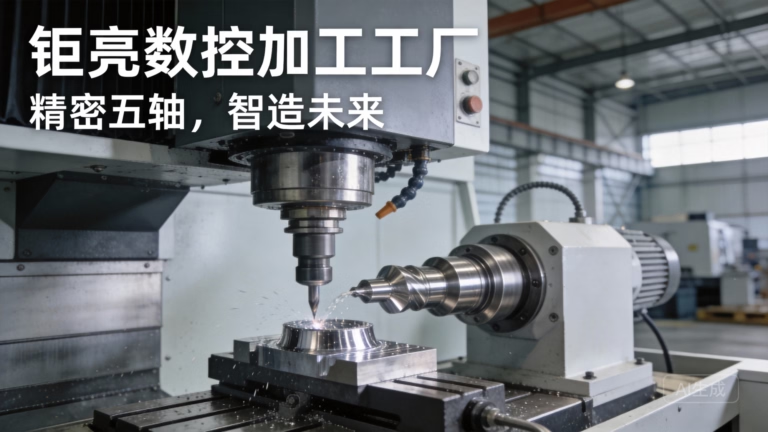
When the design calls for complex internal pockets, undercut O‑ring grooves, angled connector ports, or integrated heat sink fins, conventional 3‑axis machining quickly reaches its limits. A precision five-axis CNC machining approach allows the cutting tool to approach the workpiece from multiple orientations in a single setup, eliminating the accumulation of datum errors that plague multiple re‑ fixturing cycles.
Advantages of 5‑axis CNC for drone PDB housings:
One‑setup machining – Reduces lead time, enhances positional accuracy, and maintains tight tolerances across all features. Critical connector alignment within ±0.01 mm is readily achievable.
Access to undercuts and overhangs – Right‑angle connector recesses, dovetail slots for mounting rails, and hidden fastener pockets become straightforward.
Smooth surface finishes – Optimized tool paths produce finer surface finish directly off the machine, reducing the need for secondary hand polishing.
Rapid prototyping – Even at prototype quantities of 1–5 pieces, 5‑axis CNC can produce functional housings in days, enabling iterative design verification before committing to die casting or injection molding tools.
GreatLight Metal Tech Co., LTD. operates one of the most robust fleets of 5‑axis CNC machining centers in South China, including machines from Dema and Beijing Jingdiao. With 127 pieces of precision peripheral equipment spread across a 7,600 m² facility, they routinely hold tolerances of ±0.001 mm on critical features—a capability that is indispensable when sealing surfaces must remain perfectly flat to within a few microns to guarantee IP‑level protection.
Design for Manufacturability (DFM) Insights
Over the years, I have collected a set of DFM guidelines that help drone designers get the most out of CNC‑machined housings without driving up cost or lead time:
Unify wall thickness – Keep nominal walls between 1.5 mm and 3 mm for aluminum housings. Thin walls can vibrate and crack; overly thick walls waste weight and machining time.
Avoid deep sharp‑cornered pockets – Internal radii should be at least 30 % of the pocket depth to allow standard end mills. Specify corner relief or use ball‑end mills where stress concentration is not an issue.
Design in mounting bosses with threaded inserts – Press‑fit or heat‑stake inserts (e.g., PEM® nuts) provide reusable threads and prevent stripping in soft aluminum. Provide adequate boss diameter—typically 2× the insert diameter.
Plan for connector access – Orient connectors so that cable exit directions do not interfere with the frame or adjacent components. 5‑axis machining can create angled faces for weather‑sealed connectors without requiring manual rework.
Incorporate heat sink fins where feasible – Finned patterns can be machined into the exterior of the housing. Maintain a fin thickness of at least 2 mm and a spacing‐to‑height ratio of 1:3 to maximize heat transfer without becoming fragile.
Leave room for gaskets – Design a groove that holds an O‑ring or form‑in‑place gasket. Groove depth and width should follow the gasket manufacturer’s recommendation, typically with a compression ratio of 15–25 %.
By applying these principles early, you eliminate many back‑and‑forth iterations and build a stronger partnership with your CNC supplier.
Post‑Processing: The Final Touch That Elevates Reliability
The raw machined housing needs surface treatment to withstand real‑world conditions. GreatLight Metal offers a full in‑house suite of finishing processes, enabling a true one‑stop workflow without subcontractors:
Type II (Sulfuric) Anodizing – Provides a hard, wear‑resistant oxide layer in clear, black, or custom colors. Excellent for general‑purpose drone housings.
Type III (Hard) Anodizing – Creates a thicker, harder coating (Rockwell C 50‑70) ideal for housings subject to frequent assembly/disassembly or exposure to abrasive environments.
Chemical Conversion (Chromate/Alodine®) – Offers electrical conductivity with corrosion resistance, often used as a primer for painting or as a standalone coating when grounding continuity is essential.
Powder Coating – Delivers a durable, impact‑resistant, and aesthetically pleasing finish available in virtually any RAL color.
Laser Marking – Permanent part identifiers, orientation marks, and branding logos can be marked directly onto the housing.
EMI/RFI Shielding Coatings – For non‑metallic housings or where galvanic compatibility is required, conductive paints or electroless nickel plating can be applied.
One particular project I recall involved a thermal imaging drone that needed a housing with both an electrically isolating anodized interior (to avoid shorting) and an EMI‑tight enclosure. The solution was a two‑step process: chromate conversion on internal surfaces to maintain conductivity for grounding pads, followed by selective masking and black anodizing on the exterior. Such nuanced finishing would be difficult for a supplier without deep process engineering know‑how.
Choosing the Right Manufacturing Partner: A Comparative View
The CNC machining landscape is rich with options, from direct factories to digital platforms. As you evaluate partners for your drone housing, consider the difference between a manufacturer that controls the entire process in‑house and a platform that brokers capacity. The table below contrasts GreatLight Metal with several well‑known service providers in the custom CNC domain.
| Supplier | Business Model | In‑house 5‑axis CNC | In‑house Surface Finishing | Notable Certifications | Maximum Machining Size | IP Protection (ISO 27001) |
|---|---|---|---|---|---|---|
| GreatLight Metal | Direct manufacturer | ✔ (full range) | ✔ (complete one‑stop) | ISO 9001, IATF 16949, ISO 13485, ISO 27001 | 4000 mm | Yes |
| RapidDirect | Direct manufacturer | ✔ | ✔ (limited) | ISO 9001 | ≥ 1500 mm | Not specified |
| Xometry | Platform/network | Varies by partner | Varies by partner | ISO 9001 (selected partners) | Varies | Varies |
| Protolabs Network (Hubs) | Platform | Varies | Varies | ISO 9001 (selected partners) | Varies | Not guaranteed |
| Protocase | Custom enclosure specialist | Limited (sheet metal/3‑axis) | ✔ (powder coat, printing) | ISO 9001 | ~ 1200 mm | No |
| JLCCNC | Direct manufacturer | ✔ (5‑axis available) | Partner‑based | ISO 9001 | ~ 800 mm | No |
While platforms like Xometry and Protolabs Network offer convenience through automated quoting, the quality of the finished part can fluctuate because the actual production is farmed out to various job shops. For complex, safety‑critical drone housings that involve intricate 5‑axis geometries, tight EMI shielding requirements, and traceable certifications, a dedicated original manufacturer like GreatLight Metal provides consistency, accountability, and a complete process chain from raw stock to finished, inspected part.
GreatLight Metal operates three wholly‑owned manufacturing plants under one roof. With over 13 years of precision prototype model processing and a team of 150 skilled staff, they combine the responsiveness of a prototyping house with the repeatability of a production factory. Their ISO 9001 quality system ensures that every order is accompanied by inspection data; IATF 16949 alignment brings automotive‑grade rigor to drone manufacturing; and ISO 13485 readiness supports medical‑grade drone devices. Less tangibly, the ISO 27001 certification guarantees that your proprietary drone CAD files receive the same level of data security as those of leading automotive and aerospace clients.
Case in Point: A UAV Power Distribution Housing Manufacture
Consider a scenario typical of what I’ve seen in the field: A precision agriculture drone startup needed a new PDB housing that integrated a 4‑in‑1 ESC, camera power supply, and dual GPS modules. The housing had to weigh under 80 g, dissipate 15 W of heat from the onboard DC‑DC converter, and withstand vibration up to 20 Grms. Initial quotes from online platforms came back with long lead times and no design feedback. GreatLight Metal’s engineering team stepped in with a full DFM review. They suggested:
Switching from 7075 aluminum to 6061‑T6 to improve machinability and reduce cost, while still meeting strength requirements.
Adding a 1.5 mm‑thick internal heat spreader shelf that doubled as a mounting bracket for the converter.
Optimizing the O‑ring groove geometry for a standard commercial gasket, eliminating the need for custom tooling.
Machining the entire shell in a single 5‑axis setup, ensuring the two‑part clam‑ shell halves matched with less than 0.02 mm gap.
Prototypes were delivered within 8 business days, bead blasted and anodized black, and the thermal imaging validation showed a 12 °C drop in converter case temperature compared to the previous generation. The client moved directly to low‑volume production of 200 units using the same CNC workflow, without incurring tooling costs for die casting, thereby preserving cash and time‑to‑market. This outcome is only possible when a manufacturer has both the technical horsepower and the process‑integration mindset.
Certifications That Speak to Trust
In the world of precision manufacturing, certifications serve as objective third‑party validation of a supplier’s process maturity. A partner that invests in multiple ISO standards demonstrates not only compliance but a culture of continuous improvement. GreatLight Metal holds:
ISO 9001:2015 – The foundation of consistent quality management, covering every step from incoming material inspection to final shipment.
IATF 16949 – Originally developed for the automotive sector, this standard imposes stringent defect‑prevention and supply‑chain risk management requirements—directly transferable to mission‑critical drone electronics.
ISO 13485 – Certifies capability for medical device hardware, where traceability and cleanliness are non‑negotiable; relevant for medical delivery drones.
ISO 27001 – Ensures robust data security practices, especially critical when your PDB design contains custom algorithms or board layouts that represent core IP.
These certifications are not just plaques on a wall; they are reflected in everyday practices such as in‑process statistical process control (SPC), calibrated CMM inspection reports, and job‑specific tool life management. For any engineer who has experienced the frustration of receiving parts that “look right” but fail under load, this systemic attention to detail is a competitive advantage you can feel.
Integrating Rapid Prototyping and Small‑Batch Production
Before committing to full‑scale CNC machining of expensive aluminum alloys, it is often wise to validate form and fit with lower‑cost prototypes. GreatLight Metal’s suite of additive manufacturing options—SLA, SLS, and SLM 3D printers—allows you to receive a plastic or metal prototype in days. Once the fit is confirmed, the team can leverage the same digital master file to machine the final 6061‑T6 housing, guaranteeing dimensional consistency between prototype and production. This seamless transition from rapid prototyping to CNC series production eliminates the risk of design drift that frequently plagues multi‑vendor product development cycles.
Wrapping Up: The Real Cost of an Unreliable Housing
Every grounded drone, every fried power component, and every late‑night tear‑down caused by a substandard PDB housing carries a cost far beyond the immediate repair bill. It erodes customer trust, delays field trials, and stifles your next funding round. By contrast, a well‑designed and precisely machined housing becomes an invisible enabler—it just works, flight after flight. That peace of mind starts with selecting a manufacturing partner that matches the ambition of your engineering team.
When the reliability of your drone’s power system hinges on the integrity of its housing, entrust the project to a partner that combines deep manufacturing expertise with uncompromising quality assurance—GreatLight CNC Machining.



















