
Industry Briefing
With the rapid development of science and technology and the widespread application of ultra-precision equipment such as precision instruments and equipment, increasingly higher quality requirements have been put forward for key optical components optical systems. The shapes have been improved compared to the original plan. , spherical and cylindrical. The accuracy of aspherical surfaces, aspherical cylinders, free-form surfaces, etc. has also been improved from the original RMS1/30~1/50λ (1λ=632.8 nm) to RMS1/100~1/ 200λ.
Nowadays, most of my country’s optical manufacturing and processing still rely on traditional processing methods, such as double-sided polishing, annular polishing and multi-axis polishing.
This type of process is mainly applied to flat, spherical and cylindrical surfaces and has the advantages of low equipment cost and good batch performance. However, it is insufficient when dealing with optical components such as aspherical surfaces, free-form surfaces, large sizes. -size thin-walled parts, etc. At the same time, the traditional processing time of this method is relatively long, it largely relies on master craftsmen, and its controllability is relatively poor, making it difficult to meet the needs of customized and complex ultra-precision optical components on the market.
The main CNC polishing methods currently widely used in polishing ultra-precision optical components include:
Different polishing methods are available, including CCOS, SLP, FJP, IBF, Bonnet Polishing and MRF. Their corresponding processing characteristics have their own strengths. Helpline: 13522079385
Magnetorheological polishing technology:
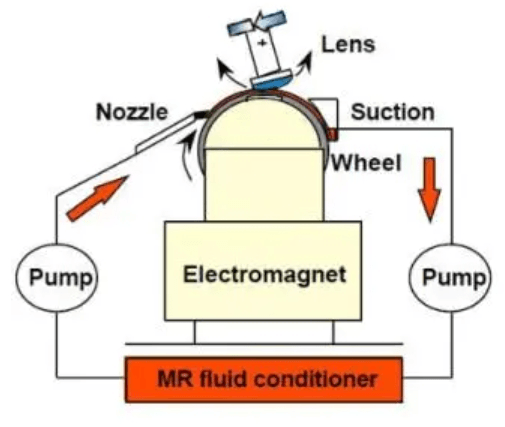
It uses the rheological characteristics of magnetorheological fluid in a magnetic field to polish the surface of optical components.
When no magnetic field is applied, the rheological properties of the magnetorheological fluid are similar to those of ordinary Newtonian fluids. When the magnetorheological fluid is subjected to a strong magnetic field, the viscosity and hardness of the magnetorheological fluid increase significantly and become similar. to a “solid” convex state forms a “flexible polishing mold”, which achieves flexible shrinkage mainly based on shear stress under the driving of the polishing wheel.
Since the viscosity and hardness of the magnetorheological fluid can be kept constant by controlling parameters such as magnetic field and flow rate, the removal function of magnetorheological polishing technology has extremely high stability and controllability. In long-term treatment, the elimination function The size. and the removal efficiency can remain unchanged, and its impact is very small compared with problems such as abrasive wear and polishing matrix deformation that occur in traditional polishing.
It is because of these properties that MRF is used as a deterministic processing technology.Widely used in high precision modification stage of optical components, RMS can reach 1/200λ。
At the same time, during processing, shear removal is mainly used. The normal processing stress is low and almost no underground damage is caused to the optical elements. Even when facing a part with a high diameter-to-thickness ratio, the processing residual stress is. small and no processing will occur. Deformation, high adaptability, good processing surface quality, rapid convergence, high precision and other processing characteristics.
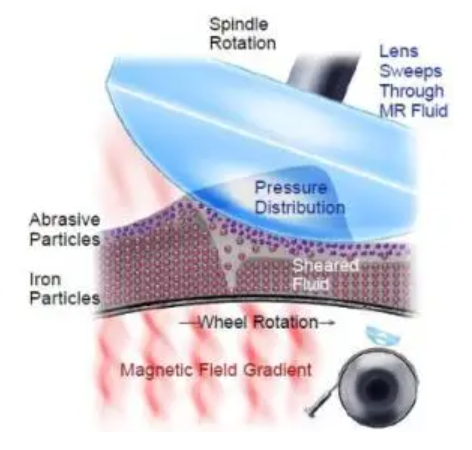
Schematic diagram of magnetorheological treatment process
Magnetorheological polishing machine tools, machine tools mainly use natural marble bases, which have the characteristics of high stability, good impact resistance and high precision of the body surface. Magnetorheological machine tool equipment can guarantee long-term high-precision operation and can meet the needs of. Ultra-precision machine tools for high-precision processing of various types are required. Marble countertops have a low coefficient of thermal expansion and are not prone to warping.
The magnetorheological polishing machine tool can realize six-axis linkage of X, Y, Z, A, B and U. It is driven by servo motor, ball screw and linear guide. It has high working positioning precision, good robustness and. stable error suppression effect. The optional movement stroke of each axis can process workpieces with a maximum size of φ3000mm, and supports equipment customization at the same time, to adapt to the curvature and processing efficiency of the different polishing components, Tianchuang now offers 5; polishing types Polishing wheels: φ20mm, φ50mm, φ100mm, φ200mm and φ340mm are available for customers to choose from. The diameter of the polishing wheel is closely related to the polishing efficiency and the curvature of the workpiece. the higher the processing efficiency, the smaller the curvature range to which polishing is suitable. Guang, in terms of equipment selection, customers are generally recommended to select several polishing wheels of different specifications according to the characteristics of their own processed parts.
Magnetorheological Polishing Ultra-Precision Machining Machine Tools
At the same time, customers can freely choose from a variety of magnetorheological fluids according to their processing needs. The material processing range covers: single crystal silicon, nickel, aluminum, ordinary glass, fused quartz, silicon carbide and other materials, with roughness. Ra down to 0.5 nm.
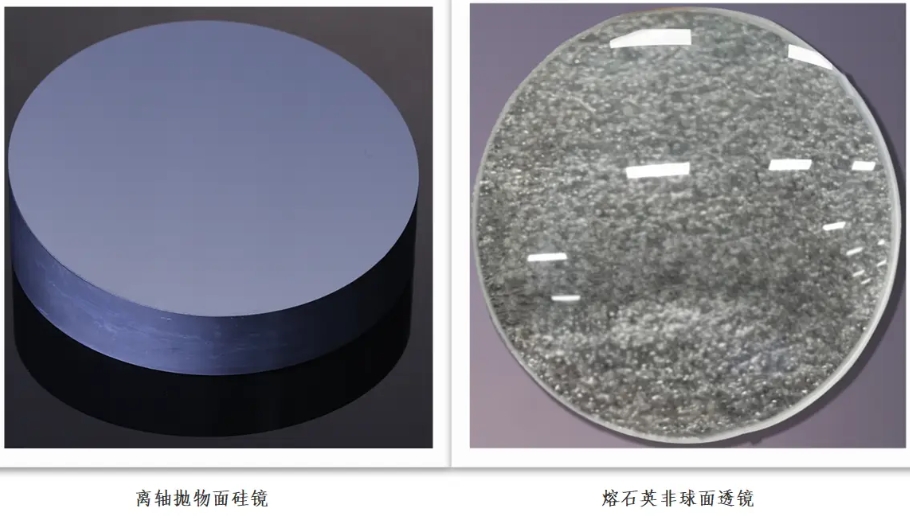
Application case
Magnetorheological polishing technology is widely used in the ultra-precision manufacturing of optical components of various shapes and properties, meeting the needs of ultra-precision processing of optical components in aerospace, ultra-precision optical device equipment, devices optoelectronic, electronic and domestic information industry. defense industry.
Magnetorheological polishing technology can realize nano-precision processing of optical components. The processing precision of Tianchuang Seiko’s magnetorheological machine tools can reach RMS1/200λ (λ=632.8nm), and the surface roughness Ra is better than 0.5nm. It is used in the field of high-precision processing of planar, spherical, cylindrical, aspherical and free-form surfaces with a large diameter/thickness ratio, and can meet the needs of very high-precision optical components in the fields of Aerospace, ultra-precision optical device equipment, optoelectronic devices, electronic information industry and national defense industry.
Here are some classic cases:
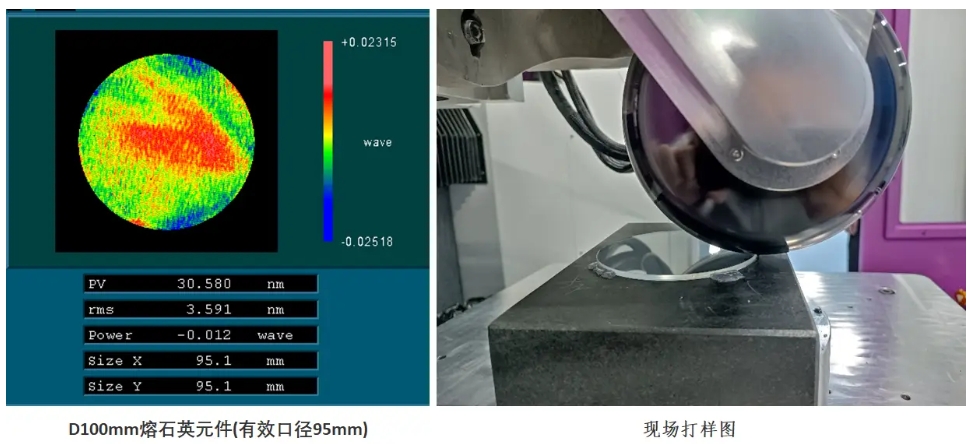
(1) fused quartz optical element D100 mm
The component is only 5mm thick, with a diameter-to-thickness ratio of 20. The PV of the incoming material is 1/2λ, and the design requires a PV of 1/20λ. Finally, after 40 minutes of treatment, the component is obtained. the effective diameter has a PV of 30.58 nm (<1/20λ), RMS3 0.59 nm (<1/170λ).
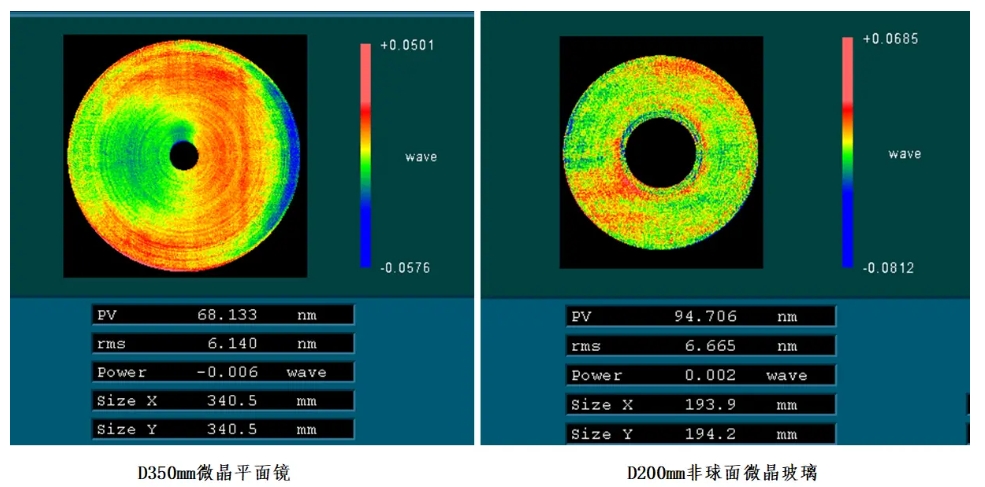
(2) Microcrystalline components
The left image shows the processing result of the D350mm microcrystalline plane mirror. The RMS is 6.14 nm and is better than 1/100λ. The piece has obvious power before processing. Its PV value is 4 um. processing hours. It can be used as optical inspection. Use a compensating mirror. The right image is an aspherical microcrystal after processing, the effective diameter is RMS6.665 nm (about 1/100λ).
(3) Aspherical silicon mirror
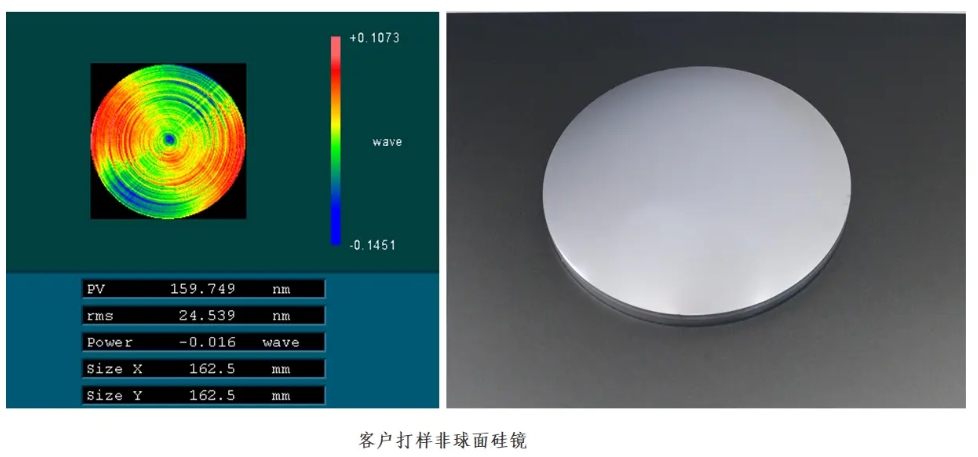
Single crystal silicon has high thermal conductivity and low thermal expansion (not easily deformed in high-energy light paths), and it is easy to process cooling structures such as micro-grooves, so it is widely used in high energy lasers. At the same time, due to its good infrared transmission, it is widely used in various infrared optical guidance systems. Magnetorheology has the ability to process and sample single crystal silicon, and the RMS of aspherical processing of single crystal silicon can reach 1/50λ.
(4) Aluminum mirror processing
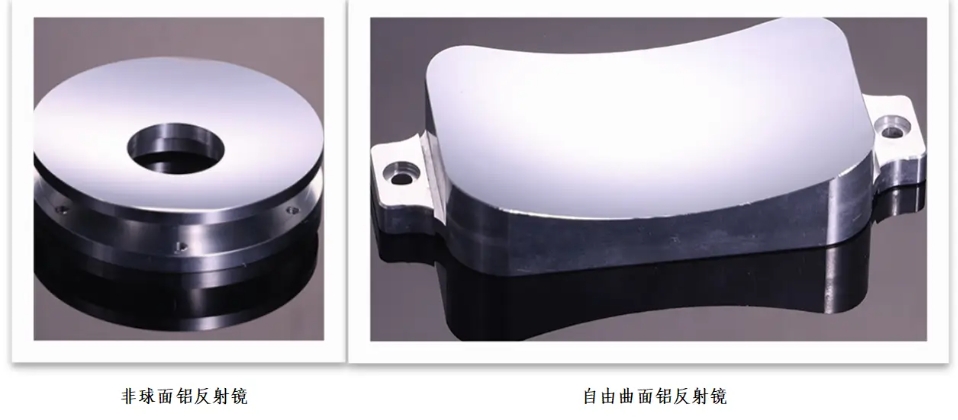
Aluminum has the characteristics of light weight, high reflectivity and good processability. It can be used in optical-mechanical integration design. It is also used in laser radars and various optical systems. Magnetorheology can be used to process aluminum mirrors, and its RMS processing accuracy can reach up to 1/70λ.
Conclusion
For the field of ultra-precision optical processing, the emergence of magnetorheological polishing technology constitutes a key technological advancement. Compared with other polishing technologies with nanometer-level processing precision, it has high removal efficiency, good stability of removal function and smooth processing surface. It has the advantages of excellent quality, high adaptability to workpiece materials, and almost no surface and subsurface damage. It can stably and reliably realize ultra-precision processing of optical components. It is widely used in many fields such as optics and instrumentation. , laser radar and space imaging. It has high market value and broad application prospects.
Daguang focuses on providing solutions such as precision CNC machining services (3-axis, 4-axis, 5-axis machining), CNC milling, 3D printing and rapid prototyping services.



















