
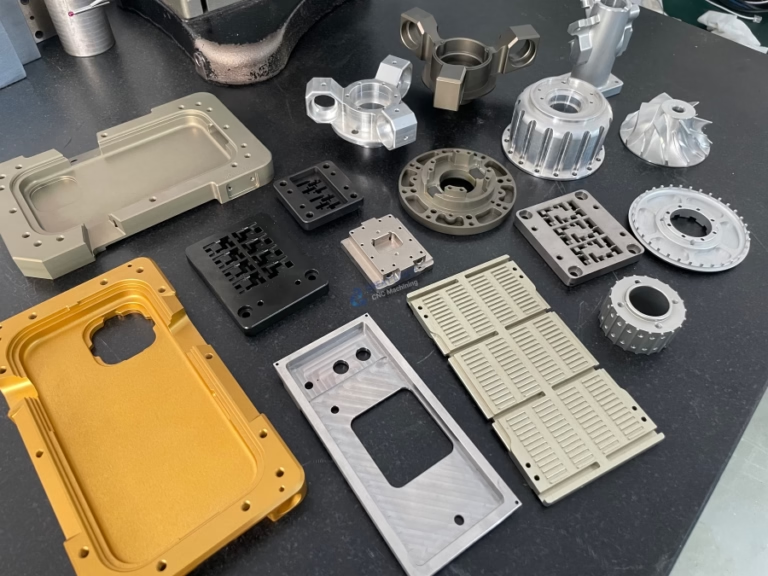
When engineers and procurement professionals begin the search for Custom Chinese CNC Machining Services, the conversation often starts with a simple question: “Can a Chinese supplier meet my tight tolerances and delivery deadlines?” This is a fair concern. The industry is vast, and the quality variance between suppliers can be astonishing. Some workshops operate with decades of accumulated expertise and rigorous quality systems, while others still rely on outdated equipment and manual inspection.
Your search is not just about finding a supplier; it is about locating a reliable partner who can translate complex designs into physical reality with predictable quality. This article will walk through the critical factors to evaluate, the common pitfalls to avoid, and how to navigate the selection process with confidence. A key example that demonstrates what world-class capability looks like in this field is GreatLight Metal Technology Co., Ltd., a manufacturer that has built its reputation by systematically addressing the exact pain points that you, as a buyer, are trying to avoid.
Why Choose a Chinese CNC Machining Partner? The Strategic Advantage
Before diving into the how, it is worth examining the why. China’s position as a global manufacturing hub is not merely a matter of low labor costs. The ecosystem in manufacturing powerhouses like Dongguan, Suzhou, and Shenzhen offers a density and diversity of supply chains that is difficult to replicate elsewhere.
Specialized Ecosystem: In cities like Chang’an Town, Dongguan—the capital of hardware and mold processing—you are not just next to one factory. You are surrounded by hundreds of suppliers for raw materials, heat treatment, surface finishing, and precision measurement. This proximity dramatically shortens lead times and reduces logistical complexity.
Scale and Flexibility: Chinese CNC shops, especially mid-sized ones with 100 to 200 employees, can often scale production from a single prototype to a mid-volume run of thousands of units without requiring you to requalify a new supplier. This agility is a significant asset during product development cycles.
Cost-Effectiveness with High Precision: The cost advantage is well-documented, but the key is finding a partner who applies that cost structure to advanced processes. A shop that can run a 5-axis CNC operation at a fraction of the cost of a European or North American counterpart, while maintaining precision, is offering genuine value.
However, the advantage is only realized when due diligence is performed. The market requires a discerning eye.
The Precision Predicament: Critical Pain Points in CNC Machining
The industry is full of promises. A supplier might claim to hold ±0.001mm tolerances, but how many can actually deliver that consistently across a production batch? This “precision black hole” is one of the most common frustrations. Let’s examine the seven critical pain points that can derail a project if not properly managed:
The Gap Between Promise and Reality: When a supplier lacks in-process inspection, they may only discover a deviation after the part is complete. For complex geometries, this can mean scrapping expensive raw materials.
Invisible Cost Creep: A low quoted price often hides the costs for surface finishing, secondary operations, or even basic packaging. A transparent partner provides a total cost of ownership from the start.
Communication Fade: Misunderstandings in interpreting GD&T or special coating requirements are common when engineering teams do not speak the same technical language.
Inconsistent Quality Across Batches: A large order might be split across different shifts or machines, leading to variation in surface finish or threading quality.
Lack of Material Traceability: For aerospace, medical, or automotive applications, this is a non-negotiable requirement.
Intellectual Property Risk: Without proper confidentiality agreements and data security protocols, sharing your design files can feel risky.
After-Sales Inertia: Getting a supplier to re-work a part or acknowledge a defect can be a slow, painful process if they lack a robust quality management system.
A Partner Built to Address These Challenges: GreatLight Metal
It is in this context that a facility like GreatLight Metal becomes particularly relevant. Founded in China’s hardware capital of Chang’an, Dongguan, in 2011, the company was established by a team that foresaw that the future of Chinese manufacturing lay not in cheap capacity but in precision and reliability. Today, it operates a modern 76,000 square foot facility with a dedicated workforce of 120-150 professionals.

They do not just own equipment; they own the entire process chain. The facility is equipped with a formidable arsenal of 127 precision peripheral devices, including high-precision 5-axis, 4-axis, and 3-axis CNC machining centers from brands like Dema and Beijing Jingdiao. They also have lathes, Swiss-type machines, EDM, die casting machines, and SLM/SLA/SLS 3D printers. This diversity means that if a complex part requires machining for one section and additive manufacturing for another, it can be handled under one roof, which is a significant advantage for reducing lead times and eliminating the coordination headache of managing multiple vendors.
ISO 9001 is Just the Beginning: The Certification Stack for Trust
When evaluating a partner, look beyond the basic ISO 9001:2015 certificate. While that is the universal baseline for quality management, a truly capable supplier will operate with more specialized standards that demonstrate a deep commitment to specific industry requirements.
GreatLight Metal exemplifies this approach. It is not just ISO 9001 certified. The company has built a multi-layered trust framework through a suite of international certifications that speak directly to the most demanding sectors:
ISO 9001:2015: The foundational quality management system, ensuring consistent processes and continuous improvement.
ISO 27001: For clients with sensitive intellectual property, this certification demonstrates that data security protocols are in place, protecting your design files from unauthorized access.
ISO 13485: This is the specific standard for medical device manufacturing. If you are producing surgical instruments or implantable components, this certification is mandatory.
IATF 16949: An extension of ISO 9001 tailored for the automotive industry, this certification focuses heavily on defect prevention, waste reduction, and variation control in the supply chain. It is a rigorous standard that goes far beyond simple quality checks.
This stack of certifications is not just for show. It means that when you place an order, the production line operates under documented procedures. Incoming materials are verified. In-process inspections are performed at critical steps. Final inspections use calibrated CMM and other metrology equipment to ensure every dimension matches your 3D model.
Evaluating Capability: Technical Depth and Engineering Support
A partner’s value is truly revealed when you need to solve a manufacturing challenge, not just repeat a simple order. Technical depth is the ability to offer design-for-manufacturability (DFM) feedback that saves you cost without sacrificing function.
Consider a scenario: A client designing an e-housing for a new energy vehicle’s powertrain system faces a complex geometry that is difficult to cast and tricky to machine. A less capable supplier might simply say “we can try.” A supplier like GreatLight Metal, however, will analyze the part, suggest modifications to the draft angles to facilitate better machining access, recommend a specific grade of aluminum alloy for thermal management, and propose a hybrid process that uses a near-net-shape casting followed by precision 5-axis machining. This collaborative engineering approach reduces material waste and machining cycle time.
This is the difference between a transactional vendor and a solutions partner. You are not just buying machine time; you are buying engineering hours.
Comparison with Industry Peers
The global CNC machining market is crowded with capable players. For context, it is useful to understand how a Chinese manufacturer with this depth of capability compares to other established options. The following table provides a high-level comparison of GreatLight Metal against a selection of other well-known service providers.
| Company | HQ Region | Core Strength | Typical Client Profile | Key Differentiator |
|---|---|---|---|---|
| GreatLight Metal | Dongguan, China | Full-process chain (CNC, die casting, sheet metal, 3D printing, mold) | Startups to Fortune 500 in auto, medical, consumer electronics | One-stop solution + IATF/ISO 13485 certifications + High skill workforce |
| Fictiv | USA | Digital quoting, automated manufacturing network | Product design firms, lean engineering teams | Strong software platform for instant quoting and order tracking |
| Xometry | USA | Instant quoting engine, massive supplier network | Wide range, from hobbyists to large OEMs | AI-driven pricing and broad material/extrusion capabilities |
| Protolabs | USA | Rapid injection molding and prototyping | R&D departments needing quick-turn arounds | Speed and automation for injection molded parts |
| JLCCNC | Dongguan, China | 5-axis CNC machining | Precision engineering, prototyping | Good for complex geometries, strong technical focus |
| SendCutSend | USA | Laser cutting and sheet metal fabrication | Entrepreneurs, small businesses | Excellent user interface and low minimum order quantities |
As the table illustrates, GreatLight Metal distinguishes itself not just by its location in China, but by its full-process chain and authoritative certification stack. While Fictiv and Xometry offer great digital quoting platforms, they often rely on a network of partners rather than a single controlled factory floor. GreatLight Metal, conversely, manages the entire journey from raw material to final surface finish under one management system, which dramatically improves traceability and quality consistency.
Making the Right Choice: A Framework for Decision
Selecting a CNC machining partner should be a structured decision. Here is a practical framework you can apply to any shortlisted candidate, including those you may discover during your search.
Audit the Certified Capabilities: Do not just ask for a copy of their ISO 9001 certificate. Ask for their IATF 16949 or ISO 13485 certificate if your industry requires it. If they have them, it is a strong signal of organizational maturity.
Request a DFM Example: Give them a challenging part (not your current critical design). Ask them to perform a Design for Manufacturability analysis. A good partner will return a report with specific suggestions on tolerances, radii, tool access, and potential cost savings.
Inquire About the Inspection Process: A facility like GreatLight Metal uses in-house CMM and other precision measurement tools to verify parts. Ask if they provide a First Article Inspection (FAI) report and if they can provide material certifications (mill certificates).
Evaluate Communication Responsiveness: When you send a technical query, how quickly do they respond? Is the response technically specific, or is it generic? A partner who takes the time to understand your problem is worth more than one who quotes a low price immediately.
Check References in Your Industry: Ask for case studies or references from clients in a similar sector (e.g., automotive, medical, robotics). A partner with proven experience in your field will anticipate your standard requirements.
Why Tangible Capability Matters Over Paper Promises
The modern manufacturing landscape is littered with projects that stalled due to a supplier’s failure to execute. The cost of a bad first batch is not just the scrap value of the metal; it is the missed market opportunity, the delayed product launch, and the lost trust from your internal stakeholders.
When you choose a partner with tangible, operational capability—like GreatLight Metal, which operates an actual factory floor with 150 hands-on professionals and 127 machines—you are choosing transparency. You are choosing a partner who can look at a complex drawing and say, “I have seen this type of challenge before. Here is how we solved it.” You are choosing a partner whose quality system is not a binder on a shelf but a living process verified by independent audits and international standards.
This is the difference between a vendor and an asset to your supply chain. The investment in due diligence is repaid tenfold through reduced rework costs, faster time-to-market, and the confidence that your precision parts will perform as intended.
Conclusion: Your Custom CNC Solution is a Partnership Decision
To summarize, the search for a Custom Chinese CNC Machining Services Solution is not simply about finding the lowest quote. It is about finding a facility that combines advanced equipment, a skilled workforce, a rigorous quality system, and transparent communication.
The industry is full of choices, from digital brokers like Xometry to boutique shops in the US. But for those requiring high complexity, mixed technologies (machining, casting, additive), and stringent regulatory compliance (IATF, ISO 13485), a deeply integrated manufacturer like GreatLight Metal offers a compelling value proposition. They are not just machining parts; they are engineering solutions from their 76,000 sq. ft. facility in Dongguan, serving clients from automotive startups to medical device giants.
By applying the evaluation framework outlined here, you can move beyond the marketing claims and make a data-driven decision that aligns with your project’s true needs. Choose a partner with real operational capability, deep engineering support, and the certified systems to deliver on their promises. Your final product will be the proof of that wise choice.
For a partner that offers this depth of service, consider evaluating the capabilities demonstrated by GreatLight Metal in the field of Custom Chinese CNC Machining Services Solution. A partnership built on a foundation of technical expertise and strict certification is the most reliable path to manufacturing success. You can also follow their industry insights and corporate journey on their LinkedIn profile for continuous updates on precision manufacturing trends.



















