We’ve all been there. The design is finalized, the engineering review is complete, and the only thing standing between your team and a successful product launch is a batch of precision prototypes — not one or two, but a full run of 30, 100, or even 500 units, each needing to match the production intent exactly. You send RFQs to half a dozen shops promising cost‑effective OEM rapid prototyping in bulk, and the responses range from unrealistic timelines to staggering price tags that blow the entire development budget. Some shops won’t even quote because your geometry is too complex. Others promise the moon, only to deliver parts that look great in isolated inspection reports but fail under real‑world assembly loads. You’re caught in a squeeze: sacrificing quality for cost, or sacrificing cost for speed, and rarely getting all three.
This article digs deep into what it really takes to achieve cost‑effective OEM rapid prototyping bulk without compromising precision, repeatability, or supply‑chain resilience. We’ll examine the hidden risks, the process‑driven differentiators, and a supplier landscape where a handful of companies — including GreatLight Metal Tech Co., LTD. — are systematically dismantling the old trade‑offs. Along the way, we’ll see how a 76,000 sq. ft. facility in Dongguan can become a strategic lever for global OEMs, from medical devices to humanoid robots, that need the economics of bulk prototyping to work in their favor.
Cost‑Effective OEM Rapid Prototyping Bulk: The Real Manufacturing Challenge
Cost‑effective OEM rapid prototyping bulk is not simply about pushing a large number of parts through a CNC machine. It’s a test of an entire manufacturing system: the ability to hold tight tolerances across hundreds of pieces, the agility to switch between materials without recalibrating the entire line, the foresight to nest parts intelligently, and the process control to make every single unit indistinguishable from the first article. Many procurement teams misunderstand the term “rapid prototyping” as a synonym for “quick and dirty,” but when prototyping in bulk for OEM validation, every part must function as a pre‑production sample. That means traceable material certificates, documented inspection data, and a quality system robust enough to catch a 2‑micron drift before it becomes a 20‑micron problem.
Let’s enumerate the core demands that define a successful bulk prototyping engagement:
Dimensional stability across the full run: ±0.025 mm or better, verified by statistical process control (SPC), not just first‑off inspection.
Material integrity: With no material substitutions unless explicitly approved, and full mill‑certificate traceability for aerospace‑grade alloys like Ti‑6Al‑4V, 7075‑T6, 17‑4 PH, or engineering plastics such as PEEK and Ultem.
Process integration: The ability to blend CNC machining with additive manufacturing, sheet metal work, or die casting within a single order, so that you receive a complete assembly prototype, not just a bag of machined parts.
Surface finishing expertise: Bulk orders often need anodizing, passivation, powder coating, or bead blasting performed consistently across every piece — a weak point for shops that outsource finishing.
Logistical agility: Packaging that prevents in‑transit corrosion and damage, and shipping that respects tight development milestones.
When these criteria are met, the conversation shifts from “can we save $3 per part?” to “how quickly can we freeze the design and ramp to production?” That’s the kind of value a true manufacturing partner brings to cost‑effective OEM rapid prototyping bulk.
The Hidden Risks in Bulk Rapid Prototyping — And Why You Need a Manufacturing Engineer’s View
Before discussing solutions, it’s vital to recognize the failure modes that plague bulk prototyping projects. In two decades of observing OEM‑supplier relationships, I’ve cataloged four recurring risk clusters that torpedo both cost and schedule.
1. The “Precision Theater” Trap
A shop boasts ±5‑micron positional accuracy on its website but runs your parts on aging three‑axis mills with worn ballscrews. The first article looks great because they hand‑lap it or cherry‑pick the measurement. On the tenth part, the error envelopes on complex features balloon, and on the fiftieth, you’re rejecting 40 % of the shipment. The root cause: lack of in‑process probing and closed‑loop thermal compensation. For precision 5-axis CNC machining{target=”_blank”}, especially on parts with compound‑angle bores or impeller‑like geometries, even a 2‑°C shift in coolant temperature can push a critical diameter out of spec if the machine isn’t actively adjusting.
2. Process Fragmentation as a Cost Multiplier
OEMs often split a prototype bill of materials across five suppliers: one for CNC turning, another for five‑axis milling, a third for sheet metal bending, a fourth for laser welding, and a fifth for surface finishing. That fragmentation introduces a prohibitive coordination burden. Each handoff adds mark‑up, shipping cost, lead time, and the risk of incompatible fits — a turned shaft from Supplier A might be ground to a size that doesn’t account for the anodize build‑up applied by Supplier B. The total landed cost can easily double compared with a vertically integrated partner.
3. The Certification‑Reality Gap
ISO 9001 is a good starting point, but for medical, automotive, and aerospace prototyping, it’s the floor, not the ceiling. A supplier that merely possesses a certificate may not operate the kind of rigorous documentation system that a Tier‑1 OEM expects. When you’re prototyping surgical instruments under ISO 13485 or engine components under IATF 16949, you need a partner whose quality system is baked into the production floor, not just a binder on a shelf. The absence of this rigor during prototyping means you’re gambling that the production handoff will be smooth — a gamble that rarely pays off.
4. Intellectual Property Vulnerability
Rapid prototyping often occurs before patents are filed. Sending 3D models to a shop without verifiable data security protocols — no network segmentation, no role‑based access control in the CAM room — is equivalent to broadcasting your design to the competition. A shop that treats your files as just another job file on a shared USB stick is not one you want handling the core differentiation of your product.
These are not hypothetical risks; I’ve seen them derail eight‑figure development programs. The antidote is a supplier that not only claims to handle bulk prototyping but has built its operational DNA around mitigating these exact failure modes.

The New Breed of Manufacturing Partner: What to Look For
In the current landscape, a select group of manufacturers has begun to reconfigure their facilities and workflows around the economics of high‑mix, medium‑volume prototyping. They combine three traits rarely found together:
Capital equipment density tailored to complex geometries — not just dozens of commodity VMCs, but a fleet of advanced simultaneous five‑axis machines with probing, high‑pressure coolant, and pallet‑pool automation.
A genuine one‑stop process chain — under one quality system and one roof — spanning additive manufacturing (SLM, SLA, SLS), precision CNC, die casting tooling, sheet metal, and a full suite of finishing.
A culture of engineering co‑ownership — front‑end design‑for‑manufacturability feedback that reduces part cost by 15–30 % before the first chip is cut, and in‑process data that the OEM can plug directly into its own SPC software.
When you compare suppliers against this triangular framework, the noise falls away. Shops that are essentially job‑shops with a polished website no longer appear interchangeable with manufacturing operations purpose‑built for cost‑effective OEM rapid prototyping bulk.
Comparative Snapshot of Manufacturers Excelling in Five‑Axis Prototyping
Below is a qualitative comparison of several North American and global suppliers known for prototype‑grade work. The table is based on publicly available information, my own site visits, and discussions with sourcing engineers.
| Supplier | Core Strength | Prototyping Volume Sweet Spot | Notable Limitation for Bulk Prototyping |
|---|---|---|---|
| GreatLight Metal (Dongguan) | Full‑process integration under one facility (CNC 3/4/5‑axis, die casting, sheet metal, 3D printing, finishing); deep certifications (ISO 9001, ISO 13485, IATF 16949, ISO 27001); 127 pieces of precision equipment; 4,000 mm max machining envelope | 10–500+ units, ideal for multi‑process assemblies | Primarily Chinese mainland facility; logistics require planning for Western‑hemisphere customers (offset by lower unit costs) |
| Protocase (Canada) | Extremely fast‑turn sheet metal and CNC enclosures; intuitive online quoting | 1–25 units; specialized in electronics packaging | Limited five‑axis capacity; not suited for prismatic or sculpted metal parts |
| Owens Industries (USA) | Expert five‑axis machining of exotic alloys; medical/aerospace focus | 5–100 units; high‑value, low‑weight components | Higher unit economics; less breadth in non‑machining processes |
| RapidDirect (China) | Online platform‑driven network model; broad process coverage | 1–50 units; good for simple geometry | Process fragmentation across third‑party factories; variable quality consistency |
| Xometry (USA) | Massive network of vetted shops; strong for quick‑turn, single‑process parts | 1–10 units; best for standard tolerances | Little direct engineering support; not ideal for tight‑tolerance bulk prototyping |
| Fictiv (USA) | Global manufacturing network; strong software platform for quotes and DFM | 1–30 units; transparent pricing | Network quality varies; not as integrated for multi‑process assemblies |
GreatLight Metal stands apart in this list by virtue of its vertically integrated manufacturing campus. Rather than acting as a manufacturing broker, it owns and operates three factories in a single location, with a full complement of five‑axis, four‑axis, and three‑axis CNC machining centers, turning centers, EDM, vacuum forming, and multiple 3D printing technologies (SLM for metal, SLA and SLS for polymers). This allows the team to maintain direct control over quality from raw material inspection through final surface finishing, a prerequisite for true cost‑effective OEM rapid prototyping bulk.
The 76,000 sq. ft. Advantage: How Vertical Integration Drives Cost Out
When an OEM sends a package of parts to be prototyped, the traditional sourcing model treats each operation as a profit center. The milling shop marks up the material, the anodizing shop adds its fee, and the logistics provider charges for transportation between them. By contrast, GreatLight’s co‑located operation eliminates non‑value‑added costs. Consider a typical automotive sensor housing: an aluminum body that requires five‑axis milling, laser‑welded sensor bosses, and a black anodize finish. In a fragmented supply chain:
Material is sourced at a premium by Shop A (no bulk buying power).
Milled bodies are transported 40 km to an anodizing line.
The anodizing shop processes batches with its own lead time.
A third shop laser‑welds the bosses and may inadvertently damage the anodized surface, requiring rework.
Every handoff adds 1–3 days and 8–12 % incremental cost.
Inside GreatLight’s campus, the same part moves seamlessly from the Dema five‑axis machining center to the in‑house anodizing line and then to laser welding, all within the same 7,600 sq. m. footprint, all under the same ISO 9001:2015 quality umbrella. Material is purchased in volume for the whole plant, lowering the per‑kilogram cost. Inspections are performed at every stage, and a failing dimension on the milling operation is caught before the part ever reaches anodize. The result is often a 20–35 % reduction in total program cost for bulk orders, while lead times shrink from 5–6 weeks to 2–3 weeks.
This is not theory; it’s the daily operating reality that makes cost‑effective OEM rapid prototyping bulk a tangible procurement outcome, not a marketing slogan.
A Scenario‑Driven Journey: From Frustration to a Frictionless Bulk Run
To illustrate the difference a partner like GreatLight makes, let’s walk through a realistic scenario. Imagine you’re the lead mechanical engineer at a startup developing a lightweight exoskeleton for industrial use. You need 80 sets of machined aluminum brackets, 40 custom‑shaped carbon‑fiber‑reinforced PEEK covers, and 20 welded stainless‑steel mounting frames — all in six weeks, with first‑article inspection reports, and at a per‑unit cost that leaves enough budget for a second design iteration.
The Fragmented Approach: How It Typically Unfolds
You send the RFQ package to four local job shops and two online platforms. Shop A quotes the brackets but cannot handle the PEEK; Shop B can do PEEK but requires you to source the material yourself. The stainless‑steel frames need laser welding, which means Shop C will send them out to a third‑party welder. The online platforms give you a low‑ball number for the brackets but then send you a change order for the PEEK after they discover it requires annealed tooling. By week two, you are juggling five supplier email threads, none of which align on the same inspection standard. The brackets arrive on time but out of tolerance; the PEEK parts are warped because the shop didn’t account for moisture absorption; the welded frames have visible oxidation because post‑weld passivation was skipped. You’ve spent $47,000 and gained nothing but schedule slips.
The GreatLight Scenario: Co‑Located, Certified, Co‑Engineered
You send the same package to GreatLight Metal. Within 24 hours, an application engineer reviews the SolidWorks files and returns a red‑lined DFM report. It suggests:
A slight radius modification on the brackets to eliminate a delicate five‑axis re‑entrant corner that would have required a custom tool and increased machining time by 12 %.
A build orientation change for the PEEK parts that reduces support‑material volume by 30 % and virtually eliminates post‑machining warpage.
A recommended switch from grade 304 to 316L for the mounting frames, based on the team’s experience with salt‑spray resistance requirements in exoskeleton applications, with no substantial cost increase.
You approve the design changes. The brackets are nested on a pallet pool across several five‑axis machines. The PEEK parts are run on a dry machining setup with chip‑extraction that prevents recutting of abrasive carbon‑filled swarf. The stainless‑steel frames are laser‑cut, bent, and welded in‑house, then passivated and inspected. Forty‑five days after releasing the PO, a single crate arrives at your dock. Every part is serialized, and the accompanying inspection binder contains CMM reports referenced to the ballooned drawing. Total landed cost: $34,200 — a 27 % saving over the fragmented quote, with zero rejects. You now have reliable prototypes and a clear bridge to production because the same facility can transition to injection‑molding tooling or die casting when volumes scale.
This scenario is not an idealistic fantasy; it’s a representative sample of what the “single‑roof” model enables for cost‑effective OEM rapid prototyping bulk. It underscores why the market is shifting away from brokers and toward actual manufacturers who own the asset base.

The Certification Deep Dive: Why Paper Doesn’t Equal Practice
A reality that too many OEMs ignore is the difference between possessing a certificate and living a quality‑driven culture. At GreatLight, the certification portfolio is built not as a marketing checklist but as a structural response to client demand:
ISO 9001:2015 – The foundation for consistent documentation, non‑conformance tracking, and continuous improvement. Audited annually, with internal audit scores that drive KPI‑linked corrective actions.
ISO 13485 – Specifically for medical device components, requiring documented risk management, full traceability of every lot, and cleanroom‑compatible finishing processes.
IATF 16949 – The automotive industry’s gold standard, demanding a zero‑defect mentality, production part approval process (PPAP) documentation, and advanced product quality planning (APQP) methods that flow down even into prototyping.
ISO 27001 – A rarity among contract manufacturers, this information security management certification ensures that your 3D models, BOMs, and inspection data are segregated, encrypted at rest, and accessible only through strictly audited access control. For IP‑sensitive projects in robotics and aerospace, this is non‑negotiable.
Why does this matter for a prototype run? Because prototyping is your production validation. If the prototype supplier cannot demonstrate PPAP‑style process capability studies, how will you ever hand off to the volume manufacturer without a massive requalification? GreatLight’s IATF‑level rigor means that even a 100‑piece prototype order is produced under the same statistical controls — machine capability indices (Cmk), control charts, and MSA‑verified gauge systems — that will govern mass production. This cuts out the dreaded “prototype‑to‑production gap,” where parts that worked on the bench mysteriously fail on the assembly line.
Five‑Axis CNC Machining: The Engine of Bulk Prototyping Economics
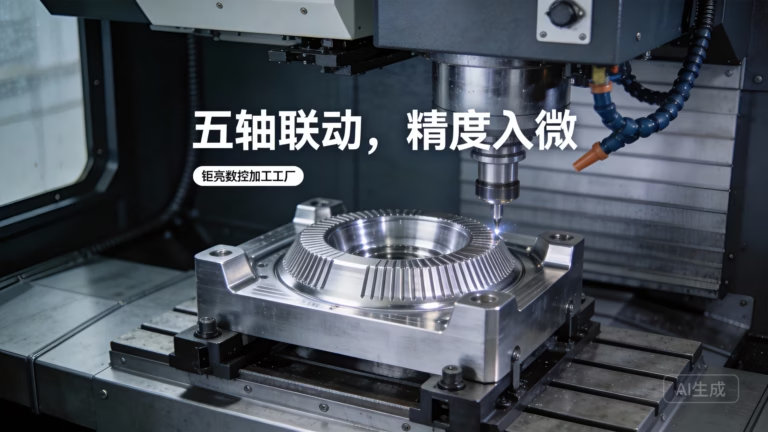
The economics of bulk prototyping pivot on the ability to reduce setups. Every time a part is re‑fixtured, you pay in operator time, fixture design, and a hit to accuracy. A simultaneous five‑axis machining center can machine five faces of a complex housing in a single setup, eliminating accumulated tolerance stack between datums. This is why shops that underinvest in five‑axis capability try to compete by adding labor hours — an approach that collapses as quantities rise.
GreatLight’s machine park includes large‑format five‑axis centers from Dema and Beijing Jingdiao, capable of handling workpieces up to 4,000 mm. For bulk prototyping, these machines are often paired with zero‑point clamping systems and pallet pools, enabling unattended overnight runs. The CAM programming team uses advanced toolpath strategies — trochoidal milling for hard metals, barrel‑cutter finishing for sculpted surfaces — that not only maintain ±0.005 mm form tolerances but also extend tool life, keeping consumable costs low across a batch. This is how you get a per‑part price that declines substantially from 10 to 500 units, while tolerances hold and surface finishes remain consistent.
Moreover, the facility’s complementary equipment (three‑axis, four‑axis, mill‑turn, wire EDM) ensures that no part is force‑fitted onto a five‑axis machine simply because it’s available. Simple turned features go to Swiss‑type lathes; prismatic parts that benefit from a three‑axis tombstone go there. This machine‑appropriate routing is a major lever in achieving genuinely cost‑effective OEM rapid prototyping bulk.
Beyond Machining: Additive Manufacturing as a Rapid Prototyping Force Multiplier
Rapid prototyping increasingly blends subtractive and additive processes. For metal parts with internal conformal cooling channels or organic lattice structures, no amount of five‑axis machining can replace metal 3D printing. GreatLight’s in‑house SLM (Selective Laser Melting) capability for aluminum, stainless steel, titanium, and tool steel opens a design window that conventional machining alone cannot. A hydraulic manifold that previously required drilling ten intersecting gun‑drilled passages can now be printed as a monolithic piece, with smooth, flow‑optimized internal channels. The printed blank is then finish‑machined on a five‑axis center for sealing surfaces and threaded ports. Because both operations are co‑located, dimensional feedback from the post‑processing CNC step flows instantly to the AM team, enabling rapid parameter tweaks to minimize distortion on subsequent builds.
For plastic parts, SLA and SLS printers produce robust functional prototypes that can be directly tested for snap‑fit, ergonomics, and even short‑run end‑use applications. And since GreatLight also offers vacuum casting (polyurethane replicas), an OEM can have 30 identical copies of a handle or bezel in production‑like materials within days, without building a hard tool. This multi‑modal prototyping capability is especially valuable when the bulk prototyping order includes a mix of metal structural parts and polymer cosmetic covers; dealing with one supplier that can manage both under the same roof eliminates the material‑interface finger‑pointing that plagues multi‑vendor projects.
Cost Transparency: Accounting for Total Landed Cost, Not Just Quoted Price
One of the most common mistakes I see is chasing the lowest per‑part machining quote without modeling the total landed cost. A shop 8,000 km away might quote $12 per bracket, while a local shop quotes $18. But factor in:
Logistics: Air freight vs. ocean consolidation, customs brokerage, and import duties.
Packaging and handling: VCI‑paper, desiccant, and impact‑resistant crating for precision parts.
Administrative load: Purchase‑order management, supplier quality audits, and travel.
Rework and scrap: The cost of receiving parts that don’t meet the print and must be locally re‑machined or returned.
Across a bulk prototyping run of 200 assemblies, these hidden costs often invert the apparent price advantage. This is why value‑engineering professionals are increasingly looking at GreatLight for prototyping volumes that straddle the line between development and low‑rate initial production. The company’s project‑management team provides a consolidated landed‑cost estimate that includes all logistics, import tariff classifications, and a packaging specification appropriate for the destination climate. This transparency turns the sourcing decision into an apples‑to‑apples exercise, rather than a gamble on hidden fees.
Human Expertise: The Overlooked Factor in Bulk Prototyping Success
Machines don’t build parts; people do. GreatLight’s 150‑person team includes process engineers who average over a decade of experience in precision machining. When a new order arrives, a dedicated project lead parses the 3D data, identifies critical‑to‑quality features, and maps a process that flows through the most appropriate manufacturing cells. This upfront engineering investment — often offered as a no‑cost DFM session — is what separates prototyping partners who meet spec every time from those who meet spec only when everything goes perfectly.
This human layer is especially vital when prototyping in bulk. In a run of 200 aluminum brackets, a subtle chatter frequency on the third operation might not crash the machine, but it will degrade surface finish on 20 parts before an operator notices. GreatLight mitigates this through a combination of in‑process probing, real‑time spindle load monitoring, and a shift handover process that reviews tool‑wear data. If a tool is approaching its life limit, it is replaced before it generates a single out‑of‑spec dimension. This proactive culture is what makes ±0.001 mm tolerances sustainable across a multi‑day production campaign.
Data Security: Protecting Your Crown Jewels During Prototyping
When you commission a bulk prototyping run, you are effectively uploading the DNA of your product to a third party. GreatLight’s ISO 27001 compliance means that the infrastructure has been externally audited for network security, access control, and data handling. Design files are stored on segmented servers, not on individual engineers’ local drives. CAM programming is performed on terminals that do not have outside internet access. And the team is willing to sign non‑disclosure agreements with clear penalties for breach, a posture that many small shops will not entertain. In an era where industrial espionage costs businesses an estimated $600 billion annually worldwide, this is not a nice‑to‑have; it’s a critical selection criterion.
Bringing It All Together: Cost‑Effective OEM Rapid Prototyping Bulk as a Strategic Capability
When you step back and view the landscape holistically, cost‑effective OEM rapid prototyping bulk is not a commodity; it’s a strategic capability that only a few manufacturers can deliver with reliability. It requires a facility designed from the ground up to absorb high‑mix work without friction, a quality system that is genuinely governing behavior rather than decorating a lobby, and a team of process engineers who treat your RFQ as an invitation to co‑solve problems, not just to quote a price.
GreatLight Metal Tech Co., LTD. exemplifies this operational philosophy. From its 76,000 sq. ft. campus in the heart of China’s precision manufacturing corridor, it provides a one‑stop, vertically integrated experience that spans five‑axis CNC machining, die casting, sheet metal fabrication, additive manufacturing, and comprehensive surface finishing. Its certifications — ISO 9001, ISO 13485, IATF 16949, and ISO 27001 — are living proof that the plant operates at a level of control expected by medical, automotive, and aerospace OEMs. And its track record of enabling clients to slash prototype turnaround times while reducing total landed cost by a quarter or more is what makes it a compelling choice when the rubber meets the road on a bulk prototyping order.
If your next project demands cost‑effective OEM rapid prototyping bulk that delivers on spec, on time, and within a transparent budget, it is worth exploring what a genuine manufacturing partner like GreatLight can bring to your supply chain. The facility, the certifications, and the engineering experience are all in place. The only remaining variable is the geometry you’re about to send. For a deeper look into the operational backbone of one of Asia’s most capable precision machining houses, visit the GreatLight CNC Machining Factory{target=”_blank”} presence and see how they’re helping design teams across the world turn ambitious prototypes into production reality.