
Cost Effective Bulk Metal Die Casting: 5 Checks Before You Commit
This guide is for engineers and procurement teams placing high-volume die casting orders. It covers the cost drivers that sit outside the per-kilogram metal price, and the questions that separate a supplier who can hold a cost effective bulk metal die casting program together from one who cannot.
In this article
- 1
- 2
- 3
- 4
- 5
- 6
- 7
What decides the real cost per part
Cost effective bulk metal die casting: what to compare, not just price
Use this as a screening sheet when you shortlist two or three casting suppliers.
| Check | Weak signal | Strong signal |
|---|---|---|
| Tooling life | No shot-count figure given | Documented 100,000+ shots on aluminum |
| Gating and cooling | "Standard die" | Gating, cooling and ejection designed per part |
| Casting to CNC | Castings shipped to a machine shop | Casting and multi-axis CNC on one site |
| Finishing | Outsourced, quote excludes it | Anodizing, plating, blasting in-house |
| Certification | ISO 9001 only | IATF 16949 or ISO 13485 when the part needs it |
| MOQ | Fixed 5,000-piece minimum | From one prototype to 10,000+ part runs |
| Quote basis | Part price only | Part price plus tooling, finishing and inspection |
Where cost effective bulk metal die casting actually saves money
The metal price per kilogram is the least interesting number in a die casting program. It moves with the market and every supplier quotes roughly the same figure on the same day. The differences that decide whether a program stays cost effective over three years sit in tooling, cycle time, scrap rate, and how many times the part changes hands before it ships.
Start with tooling amortization. If a die costs a fixed amount and runs 100,000 shots before it needs work, the tooling cost per part is that amount divided by 100,000. If the same die is designed with poor cooling and starts cracking at 40,000 shots, that per-part tooling figure more than doubles. Gating, cooling channel placement and ejection design are what buy that life, not the steel grade alone.
Next, look at shot weight. Every cycle injects metal into the part cavity plus runners, overflows and biscuit. That extra metal is remelted, which means it is paid for twice: once as purchased ingot, once as furnace energy. A die layout that trims runner mass by 15 percent cuts energy and melt loss on every shot for the life of the program. At 10,000+ part runs, that adds up quietly.
Finally, count the handoffs. Each time castings leave one vendor and arrive at another, you pay freight, a second setup, a second inspection, and you accept a second set of tolerances stacked on the first. Moving raw castings between a die caster and a machine shop is the single most common place where a cost effective bulk metal die casting quote turns out to be optimistic.
- 1Tooling lifeAsk for a shot-count estimate and the maintenance interval, in writing.
- 2Runner massRequest the ratio of part mass to total shot mass before approving the die layout.
- 3Handoff countEvery vendor in the chain adds freight, setup and inspection cost.
Casting and CNC under one roof for cost effective bulk metal die casting
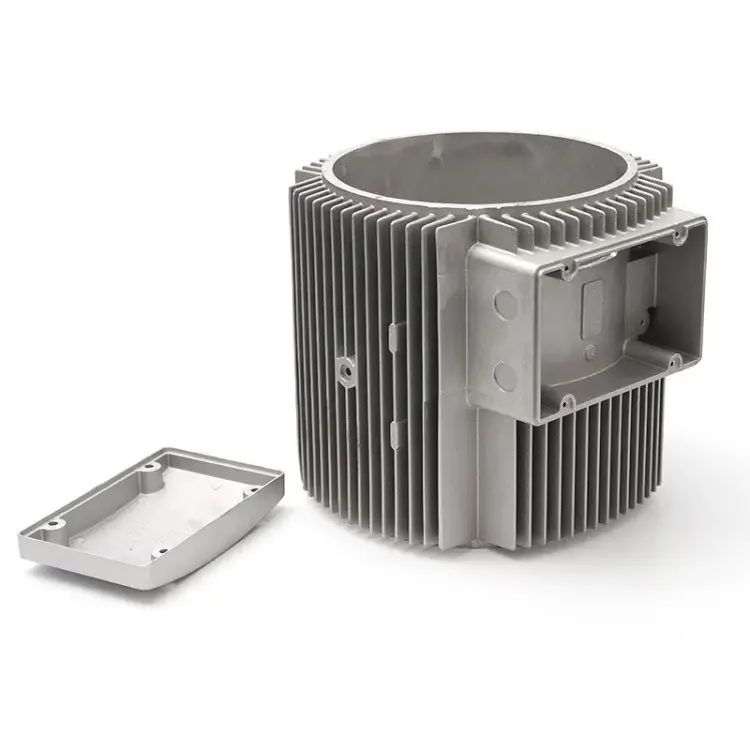
Die casting produces a near-net shape. It rarely produces a finished part. Datum faces, bearing bores, sealing surfaces and threaded features almost always need machining after the casting cools. The question is where that machining happens and who owns the tolerance stack.
When casting and CNC run on the same site under one quality system, the casting datums and the machining datums can be agreed in advance. The foundry knows which surfaces the machining fixture will clamp on, and the machining team knows how much stock the casting will leave. That conversation is difficult to have across two companies, and it is where a lot of tolerance drift starts.
GreatLight runs die casting alongside 127 high-precision CNC machines, including 16 simultaneous 5-axis machining centers, 12 four-axis mills, 27 three-axis machines and 16 mill-turn centers. Maximum processing size is 4,000 mm, so large housings and long profiles can be trimmed without a second supplier. Machining tolerances hold to ±0.005 mm (±0.0002 in) when the drawing calls for it.
The practical benefit is scheduling. A run of castings can move to CNC trimming, bead blasting and anodizing in the same plant, on one traveler, with one inspection record. That shortens the loop between a dimensional problem at machining and the die correction that fixes it.
- 1Shared datumsCasting and machining fixtures reference the same faces, agreed at DFM stage.
- 2Stock allowanceLeave enough material for cleanup at Ra 0.8–1.6 μm, not so much that cycle time grows.
- 3Single inspection recordOne quality system covers casting, machining and finishing.
Alloy choice and finishing options that change the cost curve
Aluminum alloys carry most bulk die casting volume. ADC12 is the common choice for thin walls, complex ribs and good castability. Where the part needs higher strength or better corrosion behavior after anodizing, 6061 and 6063 appear in the drawing more often, though they cast differently and the die design has to account for that.
Zinc alloys cast at lower temperatures, hold tighter as-cast tolerances and take plating well. Magnesium AZ91D cuts weight, which matters for handheld and portable products, but it needs more attention to handling and surface treatment. The right question is not which alloy is cheapest per kilogram. It is which alloy lets the wall sections, draft angles and tolerances you actually need pass without extra machining.
Finishing is where a quote often looks lower than it is. Ask whether the price includes anodizing, plating, powder coating, bead blasting or laser marking. GreatLight handles clear, color, hardcoat and conductive anodizing in-house, plus electroless nickel, zinc, silver and gold plating, powder coating, black oxide, tumbling, brushing and polishing. Laser marking holds a minimum character height of 1.5 mm.
When finishing stays in the same plant as casting and machining, the part does not travel between vendors with an unfinished surface exposed. Batch-to-batch color and texture stay consistent, and if a coating fails adhesion testing the root cause is inside one building.
- 1ADC12Good castability for thin walls and complex geometry in aluminum.
- 2Zinc alloysTighter as-cast tolerance, better plating, higher material cost per kilogram.
- 3Magnesium AZ91DWeight reduction, with more handling and finishing care needed.
Certification and inspection as cost controls
Certification is not a badge for the website. It tells you which quality system will govern your parts and how much of the inspection burden you can hand over. If your part goes into a vehicle, IATF 16949:2016 is the baseline. If it is a medical device component, ISO 13485:2016 applies. ISO 9001:2015 covers general industrial work, and ISO 27001:2022 governs how your drawings and models are handled.
Inspection practice matters more than the certificate on the wall. GreatLight checks raw material on arrival, monitors the process during the run, and inspects 100 percent of parts before shipment, with reports available on request. For a bulk program, that means a dimensional problem tends to surface inside the run rather than at your receiving dock.
The qualification rate on this equipment is 99.99 percent. That figure is only meaningful if the sampling plan behind it is real, so ask how first-article inspection is handled and how often the die is re-qualified after maintenance.
Cost effectiveness and quality are not opposing goals here. Scrap, rework, expedited freight and line stoppages are the expensive outcomes. A supplier who catches a drifting bore at hour three of a run is cheaper than one who ships it and argues about it later.
- 1IATF 16949:2016Automotive and EV programs with PPAP-style documentation needs.
- 2ISO 13485:2016Medical device components with traceability requirements.
- 3ISO 27001:2022Controls how customer CAD data and drawings are stored and shared.
How to run a cost effective bulk metal die casting program
Five steps, in order. Skipping step 1 or step 5 is where most programs lose money.
- 1Send the 3D model and drawing for DFM before quoting toolingAsk for wall thickness, draft angle and corner radius feedback. GreatLight returns quotation and a free DFM analysis within 12 hours. Fixing a 1.5 mm wall that should be 2.5 mm costs nothing at this stage and costs a die revision later.
- 2Agree the machining datums and stock allowance at the same timeMark which faces the CNC fixture will clamp and which surfaces need machining. Leave 0.3–0.8 mm stock on machined faces for aluminum, more if the surface must reach Ra 0.8 μm or finer.
- 3Approve the die layout, not just the die priceReview gating position, cooling channel routing, ejection pin placement and estimated runner mass. Ask for the expected shot count before maintenance and the re-qualification plan after it.
- 4Run a first article and hold the sampleInspect the first parts against the drawing, including as-cast dimensions and machined features. Keep the signed sample as the reference for the rest of the program.
- 5Set the finishing and inspection scope in the purchase orderName the finish, the color or coating thickness where it applies, and the inspection report you expect. An ambiguous finish line is the most common cause of a late invoice surprise.
Questions buyers ask before a bulk die casting order
What order quantity makes die casting cheaper than CNC from solid?
It depends on part geometry more than a fixed number. Die casting pays off when the shape is complex, wall sections are thin, and the annual volume is high enough to amortize tooling across the run.
For simple blocks and plates, machining from bar stock often stays competitive at low volumes. Send the model and we will tell you which route fits your volume instead of pushing one process.
Do you have a minimum order quantity for die casting?
No minimum order quantity. We run from one prototype to 10,000+ part runs.
Prototype quantities are usually machined or cast from a soft tool so you can test fit and function before committing to a production die.
How do you keep tolerances consistent across a long run?
Raw material is checked on arrival, the process is monitored during the run, and 100 percent of parts are inspected before shipment. Reports are available on request.
Die wear is tracked against the first-article sample. When a dimension starts to drift, the die is corrected before the drift reaches the tolerance limit.
Can you machine and finish the castings as well?
Yes. Casting, multi-axis CNC machining and surface finishing run under one roof, so the part does not travel between vendors.
Available finishes include anodizing, electroless nickel, zinc, silver and gold plating, powder coating, black oxide, bead blasting, tumbling, brushing, polishing and laser marking.
How do you handle confidentiality on customer drawings?
Uploads are secure and confidential, and our data handling is governed by ISO 27001:2022. An NDA is available on request.
We do not share customer models, drawings or part photos without written permission.
What information do you need to quote a bulk casting program?
Send the 3D model, a 2D drawing with tolerances and critical dimensions, the alloy or a performance requirement, the annual volume, and the finish you expect.
If you are still choosing an alloy, say what the part has to do and we will suggest one. Quotation and free DFM analysis come back within 12 hours.
Send your model and get a comparable number
We will tell you where the cost sits in your part, and which design changes would move it. No minimum order quantity, from one prototype to 10,000+ part runs.
12-hour quote and free DFM100% inspection before shipmentISO 9001, IATF 16949, ISO 13485, ISO 27001
More from the shop floor
We publish setup notes, tooling trials and inspection data from the factory floor.











