
Cost Effective Bulk 3 Axis CNC Machining Bulk
This guide is for engineers and sourcing managers placing repeat orders of prismatic parts. It covers which geometry suits 3-axis milling, which tolerances actually drive cost, and how to read two quotes side by side so the cheaper one is not hiding a second operation.
In this article
- 1
- 2
- 3
- 4
- 5
- 6
- 7
- 8
- 9
Key takeaways
Which parts belong on a 3-axis machine
Match the part to the process before you ask for a price.
| Part feature | 3-axis bulk | Move to 4 or 5 axis |
|---|---|---|
| Flat plate with holes | Ideal, one or two setups | Not needed |
| Shallow pocket, depth under 3× tool Ø | Ideal, standard end mills | Not needed |
| Deep cavity, depth over 5× tool Ø | Possible but slow, tool deflection risk | 4-axis or 5-axis with a shorter tool |
| Features on four side faces | Two or three setups, added labor | 4-axis with a rotary table, one setup |
| Undercuts and angled holes | Not reachable | 5-axis simultaneous |
| Curved 3D surfaces | Stepped finish, slow finishing passes | 5-axis ball-nose, better surface |
| Thin-wall housing | Chatter risk at high feed | 4-axis with support fixtures |
| Simple shaft with a cross hole | Mill then turn, two operations | Mill-turn center, one operation |
What makes 3 axis CNC machining bulk work
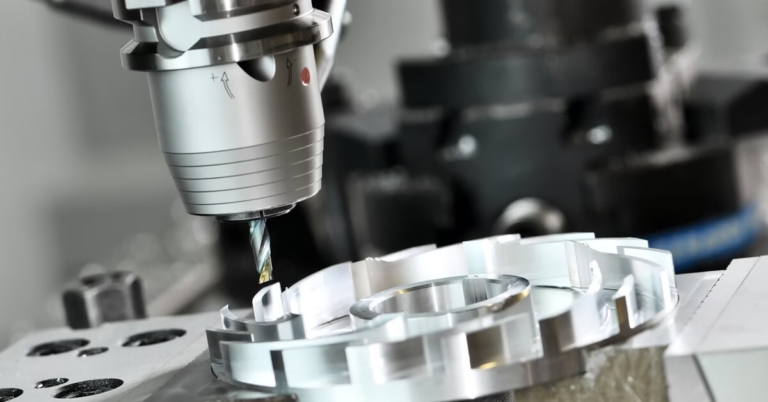
Three-axis milling moves the table in X, Y and Z while the spindle stays vertical. The cutter reaches the part from one direction. That single constraint is what keeps the process cheap: the fixture is simple, the program is short, and a machinist can prove out the first part in minutes rather than hours.
For bulk runs, the savings come from repetition. A vise or a vacuum plate holds the same blank in the same place for 5,000 cycles. Tool changes are predictable. If the part allows two, three or four blanks per cycle on a tombstone, the cycle time per part drops further without any new equipment.
This is also where 3 axis CNC machining bulk has a hard boundary. If a feature faces the back of the part and no fixture can reach it, you pay for a second setup. Every extra setup adds labor, adds a re-fixturing error, and adds queue time between operations.
Three setups on a 10,000-piece order is not a small detail. It can move the unit price by a wide margin compared with one setup, even on the same machine.
- 1Best fitPrismatic parts with orthogonal features and open tool access.
- 2Watch forFeatures on more than two faces, deep pockets, thin walls.
- 3Layout trickMultiple parts per cycle on a tombstone cuts cycle time per part.
Tolerance, finish and where the cost actually sits
Tolerance is not a single number for the whole drawing. It is a budget you spend feature by feature. On a 3-axis machine we hold ±0.005 mm (±0.0002 in) where the drawing calls for it, and we can hold it across a full production run because the setup never changes.
The mistake we see most often is a blanket tolerance block. If the title block says ±0.005 mm on every dimension, the shop has to plan for the worst case everywhere. Relax a clearance hole to ±0.1 mm and the price of that feature drops. Keep the tight callout on the bearing seat, the mating face and the dowel holes.
Surface finish follows the same logic. As-machined Ra 1.6–3.2 μm is standard for a milled face. Ra 0.8–1.6 μm needs a finishing pass or a smaller stepover. Ra 0.2–0.8 μm usually means a separate operation or a different process, and on a bulk order that cost repeats 10,000 times.
Ask one question before you release the drawing: does this feature need the tight callout, or did it inherit it from an older revision?
- 1Spend tolerance hereBearing bores, mating faces, dowel and pin holes, sealing surfaces.
- 2Relax it hereClearance holes, non-mating edges, cosmetic radii, weight-relief pockets.
- 3Finishing passAdds cycle time on every part. Specify it only where the function needs it.
Batch size and setup economics
A 3 axis CNC machining bulk order has three cost layers: fixed, semi-fixed and per-part. Fixed cost is programming, workholding design and first-article inspection. Semi-fixed is tooling and fixture wear. Per-part cost is cycle time, material and any finishing or inspection step.
Fixed cost does not care how many parts you order. That is why the first 100 pieces carry most of the setup burden and the 9,000th piece carries almost none. When you compare quotes at different quantities, compare the fixed portion separately, or the numbers will not line up.
Batch size also decides tooling. On a short run, a general-purpose carbide end mill is fine. On a long run, a tool built for the material and the cut geometry lasts longer between changes, and tool changes stop the spindle.
One practical note: splitting a 10,000-piece order into ten 1,000-piece lots usually costs more than one release, unless you are holding inventory to manage cash flow or a design change is still possible.
- 1FixedProgramming, fixture build, first-article inspection. Paid once.
- 2Semi-fixedTool wear, fixture maintenance. Scales slowly with volume.
- 3Per partCycle time, material, finishing, sampling inspection.
Material choice in a bulk 3-axis run
Material drives cutting speed, tool life and chip control. Aluminum 6061-T6 machines fast and holds tolerance well, which is why it dominates bulk brackets, plates and housings. 7075 is stronger but gummier and needs sharper tooling and more attention to chip evacuation.
Stainless 303 is the free-machining grade and behaves well in bulk. 304 and 316 work-harden if the cutter rubs instead of cuts, so feed per tooth must stay above a minimum. 17-4PH adds heat treatment and a dimensional shift, which means a finishing allowance in the program.
Steel grades such as 1018 and 1045 are straightforward on a 3-axis mill. 4140 and 4340 need lower surface speed and more rigid workholding. Titanium TC4 and Inconel take much longer per part, so a bulk order is a different conversation about cycle time rather than about setup.
Plastics are their own case. POM and ABS cut cleanly. PEEK and carbon fibre need sharp tooling and dust control, and carbon fibre wears cutters quickly, which shows up as a tooling line in the quote.
- 1Fast and stable6061-T6, 6082, 2024 aluminum; 303 stainless; 1018 and 1045 steel.
- 2Needs care304 and 316 stainless, 7075 aluminum, 4140 and 4340 steel.
- 3Slow but doableTC4 titanium, Inconel, PEEK, carbon fibre.
How to compare two bulk quotes
Two quotes for the same part can differ by a wide margin, and the lower number is not always the cheaper order. Ask for the quote broken into material, setup, cycle time, finishing, inspection and packaging. If a supplier will not break it down, you cannot tell whether they missed a step.
Check what is included. Is the first article measured and reported, or just eyeballed? Is deburring in the price? Are the parts bagged and labeled, or loose in a box? Each of those is a real cost, and a quote that omits them will surface them later as a change order.
Look at the inspection plan. A 10,000-piece order should not rely on the operator's caliper alone. Sampling with a CMM and a record of the results is the normal expectation, and it is how a dimensional drift gets caught at part 400 instead of part 9,000.
Finally, ask who owns the risk when a dimension drifts. A supplier with an in-process check and a documented reaction plan will tell you. One without it will not have an answer.
- 1Ask forLine-item breakdown, first-article report, sampling plan, packaging spec.
- 2Red flagOne lump-sum price with no cycle time and no inspection note.
- 3Red flagNo mention of what happens when a dimension drifts mid-run.
Design changes that cut cost before the first chip
A design for manufacturing review before release usually finds money. On one recent style of part, deepening a pocket so a larger, more rigid end mill could reach it removed a second tool and shortened the cycle. The change cost nothing at the CAD stage.
Corner radii are another easy win. A pocket corner must be at least the cutter radius. If the drawing calls for a sharp internal corner, the shop either uses a much smaller tool, which is slow and fragile, or adds an EDM step. Relax the radius to a standard cutter size and both problems disappear.
Thread depth and hole depth matter too. A tapped hole needs clearance at the bottom for the tap. A blind hole drilled to a depth that leaves no room for chips will break tools. Adding a small allowance in the model is free.
These changes are cheapest at the drawing stage and most expensive after the fixture is built. Send the model for review before the purchase order, not after.
- 1Pocket depthGive the tool a rigid length-to-diameter ratio where the function allows.
- 2Corner radiusMatch it to a standard cutter radius instead of calling a sharp corner.
- 3Blind holesAdd chip clearance at the bottom of drilled and tapped holes.
Seven steps to source 3 axis CNC machining bulk
Run these in order. Steps 1 to 3 happen before you send an RFQ.
- 11. Split the drawing by featureMark each dimension as critical, functional or cosmetic. Critical features get the tight tolerance, cosmetic ones get the standard block. This single pass changes the price more than any negotiation.
- 22. Count the setupsList every face that carries a feature. One or two faces means one or two setups. Three or more usually means the part belongs on a 4-axis machine, and it is worth pricing both ways.
- 33. Fix the batch quantityDecide the release quantity and whether it will repeat. Ask for pricing at that quantity and at one step above, so you can see how the fixed cost spreads.
- 44. Request the DFM review firstSend the 3D model and the 2D drawing. Ask for a written note on tool access, corner radii and any feature that needs a second operation. Use the review to revise the model before quoting.
- 55. Ask for a line-item quoteRequire material, setup, cycle time, finishing, inspection and packaging as separate lines. Compare suppliers line by line, not on the total alone.
- 66. Confirm the inspection planAgree on first-article inspection, in-process sampling frequency and the record you will receive. For regulated products, confirm the certificate that applies.
- 77. Agree on the change ruleWrite down what happens if a dimension drifts, who pays for rework, and how a drawing revision is handled mid-run. Then release the order.
Questions buyers ask before a bulk order
Is 3-axis always cheaper than 5-axis for high volume?
For prismatic parts, yes. A 3-axis machine has simpler workholding, a shorter program and a faster setup, and those advantages repeat across the whole run.
The exception is a part with features on many faces or with curved surfaces. There, the extra setups and the slower finishing passes on a 3-axis machine cost more than the higher machine rate of a 5-axis center. Price both before you decide.
What quantity counts as a bulk order?
There is no fixed threshold. The economics shift when the fixed cost per part becomes small compared with the cycle time per part. On a simple bracket that can happen at a few hundred pieces.
On a complex housing with several setups it may take a few thousand. Ask the supplier to show the unit price at two quantities and you will see where the curve flattens.
Can I mix several part numbers in one order?
Yes, and it often helps. Parts that share a material and a fixture can run back to back, which spreads the setup.
The limit is fixture design. If each part number needs its own custom fixture, mixing them adds setup, not savings. Group parts by material, tolerance class and workholding.
How do I control quality across a long run?
Agree on three checkpoints: raw material verification, in-process sampling during the run, and a final inspection before shipment. Ask for the sampling frequency in writing.
A dimensional drift on a 10,000-piece order is expensive if it is found at the end. Sampling during the run catches it early, when the fix is a tool offset rather than a rework lot.
What documentation should come with the parts?
A material certificate, an inspection report on request, and a packing list that matches the part numbers and quantities. For regulated industries, the applicable quality certificate travels with the order.
If your product needs full traceability, say so at the quoting stage. It affects how the lot is tracked and labeled, and it is easier to set up before the run starts.
Does a lower unit price always mean a lower total cost?
No. A quote that leaves out deburring, first-article inspection or proper packaging will cost more once those steps appear as extras.
Compare the scope, not just the number. Two quotes are only comparable when they cover the same operations, the same inspection level and the same delivery format.
Send your drawing for a bulk price
Send the 3D model and the 2D drawing. You get a DFM review and a line-item quote within 12 hours, and production can start within 24 hours of approval. No minimum order quantity, from one prototype to 10,000+ part runs.
DFM in 12 hoursNo MOQ±0.005 mm100% inspection
More from the shop floor
We publish setup notes, tooling trials and inspection data from the factory floor.











