
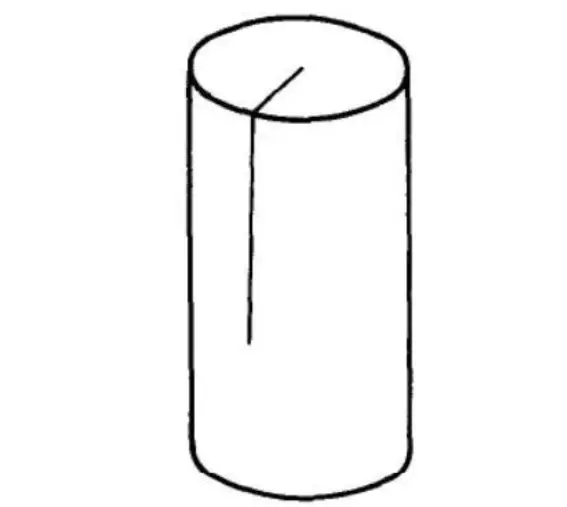
Today I will share with you common extinguishing cracks and preventive measures. I hope this will be helpful to everyone.
1. Longitudinal cracks
The cracks are axial, thin and long. When the mold is fully quenched, i.e. centerless quenching, the core transforms into quenched martensite with the largest specific volume, generating tangential tensile stress. The higher the carbon content of the mold steel, the higher the tangential tensile stress generated. tensile stress When the strength limit of steel is exceeded, longitudinal cracks form. The following factors intensify the appearance of longitudinal cracks:
(1) Steel contains many harmful impurities with low melting points, such as S, P, Bi, Pb, Sn, As, etc. When the steel ingot is rolled, it is severely separated longitudinally in the rolling direction, which easily causes stress concentration to form longitudinal quenching cracks, or raw materials. Longitudinal cracks formed by rapid cooling after rolling are not treated and remain in the product, causing the final quenching cracks to expand and form longitudinal cracks;
(2) The mold size is within the size range sensitive to quench cracking of steel (the dangerous size for quench cracking of carbon tool steel is 8-15mm, and the dangerous size of medium and low alloy steel is 25 to 40 mm) or the The selected quenching cooling medium significantly exceeds the critical size of the steel. Longitudinal cracks are easily formed when the quenching cooling rate is high.
Precautions:
(1) Strictly inspect raw materials upon entering the warehouse, and do not put steel products into production if the content of harmful impurities exceeds the standard;
(2) Try to use mold steel for vacuum melting, out-of-furnace refining or electroslag remelting;
(3) Improve the heat treatment process, using vacuum heating, protective atmosphere heating, fully deoxidized salt bath furnace heating, gradual quenching and isothermal quenching;
(4) Measures such as replacing non-centered quenching with intentional quenching, that is, incomplete quenching, to obtain a strong and strong lower bainitic structure, greatly reduce the tensile stress and can effectively avoid longitudinal mold cracking and quenching distortion.
2. Transverse cracks
The crack characteristics are perpendicular to the axial direction. In uncured molds, there is a significant tensile stress peak in the transition between the cured and uncured zone. When a large mold is rapidly cooled, a large tensile stress peak is easily formed because the axial stress formed is greater than the tangential stress. stress, resulting in lateral stress. Cross segregation of harmful impurities with low melting points such as S, P, Bi, Pb, Sn, As, etc. in the forged module or transverse microcracks in the module, which expand to form transverse cracks after quenching.
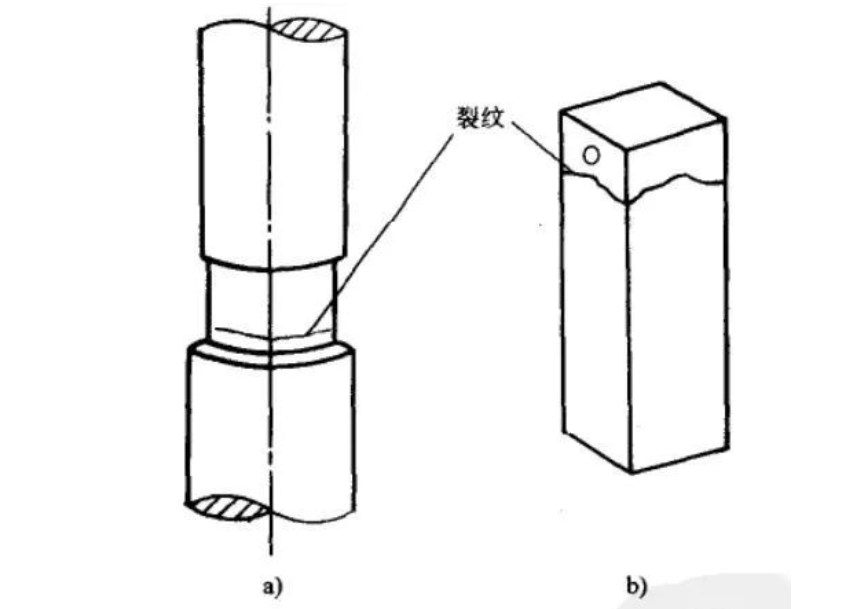
a) Transverse cracks b) Arc cracks;
Precautions:
(1) The module must be reasonably forged. The ratio between the length of the raw material and the diameter, that is, the forging ratio, is preferably between 2 and 3. The forging adopts cross shape-changing double-direction forging and is forged with five upsets. , five drawings and several shots to make carbides and carbide in steel. The impurities are fine and small, uniformly distributed in the steel matrix, and the structure of the forged fibers is distributed non-directionally around the cavity, which greatly improves the transverse mechanics. module properties and reduces and eliminates sources of stress;
(2) Select the ideal cooling rate and cooling medium: rapid cooling above the Ms point of steel, higher than the critical quenching cooling rate of steel, the stress generated by supercooled austenite in the steel is thermal stress, the surface layer is compressive stress, and the inner layer The tensile stresses cancel each other, effectively preventing the formation of thermal stress cracks, slowly cooling between Ms-Mf of the steel and significantly reducing organizational constraint during the formation of quenched martensite. When the sum of thermal stress and the corresponding stress in steel is positive (tensile stress), it is easy to quench and crack. When it is negative, it is not easy to quench and crack. Making full use of thermal stress, reducing phase change stress, and controlling the stress sum to be negative can effectively avoid the occurrence of transverse quenching cracks. CL-1 organic quenching medium is an ideal quenching agent, which can reduce and avoid distortion of the quenching mold and control the reasonable distribution of the cured layer. By adjusting the different concentration ratios of CL-1 quenching agent, different cooling rates can be obtained, and the required hardened layer distribution can be obtained to meet the needs of different mold steels.
3. Arc cracks
This often occurs with sudden changes in shape, such as die corners, notches, holes, and die wiring burrs. Indeed, the stress generated on the edges and corners during quenching is 10 times higher than the average stress on the smooth surface.
(1) The higher the content of carbon (C) and alloying elements in the steel, the lower the Ms point of the steel. If the Ms point decreases by 2 °C, the quench cracking tendency will increase by 1.2 times. The MS point decreases by 8°C, the tendency of quenching cracking will increase by 8 times;
(2) The transformation of different structures and the transformation of the same steel structure are not simultaneous. Due to the specific tolerance of different structures, enormous organizational stresses are caused, leading to the formation of arc-shaped cracks at the junction of the structures. structures;
(3) Tempering is not carried out in time after quenching, or the tempering is insufficient, or the austenite retained in the steel is not completely transformed and remains in the service state, promoting the redistribution of stresses, or the retained austenite develops a martensite phase when the mold. is in service. The deformation produces new internal stress, and when the overall stress is greater than the strength limit of the steel, arc-shaped cracks are formed;
(4) It contains the second type of hardened brittle steel. After quenching, it returned to high temperature and cooled slowly, causing harmful impurity compounds such as P and S present in steel to precipitate along the grain boundaries, thereby greatly reducing the grain boundaries. bonding strength, strength and toughness, and the increase in brittleness during service, arc-shaped cracks are formed under the action of external force.
Precautions:
(1) Improve the design, try to make the shape symmetrical, reduce shape mutations, add processing holes and reinforcement ribs, or use combined assembly;
(2) Rounded corners replace right angles and sharp edges, and through holes replace blind holes, which improves processing accuracy and surface finish, and reduces sources of stress concentration. Generally, hardness requirements are not high for places where right angles, sharp edges, blind holes, etc. are required. cannot be avoided. , can be wrapped or filled with iron wire, asbestos rope, refractory mud, etc., to artificially create a cooling barrier, so that it can be cooled and quenched slowly to avoid stress concentration and prevent . the formation of arc cracks during quenching;
(3) The quenched steel should be tempered in time to eliminate part of the internal quenching stress and prevent the quenching stress from expanding;
(4) Tempering for a longer period improves the toughness of the mold;
(5) Full quenching to achieve stable microstructure and properties; several quenches to completely transform the retained austenite and eliminate the new stresses;
(6) Reasonable quenching to improve the fatigue resistance and comprehensive mechanical properties of steel parts; For cast steels with second-type tempering brittleness, they should be rapidly cooled (water cooling or oil cooling) after high-temperature tempering to eliminate secondary tempering. income-type fragility. Prevent and avoid the formation of arc cracks during quenching.
4. Peeling cracks
When the mold is in use, under the action of stress, the hardened, quenched layer peels off piece by piece from the steel die. Since the specific volumes of the surface fabric and the core fabric of the mold are different, axial and tangential quenching stresses are formed on the surface during quenching, and tensile stress is generated in the radial direction, which suddenly transforms in peel cracks. occur in the narrow range of rapid stress changes, which often occur in the Sutra table During the layer chemical heat treatment mold cooling process, due to the synchronicity between the chemical modification of the surface layer and the phase transformation of the steel matrix, the expansion of the quenched martensite of the inner and outer layers does not occur at the same time. , resulting in significant phase transformation stress, causing the chemical treatment infiltration layer to detach from the matrix structure. Such as flame surface hardening layer, high frequency surface hardening layer, carburizing layer, carbonitriding layer, nitriding layer, boration layer, metallization layer, etc. It is not advisable to carry out rapid tempering after quenching the chemical permeable layer, particularly if low temperature tempering and rapid heating below 300°C will cause tensile stress to form in the surface layer and the formation of compressive stress at the core of the steel matrix and the transition layer, when the tensile stress is greater than the compressive stress, resulting in the chemically penetrated layer has been separated and taken off.
Precautions:
(1) The concentration and hardness of the chemically permeable layer of mold steel should be gradually reduced from the surface inward to improve the bonding strength between the permeable layer and the die. Diffusion treatment after permeability can transition the chemically permeable layer. uniform layer and matrix;
(2) Diffusion annealing, spheroidization annealing, and quenching and tempering are carried out before chemical treatment of the mold steel to completely refine the original structure, which can effectively prevent and avoid cracking peeling and guarantee product quality.
5. Network Cracks
The depth of cracks is shallow, generally about 0.01-1.5mm deep, radiating, also called cracks.
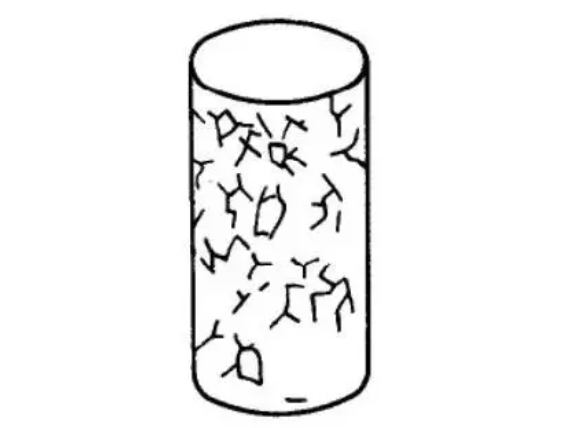
The main reasons are:
(1) The raw materials have a deep decarburization layer that is not removed by cold cutting, or the finished mold is heated in an oxidizing atmosphere furnace to cause oxidative decarburization;
(2) The metal structure of the decarburized surface layer of the mold has a different carbon content and specific volume than the martensite of the steel die. When the decarburized surface layer of the steel is quenched, a large tensile stress is generated. surface metal is often drawn into a network along grain boundaries;
(3) The raw material is coarse-grained steel, the original structure is coarse, and there are large pieces of ferrite, which cannot be removed by conventional quenching and remain in the quenched structure, or the Temperature control is inaccurate, the instrument fails, and the structure overheats or even burns too much. The grains are coarse and the grain boundary bonding strength is lost. When the mold is quenched and cooled, carbides from the steel precipitate along the austenite grain boundaries. reduced, toughness is poor and brittleness is high. Under the action of tensile stress, the steel carbides form a network along the grain boundaries.
Precautions:
(1) Strictly inspect the chemical composition, metallographic structure and flaw detection of unqualified raw materials and coarse-grain steel are not suitable as mold materials;
(2) Select fine grain steel and vacuum electric furnace steel, and recheck the depth of the decarburization layer of raw materials before putting into production. The cold cutting machining allowance must be greater than the depth of the decarburization layer;
(3) Develop advanced and reasonable heat treatment processes, use microcomputer temperature control instruments with a control accuracy of ±1.5°C, and regularly calibrate the instruments on site;
(4) For the final processing of molded products, electric vacuum furnaces, protective atmosphere furnaces and fully deoxidized salt bath furnaces are used to heat the molded products to effectively prevent and avoid the formation of cracks in the network.
Daguang focuses on providing solutions such as precision CNC machining services (3-axis, 4-axis, 5-axis machining), CNC milling, 3D printing and rapid prototyping services.



















