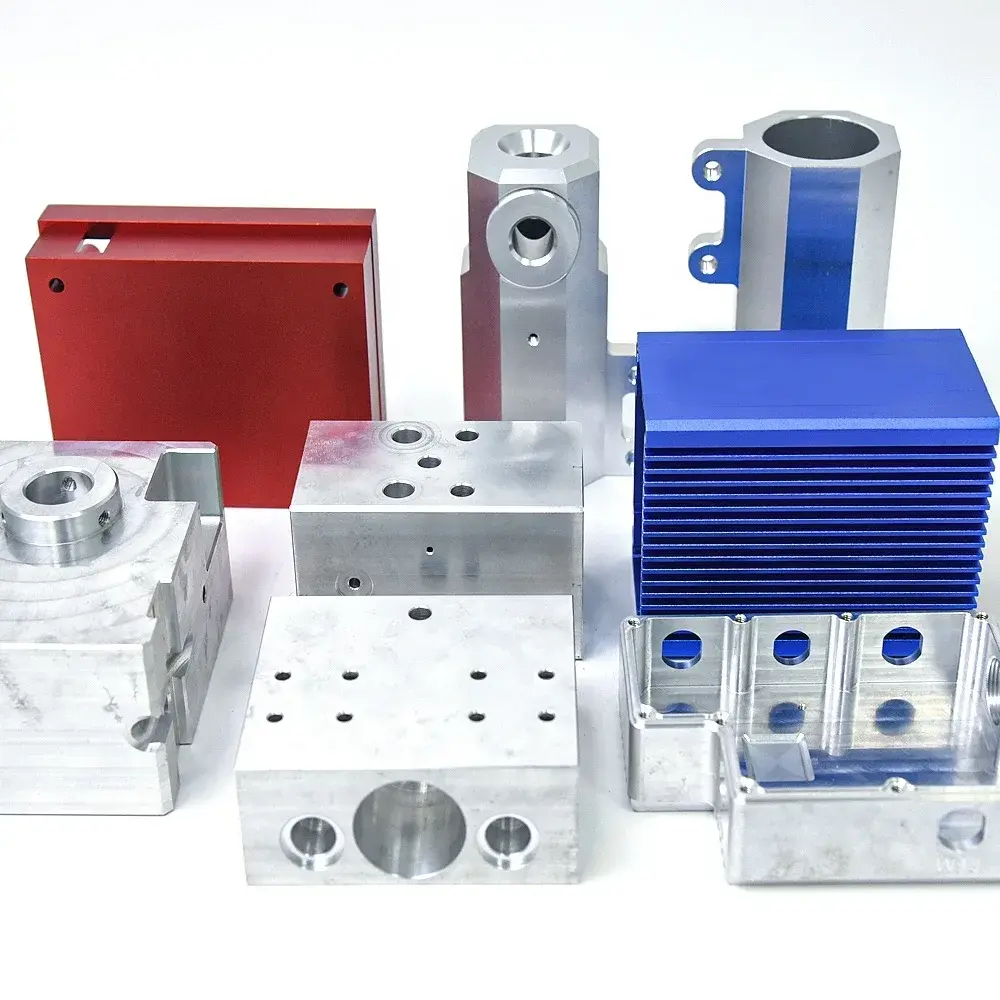
Deep hole processing is a difficult point in mechanical processing and is also a hot topic in current processing. At present, as the requirements for complex deep hole processing become more and more demanding, high precision and high efficiency are required. Therefore, it is crucial to master the processing performance and application range of different deep hole drills. This article mainly introduces the characteristics, scope of application and deep hole processing precautions of various deep hole drill bits.
What is a deep hole?
In mechanical manufacturing and processing, cylindrical holes whose depth exceeds 10 times the hole diameter are generally called deep holes. Deep holes are distinguished by the ratio of hole depth (L) to hole diameter (D) (L/D). They can generally be divided into three types: general deep holes, medium deep holes and special deep holes. (Ps: the larger the L/D ratio, the more difficult it is to treat.)
Deep holes are classified according to the L/D ratio:
(1) L/D=10~20, which is a general deep hole. It is often processed with a long twist drill bit on a drill press or lathe.
(2) L/D=20~30, which is a medium deep hole. Often treated on a lathe.
(3) L/D=30~100, which is a special deep hole. It should be machined using a deep hole drill on a deep hole drill or special equipment.
Features of deep hole processing
1. The tool holder is limited by the opening, with a small diameter and a large length, resulting in poor rigidity and low strength. It is prone to vibration, ripple and cone during cutting, which affects the straightness and roughness of the surface of deep holes.
2. When drilling and reaming holes, it is difficult for the cooling lubricant to enter the cutting area without using special devices, which reduces the durability of the tool and makes the removal of difficult chips.
3. During deep hole processing, you cannot directly observe the cutting conditions of the tool. You can only judge based on your work experience by listening to the sound while cutting, looking at the chips, touching the vibration and temperature of the workpiece, and observing the instruments. (oil pressure gauge and electric meter). Is the cutting process normal?
4. It is difficult to remove chips. Reliable means should be used to break up chips and control chip length and shape to facilitate smooth removal and avoid chip clogging.
5. In order to ensure that deep holes run smoothly during processing and achieve the required processing quality, internal (or external) chip removal devices, tool guiding and supporting devices and High pressure cooling and lubricating devices should be added to the tool. .
6. The heat dissipation conditions of the tool are poor, and the cutting temperature increases, which reduces the durability of the tool.
Types and structures of deep hole drills
Deep hole drill bits are divided into two types according to chip removal methods: external chip removal and internal chip removal. External chip removal includes gun drills and solid alloy deep hole drills (which can be divided into two types: with cooling holes and without cooling holes). Internal chip removal is divided into three types: BTA deep hole drills, jet suction drills and DF system; deep hole drills. The types and usage range of deep hole drill bits are shown in the table below.
Characteristics and processing range of various drill bits for deep hole drilling
1. Pistol practice
Gun drills got their name because they were originally used mainly for processing gun barrels and barrels in the military industry. Gun drill bits are effective deep hole machining tools for a wide range of applications, from deep hole machining of mold steels, fiberglass, plastics such as Teflon, to high strength alloys such as P20 and Inconel. In processing deep holes with strict tolerance and surface roughness requirements, gun drilling can guarantee the dimensional accuracy, positional accuracy and straightness of the hole.

The working principle of the gun drilling system: the cutting fluid enters inside the drill pipe through the oil inlet on the tailstock, reaches the drill head for cooling and lubrication and evacuates chips from the V-shaped groove outside the drill bit. This system is mainly used for processing small diameter deep holes (hole diameter less than 20mm).

Application scope of gun drilling: gun drilling (deep hole drilling by external chip removal) is mainly used to process holes with a depth of φ2 ~ 20mm, aspect ratio L/ D>100, with accuracy IT8~IT10 and surface roughness value Ra=12.5~3.2μm hole, production efficiency is lower than drilling deep holes with elimination of internal chips.
2. Deep hole drill for internal chip removal BTA
Since the gun drill rod is asymmetrical, it has low torsional rigidity and can only transmit limited torque. Therefore, gun drilling is only suitable for processing parts with small diameter holes. In order to adapt to more complex large diameter deep hole processing requirements, deep hole drilling technology with internal chip removal has emerged. In internal chip removal, since the chips are discharged from the drill pipe and do not scrape or contact the machined surface, the surface treatment quality is higher than that of auger drilling. gun and the processing hole diameter range is also larger.
The BTA system drill bit and drill rod are hollow cylinders. The principle of operation is shown in the figure below. The cutting fluid enters the oil distributor through the inlet after being pressurized, and then flows through the sealed annular space formed by the drill bit. the shank and the hole wall towards the cutting part for cooling, and press the chips into the chip outlet on the drill bit, then discharge them from the outlet through the inner cavity of the drill pipe.

Deep hole drilling for internal chip removal is suitable for processing deep holes with a diameter of 20mm or more and an aspect ratio of not more than 100. The processing accuracy is IT7~IT10, the roughness of the treated surface is Ra3.2 ~ 1.6. μm, and the production efficiency is external chip removal more than 3 times.
The main disadvantage of deep drilling by internal chip removal BTA: special machine tool equipment must be used, and the machine tool must also be equipped with an oil chip separation device to separate and recycle the fluid cutting by gravity sedimentation or electromagnetic separation. In addition, during the cutting process, a high pressure zone is formed between the workpiece and the oil distributor, so a reliable seal must be formed between the workpiece and the oil distributor before drilling.
3. Jet suction drill
The deep hole drilling system with internal chip removal has the disadvantage of significant loss in the annular oil channel. It requires higher pressure and flow during processing. For this reason, drilling technology with high production efficiency and better processing quality has been developed. walk. ——Jet suction drill.
The jet suction drill uses the principle of jet suction effect of fluid mechanics to invent a double-tube deep hole drilling method for chip removal. It uses two concentric drill rods to connect the tool to the machine tool via a connector. adopts double-layer tube cutting rod, the cutting fluid enters through the inlet after being pressurized, and 2/3 of the cutting fluid enters the annular space between the inner and outer drill rods, flows to the cutting part for cooling and lubrication, and pushes the chips into the internal cavity of the drill pipe.

The remaining one-third of the cutting fluid is sprayed into the internal drill pipe at high speed from the crescent-shaped nozzle on the internal drill pipe, forming a low pressure zone in the internal cavity of the internal drill pipe , which produces a suction effect on the cutting fluid carrying the chips. It has a dual function of spraying and suction, which encourages the chips to be quickly discharged from the outlet.
The oil supply to the jet-suction drill is via the rotary connector. The guide seat mainly serves as a support and does not need to be close to the workpiece. This is a great advantage for five-axis machining. As we generally encounter non-flat surfaces during five-axis machining, the guide seat cannot be close to the workpiece. In addition, the jet suction drill will produce a vacuum effect during processing, which will remove chips and be more flexible to use.
Jet suction drilling is mainly suitable for processing holes with an aspect ratio of not more than 100 and a diameter ranging from 18 to 65mm, with an accuracy of IT9 to IT11.
4.DF system deep hole drilling
DF system deep hole drilling is also called single-pipe jet drilling. DF is the abbreviation of Double Feeder in English, and its original meaning is double oil inlet device. The DF system deep hole drill bit is a hole processing tool first developed by Nippon Metallurgical Co., Ltd. in the mid-1970s. It is developed on the basis of ordinary jet drilling. This is a processing system that combines the BTA ordinary internal chip removal deep hole drill to expel chips and the jet drill to vacuum chips. Since a drill pipe is supported by cutting fluid, the vibration is reduced, the chip removal space is large, the processing efficiency is high and the precision is good, and it can be used for high precision deep hole processing; 3 to 6 times that of gun drilling, and better than that of BTA internal drilling. Chip drills are 3 times more expensive, but the cost of use is higher.

It can be seen from the relevant configurations required by the above different drill bits that no matter what chip removal method is, it is composed of workpieces, cutting tools, special auxiliary tools, machine tools, control systems and other elements. Among them, special auxiliary tools depend on the cutting fluid supply method, chip removal method and relative movement method between workpiece and tool. It can be seen that deep hole processing requires special equipment and special auxiliary tools, so the equipment structure is complex and expensive.
Precautions when processing deep holes
1. Key points of deep hole processing operations
The coaxiality of the center lines of the spindle and the tool guide sleeve, the toolbar support sleeve, the workpiece support sleeve, etc. must meet the requirements; the cutting fluid system should be smooth and normal; there should be no central hole on the machined end; face of the workpiece and avoid drilling on the inclined surface. The shape of the chips should be kept normal to avoid the generation of straight strip-shaped chips; use a higher speed to process holes when the bit is about to drill. , the speed should be reduced or stopped to avoid damage to the drill bit.
2. Key points to note when using cutting fluid for deep hole machining
A large amount of cutting heat will be generated when machining deep holes, which is not easy to diffuse. Sufficient cutting fluid should be supplied to lubricate and cool the tool. Typically, a 1:100 emulsion or extreme pressure emulsion is used; When higher machining precision and surface quality or tough materials are required, extreme pressure emulsion or high concentration extreme pressure emulsion is generally used. The kinematic viscosity of cutting oil is generally (40). ℃)10~20cm2/s, cutting fluid flow rate is 15~18m/s; when processing small diameters, use low viscosity cutting oil; For processing deep holes that require high precision, the cutting oil ratio can be 40% extreme pressure vulcanized oil + 40% kerosene + 20% chlorinated paraffin.
The pressure and flow rate of cutting fluid are closely related to the hole diameter and processing method. The specific reference is shown in the table below.

3. Precautions when using deep drill bits
1) The end face of the part is perpendicular to the axis of the part to ensure reliable sealing of the end face.
2) Before formal processing, pre-drill a shallow hole in the hole position of the workpiece, which can serve as a guide and centering function when drilling.
3) To ensure tool life, it is best to use automatic tool feeding.
4) If the guide elements in the liquid inlet and the movable center support are worn, they should be replaced in time to avoid affecting the drilling accuracy.
To summarize
Deep hole processing occupies a very important position in the field of mechanical processing, accounting for about 40% of the hole processing volume. The continuous emergence of new high-hardness and high-value deep-hole parts that are difficult to machine has led to continuous improvement in the processing depth, processing precision and processing efficiency requirements of processed parts. as a key process and treatment difficulty. it is only by mastering the concept of deep holes, deep holes. Only by understanding the characteristics and difficulties of processing and having a thorough understanding of the types, structures and use ranges of different deep hole drills can we better improve the efficiency of deep holes. treatment.
Daguang focuses on providing solutions such as precision CNC machining services (3-axis, 4-axis, 5-axis machining), CNC milling, 3D printing and rapid prototyping services.