
CNC Machine Production Services: How to Choose a Supplier
This guide is for engineers and procurement teams comparing CNC machine production services for parts that must repeat, not just run once. You will see which tolerances, lead times, quantities, and certifications actually matter, and which claims to test before you release a purchase order.
In this article
- 1
- 2
- 3
- 4
- 5
- 6
- 7
Key takeaways
What to check before you award a CNC production order
Use this as a scoring sheet when you compare two or three shops.
| Check | What good looks like | Red flag |
|---|---|---|
| Achievable tolerance | ±0.005 mm on listed features, with the machine named | ±0.01 mm quoted for every feature |
| Quote turnaround | Price plus DFM notes within 12 hours | Price only, no manufacturability comments |
| First production start | Tooling and programming begin within 24 hours | Vague start date after deposit |
| Order quantity | One prototype to 10,000+ part runs, no MOQ | Minimum charge that forces phantom volume |
| Process match | 5-axis for complex angles, mill-turn for round parts | One process offered for every geometry |
| Certification fit | ISO 9001, plus IATF 16949 or ISO 13485 as needed | Certificates not tied to your industry |
| Inspection scope | 100% inspection before shipment, reports on request | Sampling only, report as an extra |
| Confidentiality | NDA available, secure uploads | CAD files sent over plain email |
The deciding question
Choose the supplier that names the machine, the tolerance, and the inspection step in writing. Everything else is a promise.
Match the machine to the part, not the part to the machine
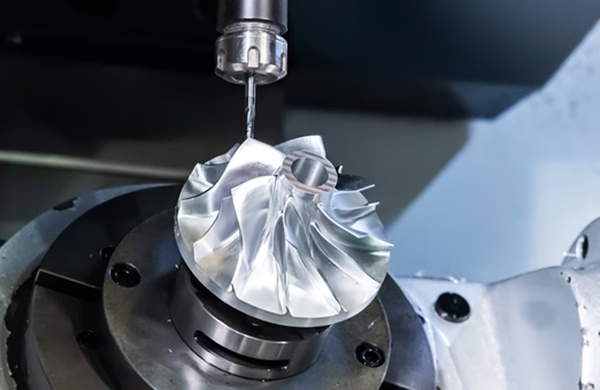
Most production problems start at the quotation stage, when a shop accepts work that does not fit its equipment. A part with compound angles, deep pockets on five faces, or a tolerance stack across two datums belongs on a simultaneous 5-axis center. A shaft with a cross-hole and a turned face belongs on a mill-turn center. If the quote does not tell you which machine will run the job, ask. The answer predicts whether the second batch will match the first.
Volume changes the decision. At one to fifty parts, setups and fixtures dominate the cost. At several thousand parts, cycle time and tool life dominate. A supplier with 16 simultaneous 5-axis centers, 12 four-axis mills, 27 three-axis machines, and 16 mill-turn centers can move a job between platforms as volume grows, instead of forcing a re-quote every time the forecast changes.
Size sets a hard boundary. Work up to 4,000 mm can be handled on large travels, while 750 × 1,150 × 550 mm and 600 × 600 × 600 mm cover most enclosure and manifold work. Compact travels of 500 × 500 × 450 mm and 500 × 310 × 200 mm suit small precision parts. A Ø400 mm rotary table adds fourth-axis positioning for features that would otherwise need a second setup.
- 15-axisComplex angles, five-face access, fewer fixtures, tighter position control.
- 2Mill-turnRound parts with milled flats, slots, and cross-holes in one cycle.
- 33-axisPrismatic parts with features reachable from one or two sides.
Material choice drives finish, tooling, and cost
Aluminium alloys such as 6061, 7075, and 6082 cut fast and hold tight tolerances, which makes them the default for prototype and production runs where weight matters. Stainless grades like 303, 304, 316L, and 17-4PH hold up in corrosive or medical environments but work-harden, so feeds and speeds need to be right from the first pass. Steel grades including 1018, 1045, 4140, and 4340 take higher loads and can be heat treated after machining.
Titanium and nickel alloys are a different conversation. Ti-6Al-4V and Inconel cut slowly, wear tools quickly, and usually need more stock left for finishing. If a supplier quotes titanium at aluminium cycle times, the quote is optimistic. Magnesium AZ31B and AZ91D machine quickly but need chip control and fire-safe handling.
Finish requirements should be settled before the quote, not after. As-machined surfaces run Ra 1.6–3.2 μm, high-finish work sits at Ra 0.8–1.6 μm, and fine finishes reach Ra 0.2–0.8 μm. Anodizing, plating, powder coating, bead blasting, and laser marking each add handling and can shift dimensions slightly, so specify them up front.
- 1Aluminium6061-T6, 7075, 2024, 5052, 6082, ADC12.
- 2Stainless303, 304, 316L, 17-4PH, 440C.
- 3Steel1018, 1045, 4140, 4340, A36, tool steel.
- 4Titanium and specialTA1, TA2, TC4, Inconel, magnesium.
Read the certification list against your industry
Certifications are not a score. They are a match test. ISO 9001:2015 covers a general quality management system and is the baseline for any supplier. IATF 16949:2016 is written for automotive supply chains and matters when your part ends up in a vehicle or EV program. ISO 13485:2016 applies to medical devices, where traceability and process validation carry more weight. ISO 27001:2022 covers information security, which is what protects your CAD data and drawings.
Inspection depth is the practical side of the same question. A shop that inspects 100% of parts before shipment, checks incoming raw material, monitors in-process dimensions, and performs a final inspection is doing what a production order needs. Dimensional reports should be available on request. If a supplier treats reports as a paid extra, budget for them or look elsewhere.
A qualification rate of 99.99% is a claim you can test with a first article inspection. Ask for the report on the first batch and compare the measured values against the drawing. That single document tells you more about the process than any brochure.
Lead time, quantity, and what the quote should contain
A useful quote arrives fast and says something about the part. Quotation and free DFM analysis within 12 hours is a workable benchmark. Production can start within 24 hours once the order is released, and parts ship in 3–5 days for standard work. Historical late-delivery probability below 2% is the kind of number worth asking a supplier to stand behind in writing.
Order quantity should not be a barrier. No minimum order quantity means one prototype and a 10,000+ part run are both on the table. That matters when your forecast is uncertain or when a design change is likely after the first article. A shop that can flex between volumes without re-tooling from scratch saves weeks.
Confidentiality belongs in the commercial section, not a footnote. NDA available on request, secure uploads, and ISO 27001:2022 controls are the minimum for parts that carry your IP. If drawings go over plain email with no agreement, the price is irrelevant.
- 1Quote contentPrice, lead time, machine assignment, DFM notes, inspection scope.
- 2Payment and releaseAgree on what triggers production start and what counts as acceptance.
- 3Change controlDecide how a drawing revision is priced before the first order.
Step by step: vetting a supplier for production work
Run these in order. Each step produces a document you can compare across suppliers.
- 1Send the drawing package with tolerances markedHighlight only the features that are critical. If everything is ±0.005 mm, the quote will be inflated or ignored.
- 2Request a quote plus DFM commentsExpect a response within 12 hours. Check whether they flagged thin walls, deep pockets, or datum conflicts.
- 3Ask which machine will run the job5-axis for compound angles, mill-turn for round parts with cross features, 3-axis for simple prismatic work.
- 4Confirm the inspection plan100% inspection before shipment, in-process monitoring, and a first article report on request.
- 5Check certification fitISO 9001:2015 as baseline; add IATF 16949:2016 or ISO 13485:2016 if your industry requires it.
- 6Place a small first orderOrder one to five parts. Measure them yourself and compare against the drawing before releasing volume.
- 7Scale with a fixed processKeep the same fixtures and programs. Moving to a cheaper process mid-program is how dimensions drift.
Questions buyers ask before releasing an order
What tolerance can CNC machine production services actually hold?
On the right machine and material, ±0.005 mm (±0.0002 in) is achievable on specified features.
It is not a blanket number for the whole drawing. Deep pockets, thin walls, and long unsupported sections move during cutting, so mark only the critical dimensions and let the rest run to general tolerance.
Do I need a minimum order quantity to start production?
No. Runs from a single prototype up to 10,000+ parts are normal when the supplier controls its own programming and fixtures.
Low-volume orders cost more per part because setup is spread over fewer units. That is a pricing effect, not a reason to refuse the order.
How fast can parts ship after I approve the quote?
Production can start within 24 hours of release, and standard parts ship in 3–5 days.
Complex 5-axis parts, titanium, or work that needs anodizing and laser marking will take longer. Ask for the schedule per operation, not one total number.
Which certifications matter for my industry?
ISO 9001:2015 for general manufacturing, IATF 16949:2016 for automotive and EV, ISO 13485:2016 for medical devices, and ISO 27001:2022 when your drawings and data need protection.
Match the certificate to the market your product ships into. An extra certificate that your industry does not recognize adds cost without adding value.
What should be in a production quote besides price?
Lead time, machine assignment, material certification, inspection scope, finish specification, and DFM notes.
If a quote is a single number, you cannot compare it against another supplier. Ask for the missing items before you decide.
How do I protect my design when I send CAD files?
Ask for an NDA and confirm how files are stored and who can access them. ISO 27001:2022 is the relevant control set.
Share only what the shop needs to quote. A simplified STEP file with critical dimensions marked is enough for pricing.
Send a drawing and get a production-ready quote
Upload your CAD files for a quote and free DFM analysis within 12 hours. NDA available on request.
12-hour quoteNo minimum order quantity100% inspection before shipmentNDA on request
More from the shop floor
We publish setup notes, tooling trials and inspection data from the factory floor.











