
Chinese CNC Machining Services Inc: 7 Checks Before You Buy
This guide is for product engineers and sourcing managers who are qualifying a Chinese CNC machining supplier for the first time, or replacing one that keeps missing dates. It covers the seven checks that actually predict whether a shop can hold your tolerance, protect your drawings and ship on schedule.
In this article
- 1
- 2
- 3
- 4
- 5
- 6
- 7
- 8
- 9
What matters most when you screen a supplier
Seven checks and what a real answer looks like
Use this as a scorecard. A supplier that answers four or more rows with vague language is a risk on your first order.
| Check | Weak answer | What to look for |
|---|---|---|
| Tolerance | We can do anything you need | A number: ±0.005 mm, with the machine and setup named |
| Machine list | Advanced imported equipment | Counts by axis: 5-axis, 4-axis, mill-turn, max size |
| Certifications | We are ISO certified | ISO 9001:2015, IATF 16949:2016, ISO 13485:2016, ISO 27001:2022 |
| Quote speed | We will reply soon | Quote and DFM notes within 12 hours |
| First article | Samples take a few weeks | Production start within 24 hours of PO |
| MOQ | We prefer larger orders | No minimum order quantity, prototype to 10,000+ parts |
| Drawing control | Your files are safe here | NDA on request, restricted file access, no third-party sharing |
Pick the supplier that answers with numbers
If a shop can name its machines, its tolerance, its certificate scope and its inspection gates, it can probably run your part. If it answers with adjectives, keep looking. Send one representative part and judge the DFM notes before you release volume.
Tolerance claims: why chinese cnc machining services inc quotes vary so much
Two suppliers can quote the same bracket and land 40 percent apart. The gap is usually not labor cost. It is the setup they plan to use. A part held in a 3-axis vise and flipped three times accumulates positional error at every flip, so a shop planning that route must quote a looser tolerance or add an extra operation to hit the tight one.
When a supplier says they hold ±0.005 mm, ask which machine and which setup. On a 5-axis center the part stays in one fixture while the tool reaches five faces, so the datum never moves. That is where the tight number comes from. On a 3-axis machine the same feature may need two fixtures and a re-indication step, which costs time and adds risk.
Surface finish follows the same logic. Ra 0.8–1.6 μm is a normal machined finish for aluminum and mild steel. Ra 0.2–0.8 μm needs a finer step-over, a sharper insert and often a separate finishing pass. If a quote lists a mirror finish at the same price as an as-machined surface (Ra 1.6–3.2 μm), the shop has not read your drawing.
The practical test is simple. Send one part with a tight bore, a thin wall and a true-position callout. Ask for the setup plan, not just the price. A shop that answers with fixture names has done this before.
- 1Tight tolerance needs 5-axisOne fixture, five faces, no re-datum between operations.
- 2Thin walls distortBelow 1 mm wall thickness, expect multiple light passes and stress relief.
- 3Finish is a separate costRa 0.2–0.8 μm is a finishing operation, not a default.
Machine capacity: what the equipment list tells you about your part
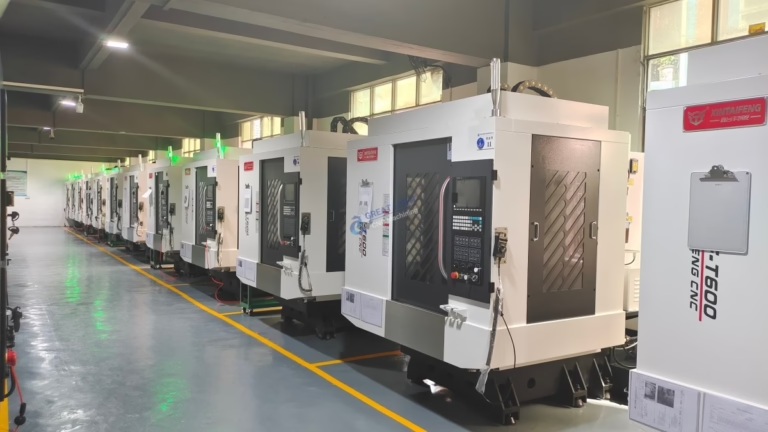
A supplier's machine list is a map of what they can and cannot take. GreatLight runs 127 high-precision CNC machines across three wholly-owned plants covering 7,600 m². That number alone is not useful. The split is. There are 16 simultaneous 5-axis machining centers, 12 four-axis mills, 27 three-axis machines and 16 mill-turn centers.
That mix matters for part routing. A housing with features on five sides goes to a 5-axis center. A shaft with a cross-hole and a thread goes to a mill-turn center, where turning and milling happen in one program and the concentricity callout is held without a second op. A simple plate can run on a 3-axis machine all day at a lower rate.
Size sets the ceiling. The largest travel is 4,000 × 400 × 150 mm, so long extruded profiles and rails fit. Medium travels of 750 × 1,150 × 550 mm and 600 × 600 × 600 mm cover most enclosures and manifolds. Compact travels of 500 × 500 × 450 mm and 500 × 310 × 200 mm handle small precision work. A Ø400 mm rotary table adds 4th-axis indexing for round parts with cross features.
If your part is bigger than the largest travel, the supplier will either decline or split it, and splitting introduces a joint you have to design for. Ask for the travel numbers before you send the model.
- 1Mill-turn for concentric partsTurning plus milling in one setup holds runout on shafts and fittings.
- 2Check the travel envelope4,000 mm max length; beyond that, expect a split or a decline.
- 3Rotary table for cross featuresØ400 mm table indexes holes and slots around a round part.
Certifications: read the scope, not the logo
Certificates are cheap to display and expensive to earn, so the question is never whether a supplier has one. It is whether the audit covers the building, the process and the shift that will run your parts. A quality system certified for one product family does not automatically cover a new machining cell added later.
For general industrial work, ISO 9001:2015 is the baseline. It tells you there is a documented process, a calibration schedule and a corrective-action loop. For automotive and EV parts, IATF 16949:2016 adds production-part approval, traceability and change control, which is what you need when a drawing revision must not silently reach the shop floor.
Medical work moves the bar again. ISO 13485:2016 covers design transfer, process validation and record retention, so a supplier holding it can support device builders through audits. ISO 27001:2022 is the one buyers overlook. It governs information security, which is what protects your CAD files, your quantities and your launch dates.
Ask for the certificate number and the scope statement. Then ask which plant is on it. If the answer is vague, treat the certification as marketing.
- 1ISO 9001:2015Baseline quality system for general industrial parts.
- 2IATF 16949:2016Automotive-grade change control and traceability.
- 3ISO 13485:2016Medical device process validation and records.
- 4ISO 27001:2022Information security around your drawings and data.
Lead time: separate the quote from the first article
Most schedule failures come from a buyer treating lead time as one number. It is at least two. The first is how long it takes to get a price and engineering feedback. The second is how long it takes to cut metal after you release the order. A shop can be fast at one and slow at the other.
A working benchmark: quotation and free DFM analysis within 12 hours, production start within 24 hours, and parts shipping in 3–5 days for standard prototypes. Historical late-delivery probability below 2 percent is the kind of figure worth asking about, because it implies the shop tracks its own on-time rate rather than guessing.
The trap is the free DFM report. If a supplier returns a price in a day but no manufacturability notes, you have a quote, not an engineering review. Look for comments on wall thickness, tool reach, tolerance stack and any feature that will need a second operation. Those notes are where your cost actually lives.
For repeat production, ask how the shop handles a rush order that lands between two scheduled jobs. Capacity is not just machine count. It is how the shop sequences work when everything is late.
- 1Quote stagePrice plus DFM notes within 12 hours.
- 2Kickoff stageProduction start within 24 hours of PO release.
- 3Delivery stagePrototype parts ship in 3–5 days.
MOQ, materials and finishing: the small-order reality
Minimum order quantity is where a supplier's business model shows. A shop tooled for high-volume production will quote a one-off at an absurd price to push you away. A shop set up for mixed production will take the one-off and the 10,000-part run on the same floor. No minimum order quantity is a real advantage when you are still validating a design.
Material availability decides whether your quote holds. Common grades are stocked: 6061-T6, 7075 and 2024 aluminum, 303 and 316L stainless, 17-4PH, 4140 and 4340 steel, plus C36000 brass and TC4 titanium. Exotic grades like Inconel or magnesium AZ31B are available but add sourcing time, so the price moves if you change alloy after quoting.
Finishing is the last place costs hide. Anodizing in clear, color, hardcoat or conductive form is standard. Electroless nickel, zinc, silver and gold plating, powder coating and black oxide are routine. Bead blasting, tumbling, brushing and polishing change the surface without changing dimensions, which matters on mating faces. Laser marking needs a minimum character height of 1.5 mm, so a tiny serial number may need to move to a different face.
Give the supplier the finish callout and the masking notes together. A masked anodize job priced as an unmasked one will come back with a change order.
- 1One prototype is fineNo minimum order quantity, from a single part to 10,000+.
- 2Common alloys are stocked6061-T6, 316L, 17-4PH, 4140, C36000, TC4.
- 3Masking drives finishing costSend the finish callout and mask plan in the same RFQ.
Inspection and documentation: what you should receive with the parts
A supplier that inspects every part and a supplier that says it inspects every part look identical on a website. The difference is the paperwork. Ask what arrives in the box: a dimensional report, a material certificate, a first-article report, a finish thickness reading. If the answer is a verbal assurance, you have no traceability when a field failure appears eight months later.
A sound process has three gates. Raw material is checked against the certificate before it reaches a machine. In-process monitoring catches drift while the part is still in the fixture, which is the only point where a correction is cheap. Final inspection confirms the drawing before shipment. Reports are available on request, and the 99.99 percent qualification rate is a claim you can test with your own first article.
For regulated industries, documentation is not optional. An aerospace bracket, a medical housing or an automotive sensor body each needs a paper trail that survives an audit. Ask for the report format before you order, so it matches what your quality team already uses.
One more item: calibration records for the measuring equipment. A CMM with an expired calibration sticker produces numbers nobody can defend.
- 1Three inspection gatesIncoming material, in-process monitoring, final check.
- 2Reports on requestRequest the format before ordering, not after.
- 3Calibration mattersAsk for the calibration interval on measuring tools.
How to qualify a supplier in six steps
Run this sequence on any new supplier before you release a production order.
- 1Send one representative partPick a part with your tightest tolerance and one awkward feature. Ask for a quote and DFM notes within 12 hours.
- 2Read the DFM notes firstLook for comments on wall thickness, tool reach and tolerance stack. No notes means no engineering review.
- 3Ask for the setup planWhich machine, how many fixtures, where the datum is picked up. This tells you if ±0.005 mm is realistic for your geometry.
- 4Request certificate scopeGet the number and the plant name for ISO 9001:2015, IATF 16949:2016, ISO 13485:2016 or ISO 27001:2022 as applicable.
- 5Order a small batchStart with the prototype quantity. No minimum order quantity lets you test the shop without committing to volume.
- 6Inspect the first shipment in-houseCheck the report against your own measurements. Discrepancies here are the cheapest problem you will ever find.
- 7Sign the NDA before sending production filesUploads stay confidential and an NDA is available on request. Do this before the second RFQ, not after.
Questions engineers ask before the first order
How close can a Chinese CNC machining supplier hold on a first order?
±0.005 mm is achievable on 5-axis centers when the part stays in one fixture and the shop controls temperature at finishing. On a 3-axis route with multiple flips, expect the stack to grow.
Send your tightest feature in the RFQ and ask for the setup plan. The answer tells you more than the tolerance line on the quote.
Is there a minimum order quantity for prototypes?
At GreatLight there is no minimum order quantity. A single prototype and a 10,000-part run both go through the same floor.
That matters when you are validating a design and do not want to commit to tooling or volume before the first article passes.
Which certifications should I ask for?
ISO 9001:2015 for general industrial work, IATF 16949:2016 for automotive and EV, ISO 13485:2016 for medical devices, and ISO 27001:2022 when data security matters.
Ask for the certificate number and which plant is covered. A certificate that does not name the building running your parts is not evidence.
How do I protect my drawings and design data?
Sign an NDA before the second RFQ. Uploads are kept secure and confidential, and the supplier should confirm who can open your files internally.
ISO 27001:2022 certification is a useful signal because it covers information security as a managed system, not a promise.
What surface finishes are available, and what do they cost in lead time?
Anodizing, plating, powder coating, black oxide, bead blasting, tumbling, brushing, polishing and laser marking are all standard.
Laser marking needs a minimum character height of 1.5 mm. Finishing is usually a separate operation, so add it to your schedule rather than assuming it runs in parallel.
How fast can production start after I place an order?
Quotation and DFM analysis come back within 12 hours, production can start within 24 hours, and prototype parts typically ship in 3–5 days.
Factors that push the date out: alloy changes after quoting, masking added late, and missing finish callouts. Lock those in the RFQ.
Send your drawing and get a quote with DFM notes
Upload a STEP file and we will return a price, a setup plan and manufacturability notes within 12 hours. No minimum order quantity, 100% inspection before shipment, and an NDA available on request.
Quote and DFM in 12 hoursNo minimum order quantity100% inspection before shipmentNDA available on request
More machining notes from the shop floor
We publish setup notes, tooling trials and inspection data from the factory floor.











