
Chinese Bulk CNC Milling and Turning Suppliers: How to Tell Them Apart
This guide is for engineers and sourcing managers who need to place a 5,000-piece run, not a one-off. It covers how suppliers differ in process control, what 5-axis and in-house finishing actually buy you at volume, and which checks predict quality before you send a PO.
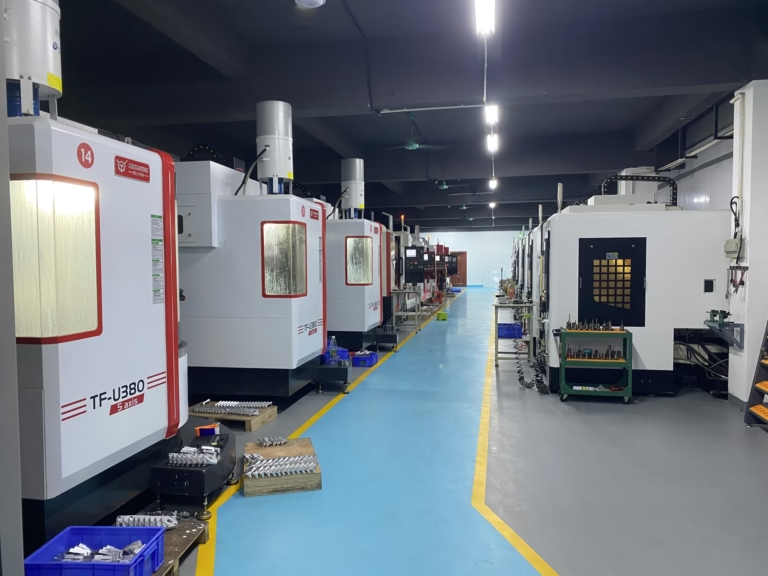
What Changes When Volume Goes Up
The core question is not who can cut a part cheaply. It is who can cut the 8,000th part the same way as the first.
Why Bulk Milling and Turning Is a Different Job
A single prototype hides almost every weakness in a machine shop. If the first part is in tolerance, it ships. In bulk production, the small variables that did not matter on part one start to accumulate. Tool wear moves the effective cutting edge. Spindle and ball screw heat expands the machine frame over a long shift. Clamping pressure deforms a thin wall differently once fixture wear sets in. Measurement drift creeps in when the same gauge is used for hours.
None of this shows up on a supplier's website gallery. It shows up in the process control they run: how often they change inserts, whether they re-zero after a thermal soak, whether they measure with a coordinate measuring machine or a caliper, and whether anyone records the result. A shop that holds ±0.01 mm on a one-off can drift past ±0.05 mm by part 500 without that discipline.
So when buyers compare Chinese bulk CNC milling quotes, the number on the first page is the least informative piece of data. The useful questions are about machines, inspection frequency, and who owns the process after the chips stop flying.
Three Practical Supplier Types, Not a Ranking
It helps to sort suppliers by what they can reliably repeat, not by country. The first type is the small job shop. It may run a handful of 3-axis verticals and a manual lathe. It is fine for brackets, spacers, and low-tolerance fixtures. It usually lacks a CMM, sends surface treatment out, and cannot tell you what its process capability index is.
The second type is the mid-tier factory with 20 to 60 machines, some 4-axis capability, and a quality system on paper. It can handle moderate complexity, but sub-contracts heat treat, anodizing, and sometimes turning. Every handoff adds a queue, a re-inspection, and a chance for the finish to be applied to a part that was already out of tolerance.
The third type is vertically integrated. It owns its own turning, milling, finishing, and inspection under one roof, holds automotive and medical certifications, and runs simultaneous 5-axis equipment. This is where bulk production becomes predictable. The gap between type one and type three is where most sourcing risk lives, and it is measured in rework, not in unit price.
Matching Part Type to Supplier Capability
Use this as a first filter when you are deciding how much supplier to buy.
| Part / Run Type | Minimum Capability Needed | Watch For |
|---|---|---|
| Flat bracket, ±0.1 mm, 500 pcs | 3-axis mill, manual deburr | No CMM; finish sourced out |
| Shaft with cross-holes, 2,000 pcs | Mill-turn or 4-axis | Re-chucking error; roundness drift |
| Impeller or medical housing | Simultaneous 5-axis | 3+2 posing sold as 5-axis |
| Thin-wall enclosure, Ra 0.8 μm | 5-axis plus in-house finishing | Clamp marks; anodize color shift |
| Mixed metals, 10,000+ pcs | Vertical integration + IATF | Sub-supplier handoff delays |
What 5-Axis Actually Buys You in Bulk
Five-axis milling is often sold as a way to cut complex geometry. In bulk production the bigger benefit is fewer setups. Every time a part moves from one fixture to another, you add a locating error and a queue. A part that would take four operations on 3-axis machines can often be finished in two on a simultaneous 5-axis center. That removes three chances for the datum to shift.
The second benefit is surface quality on contoured faces. When the tool stays normal to the surface through a continuous path, you avoid the witness lines and scallops that come from repositioning the part. On a visible housing, this can remove a polishing step that would otherwise be manual and inconsistent across a 3,000-piece run.
The third benefit is reach. Deep pockets, undercuts, and features on five faces of a part become accessible without long tool holders that chatter. For parts like impellers, turbine housings, and complex manifolds, 5-axis is not a luxury. It is the only way to hold the tolerance repeatably at volume.
- 1Setup reductionFewer fixtures means fewer datum shifts and shorter queue time between operations.
- 2Surface consistencyContinuous tool contact avoids scallops that require manual polishing.
- 3Geometry accessDeep cavities and undercuts cut with short, rigid tooling.
- 4RepeatabilityThe same program runs the same path on part 1 and part 8,000.
The Hidden Cost of Outsourced Post-Processing
Most quality escapes in bulk orders happen after machining. Anodizing thickness varies by rack position. Powder coat builds up in threaded holes. Heat treat moves a part that was already at the top of its tolerance band. When these steps are sub-contracted, the machining supplier loses visibility and the buyer absorbs the delay.
A vertically integrated shop controls the sequence. It knows which surfaces are datum features and masks them before finishing. It can re-measure after heat treat and, if the part moved, adjust the machining stock on the next batch rather than shipping a batch that is uniformly at the limit.
In-house finishing also shortens the loop. A part does not sit in a truck for two days between operations. For a 10,000-piece order, that saved transit time can matter more than a few percent on the unit price.
How to Vet a Bulk Supplier Before You Send Files
Ask for the machine list with axis count and travels. A supplier that cannot tell you the difference between 3+2 positioning and simultaneous 5-axis will not hold tolerance on a contoured part. Ask how many machines run lights-out or through a second shift, because capacity is what determines whether your order queues behind someone else's.
Ask how inspection is structured. A credible answer names the stages: incoming material check, first-article inspection, in-process checks at defined intervals, and final inspection before shipment. Ask whether reports are available on request and whether the CMM is climate controlled. A caliper-only shop is not a bulk supplier for tight tolerance work.
Ask about the certification that matches your industry. ISO 9001:2015 covers general quality management. IATF 16949:2016 is the automotive standard. ISO 13485:2016 applies to medical devices. ISO 27001:2022 covers information security, which matters if you are sending proprietary CAD. If a supplier claims a certification, ask for the certificate number and scope.
Finally, ask about confidentiality. A mutual NDA should be routine, not a negotiation. Uploads should be handled on a secured channel, and the supplier should be able to describe who inside the company can see your files. For defense, medical, and unreleased consumer products, this is a pass-or-fail question.
What We Run at GreatLight
GreatLight Metal Technology has been machining in Dongguan since 2011. We operate three wholly-owned plants covering 7,600 m², with 127 high-precision CNC machines. The fleet includes 16 simultaneous 5-axis machining centers, 12 four-axis mills, 27 three-axis machines, and 16 mill-turn centers. Maximum processing size is 4,000 mm, and we run a Ø400 mm rotary table for round and prismatic work.
We hold ±0.005 mm on qualifying features and routinely finish to Ra 0.8–1.6 μm. Our qualification rate is 99.99%, and every order receives 100% inspection before shipment. That includes raw material verification, in-process monitoring, and final inspection, with reports available on request. We machine aluminium, stainless, steel, copper and brass, titanium alloys including Ti-6Al-4V, Inconel, magnesium, and engineering plastics from ABS to PEEK and carbon fibre.
Finishing, anodizing, plating, powder coating, bead blasting, and laser marking are handled in-house. We work with no minimum order quantity, from one prototype to runs over 10,000 pieces. Quotation and free DFM analysis come back within 12 hours, and production can start within 24 hours. Parts typically ship in 3–5 days, and the historical late-delivery probability is below 2%.
Typical Tolerances and Finishes by Feature
These are the ranges we quote against, not a guarantee for every geometry.
| Feature | Tolerance | Surface Finish |
|---|---|---|
| Milled pocket, aluminium | ±0.01 mm | Ra 1.6–3.2 μm |
| Turned shaft, stainless | ±0.005 mm | Ra 0.8–1.6 μm |
| Bearing bore, steel | ±0.005 mm | Ra 0.2–0.8 μm |
| Contoured 5-axis face | ±0.01 mm | Ra 0.8–1.6 μm |
| Laser mark, min char height | 1.5 mm | As marked |
Questions Engineers Ask Before Ordering
What is the minimum order quantity for bulk milling and turning?
There is no minimum order quantity. We run from a single prototype to production runs over 10,000 pieces.
For very small quantities, unit cost is dominated by setup and fixturing. Once volume rises, the per-part cost falls as setup is amortized.
How do you keep tolerance stable across a long production run?
We control tool wear by tracking insert life per material and replacing on a schedule rather than on failure. Machines are allowed to reach thermal stability before tight-tolerance features are cut.
In-process checks run at defined intervals, not just at the start and end of the order. If a dimension trends, we adjust the offset before parts drift out of band.
Can you machine thin-wall parts without distortion?
Yes, but it requires the right sequence. We rough with extra stock, stress-relieve or let the part normalize, then finish in light passes with low clamping pressure.
For very thin walls, we may suggest a different material temper or a fixture that supports the wall from the inside. The DFM analysis flags this before quoting.
What certifications do you hold?
ISO 9001:2015, IATF 16949:2016, ISO 13485:2016, and ISO 27001:2022.
The IATF and ISO 13485 certifications cover automotive and medical device work respectively. ISO 27001 covers information security for customer data and CAD files.
How do you handle IP and confidentiality?
Uploads are handled on a secure channel, and we sign a mutual NDA on request. Access to customer files is limited to the engineers and programmers who need them for the job.
We do not share customer drawings, part photos, or project details without written permission.
How fast can you quote and ship a bulk order?
Quotation and free DFM analysis come back within 12 hours. Production can start within 24 hours of approval.
Parts typically ship in 3–5 days depending on quantity and finishing. For orders with anodizing or heat treat, add the finishing cycle time.
Send a Drawing, Get a Quoted Process Plan
Upload your CAD and we will return a quotation with DFM feedback within 12 hours. No minimum order quantity, NDA on request.
12-hour quoteFree DFM analysis100% inspectionNDA available









