
How to Read a CNC Milling Turning Company Review
Most reviews rank shops by price and stars. That tells you almost nothing about whether your part will come off the machine in tolerance. This page is for engineers and buyers who need to judge a cnc milling turning company on equipment, inspection and process control. Read it and you can build a shortlist, ask better questions, and spot the claims that do not hold up.
What a review can and cannot tell you
A review is a starting filter, not an audit. Use it to cut the list, then verify with your own questions and a test part.
The six things worth checking before you trust a review
Public reviews cluster around delivery speed and how easy the sales contact was. Useful, but incomplete. Your part can ship on time and still fail incoming inspection. The review never saw the drawing, the tolerance callouts or the material certificate. Treat it as a filter for the shortlist, not as proof of capability.
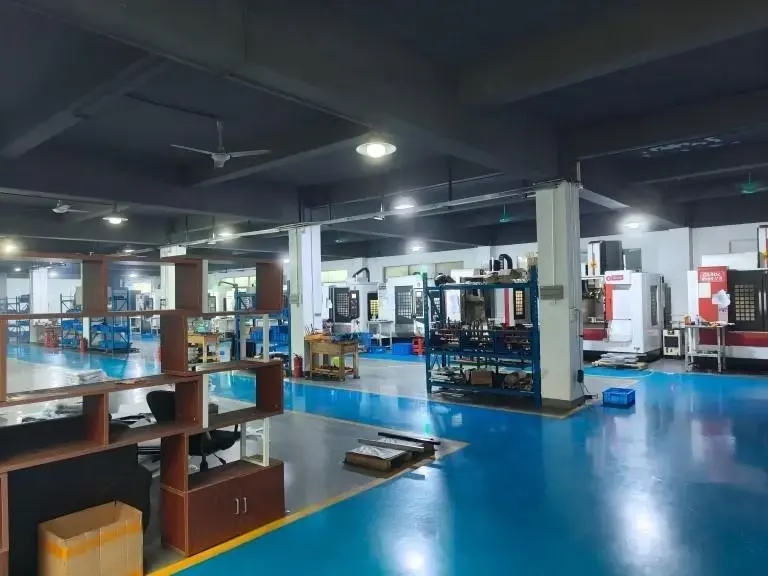
Start with machine inventory. A shop that lists 5-axis centers, mill-turn lathes and Swiss-type machines can hold a feature in one setup instead of three. That reduces stack-up error. If every part is cut on a 3-axis mill with a rotary table bolted on, deep pockets and compound angles get expensive fast.
Then look at how the shop inspects. A CMM in a temperature-controlled room is a different signal from calipers at the bench. Ask what percentage of parts get measured, and whether you receive a report. At GreatLight, inspection runs on raw material, in process and at final, with 100% of parts checked before shipment.
Finally, check the certifications against your industry. ISO 9001:2015 covers general quality systems. IATF 16949:2016 matters for automotive and EV work. ISO 13485:2016 applies to medical devices. ISO 27001:2022 covers how your CAD files and IP are protected. A shop with none of these may still do good work, but you carry more risk.
- 1Machine mixCount real 5-axis and mill-turn capacity, not just total spindle count.
- 2Inspection depthAsk for the measurement plan and a sample report before you order.
- 3Tolerance history±0.005 mm is a floor, not a marketing line. Ask which features hold it.
- 4Data handlingNDA and ISO 27001 controls matter when drawings are your product.
Why machine count alone is a weak signal
A shop can advertise 100 machines and still be the wrong partner for a titanium bracket with a true position callout of Ø0.05 mm. What matters is the right machine for the geometry. Simultaneous 5-axis motion cuts contoured surfaces without re-fixturing. Mill-turn centers finish a shaft with cross-holes in one cycle. Swiss-type lathes handle small-diameter, long parts that chatter on a chucking lathe.
Size range matters too. GreatLight runs parts up to 4,000 mm on the large travels, with medium platforms at 750 × 1,150 × 550 mm and 600 × 600 × 600 mm. A Ø400 mm rotary table covers round work that needs indexed features. If your part is bigger than the shop's largest travel, no amount of review praise will help.
Material experience is the other half. Aluminum 6061 and 7075 cut differently from 17-4PH stainless, Inconel or Ti-6Al-4V. Tool wear, spindle load and thermal growth change the strategy. Ask which alloys the shop runs weekly, not which ones appear on a list.
Matching part type to process
Use this as a first pass. The final call depends on tolerance, quantity and surface finish.
| Part type | Best process | Why |
|---|---|---|
| Prismatic housing, tight bores | 5-axis milling | One setup, fewer datum shifts |
| Shaft with cross-holes | Mill-turn center | Turning and milling in one cycle |
| Small long-diameter pin | Swiss-type lathe | Less deflection on slender stock |
| Prototype bracket, 1–10 pcs | 3-axis or 4-axis | Lower setup cost for simple geometry |
| Large frame up to 4,000 mm | Large-travel mill | Fits the work envelope without splicing |
| Round part with indexed flats | Ø400 mm rotary table | Accurate angular spacing |
| Hardened tool steel insert | Milling plus EDM check | Cuts after heat treat, controls edges |
Separating real capability claims from noise
Look for reviews that name the part, the material and the problem. A comment like "fast turnaround, good communication" is a service note. A comment like "held ±0.01 mm on a 300 mm aluminum plate after anodizing" tells you the shop understands finish thickness and how it shifts a dimension.
Beware of reviews that only describe the sales experience. Quoting is easy. The hard part is the second and third order, when the fixture is proven and the process still holds. Ask whether the reviewer ran one prototype or a production batch.
Timing claims deserve scrutiny. A shop that quotes in 12 hours with free DFM feedback, starts production within 24 hours and ships in 3–5 days is working from a real process plan. If the review says "instant quote" but never mentions the drawing review, the speed may come from guessing.
One more filter: how the shop handles a problem. Every machine shop will eventually scrap a part or miss a feature. What matters is whether they flag it before shipment or after your assembly line stops.
When a full-service shop is the wrong choice
Not every job needs an integrated supplier. If you are cutting simple 2D plates from 3 mm aluminum and the tolerance is loose, a local waterjet or laser shop will be cheaper and faster. Milling and turning add cost you do not need.
Prototypes with extreme undercuts or internal channels may be better served by 3D printing or vacuum casting first, then machining only the critical interfaces. Running a full 5-axis program on a part you will redesign next week wastes money.
Very high volumes of one simple turned part can move to cold heading or screw machining. A cnc milling turning company competes on flexibility and tolerance, not always on unit price at 500,000 pieces.
The honest answer is that fit depends on geometry, tolerance, material and quantity. If a supplier tells you they are right for everything, that is a signal to keep looking.
Questions engineers ask about supplier reviews
How do I verify a shop's tolerance claim before ordering?
Send a test part with features that stress the process: a deep pocket, a thin wall, a tight true position callout. Ask for the inspection report with actual numbers, not a pass or fail stamp.
Compare the reported values to the drawing. If the shop cannot show measured data, the tolerance claim is unproven.
What does a 12-hour quote actually include?
A useful quote includes a DFM review, not just a price. Look for notes on wall thickness, tool access, tolerance feasibility and suggested material changes.
Ask whether the price covers inspection reports, material certificates and surface finish. Hidden add-ons distort the comparison.
Do I need a shop with ISO 13485 or IATF 16949?
It depends on your market. Medical device components usually need ISO 13485:2016 traceability and process control. Automotive and EV parts often require IATF 16949:2016.
For industrial machinery or robotics, ISO 9001:2015 plus a solid inspection routine may be enough. Match the certification to your audit requirements, not to a checklist.
How should I handle confidentiality when sending CAD files?
Ask for an NDA before sharing the model, and confirm how files are stored and who can open them. ISO 27001:2022 is a useful signal that information security is managed, not improvised.
At GreatLight, uploads are treated as secure and confidential, and an NDA is available on request.
Can one shop handle both prototype and production quantities?
Yes, if the process is planned for it. The same 5-axis program can cut one part or a batch, but the fixture and inspection plan should scale.
GreatLight has no minimum order quantity, so a single prototype and a 10,000-part run go through the same quality system.
What lead time is realistic for machined parts?
For a clean drawing and available material, production can start within 24 hours of order confirmation and parts ship in 3–5 days. Complex geometry or special alloys add time.
Treat any review that promises same-day shipping on a first article as marketing until the process is proven.
Get a second opinion on your next part
Send a drawing and we will return a quote with DFM notes within 12 hours. No minimum order, inspection reports on request.
12-hour quote100% inspectionNDA on request









